It's Friday evening, you've got a dozen cartons ready beside the front door, and there's no time to drive to the post office. You need them moving, but you don't want a rushed booking to turn into an oversized-parcel charge or a missed collection. The right parcel pickup service starts with three checks: what you're sending, how much space it takes up, and whether the driver and recipient can access it.
What a Parcel Pickup Service Does for You
A parcel pickup service means a carrier collects prepared parcels from your home or business during a booked window. It's much like booking a taxi instead of driving yourself: you arrange the trip, provide accurate details and have everything ready when the driver arrives.
For that Friday-evening seller, the useful move isn't assuming a courier will arrive immediately. It's checking the next available collection, choosing a service that meets the customer's deadline and keeping the cartons ready for handover.
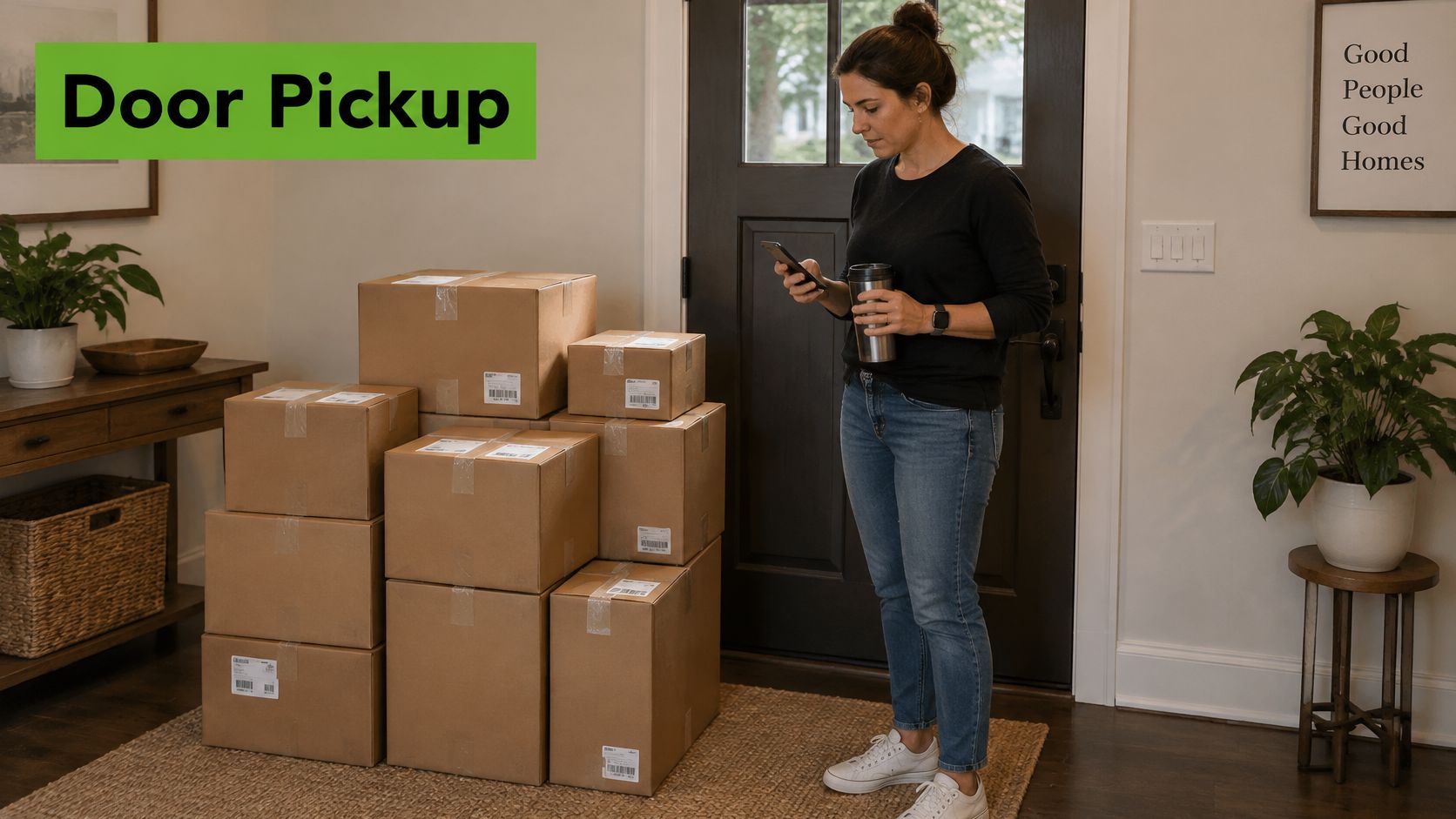
Who should use door-to-door collection
The scope here is local and Australia-wide box and parcel shipping only. No international shipping, and no pallet freight.
Collection particularly suits:
- Small businesses sending regular orders without spare staff for depot runs.
- Online sellers serving customers across Australia from a home office, shop or storeroom.
- Households sending an occasional large parcel that's awkward to carry or fit in a car.
Australia Post delivered 514.3 million parcels in FY2025, with domestic parcel volumes increasing 2.6% over the previous year, according to its annual performance statement. Parcel shipping is everyday infrastructure, not a niche service.
Judge the whole job, not just the postage
A cheap label isn't automatically the cheapest way to send something. Add your driving time, fuel, parking and time away from packing orders before deciding that drop-off saves money.
The strongest savings usually come from matching the goods to the service, packing efficiently and choosing a collection arrangement you can reliably meet. Tracking then gives you the reference you need if the shipment stalls.
Quick test: If a parcel is heavy, bulky or time-sensitive, check pickup before committing to a drop-off. Collection usually wins when transporting it yourself creates more work than preparing it for the driver.
What Can and Cannot Be Sent
Clothing, books, homewares, printed materials and suitable electronics are natural candidates for box and parcel delivery. They still need protective packaging and carrier acceptance, particularly when they're fragile, valuable or contain a battery.
Don't assume a familiar household product is ordinary freight. Cordless tools, power banks and other devices can contain lithium batteries; aerosols, paint and cleaning chemicals can also require special handling.
Check regulated goods before requesting a quote
The Australian Dangerous Goods Code covers classification, packaging performance, marking, documentation and UN-number identification; its limited-quantity guidance requires strong packaging closed against accidental release, generally limits package mass to 30 kg, reduces that to 20 kg for certain tray-wrapped or easily punctured containers, and normally requires a limited-quantity diamond of at least 100 × 100 mm.
Those are dangerous-goods requirements, not permission to use an ordinary parcel service. The carrier must accept the product, and its own parcel limits still apply.
Before booking, check:
- Product identity: Use the product information and safety data sheet to establish what you're sending.
- Transport classification: Confirm the applicable UN classification and packaging instruction rather than guessing from a retail description.
- Packaging suitability: Use packaging that prevents release and meets the applicable requirements.
- Carrier acceptance: Obtain confirmation before paying for a service that might refuse the consignment.
Incorrect classification can expose drivers and depot staff to leaking substances or incompatible loads. Use this hazardous goods classification guide to help organise the questions you need answered.
Separate specialist packing from carrier permission
Bottles need protection against breakage and leakage as well as acceptance checks. For a South Australian wine shipment, explore wine shipping in SA from McLaren Vale Cellars for product-specific context, then confirm your chosen carrier's conditions.
Undeclared dangerous goods don't belong in the booking. Oversized or overweight parcels also need another approved freight method. Don't try to make an unsuitable consignment fit by understating its contents or measurements.
Packing Your Parcel to Keep Costs Low
Empty space can cost money. Eligible flat-rate packaging is priced by size, while ordinary boxes are assessed against actual or cubic weight, so the outside dimensions matter as much as the scale reading.
The Australia Post Parcel Post guide calculates cubic weight as volume in cubic metres multiplied by 250, meaning a 0.04 m³ box has a cubic-weight equivalent of 10 kg, even if the sealed contents weigh only 4 kg. Use the cubic weight formula guide before you choose between two carton sizes.
Packaging options, limits and reference prices
The satchel reference prices below come from Australia Post's Parcel Post pricing, which lists size-based postage for eligible prepaid satchels up to 5 kg. Treat small, medium and large as ordered flat-rate steps inside that eligible range: small sits above the 280 × 215 mm extra-small, medium sits between small and large, and large stays below the 510 × 440 mm extra-large. The own-box limits come from Australia Post's size and weight guidelines, which set a domestic maximum of 22 kg, 105 cm long and 0.25 m³.
| Packaging option | Size or limit | How it is priced | Reference price |
|---|---|---|---|
| Extra-small satchel | 280 × 215 mm, up to 5 kg | By size | $10.55 |
| Small satchel | Flat-rate step above 280 × 215 mm extra-small, up to 5 kg | By size | $12.05 |
| Medium satchel | Middle flat-rate step between small and large, up to 5 kg | By size | $16.40 |
| Large satchel | Flat-rate step below 510 × 440 mm extra-large, up to 5 kg | By size | $20.70 |
| Extra-large satchel | 510 × 440 mm, up to 5 kg | By size | $24.95 |
| Own box or non-flat-rate packaging | Up to 22 kg, 105 cm long, 0.25 m³ | Greater of actual or cubic weight | Quote at booking |
For non-flat-rate packaging, Australia Post's domestic sending guidance confirms that the greater of actual and cubic weight is used together with the destination. These are Australia Post reference rules and prices; another carrier's pickup service can apply different limits or charges.
Pack snugly without sacrificing protection
Match the packaging to the order you're sending, not the largest order you might receive. A satchel suits flexible, non-fragile goods. Choose a rigid carton when the contents need crush protection.
For guidance on carton styles, Storage & Removal Boxes Ltd's Where to get cardboard boxes for posting? offers useful packaging context. It is a UK resource, so use it for box selection rather than Australian postage pricing.
- Choose the smallest suitable box: Leave enough room for cushioning without surrounding a small product with unnecessary air.
- Fill movement gaps: Cushion individual items and stop them knocking together.
- Seal every seam: Use parcel tape across the main joins and vulnerable edges.
- Remove old labels: Eliminate competing addresses and barcodes.
- Measure the finished parcel: Include bulges and packing materials, then weigh it sealed.
Listed prices can change. Confirm the live quote before booking, including collection and any selected extras.
Choosing the Right Pickup Option for Your Parcel
Adding a pickup option can make delivery less convenient. A distant collection point, narrow opening hours or a carton that won't fit a locker can shift the work from the seller to the customer.
Separate sender collection from recipient collection. A courier picking up your outgoing boxes solves a different problem from a customer collecting an incoming order.
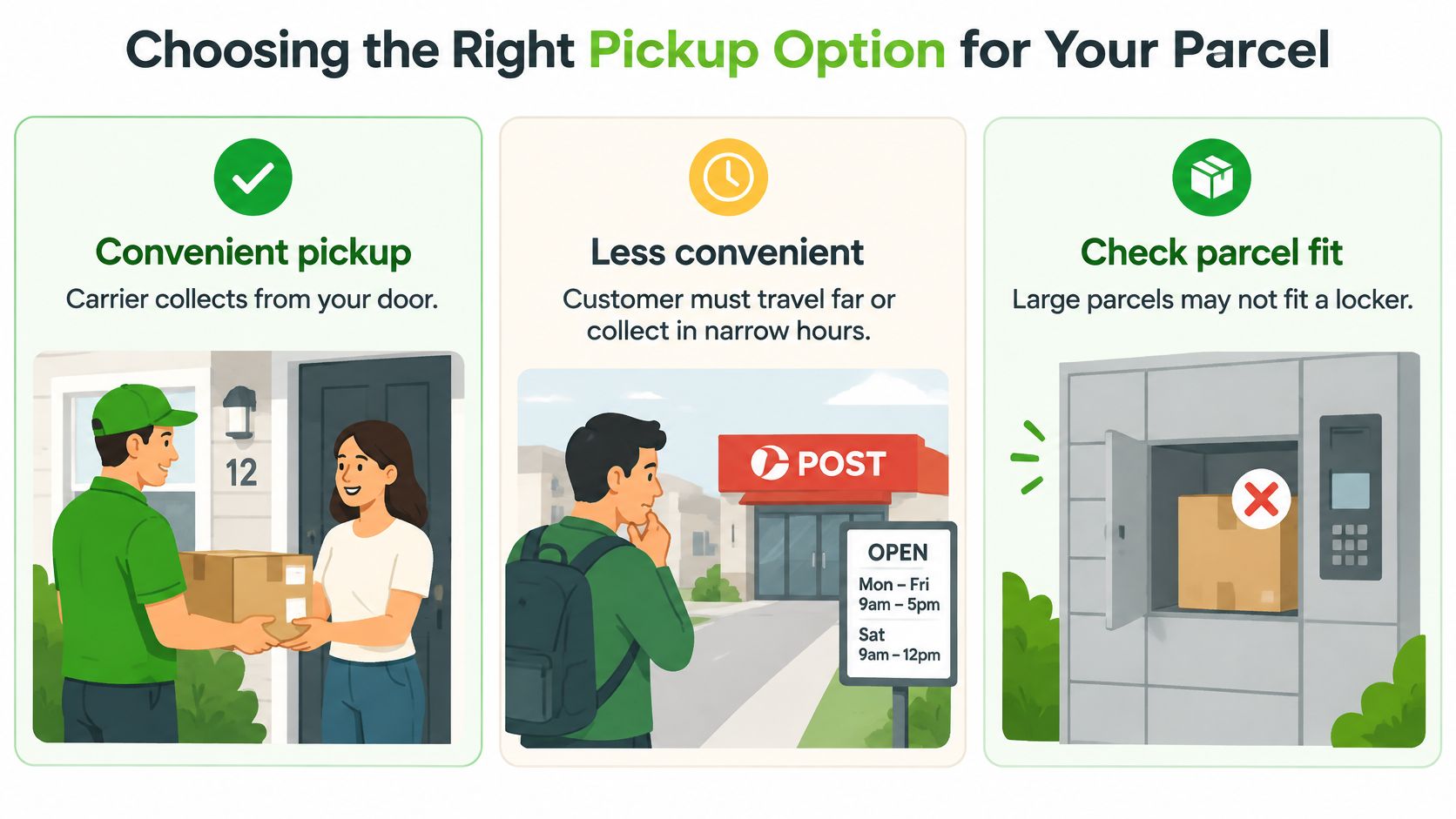
Pickup options compared for senders and recipients
| Option | Best for | Trade-off | Cost pattern |
|---|---|---|---|
| Home pickup | Businesses with regular orders or bulky cartons | Needs a set pickup window | Grouping orders can reduce collection overhead per consignment |
| Depot drop-off | Sellers near a depot who can meet its dispatch cut-off | Travel time and fuel for the sender | Often the lowest direct parcel charge, but include your travel costs |
| Parcel locker | Recipients away during working hours, with suitable small parcels | Size limits and a collection window | Compare the eligible delivery service; customer travel remains an added cost |
| Customer click-and-collect | Customers wanting cheaper or faster access | Customer must travel and collect during available hours | Lower-cost option where the retailer's collection price beats delivery |
Australia Post's 2026 eCommerce Report found 48% of shoppers prefer collection points when they can't receive a delivery at home. That supports offering a choice, not replacing home delivery outright.
Australia Post's October 2025 quarterly eCommerce update reports that 57% of shoppers say time sensitivity makes fast delivery more important than free delivery, while 58% of click-and-collect users chose it because it was cheaper. Ask whether your customer needs lower cost, certainty or speed before deciding for them.
Match access to the actual customer
Age differences also matter: Australia Post's 2025 eCommerce Report found 45% of Millennials would switch retailers to access out-of-home collection points, while approximately three-quarters of Baby Boomers and Builders didn't use them in 2024.
For repeat urban customers, a nearby collection point can work well. For addresses with repeated unsuccessful deliveries, customer-selected collection can give more control. For bulky goods, favour door-to-door delivery unless the customer has suitable transport and explicitly wants to collect.
A cheaper delivery option isn't cheaper for the customer if they must take time off work or organise a car to retrieve it.
Check opening hours, identification requirements, storage periods, accessibility and walking distance. Use express versus standard shipping to assess urgency separately, and keep home-delivery pricing clear for customers who can't travel.
Book Your Pickup in Six Steps
Have the parcels packed, your recipient details checked and a printer available before opening the booking form. That turns the booking into a straightforward comparison rather than a scramble for missing information.
Aeros Couriers is one option alongside direct carrier booking: it provides instant quotes, printable labels and shipment tracking for local and Australia-wide box and parcel deliveries. Keep this booking to cartons and satchels, not pallets.
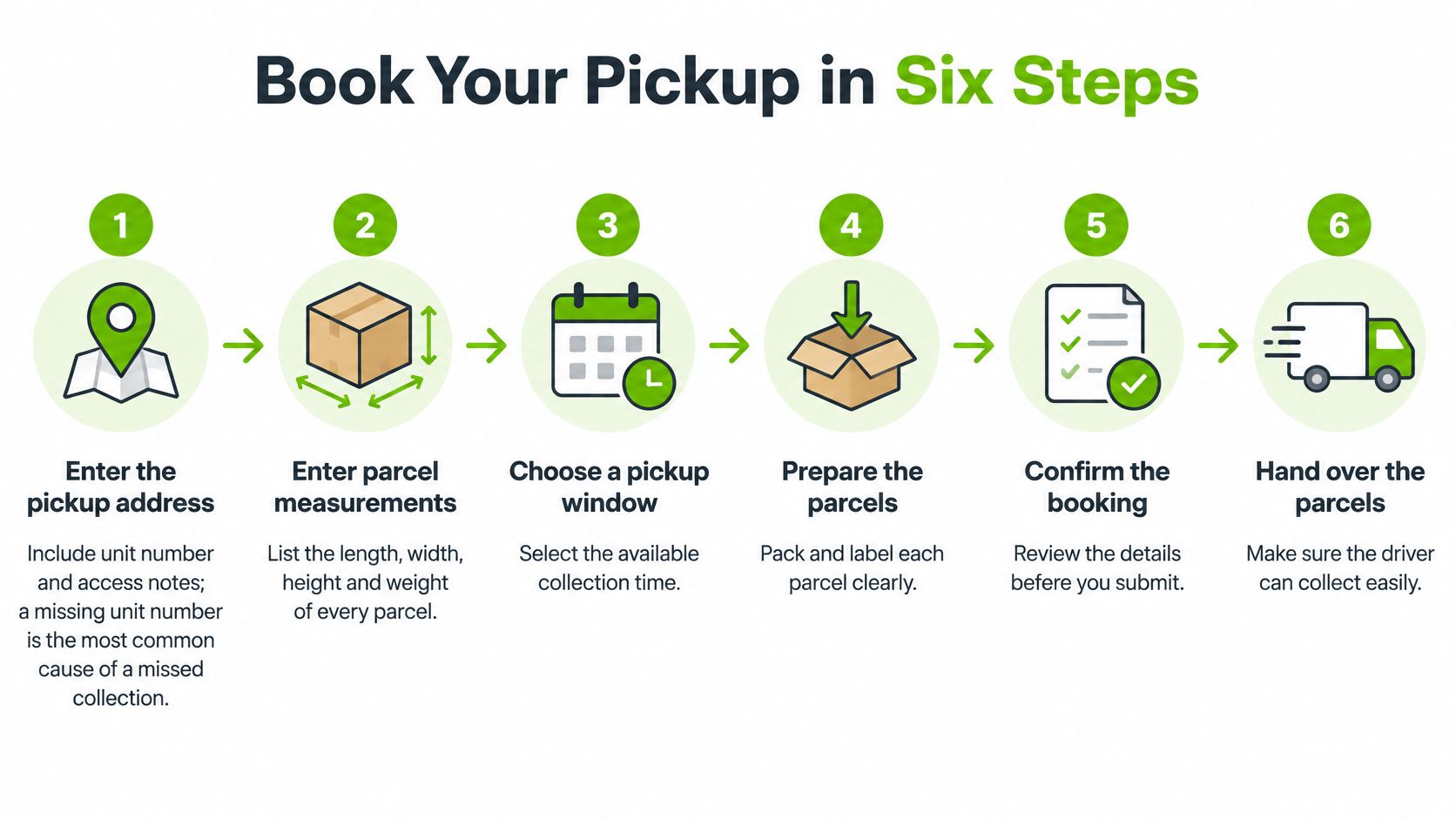
Prepare the details before paying
Enter the complete pickup address. Include the unit or suite, street address, suburb, postcode and a contact who'll answer the phone. Add practical access notes, such as the loading entrance or reception desk. A missing unit number or locked gate can prevent collection even when the driver reaches the correct street.
Enter each packed parcel's measurements. Use a tape measure and scales, not the product's catalogue dimensions. Record the length, width, height and weight of every box separately. A frequent mistake is copying one carton's details across a batch even though the others have different contents or packaging.
Choose the service level against the actual deadline. Read the delivery estimate for the destination before paying, particularly for regional addresses. Don't treat a metropolitan estimate as an Australia-wide promise. If the order must arrive for an event, check whether the selected service offers a commitment or only an estimate.
Confirm the collection and prepare the handover
Select an available pickup window and check the cut-off. Choose a period when someone can provide access and the parcels will be ready. Carrier cut-offs differ, and missing one can push dispatch into a later operating day. Don't promise your customer a departure date until you've checked what's available.
Complete the contents declaration accurately. Identify regulated products before submitting the booking and obtain acceptance where necessary. Don't select ordinary goods just because the form is quicker to finish that way. If you can't establish the product's transport classification, stop and clarify it before collection.
Print, attach and check every label. Put the label on the largest suitable flat face with the barcode visible, unfolded and clear of seams. Match each label to its parcel, especially when several orders look alike. Keep the prepared parcels in the agreed accessible location without exposing them to weather or theft.
An online courier booking guide can help you organise this workflow. With the details ready, quoting and booking needn't become another lengthy admin job.
Before confirming, compare the full payable amount, not just the headline transport rate. Check collection inclusions, signature options, cover conditions and any address-related charges; reference postage prices aren't automatically like-for-like courier quotes.
Before the driver arrives: Save the booking confirmation and tracking number, count the labelled parcels, and tell anyone covering reception exactly what's being collected.
For a business, nominate one person to own the handover. That avoids a driver being told there's nothing to collect while the outgoing cartons sit behind another counter.
Tracking Your Parcel and Fixing Common Problems
Use the tracking number on the label as your reference for shipment events and support enquiries. A shipment-level dashboard helps you follow each parcel separately instead of assuming every box in a batch has reached the same point.
Tracking statuses and the action each one needs
Carrier wording differs, but these common statuses provide a practical starting point. Read any accompanying event notes before deciding what happened.
| Status | What it means | What to do |
|---|---|---|
| Booked | Pickup requested; driver may not yet be assigned | Confirm the address and pickup window |
| Collected | Driver has taken the parcel | Keep the receipt; no action needed |
| In transit | Moving between depots towards the destination | Wait for the next scan |
| Delivery attempted | A delivery attempt wasn't completed, commonly because the recipient was unavailable | Check delivery instructions and arrange redelivery or collection |
| Exception | A problem needs attention, potentially involving an address or label | Contact support with the tracking number |
Fix the cause, not just the status
Parcel not collected: Check the booked window, confirmation and collection point first. The driver may have missed the window, lacked access or been unable to find the cartons. Contact support, establish whether collection is still expected and rebook against the next available cut-off if necessary.
Label won't scan: Reprint it rather than tracing or writing over the barcode. Attach the replacement flat, remove or fully cover the faulty label, and avoid wrapping the barcode around a box edge. A readable address doesn't substitute for a readable shipment identifier.
Delivery attempted: Confirm what prevented handover before requesting another attempt. Check the recipient's availability, entry instructions and contact number, then arrange an authorised redelivery or collection option. Don't add permission to leave a parcel unattended without the recipient's agreement and carrier approval.
A quiet tracking page doesn't establish that a parcel is lost. Check the last event, location and expected delivery window; this guide to parcel tracking not updating can help you organise the next checks.
Keep the pickup receipt and tracking number until delivery is confirmed. For an exception, send support the tracking reference, the relevant address details and a concise description of the problem so they can investigate the actual consignment.
Get your next box moving with a live quote for fast, low-cost local or Australia-wide parcel collection. Visit Aeros Couriers to compare available services, book your pickup, print your labels and track the shipment, with no pallet booking needed.
Courier quotes, tracking and support
Ready to send a parcel? Compare the available services for your postcodes, parcel dimensions and weight. For an existing delivery, use your consignment number to check tracking or ask our team for help.