
Most advice on a shipping insurance quote says to tick a cheap box, pay a few dollars, and get back to packing. That advice falls apart the day a carton arrives cracked and the payout hinges on paperwork you never kept.
A low premium can hide narrow cover. The figure that should drive the decision is not the freight price. It is what you will spend putting the customer right if the box is lost or broken. For an Australian online seller, that often means a replacement, a refund and return postage, even when the courier caused the damage.
This is about local sending only. Boxes and parcels, Australia-wide, at the cheapest price that still holds up. No pallets. Fast box and parcel runs, not freight that needs a forklift.
Treat every shipping insurance quote as two tests. Can you prove the packing and the value if something breaks? And does the limit match the customer remedy you would pay, not only the wholesale cost of the item?
What Insurers Need Before They Can Quote
A shipping insurance quote is only useful if its inputs match the parcel and the evidence you could produce after a loss. Check the cover against what you would owe the customer, including any replacement or refund, rather than judging the quote by the freight price alone.
Declared value sets the insured amount and the claim ceiling. Enter a replacement cost you can support with an invoice, then keep that figure consistent across the quote and any claim form. If your consumer-law obligations require you to put the customer right for more than the item's wholesale cost, account for that exposure when assessing the limit.
Packaging helps the insurer assess breakage and handling risk. A double-walled carton with suitable void fill presents a different risk from a thin mailer holding glass.
Item category identifies goods that may be fragile, perishable, dangerous or prohibited. Glassware and a cotton tee need different handling, and a standard quote may not cover a category that was entered incorrectly.
Packed dimensions and weight affect carrier pricing and handling exposure. Weigh and measure the sealed carton, not the bare product. Size also affects cubic pricing, so use the cubic weight formula when preparing the parcel details.
Pickup and delivery addresses determine whether a route is classed as metro, regional or remote. Check both ends rather than relying on a general route assumption.
Delivery option affects the risk at the doorstep. A signature-required delivery differs from an unattended drop, so choose the option that reflects how the parcel will realistically be received.
Evidence on hand can determine whether a claim is supportable. Keep the invoice, photos of the packed parcel and tracking scans. A quote based on details you cannot later prove may offer little practical protection.
| Input | What the insurer uses it for | Example to enter |
|---|---|---|
| Declared value | Sets the sum insured and the claim ceiling | $220 replacement cost of a boxed lamp |
| Packaging | Judges breakage and handling risk | Double-walled carton with 5 cm of void fill |
| Item category | Flags fragile, perishable, dangerous or prohibited goods | Glassware, fragile |
| Packed dimensions and weight | Sets carrier price and handling exposure | 32 x 24 x 18 cm, 4.8 kg sealed |
| Pickup and delivery addresses | Classifies the route as metro, regional or remote | Melbourne CBD to Alice Springs, remote |
| Delivery option | Shows the risk of unattended drop-off | Signature required |
| Evidence on hand | Shows whether a claim can be proven | Invoice, packing photos, tracking scans |
Write the same declared value on the invoice, the quote and the claim form. If the figures differ, the insurer may question what value you are asking it to cover.
How to Get Your Quote in Five Steps
Work in this order. Each step has one reason and one slip that quietly ruins the shipping insurance quote.
- Pull the supplier invoice. Write the replacement value of the item, not the sale price you happened to pay. Insurers question a discounted figure at claim time, and a low entry caps what you can recover. The slip is copying the checkout total from a promotion.
- Pack it for real, then weigh and measure the sealed carton. Packed size is what gets priced and what gets handled. The slip is typing the bare product weight from the product page, which understates both freight and risk.
- Enter the pickup and delivery postcodes and label each end. Mark metro, regional or remote. A remote drop changes the handling chain, so a city-to-city assumption will not describe the job. The slip is leaving both ends as "metro" because that is what the form defaults to.
- Choose the delivery option before you look at the premium. Standard, signature on delivery, or a secure drop changes the risk, not only the price. An unattended leave is cheaper to book and harder to defend. The slip is picking the option that shaves a dollar without noting who can receive the box.
- Set the insured amount equal to the declared value, then read every line. Check the excess, the exclusions, whether delay is covered, the claim deadline and the notification window. Run the numbers through a shipping rate calculator so freight and cover sit on one screen. The slip is paying the first total you see.
If any figure differs from the invoice, fix the input and re-quote before you pay. A quote built on the wrong inputs is the one most likely to be contested, and fixing it after a loss is slower than fixing it now.
Practical rule: Do not pay a quote you have not compared, line by line, with the invoice in your hand.
What Moves Your Premium Up or Down
A low premium can be a poor deal if the cover excludes the loss you are most likely to face. Judge the quote against the evidence you can produce after damage, and against your consumer-law exposure as a seller, not just the parcel's freight cost. The parcel's value may be only part of the potential loss.
Declared value, fragility, and route have the strongest effect on a parcel premium. A higher declared value generally raises the premium, but the amount should be supported by an invoice or other records. Inflating the value costs more without guaranteeing a larger settlement: a claim still depends on proof. Glass, ceramics, and electronics face a greater risk of breakage in transit, which may affect the rate or the terms. Perishable or dangerous goods may require declaration or separate cover, so check the item rules before relying on a standard quote. Remote and regional routes can involve more handling points, which may affect the price.
Packing and delivery choices also shape the quote. Documented, well-built packaging supports a claim; weak packing can put damage cover at risk. Signature on delivery may reduce theft and non-delivery disputes, while delay cover can add cost if it extends protection beyond standard wording. A higher excess usually lowers the premium, but leaves you paying more of any accepted claim. Weigh that saving against what you could afford to absorb.
The insurer sets the actual rate for each factor. Any percentage used in an example is illustrative, not a tariff. To see what changes the cost, compare quotes for the same parcel and adjust one factor at a time.
| Factor | Effect on premium | Why it matters |
|---|---|---|
| Declared value | Rises with value | Sets the sum insured and should match the invoice |
| Fragility or breakage risk | May rise | Glass, ceramics, and electronics can be vulnerable in transit |
| Perishable or dangerous goods | May rise or be excluded | May require a declaration or separate cover |
| Remote or regional route | May rise | More handling points can affect the risk |
| Documented packaging | May lower risk | Strong packing supports a claim |
| Signature on delivery | May lower risk | Can reduce theft and non-delivery disputes |
| Delay cover added | May raise | Standard wording may exclude delay and lost market |
| Higher excess | Usually lowers | You carry more of each claim yourself |
Freight price sits next to the premium
Compare the full checkout cost. Australia Post's eligible flat-rate packaging is priced by size band, and current prices are listed on its published pricing page. Check those prices before comparing packaging options. Other packaging may be priced using the greater of actual weight or cubic weight, along with the destination, so carton dimensions can affect which quote is cheapest.
Try more than one packaging size and compare freight plus cover. A slightly dearer carton that fits a lower size band may cost less overall than a cheap mailer, while also giving the item better protection. The cost for shipping guide can help you separate the freight charge from the insurance premium before comparing quotes.
Reading a Sample Quote Line by Line
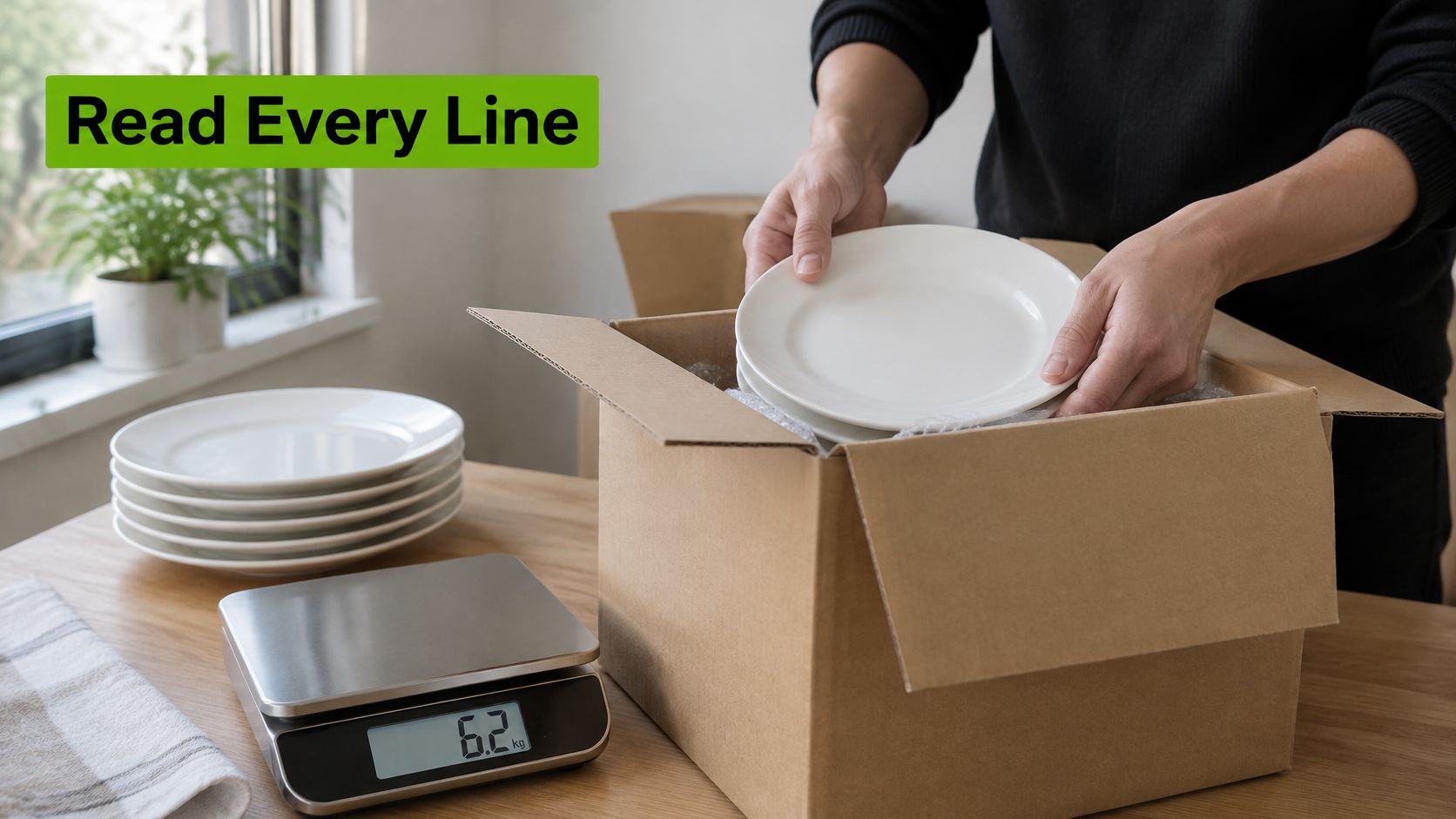
Take one job and read it as a claim, not as a checkout total. A seller sends a $480 ceramic dinner set in a double-walled carton, 6.2 kg packed, from Melbourne to Alice Springs, signature required. The dollar figures below, other than the invoice value and the published delivery window, are illustrative. They show the arithmetic. They are not a live rate.
Declared value and sum insured are both $480. That pairing is right. A sum insured above the invoice is wasted premium. A figure below the invoice invites an underpayment when the set is a total loss.
The premium is shown at an illustrative 2% of value, or $9.60. Ask how the rate is set. Do not treat 2% as fixed, and do not treat a lower percentage as better cover.
The excess is an illustrative $50. On a total breakage the payout is $430, not $480, because the excess comes off the top. Compare $430 with what replacing the set and reshipping it really costs. If that gap hurts, the excess is too high for this parcel, even if the premium looks tidy.
What the delivery line does not pay
Australia Post's domestic Parcel Post service generally takes 2 to 6 business days, which is the benchmark here for standard Australia-wide boxes rather than express freight, according to Australia Post's Parcel Post guide. That window is a general estimate. It stretches with origin, destination, weekends, public holidays and remote areas. Alice Springs is not a next-suburb drop.
Delay cover is not included. A late set ordered for a dinner is a loss this quote does not pay. If the date matters, add delay cover or choose a faster service. Do not assume the transit estimate is a promise.
| Quote line | Illustrative figure | What to check |
|---|---|---|
| Declared value | $480 | Matches the supplier invoice |
| Sum insured requested | $480 | Equal to value, never above it |
| Premium | $9.60 at an illustrative 2% | Ask how the rate is set |
| Excess | $50 | Deducted from any payout |
| Payout on total breakage | $430 | Compare with replacement cost |
| Delivery window | 2 to 6 business days | Standard benchmark, varies by route |
| Delay cover | Not included | Add it if the set is needed for an event |
| Packing exclusions | Damage from inadequate packing | Confirm in the written wording |
| Claim notification deadline | Written window, not assumed | Get it in writing before paying |
Fill the unknown cells before you pay. Poor-packing exclusions and the claim notification deadline belong in the written wording, not in a verbal "you're covered". If either cell is blank, the quote is not finished.
Checking Cover and Booking Your Parcel
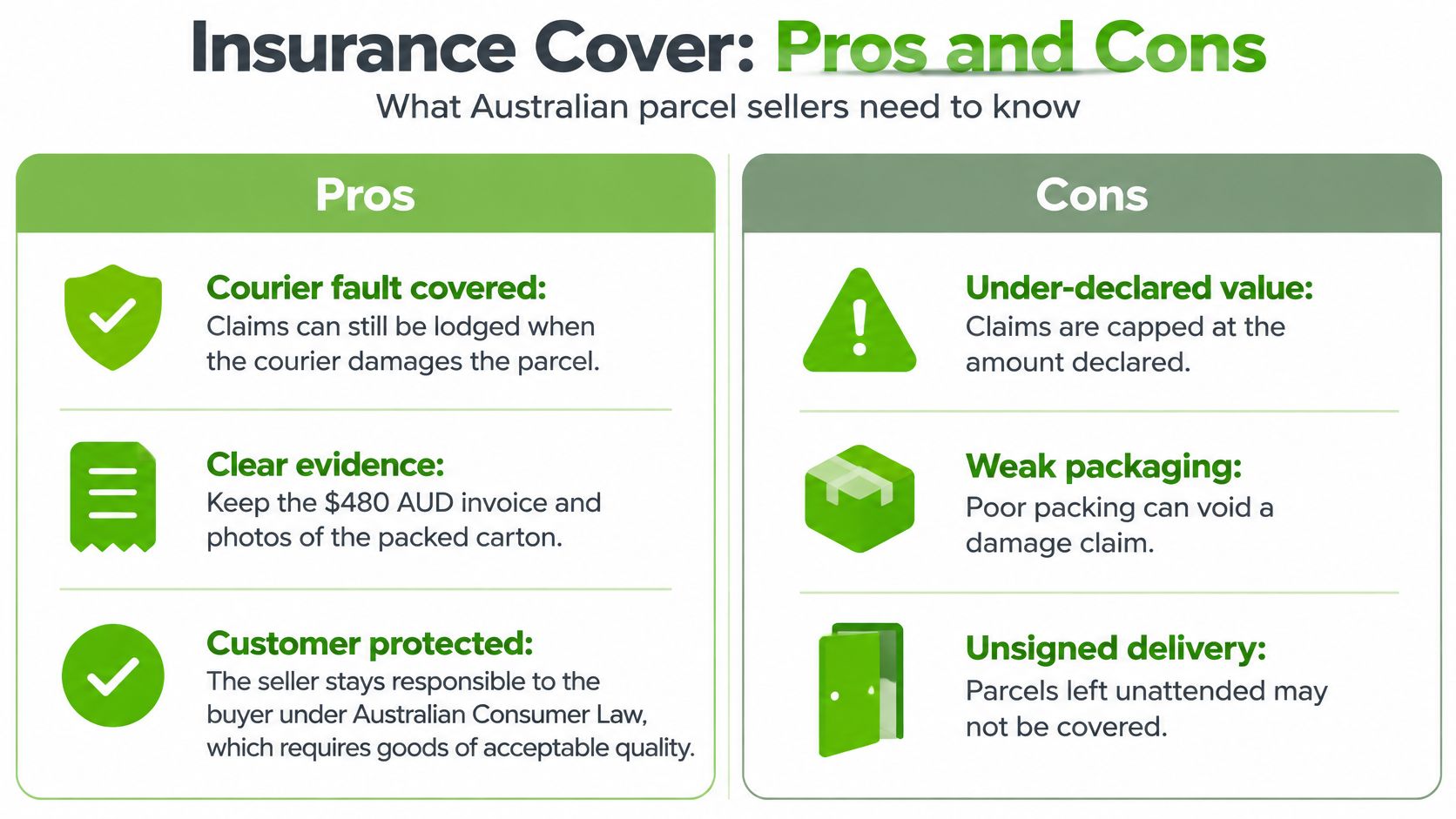
The parcel's freight price is not the right measure of whether cover is adequate. The seller remains responsible to the customer when goods arrive damaged, even if the courier caused the damage. Under Australian Consumer Law, retailers generally must provide goods of acceptable quality and offer a repair, replacement or refund when goods arrive damaged. The Western Australian Commissioner's explanation of shipping insurance supports this consumer-law point. You should handle the customer's remedy directly, then pursue any claim available under the cover.
The exposure can exceed the parcel's wholesale value. Replacement stock, a refund and return postage may all become your cost. A carrier's compensation limit may leave much of that bill uncovered, so judge a quote against the customer remedy you could owe, not just the freight charge.
Four cover options side by side
Australia Post's published terms describe ordinary services as generally suited to items valued up to $100, with compensation commonly limited to $100. Its published Extra Cover terms allow protection for eligible deliveries up to $5,000, subject to conditions, excess and proof requirements. Check the current Australia Post terms for ordinary services and Extra Cover before relying on either figure. For any cover, confirm the written wording, including exclusions.
Included freight insurance on a booking is another option, but the limit, excess and exclusions should be visible before payment. Home contents cover may not protect parcels left outside, so check the policy wording rather than assuming porch theft is covered. The distinction between transit cover and insurance can help clarify what protection the booking really provides.
| Cover option | Typical limit | What it leaves out | Check before booking |
|---|---|---|---|
| Australia Post ordinary service | $100 compensation | Anything above $100 | Declared value over $100 |
| Australia Post Extra Cover | Up to $5,000 | Check the exclusions in the written wording | Excess and proof requirements |
| Included freight insurance on Aeros Couriers | Limit shown on the instant quote | Exclusions listed at booking | Limit, exclusions and excess shown at booking |
| Home contents cover for parcels left outside | Commonly not covered | Porch theft may not be covered | Use signature or a safe drop point |
When to upgrade, and when the default is enough
Upgrade when the declared value exceeds the carrier limit, the item is fragile or high value, the route is regional or remote, or likely customer-remedy costs exceed the parcel's wholesale value. A low-value, durable item sent with signature or to a safe drop point may need less protection. A cheap tee in a tough mailer going across one city is a different risk from ceramics sent inland.
Before booking, check each line:
- Run the instant quote using the packed carton's weight and dimensions, not an estimate.
- Confirm included freight insurance and its limit, excess and exclusions before paying.
- Match the declared value to the amount on your invoice.
- Choose delivery with the risk at the destination in mind, not only the freight price.
- Print the label last, after saving the invoice and taking packing photos.
If a limit or exclusion is unclear, ask support before booking. A low premium is poor value if the wording leaves you paying the customer's remedy and the evidence you can produce does not support a claim.
Evidence and Packing That Make a Claim Pay
This is the part of the quote you control. Premium and wording are set at booking. Proof is built in the packing bench.
Before you seal, photograph the item and the packed carton from every side, including the label. The insurer needs to see the packing standard you used, not the standard you describe later. If you pack prints, glass or awkward shapes, the Famous Movie Posters packing guide is a useful extra on protection materials, even when your own goods are ordinary retail stock.
Keep the commercial invoice, proof of value and the consignment label in one folder per parcel. Scan or save the tracking events as they land. At delivery, note any visible damage on the proof of delivery before anyone signs. A clean signature with no note is hard to unwind.
If something goes wrong, notify the insurer or broker promptly and check the deadline in the written wording. Keep the damaged goods as they are. Do not repair them and do not throw them out until inspection is authorised. Then submit a short loss chronology with the tracking, the photos, the packaging evidence and the value proof.
Claims fail more often on a missing photo, or an invoice that does not match the insured amount, than on a difficult insurer. The insurance for courier notes sit well beside that habit, because cover you cannot evidence is cover you do not really have.
Photograph every parcel as a routine, the same way you print a label. Do it on the quiet jobs, not only the expensive ones. Then the shipping insurance quote becomes a tool you can put to real use.
Aeros Couriers books local and Australia-wide box and parcel deliveries with an instant quote, so you can see freight and the included insurance detail before you pay. Pair that checkout with the declared value, packing photos and delivery option you have already decided, and the cheap fare is no longer a guess. Visit Aeros Couriers to price the carton you are about to send.
Courier quotes, tracking and support
Ready to send a parcel? Compare the available services for your postcodes, parcel dimensions and weight. For an existing delivery, use your consignment number to check tracking or ask our team for help.