You've got a packed order on the bench, a customer waiting for tracking and several courier quotes that don't seem to include the same things. The lowest price looks tempting, but you don't want a surprise charge or a delivery promise you can't keep.
To book a courier online without overpaying, compare the whole job, not just the freight price. For local and Australia-wide box and parcel deliveries, that means balancing packaging, cover, delivery timing and what happens if something goes wrong. You don't need a complicated shipping system, just accurate details and a repeatable way to choose.
Details to Have Ready Before You Book
One wrong measurement can turn a cheap quote into a reweigh charge or a failed pickup. Measure the packed parcel, not the product going inside it, and weigh everything that will travel: box, padding, tape and all. I've watched a small underestimate on the scales wipe out the gap between two quotes, so the scales belong on the packing bench, not in the cupboard.
Check the box against the service before you pay. I confirmed the figures against Australia Post's current published requirements: parcels can be up to 105 cm in length, 22 kg in weight and 0.25 cubic metres in volume, and anything outside those caps risks refusal or a surcharge. Those limits are one carrier's rules, not an industry standard. Other couriers set their own caps, and some apply oversize charges at lower thresholds, so confirm your selected carrier's conditions rather than assuming a large carton qualifies.
Booking inputs and the mistakes that change the price
| Detail | What to enter | Mistake that costs money |
|---|---|---|
| Pickup and delivery postcodes | Full postcode and suburb at both ends | Entering the suburb without confirming its postcode |
| Outer length, width and height | Measurements in centimetres on the packed box | Measuring the product instead of the carton |
| Weight | Dead weight including packaging and tape | Estimating from the item alone |
| Parcel limits | Your carrier's published caps, checked before payment | Assuming an oversized box qualifies for ordinary parcel handling |
| Address type | Residential, business or limited access | Misclassifying a depot or farm instead of checking its access requirements |
| Dangerous goods | Batteries, aerosols and chemicals declared before payment | Assuming restricted goods can travel in an ordinary satchel |
| Contact and hours | Name, phone number, opening hours and handling notes | Arranging collection when nobody can assist the driver |
| Service level | Standard or faster, with the ETA beside the price | Choosing on price without checking the delivery window |
Lay both addresses out in the standard Australian address format, complete with unit numbers, business names and access instructions. A farm gate, locked reception or narrow driveway deserves a clear note the driver can act on.
Restricted contents need a separate check. Australia Post's Dangerous Goods Guide states that dangerous goods are prohibited in the mail except where permitted under applicable requirements, so declaring an item does not automatically make it acceptable to send.
Ready-to-book check: Could a colleague arrange this shipment from your notes without ringing you?
If not, fill the gap before comparing prices. Accurate details are what give a low headline quote any meaning, because a cheap freight price stops being cheap once it triggers a reweigh fee or a second pickup attempt. This guide covers boxes and parcels within Australia, not pallets.
How to Compare Quotes for the Real Cheapest Option
A useful starting point is Australia Post's published domestic postage-only pricing: $10.20 up to 250 g, $11.70 over 250 g up to 500 g, $16.00 over 500 g up to 1 kg, $20.25 over 1 kg up to 3 kg, and $24.45 over 3 kg up to 5 kg. These prices exclude packaging, so they're a benchmark rather than your complete sending cost.
Australia Post parcel postage benchmark by weight
| Weight band | Postage only (AUD) | What to check in your quote |
|---|---|---|
| Up to 250 g | $10.20 | Whether packaging and insurance are additional |
| Over 250 g up to 500 g | $11.70 | Whether a smaller suitable box keeps the parcel in this band |
| Over 500 g up to 1 kg | $16.00 | Whether the postcode-specific ETA fits your promise |
| Over 1 kg up to 3 kg | $20.25 | Whether regional or remote surcharges apply |
| Over 3 kg up to 5 kg | $24.45 | Signature costs and applicable size limits |
Weight bands work as steps, not slopes. Using the published bands above, a hypothetical packed parcel weighing 1.2 kg falls into the $20.25 band, while a safely repacked version weighing 950 g falls into the $16.00 band, a calculated $4.25 postage difference.
That's a reason to choose packaging carefully, not to remove protection the product needs. A snug, sturdy carton can be economical; a flimsy one that leaves the contents exposed isn't.
Compare the complete sending cost
Use a shipping rate calculator with the same packed parcel and addresses for every quote. Put the available options side by side and check:
- Total payable: GST, fuel charges, packaging and any additional cover.
- Delivery estimate: The ETA for your actual pickup and destination postcodes.
- Regional charges: Any location-based additions or service restrictions.
- Included protection: The cover limit, exclusions and excess.
- Signature option: Its price and what delivery evidence the carrier provides.
Check whether the service uses volumetric weight, meaning the space occupied can affect the charge rather than weight alone. Don't assume a large, lightweight carton will receive the lowest weight-based price.
The cheapest suitable quote is the lowest complete price that meets your delivery promise and leaves you comfortable with the uninsured risk.
How to Book a Courier Online in Seven Steps
Once your details are ready, the online form should be straightforward. Set aside a few uninterrupted minutes and follow the checks in order, rather than paying first and trying to correct the shipment afterwards.
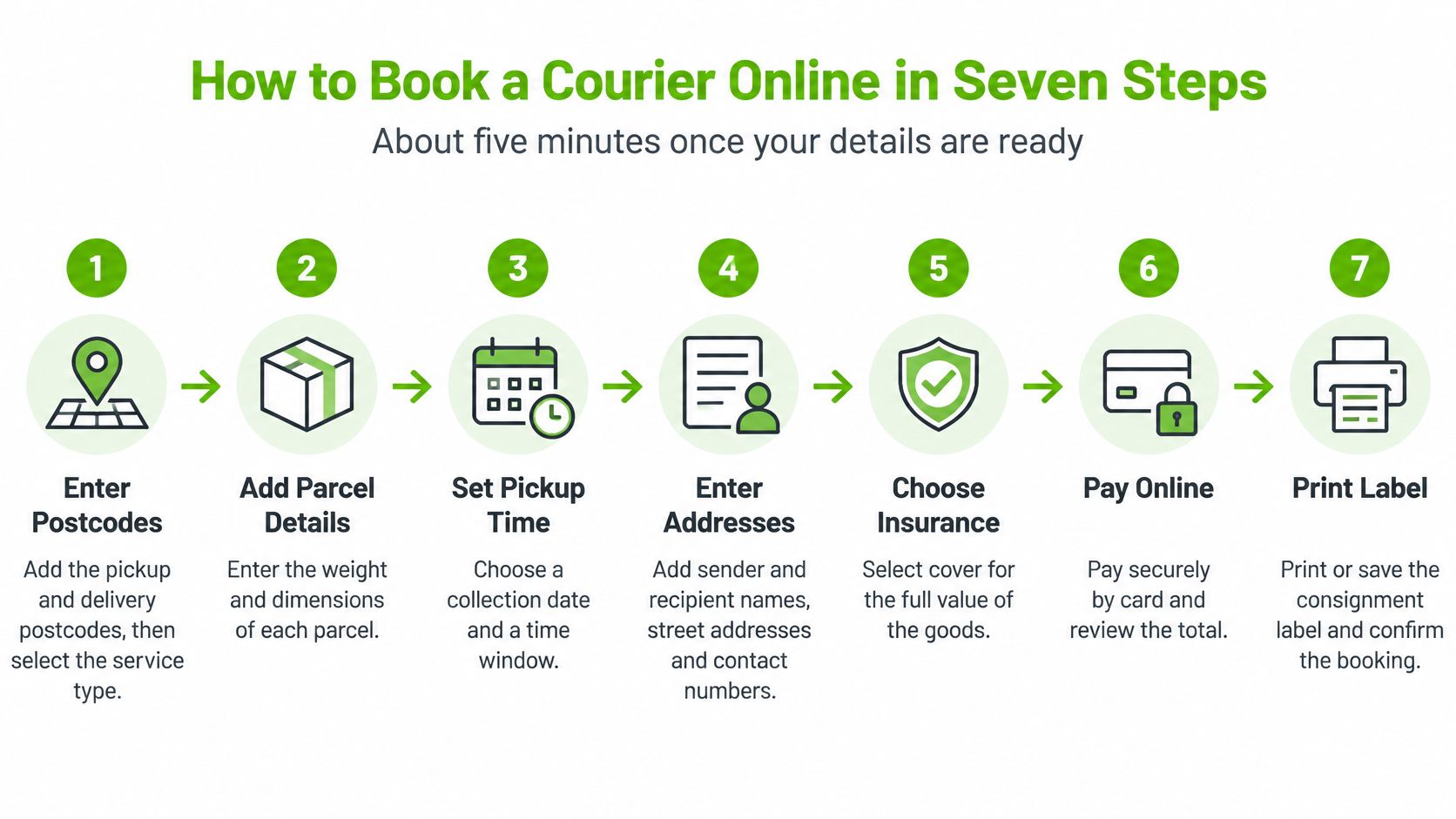
From quote to payment
Enter the pickup and delivery postcodes. Select residential, business or the appropriate access category at each end, then supply the complete addresses when prompted.
Add the parcel details. Enter the outer dimensions, packed weight and quantity, using a separate entry for each different box size so the quote matches what the driver will collect.
Choose the service level. Read the ETA beside the price and select a collection date or pickup window where the booking system offers one.
Review the total and included cover. Check the final charge against your original inputs, and read the protection terms rather than assuming the item's full value is covered.
Declare restricted or dangerous contents before paying. Confirm that the carrier accepts the goods and packaging, because a declaration alone isn't permission to send them.
Pay and save the booking reference. Keep the confirmation somewhere you can retrieve quickly if collection or delivery needs attention.
Print and attach the label, then confirm collection. Place it flat on a large surface of the box, keep the barcode readable and remove or obscure old shipping labels.
A practical booking example
Consider a hypothetical homewares seller in Ballarat sending a 1.4 kg bundle to a Darwin residence. The seller enters the measured box dimensions, packed weight and residential destination, then compares the displayed price and ETA before choosing a service.
They don't promise the customer a delivery date based on the word “express” alone. They check the actual route estimate, prepare the parcel that evening and save the label and confirmation together.
Australia Post provides a postage benchmark; an instant-quote platform such as Aeros Couriers offers another booking route, displaying available prices with metro ETAs and regional considerations before payment. That allows the sender to make the timing decision before dispatch rather than after a customer asks why the parcel hasn't arrived.
If the paperwork terminology is unfamiliar, this explanation of what a consignment note is helps distinguish the shipment record from the physical label.
A finished booking should leave you with a reference number, a readable label and a confirmed pickup window. A successful payment on its own isn't the final check.
Regional Addresses and Realistic Delivery Times
A parcel to inner Melbourne and the same parcel to a property outside Broken Hill can share a booking form and almost nothing else. Coverage, surcharges and transit times all shift once the destination leaves the capital cities, and the ETA that looks acceptable for a metro suburb can stretch considerably on a regional route.
Check three things on the quote screen before you pay: the ETA shown for that exact postcode pair, any regional or remote surcharge sitting in the price breakdown, and the delivery conditions attached to the service. All three are visible in most instant-quote tools. The bold price is rarely the full price.
What changes as the address gets harder to reach
| Destination | What the quote may not tell you | Check before you book |
|---|---|---|
| Metro to metro | The estimate is usually dependable | The ETA for your specific postcode pair |
| Metro to regional town | A surcharge can sit on top of the base price | The full price breakdown and the town's own ETA |
| Outer regional | Fewer carriers and wider delivery windows | Which services actually cover the postcode |
| Remote or very remote | Depot pickup or set delivery days may replace door delivery | The delivery-point rules for that address |
| PO box, farm or mine site | Some couriers cannot deliver there at all | Whether a street address, signature or alternative point is required |
The cheapest regional quote deserves the same scepticism as any cheap quote. Price the total landed cost after surcharges, weigh the reliability of the stated ETA and consider what happens if the parcel needs a claim, rather than comparing the headline figure alone. A mid-priced service that delivers to the door often beats a cheaper one that ends at a depot forty minutes from your customer.
Make a promise you can support
For time-sensitive parcels, confirm the carrier's collection cut-off and whether the destination really receives the selected service level. Never assume a courier can deliver to a PO box, enter a gated property or leave goods at an unattended farm gate.
Give customers a delivery range with a buffer suited to the route, rather than converting an estimate into a guaranteed date. If an order must arrive for an event, read the service conditions for that destination before accepting the deadline.
A consistent small-business shipping process gives everyone on your team the same postcode checklist, so these checks happen on every order instead of depending on who took the call.
Before accepting payment: Does the delivery estimate you're showing the customer match the route, surcharge and conditions on the booking screen?
Confirm Your Booking and Track Your First Parcel
The confirmation screen appears, a reference number lands in your inbox, and the job feels done. It isn't. That reference doubles as your tracking number, and the first few scans tell you whether the quote you picked was genuinely cheap or just cheap-looking.
Your tracking reference sits in three places: the booking confirmation email, the order history in your courier account, and the barcode on the printed label. Paste it into the carrier's tracking page or your booking dashboard and the parcel's journey appears as a sequence of events: label created, a pickup scan when the driver collects, depot scans as it moves between facilities, an "out for delivery" event on the final day, then a delivered scan with proof of delivery or a photo. Learn to read that sequence once and every future booking gets easier.
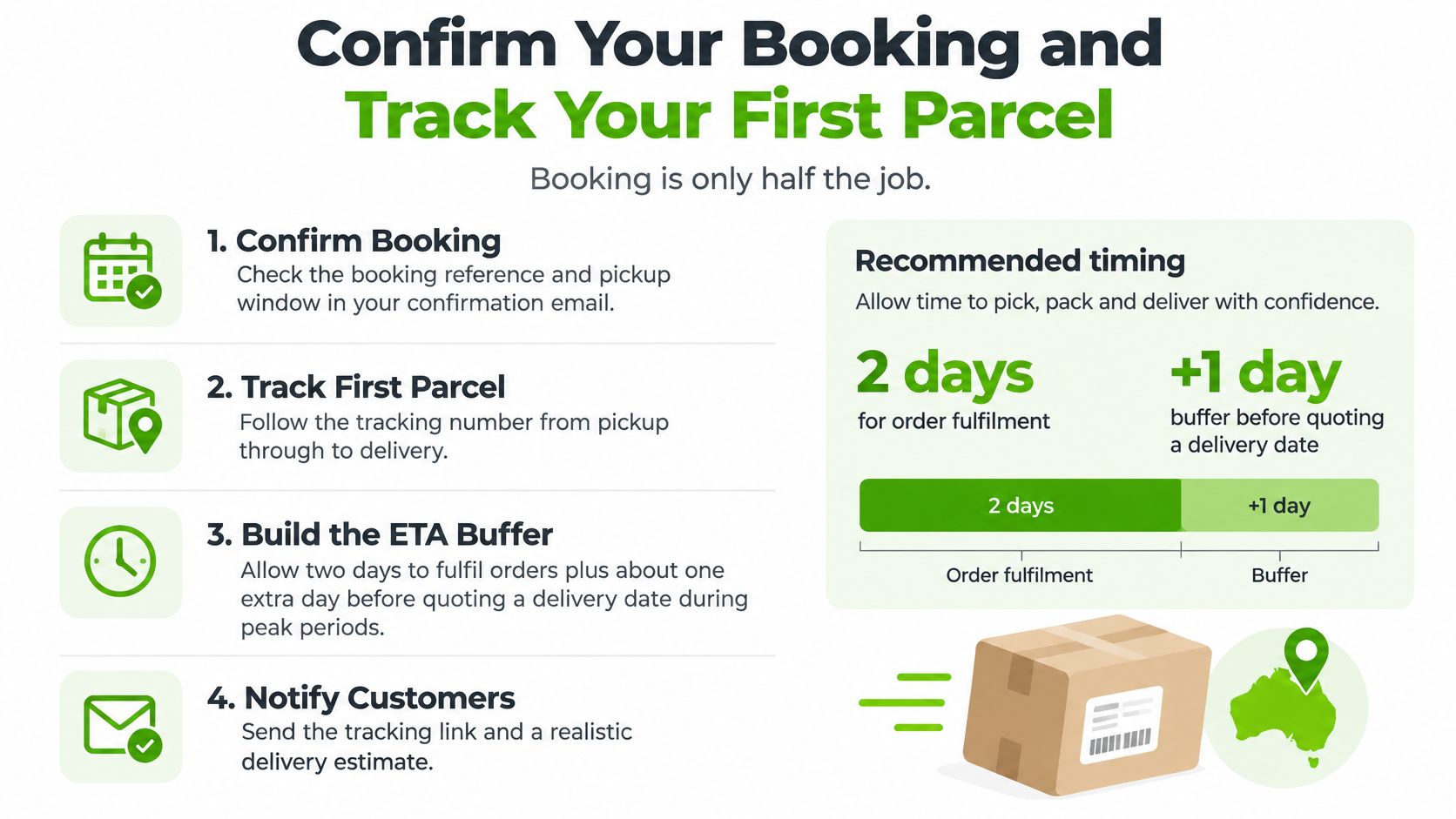
Your post-booking checklist
- Match the confirmation: Check the booking reference, collection window and amount charged against the quote you accepted.
- Inspect the label: Make sure it prints clearly and sits flat before handover.
- Watch the first scan: If no pickup scan appears inside the agreed collection window, contact support the same day.
- Follow it to the door: Track progress against the date range you gave the customer, and save screenshots of every exception.
That first tracking run also settles the cheapest-quote question. A service that collects late or goes quiet between depots can cost more in follow-ups and claims than a pricier option that scans on schedule. Review your bookings monthly: delivered-within-promise rate, pickup-scan timeliness and exception rate show which quotes were truly cheap.
Book a real parcel this week, watch every scan through to delivery and note where cost or timing surprised you. One tracked shipment teaches more than any rate table.
Insurance, Signature and Claims When a Parcel Goes Wrong
A lost parcel costs far more than the freight charge you paid. Finder's December 2025 survey of 1,006 Australians found that 18% had experienced a missing parcel in the previous year, with an average value of $221, and Finder extrapolated those survey responses to an estimated $867 million in national losses.
That risk is why the cheapest quote stays an open question until you've read the fine print. Included cover, optional protection and signature on delivery each do a different job, so price them separately and treat them as three line items in your total landed cost, not one bundled decision.
A $4 saving on the headline price vanishes fast if the standard cover excludes your product category or the claim deadline passes while you're still gathering paperwork.
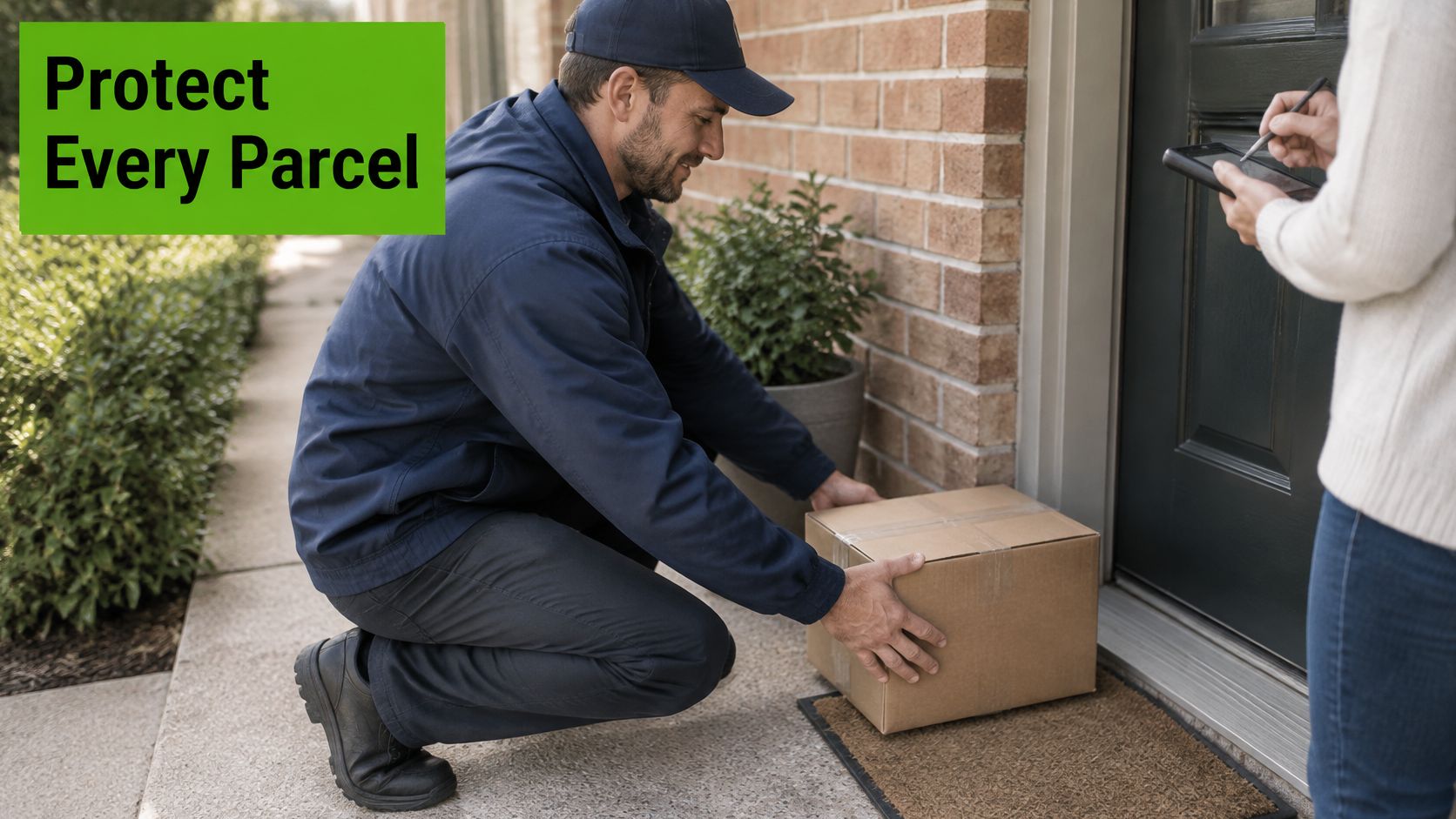
What to do when delivery goes wrong
Tracking says delivered, but nothing arrived. Request the proof of delivery and any delivery photo, check them with the recipient, then lodge an investigation or claim through the applicable booking provider or carrier.
The parcel went to the wrong address. Compare the address entered during booking with the printed label and delivery evidence. A mismatch helps identify where the error occurred, but doesn't by itself settle responsibility.
The contents arrived damaged. Ask the recipient to photograph the unopened outer box first, then document the inner packaging and product as they unpack it. Keep the packaging until the claim handler confirms it's no longer needed.
A signature was required, but none appears. Request the signature record and delivery details before escalating the discrepancy.
Keep evidence before you need it
Retain the booking confirmation, label copy, pickup scan, delivery scan and photographs, along with evidence of the goods' value where required. Reading courier insurance guidance beforehand helps you ask the right questions, but the applicable policy and service terms always determine what's covered.
For fragile or high-value goods, favour signature and suitable cover after checking exclusions and excess. For low-value items, weigh the optional fee against the loss you could reasonably absorb. Signature gives you delivery evidence; damage protection comes from the cover itself.
Before booking, confirm what the cover includes, what it excludes, the excess and the claim deadline. Those details vary between providers, and the deadline is the last thing you want to learn about after something goes wrong.
Aeros Couriers offers instant quotes, online booking, label printing and tracking for local and Australia-wide box and parcel deliveries, with freight insurance included subject to its terms. Visit Aeros Couriers with your packed dimensions, weight and postcodes ready, then compare the complete price and delivery estimate before booking.
Courier quotes, tracking and support
Ready to send a parcel? Compare the available services for your postcodes, parcel dimensions and weight. For an existing delivery, use your consignment number to check tracking or ask our team for help.