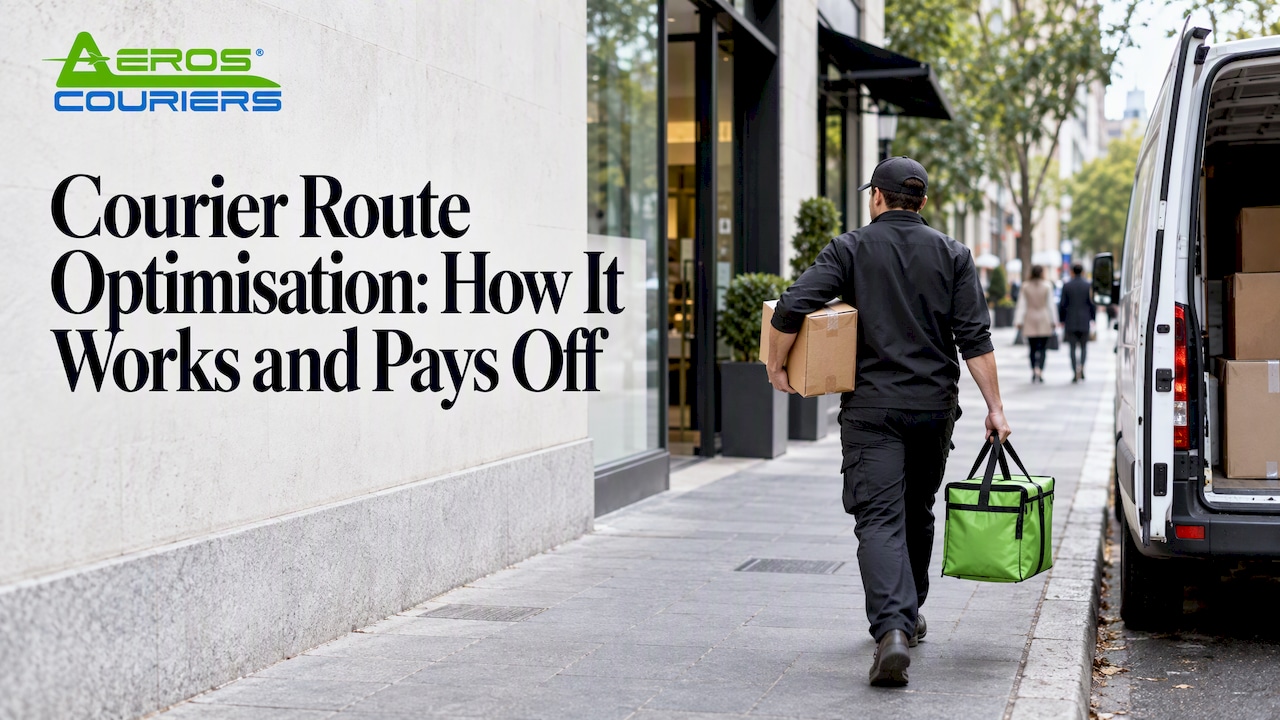
Courier route optimisation is the process of choosing which driver visits which stops, and in what order, so the whole day’s deliveries are completed with the least distance, time and cost your constraints allow. It goes further than a map app. A map gives you a path between addresses. Optimisation weighs time windows, vehicle capacity, driver hours and traffic across every stop at once, then rebuilds the plan when conditions change.
This guide explains the idea without the jargon, shows what a good optimiser takes into account, and sets out practical steps a small Australian business can take today, whether you run your own vans or book parcels through a courier platform.
TL;DR
- Route planning builds a path. Route optimisation chooses the best sequence and allocation of stops across the whole schedule, within real-world limits.
- The maths behind it is the vehicle routing problem, a well-studied framework for assigning stops to vehicles and ordering them.
- In Australian city centres, loading zones and walking distance can matter as much as road distance.
- Small businesses can start with load consolidation, GPS review and live traffic data before buying any software.
- If you do not run a fleet, booking through a courier that optimises for you gets you the same benefit without the setup.
Table of Contents
- Route planning versus route optimisation
- The vehicle routing problem in plain terms
- What a good optimiser has to juggle
- Why central-city delivery needs its own thinking
- What route optimisation does to time, cost and reliability
- Practical steps for a small Australian business
- Safety and time windows: where optimisation must not push too hard
- Our perspective: optimisation should be something you buy, not something you build
- Sending parcels without running routes yourself
- How to judge a courier’s routing and reliability
- FAQ
- Sources
Route planning versus route optimisation
The two terms get used interchangeably, but they describe different jobs.
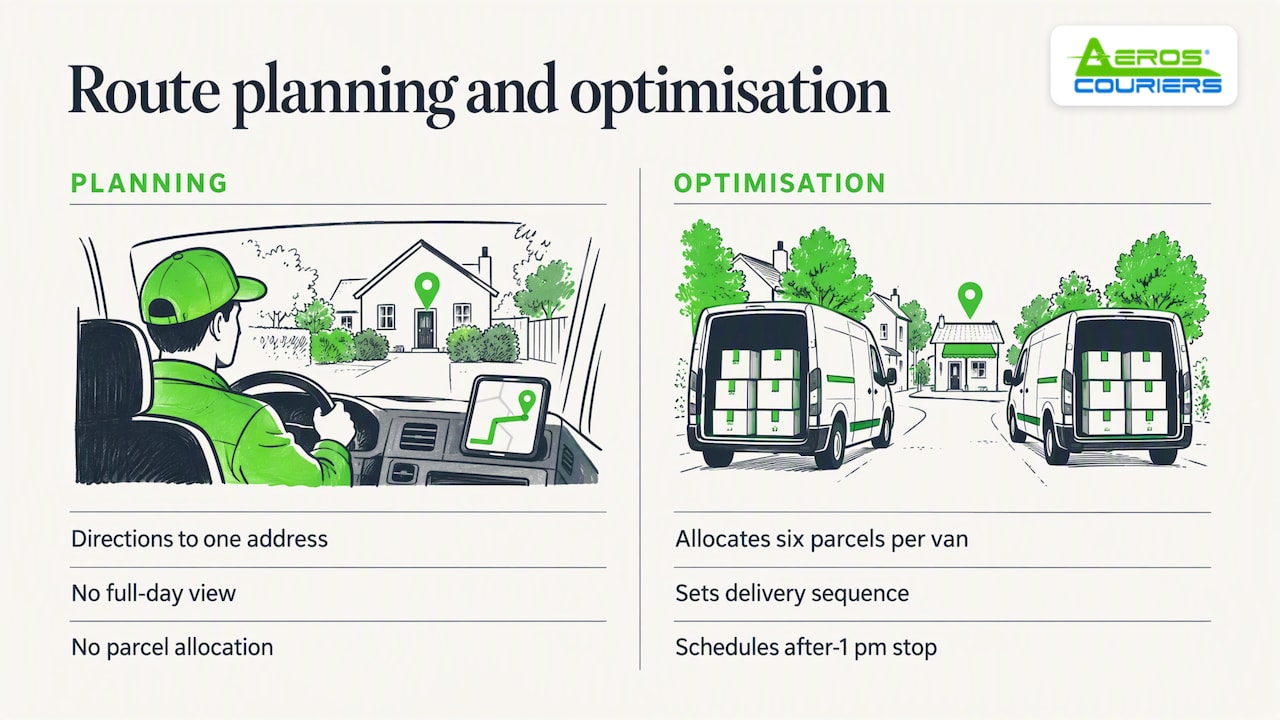
Route planning is the broader task of building a route: picking a start, a finish and the roads in between. Navigation is the simplest form. It gives directions between one address and the next, and it has no view of the rest of the day.
Optimisation looks at the entire delivery schedule. According to one industry explainer, it organises orders, vehicles and constraints into a workable, efficient plan rather than just drawing a line on a map. The same source family describes the practical result as a sequence and allocation of deliveries that takes into account locations, time windows, driver hours, vehicle capacity, service times and road conditions.
A simple way to feel the difference: imagine twelve parcels and two vans. Planning tells each driver how to reach any single address. Optimisation decides which six addresses go to which van, which comes first, and which should wait until the afternoon because the customer is only open after 1 pm.
The vehicle routing problem in plain terms
Behind most routing software sits a classic mathematical framework called the vehicle routing problem, or VRP. Google’s open-source optimisation documentation describes it as finding routes for a fleet of vehicles visiting a set of locations, subject to constraints and an objective, for example the shortest total distance or the shortest longest route.
Two details are worth knowing:
- With a single vehicle the VRP shrinks to the travelling salesperson problem: visit every stop once, as efficiently as possible.
- The objective you choose changes the answer. Minimising total distance can leave one driver with a huge day and another with a light one. Minimising the longest route balances the load.
This is why “best route” is never a single fixed thing. It depends on what you are trying to save: kilometres, hours, fuel, overtime or missed delivery windows.
What a good optimiser has to juggle
Real deliveries are messy. Research on urban last-mile routing says the problem is more uncertain and dynamic than conventional vehicle routing, and needs more frequent real-time adjustment of plans. The same review lists the typical inputs: delivery locations, travel time or distance data, vehicle capacity and access restrictions, driver hours, service times, customer time windows, parking and changing traffic.
Here is how those inputs play out in an ordinary Australian delivery day.
| Input | What it means in practice | What goes wrong if ignored |
|---|---|---|
| Delivery locations | Clustering stops by suburb or street so no one doubles back | Two drivers cross the same suburb |
| Time windows | Business hours, reception cut-offs, “after 2 pm” requests | Failed deliveries and redelivery costs |
| Vehicle capacity | Volume and weight a van or bike can carry | Half-empty runs, or stops left behind |
| Driver hours | Breaks and shift limits | Overtime, fatigue, compliance risk |
| Service time | Minutes spent parking, walking, getting a signature | Plans that look good on paper and run late |
| Traffic and roadworks | Peak-hour congestion, closures | Late afternoon stops missed |
| Access restrictions | Height limits, loading docks, building rules | A vehicle that cannot physically reach the door |
Notice that only the first row is about distance. Most of the cost of a poor route hides in the other six.
Why central-city delivery needs its own thinking
If you deliver in Sydney, Melbourne or Brisbane CBDs, the shortest road route is often not the fastest way to finish the job. An Australian academic study, Optimising courier routes in central city areas, models both vehicle and walking routes, because a courier may park once in a loading zone and then serve several customers on foot.
The model includes the choice of loading zone, vehicle access paths, pedestrian paths, which customers are allocated to which stop, and maximum parking durations. The lesson for any business: a route that minimises road distance alone can be inadequate. Loading-zone availability and walking distance together shape how productive a courier is and what the run costs.
In practice, that means:
- Group nearby buildings into one parking stop where the rules allow.
- Know the time limits on the loading zones you use most.
- Count the walk and the lift ride as part of the delivery, not as free time.
What route optimisation does to time, cost and reliability
Be wary of any claim of a single universal saving. Results depend on your starting point, your area and your parcel density. What the evidence does support is the direction of the benefit.
The Australian Government’s energy guidance for road transport says route planning can reduce distance travelled, improve fleet utilisation and avoid congestion, and that booking systems can help reduce fleet size and total distance driven. Fewer kilometres means less fuel, less wear and fewer hours paid.
On the customer side, the Commonwealth’s postal modernisation discussion paper lists possible benefits including easier, faster and cheaper parcel sending for small business, along with improved tracking so delivery information is more accurate.
For a sense of scale from recent research, a 2026 Australian study of regional mail delivery found that an adaptive multimodal system cut delivery time by up to 21.67% and CO2 emissions by up to 11.36% compared with van-only operations. That is a regional, mail-specific result, so treat it as an example of what rethinking the delivery model can achieve, not as a number to expect for your own run.
The three outcomes you can reasonably aim for:
- Faster delivery. Less backtracking and fewer missed windows.
- Lower cost per parcel. More stops per hour and fewer vehicles on the road.
- Better reliability. Realistic plans with buffers, so customers get accurate delivery information.
Practical steps for a small Australian business
You do not need a dispatch centre to improve your routes. The Australian Government’s guidance points to a handful of steps that suit small operators, and they work in this order.
1. Consolidate deliveries
The same government guide recommends consolidating deliveries and loads so fewer vehicles and trips are needed and each vehicle is better filled. For a small shop, that can be as simple as moving from daily dispatch to set dispatch times, or batching orders by postcode.
2. Review your GPS data
If your vehicles already have GPS, look at last month’s trips. The guidance suggests reviewing this data to spot inefficient routes. Look for repeated detours, long idle times at particular addresses and the same streets appearing on multiple trips in a day.
3. Use live traffic information
Real-time traffic data is widely available, and the same guidance encourages its use. Even a manual check before the afternoon run can move a congested leg earlier or later.
4. Book vehicles and slots with a system
Computer-based vehicle booking, rather than ad hoc phone calls, helps avoid duplicated trips and idle vehicles.
5. Add time windows to your customer data
Collect delivery constraints at checkout: business hours, a safe place, an access code. Every missing detail becomes a failed delivery later.
6. Consider planning tools only when the above is in place
Software helps most once you know your constraints. If you feed it poor addresses or unrealistic service times, it will produce confident but wrong plans. For city-wide freight planning, Transport for NSW publishes a Last Mile Freight Toolkit covering guiding principles, measurement and forecasting, design and management solutions, and future approaches. It is aimed at planners, but it shows how councils think about the delivery environment you operate in.
For more on the final leg specifically, our guide to last mile delivery for Australian small businesses goes deeper.
Safety and time windows: where optimisation must not push too hard
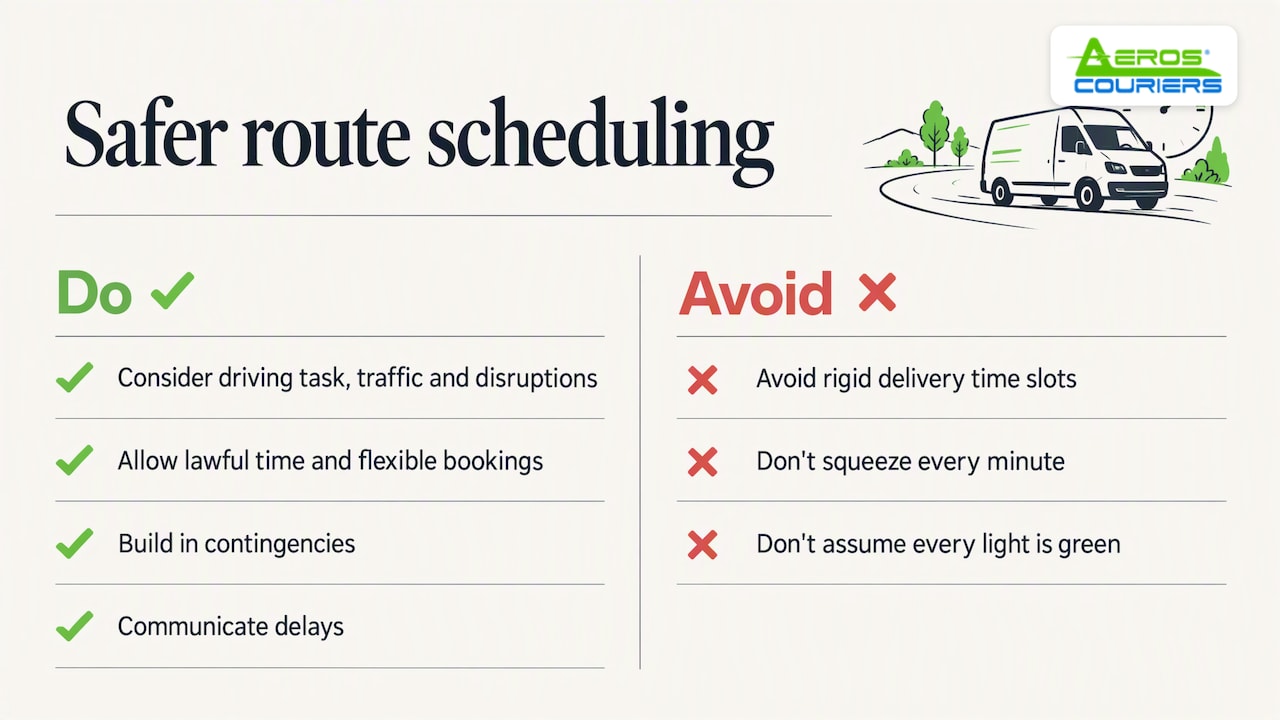
An optimised route that squeezes every minute can create risk. The National Heavy Vehicle Regulator warns that rigid delivery time slots can pressure drivers to speed or drive while fatigued, putting drivers, workers and the public at risk.
Its advice for heavy-vehicle schedules is relevant to any delivery planner: consider the complete driving task, traffic delays and unforeseen circumstances, allow lawful time and flexible bookings, build in contingencies, and communicate delays. If you run heavy vehicles, the NHVR’s guidance on chain of responsibility applies to you and to the people who schedule your loads, so read it directly.
The NHVR’s Master Code of Practice adds further practical points: bring route hazards to drivers’ attention before a journey, use monitoring data to inform safety processes, and provide accurate collection and delivery-location information.
The takeaway is simple. Good optimisation leaves slack. A plan with a ten-minute buffer per run is more reliable than one that assumes every light is green.
Our perspective: optimisation should be something you buy, not something you build
Most of the people who find us are not logistics managers. They are shop owners, online sellers and individuals who need a parcel to arrive, and they have no wish to learn about the vehicle routing problem.
Our view is that route optimisation is real and valuable, but for a small business it is most efficiently delivered by the courier, not by you. We use technology for route optimisation and active parcel monitoring so that the work of sequencing stops, avoiding congestion and catching problems early sits with us. You get the outcome: a parcel that arrives quickly, with tracking you can read, at a price you can see before you book.
Three things we hold to:
- The price you see is the price. We do not add fuel surcharges or handling costs after the fact, because a cheap route that ends in a surprise invoice is not a saving.
- Speed and reliability come from planning, not promises. Optimised routes mean fewer wasted kilometres, which is what makes low rates sustainable.
- A human should answer when something goes wrong. Technology finds most problems early, but a delayed parcel still deserves a quick response from a real person.
If you do run your own vehicles, the steps above are worth doing. If you mainly send parcels, spend your time on your business and let the courier do the routing.
— Aeros
Sending parcels without running routes yourself
If your goal is simply to get parcels moving, you can compare and book through our platform. Enter your parcel details, see rates side by side, print your label and arrange door-to-door pickup. Our parcel delivery service covers Australia-wide delivery for parcels up to 25 kg, with shipment tracking, insurance and Australian customer support. For time-critical jobs, express and same-day options are available from our main booking page.
To see how different delivery options stack up before you choose, use our guide to comparing couriers. Once your parcel is on its way, direct courier tracking shows you where it is.
How to judge a courier’s routing and reliability
You cannot see a courier’s routing engine, but you can judge its results. Ask these questions before you book:
- Is tracking live and specific? Updates should show real progress, not just “in transit”.
- Are delivery windows realistic? Overly tight promises often mean padded excuses later.
- Is the price final? Look for fuel, handling or residential surcharges added at checkout.
- What happens when something goes wrong? Find out whether you can reach a person quickly.
- Is the parcel insured? Check what cover is included and what it costs to raise it.
Our article on what makes a great courier company covers these criteria in more depth.
FAQ
What is the difference between route planning and route optimisation?
Route planning builds a path or stop order, and navigation gives directions from one address to the next. Route optimisation evaluates the whole delivery schedule, including time windows, vehicle capacity, driver hours and traffic, and chooses the best allocation and sequence of stops. Think of planning as drawing the route and optimisation as deciding which routes should exist at all.
What is the vehicle routing problem used for?
It is the mathematical framework for deciding routes for several vehicles that must visit a set of locations, under constraints, while minimising something like total distance or the longest single route. Courier and freight software uses it to allocate stops to vehicles and put them in order. With only one vehicle it becomes the travelling salesperson problem.
Can a small business benefit from route optimisation without buying software?
Yes. Consolidating loads, batching orders by area, reviewing GPS trip data and checking live traffic before each run are all steps the Australian Government’s road transport guidance supports. Software becomes worthwhile once your addresses, time windows and service times are accurate. Alternatively, book through a courier that optimises routes as part of its service.
Does the shortest route always give the fastest delivery?
No. In dense city areas, parking, loading zones and walking time can outweigh road distance, and traffic changes through the day. Research on Australian central-city courier routes shows that loading-zone availability and walking distance both affect productivity and cost, so the best route is often not the shortest one.
How do I avoid hidden costs when booking a courier?
Compare the total price at checkout, not the headline rate, and check for fuel, handling or residential delivery surcharges. With Aeros Couriers, pricing is transparent, with no fuel surcharges or handling costs added. Check tracking, insurance and support details before you confirm.
Sources
- What Is Delivery Route Optimization? (SmartRoutes)
- What Is Route Optimization? (PrimoRoute)
- Vehicle Routing Problem, OR-Tools (Google for Developers)
- A Review of Literature on Vehicle Routing Problems of Urban Last-Mile Delivery (MDPI, 2023)
- Optimising courier routes in central city areas (ScienceDirect, 2018)
- Road transport (energy.gov.au)
- Modernisation of Postal Services Discussion Paper (Australian Government, 2023)
- Last-mile mail delivery using multimodal green transport (Frontiers, 2026)
- Last Mile Freight Toolkit (Transport for NSW)
- Managing the risks of time slot bookings (NHVR)
- Master Code of Practice 2026 (NHVR)
Recommended
- What Makes a Great Courier Company for Fast Australian Parcel Delivery?
- Your Ultimate Guide on What Makes a Courier Service the Best
- How to Find the Best Courier in Australia for Your Business
- Finding the Best Courier for Small Business in Australia
Courier quotes, tracking and support
Ready to send a parcel? Compare the available services for your postcodes, parcel dimensions and weight. For an existing delivery, use your consignment number to check tracking or ask our team for help.