

Courier prices in Australia run from under $5 for a light parcel on a discounted platform rate to well over $30 for a heavier or faster delivery, and the gap comes down to weight, size, route, speed and the fees added on top. Retail delivery fees paid by shoppers have climbed too: standard delivery averaged $11.30 and express $15.50, up 8.7% and 5.5% respectively. This guide shows what moves a quote, which extras catch people out, and how to compare prices so the number you see is the number you pay.
TL;DR
- Retail standard delivery fees now average $11.30 and express $15.50 in Australia, so a quote well below those figures needs a closer look at what it includes.
- Price is driven by parcel weight, dimensions, distance and speed. Whichever is larger, actual or cubic weight, usually sets the charge.
- Residential, remote-area, fuel and handling charges can add more than the base rate. Ask for the all-in price before you book.
- Flat-rate pricing is easy to budget for. Calculated pricing can be cheaper for light or small parcels but may not show the total until the end.
- Our rates start from $4.90 (ex GST) for parcels up to 25kg, with no fuel surcharge or handling fee added.
Table of Contents
- What courier delivery costs in Australia in 2026
- What decides the price of a courier quote
- Extra fees that push the price up
- Flat rate or calculated price: which suits you?
- A worked example: three parcels, three price drivers
- How to compare courier quotes properly
- Ways to cut your courier costs
- Our perspective on courier pricing
- Book a courier with the price shown up front
- FAQ
- Sources
What courier delivery costs in Australia in 2026
There is no single price for a courier in Australia, because the price depends on what you send and where. Three reference points help.
The retail average. Shoppers paying online retailers saw standard delivery fees rise 8.7% to $11.30 and express delivery rise 5.5% to $15.50. Those are what retailers charge customers, not what a courier charges the retailer, but they show what the market treats as normal for a standard parcel.
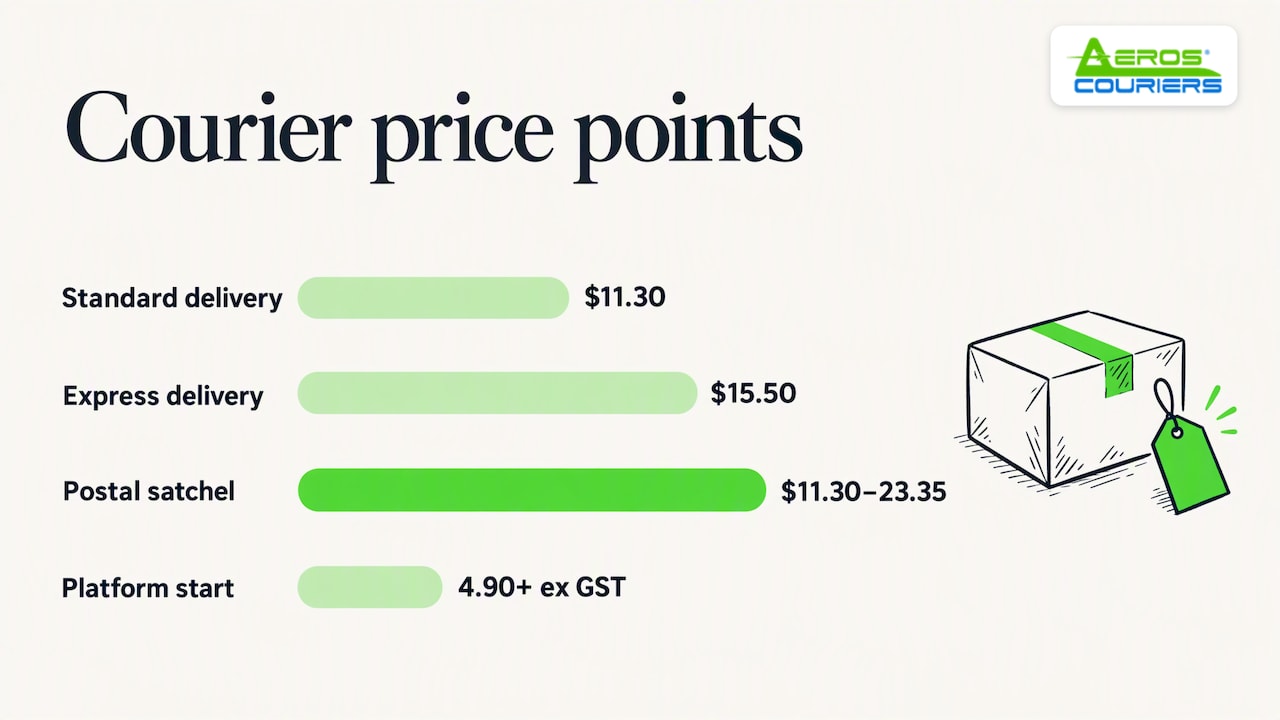
Fixed-rate satchels. Prepaid national-postal-service Parcel Post satchels for items under 5kg are fixed-price, ranging from $11.30 for a small satchel to $23.35 for an extra-large one. Fixed prices are simple, but you pay the same whether the item fills the satchel or not. We cover these in detail in our guide to the prepaid satchel sizes and prices and the small satchel option.
Discounted platform rates. Booking through a platform that buys at bulk carrier rates can bring the entry price down sharply. Our rates start from $4.90 (ex GST) for parcels up to 25kg, and the full price for your parcel appears when you enter its details.
| Option | How it is priced | Typical starting point | Best for |
|---|---|---|---|
| Retail checkout delivery | Flat or tiered fee set by the shop | $11.30 average standard, $15.50 average express | Shoppers buying online |
| Prepaid postal satchel | Fixed by satchel size, under 5kg | $11.30 to $23.35 | Small, light, regular items |
| Aeros Couriers platform | Quoted from parcel details, up to 25kg | From $4.90 (ex GST) | Small businesses and individuals sending parcels often |
| Freight, large or heavy items | Quoted per job | Quote required | Pallets, bulky or oversized goods |
The table is a guide to how options are priced, not a promise for your parcel. Your real price depends on the factors below.
What decides the price of a courier quote
The business.gov.au shipping guide notes that instant quotes can be based on an order’s size and weight. In practice, five things do most of the work.
Weight: actual versus cubic
Every courier charges on a “chargeable weight”. That is the greater of two numbers: the weight on the scales (dead weight) and the weight calculated from the box’s volume (cubic weight). A pillow or a cushion weighs almost nothing but fills a large carton, so it is billed on its cubic weight. Each carrier sets its own conversion factor, so the same box can cost different amounts with different carriers.
The practical lesson: weigh and measure the packed parcel, not the product. Oversized cartons are the most common reason a quote comes in higher than expected.
Dimensions
Length, width and height feed the cubic weight, and many carriers also set size limits. A long, thin item can attract a surcharge or be refused on a standard service even if it is light. Trimming a few centimetres off a carton, or using a snugger box, can drop you into a cheaper band.
Distance and zones
Couriers price by zone. A parcel across a single metro area costs less than one crossing the country, and a parcel heading to a regional or remote postcode usually costs more again. Sydney to Perth is a very different trip from Sydney to Parramatta.
Speed
Standard road services are the cheapest. Express, same-day and air options cost more because they use dedicated capacity or faster modes. If the recipient doesn’t need the parcel tomorrow, a standard service is where the savings are. Our breakdown of express delivery costs and hidden fees shows where the premium comes from.
Pickup and drop-off
Door-to-door pickup is more convenient than dropping off at a depot or post office, and some carriers charge for it. Check whether collection is included in the quote, particularly if you send several parcels a week.
Extra fees that push the price up
The base rate is only the start. Common additions in the Australian market include:
- Fuel surcharge. A percentage added to the base rate by many carriers and adjusted as fuel costs move.
- Residential delivery fee. A per-parcel charge for delivering to a home rather than a business address. Our guide to residential surcharges explains how it shows up on invoices.
- Remote-area surcharge. A flat extra for postcodes outside the main delivery network. Carriers publish lists of eligible postcodes.
- Handling or oversize fees. Charged for items that are over a set length, unevenly shaped or cannot be machine-sorted.
- Signature, redelivery and failed-pickup fees. Added when nobody is home or an address is wrong.
- GST. Many business rate cards show prices excluding GST, which adds 10% at invoice.
A rate card that shows a low base price and a long list of surcharges can end up dearer than a higher base price with everything included. Our courier rate card guide walks through how to read GST and fee lines.
One commercial guide makes the same point: the cheapest base rate isn’t necessarily the lowest total cost once delays, damage, support enquiries, insurance and residential or remote surcharges are counted.
Insurance
Carriers typically include only limited cover for loss or damage, and the amount varies by service. If you send items worth more than the included cover, extra insurance is worth pricing in. We have a separate guide to what courier insurance costs.
Flat rate or calculated price: which suits you?
The business.gov.au guide describes four ways to present shipping charges to customers: free, flat-rate, tiered or exact-cost. The same split applies to what you pay a courier.
Flat rate gives a fixed charge per parcel. It works well for products of similar size and weight, because you know your cost before the order is even placed. It is less kind to your margin when parcels vary widely, since light items subsidise heavy ones.
Exact-cost pricing is calculated from size and weight. It tracks the true cost closely, but the same guide warns that customers may not see the total until checkout. If you are a seller passing the charge on, that can lead to abandoned carts.
A simple rule of thumb:
- If most parcels fall in one or two size bands, use flat or tiered rates and set them with a margin for the heavier orders.
- If your range is wide (a 300g accessory and a 20kg box in the same shop), quote on actual size and weight.
- If you ship rarely, calculated prices usually beat a fixed satchel for light parcels and are far cheaper for anything awkward.
A worked example: three parcels, three price drivers
To show how the factors combine, here are three typical sends. These are illustrations of how pricing logic works, not quotes.
A 1kg parcel, same city. The dead weight is low, the zone is local and a standard service is plenty. This is where the lowest base rates apply. The thing to check is whether a residential fee is added if it goes to a home.
A light but bulky parcel, interstate. A 2kg cushion order in a 60cm carton can have a cubic weight several times its dead weight. The billable weight jumps, and the price follows. Repacking into a smaller carton is the cheapest fix.
A 20kg box to a regional address. The weight is within a 25kg limit, but regional delivery and possibly a heavyweight or residential handling fee apply. Here the all-inclusive figure matters more than the headline base rate.
How to compare courier quotes properly
Quotes are only comparable when they describe the same thing. Before you rely on one, check the points business.gov.au suggests for choosing a provider: how easy it is to get a quote, shipping times, supported parcel sizes and weights, pickup availability, and compensation for lost or damaged parcels. It also recommends checking that the provider offers insurance and tracking.
In practice, put the same parcel through every option and write down:
- Packed weight and dimensions, identical in every quote.
- Pickup address type, residential or business, and the delivery address type.
- Service level, and the stated delivery time.
- All fees: fuel, residential, remote area, handling, GST.
- Included cover, and the price to raise it.
- Tracking and support: who do you contact when a parcel stalls?
For bulky or unusual goods, the questions multiply. The cost and booking playbook for ATV shipping is a useful example of the details worth confirming before you commit to a quote for a large item: dimensions, packaging, and what the quoted price covers.
If you are weighing up carriers by type, our guides to Australian courier companies for small businesses and courier companies in Australia set out what each kind of provider does well. If your parcels are large, see how to send big parcels cheaply.
Ways to cut your courier costs
- Right-size your packaging. A smaller carton lowers cubic weight, which is often the biggest lever you have.
- Batch your pickups. Fewer, larger collections reduce per-pickup costs where they apply.
- Ship to business addresses where you can. It avoids residential fees. Offer click-and-collect or workplace delivery to customers who prefer it.
- Use standard services by default. Reserve express and same-day for orders that genuinely need it.
- Compare per parcel, not per carrier. The cheapest option for a 1kg satchel is rarely the cheapest for a 15kg carton.
- Use bulk or platform rates. Platforms that buy volume from major carriers pass part of the discount on to smaller senders.
- Count the whole cost. A refund or reship after a lost parcel wipes out the saving from a cheap rate.
Our perspective on courier pricing
We built Aeros Couriers because the most common complaint we hear is not that couriers are expensive. It is that the price on the quote is not the price on the invoice. Fuel surcharges, handling charges and residential fees arrive late, and a small business that priced its shipping carefully ends up absorbing the difference.
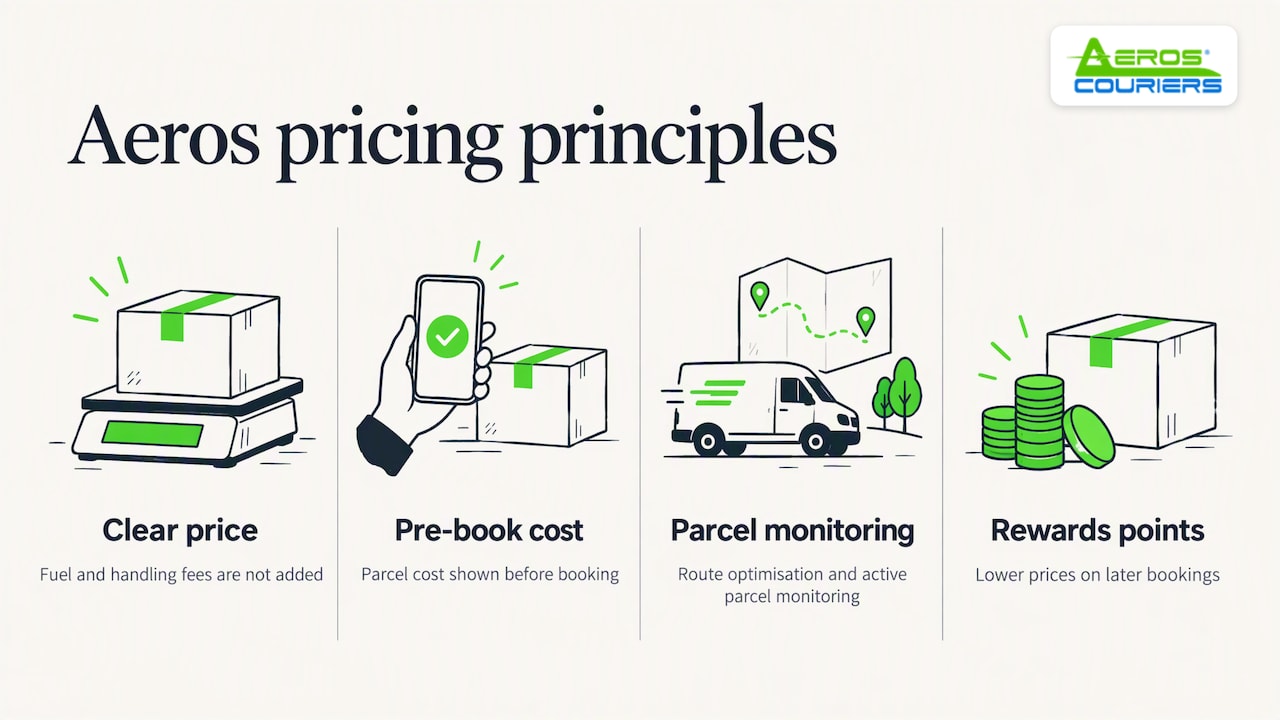
Our view is simple. A price should be one number, and it should include what it takes to move the parcel. That is why we do not add fuel surcharges or handling fees to our rates. It is also why we show the cost of a parcel before you book, so you can compare it with any other option on equal terms.
The second thing we believe is that price is only half of value. Route optimisation and active parcel monitoring matter because a late or lost parcel costs more than a few dollars saved on the rate. When something does go wrong, you should be able to reach a person who can fix it quickly. Rewards points that bring later bookings down in price are our way of looking after regular senders, who tend to be small businesses and individuals rather than large accounts with negotiated contracts.
— Aeros
Book a courier with the price shown up front
If you are ready to put a real parcel through a quote, you can compare and book a parcel delivery with us. Rates start from $4.90 (ex GST) for parcels up to 25kg, with pickup from your door, printable labels, tracking and insurance, and no fuel surcharge or handling fee added on top.

Sending something heavier or time-critical? Our freight option covers larger jobs, and express, same-day and air courier services are available from the Aeros Couriers home page. To see a price for your exact parcel, use the shipment rate page.
FAQ
How much does it cost to send a parcel in Australia?
It depends on weight, size, distance and speed. Retail checkout fees currently average $11.30 for standard and $15.50 for express delivery, while platform rates for light parcels can start much lower. Our rates begin at $4.90 (ex GST) for parcels up to 25kg.
What is the cheapest way to send a parcel?
Usually a standard road service, booked through a platform that buys at bulk carrier rates, in a carton sized closely to the contents. Compare the all-in price including residential and remote-area fees, not only the base rate.
Why was my courier invoice higher than the quote?
The usual causes are cubic weight (the carton was larger than its weight suggested), residential or remote-area surcharges, fuel or handling fees, and GST on an ex-GST price. Checking the rate card before you book and measuring the packed parcel helps avoid it.
Is a flat rate cheaper than a calculated price?
Not always. A flat rate suits products of similar size and weight and is easy to budget. Calculated pricing follows your actual parcel, so it is often cheaper for light or small items, but check the total before you commit.
Do I need insurance when I send a parcel by courier?
Check how much cover is included and compare it with the value of what you are sending. If the item is worth more than the included cover, or hard to replace, add insurance when you book.
Sources
- Australian retailers face delivery gap as costs rise
- Shipping | business.gov.au
- Australia Post services and prices explained
- eCommerce Shipping Guide: Reduce Costs and Protect Margin
- ATV Shipping: Your Complete Cost and Booking Playbook
Recommended
- Courier Prices: Compare Total Cost, Not Headline Rates in Australia
- Courier Companies in Australia: A 2026 Shipping Guide
- Australia’s Courier Prices Explained A Practical Guide
Courier quotes, tracking and support
Ready to send a parcel? Compare the available services for your postcodes, parcel dimensions and weight. For an existing delivery, use your consignment number to check tracking or ask our team for help.