
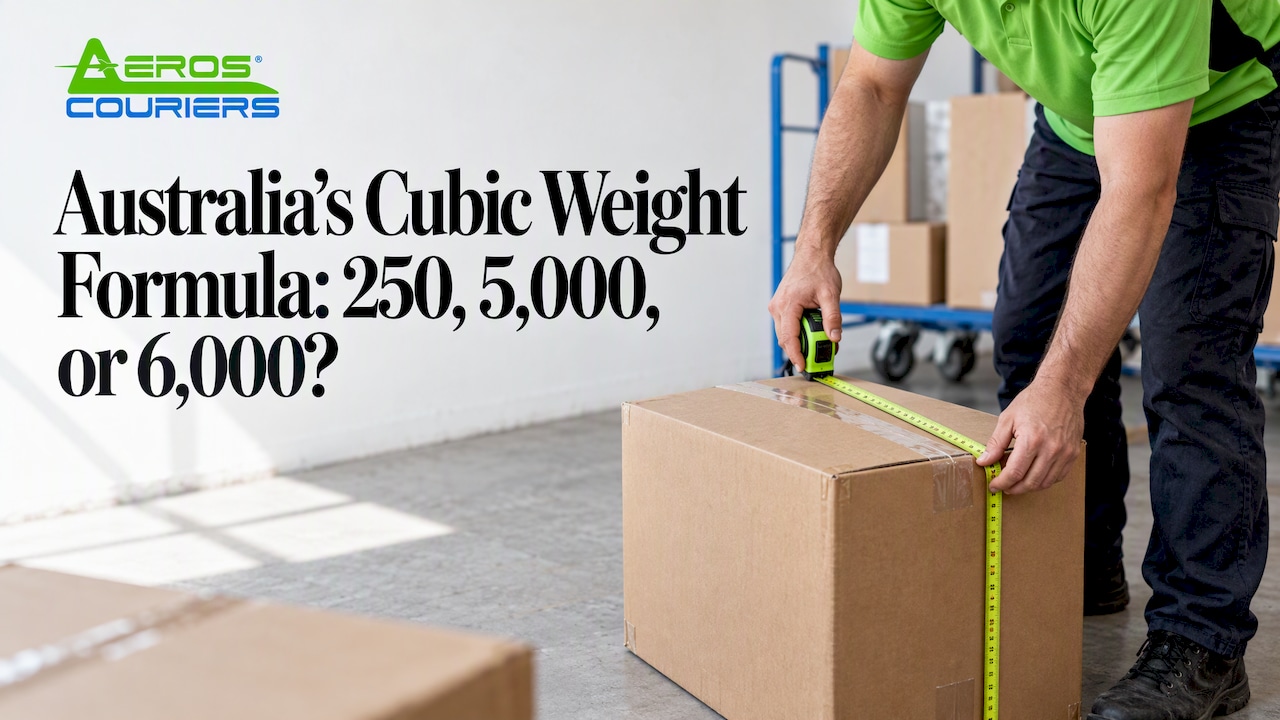
The cubic weight formula is length × width × height (in centimetres) divided by a conversion factor, giving a result in kilograms. Carriers then charge you for whichever is greater: your parcel’s actual weight or its dimensional weight. Typical divisors are around 250 for parcels and post, and 5000 or 6000 for air freight.
TL;DR:
- Measure the smallest enclosing box, including padding, protrusions, and any pallet; round each dimension up to the next whole centimetre before calculating volume.
- Confirm the divisor for the exact service before booking: a carrier may use different factors for standard parcels, express shipments, and air freight.
- Weigh the finished parcel on scales instead of estimating, then compare its reading with the calculated figure before accepting a quote.
- Repack bulky items to reduce unused space, then record the measurements and divisor so you can verify the quoted charge later.
Table of Contents
- How to calculate cubic or volumetric weight step by step
- Which divisor applies to your shipment type
- How to measure a parcel correctly before you book
- Worked examples: converting centimetres to kilograms and cubic metres
- Why carriers bill on cubic weight instead of actual weight
- How we help you manage cubic weight costs
- A quick checklist to avoid cubic-weight surprises
- Get an instant rate once you know your cubic weight
- FAQ
- Sources
How to calculate cubic or volumetric weight step by step
The formula works on volume first, then converts that volume into an equivalent weight. You measure length, width and height in centimetres, multiply them to get cubic centimetres, then divide by the carrier’s conversion factor to land on a kilogram figure you can compare against the parcel’s actual weight.
A simple workflow keeps this consistent whether you’re doing it by hand or building a spreadsheet:
- Measure length, width and height in centimetres, rounding each up to the nearest whole centimetre.
- Multiply the three figures to get the volume in cubic centimetres.
- Divide that volume by the carrier’s conversion factor (commonly 250 for parcels).
- Compare the result to the parcel’s actual weight on scales.
- Use the higher of the two figures as your chargeable weight.
Say a box measures 40cm × 30cm × 25cm. That’s 30,000 cubic centimetres. Divided by a typical parcel divisor like 250, the dimensional weight comes to a figure in kilograms that you can compare against the parcel’s actual weight. If the actual weight on the scales is only 8kg, the carrier bills you on the 120kg figure, because the box is taking up far more space than its weight suggests.
Which divisor applies to your shipment type
Carriers publish their own conversion factors, and the right one depends entirely on the transport mode you’re using. Getting this wrong before you book is one of the easiest ways to be surprised by a quote.
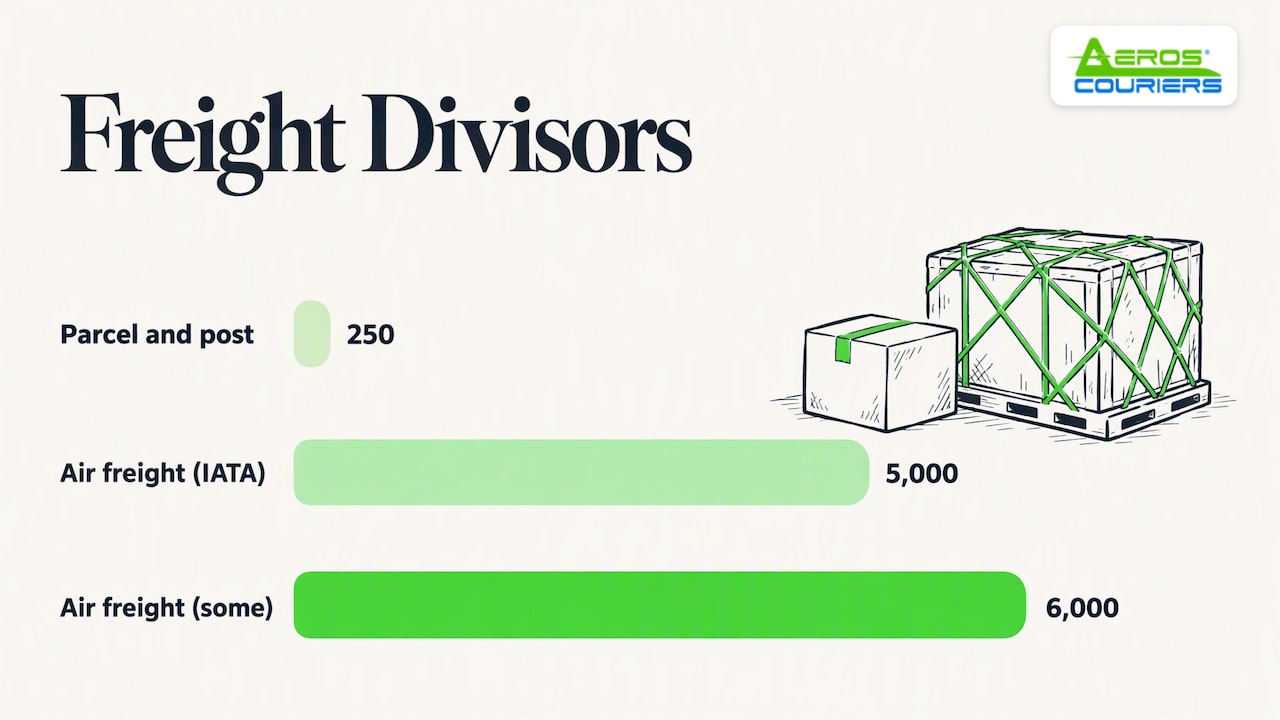
- Parcel and post services commonly use a divisor of 250, as shown on parcel cubic-weight calculators.
- Air freight typically applies the IATA standard divisor of 5000.
- Some air freight contexts instead use a divisor of 6000, so it pays to check which one your carrier quotes.
- Sea freight and palletised cargo are often rated directly in cubic metres or tonnes rather than through a parcel-style divisor.
A typical parcel calculator divides length × width × height in centimetres by 250 to produce the cubic weight in kilograms. That single number explains why a lightweight but bulky item can cost more to send than a small, dense one.
Rates and divisors vary by service level even within the same carrier, so the figure that applies to a standard parcel service won’t necessarily apply to an express or freight booking.
How to measure a parcel correctly before you book
Dimensioning comes down to one rule: measure the smallest rectangular box that fully encloses your item, including any packaging, padding or protrusions. If your item is on a pallet, the pallet’s footprint and height count too, not just the goods sitting on it.
Automated dimensioning instruments used across the freight industry are built to this same principle. Under the Supplementary Certificate of Approval issued by the National Measurement Institute, approved dimensioners must report the smallest enclosing box, along with the dimensions, volume and conversion factor used to generate the dimensional weight. That printed or displayed information is worth keeping if you ever need to query a charge.
- Round each dimension up to the nearest whole centimetre before multiplying.
- Include the outer packaging, not just the product inside it.
- Record the carrier’s divisor alongside your measurements so you can check the maths later.
Pro Tip: Photograph the dimensioner’s printed ticket at drop-off when one is provided; it’s your reference if a chargeable weight is ever disputed.
Worked examples: converting centimetres to kilograms and cubic metres
Running the numbers on a couple of common scenarios makes the formula easier to apply to your own shipments.
The air freight examples show why the divisor matters as much as the dimensions themselves: the same box produces a different billable weight depending on whether the carrier uses 5000 or 6000.
It helps to remember that a cubic metre is a volume, not a weight. As the NSW Government’s rigging guide notes, water sits at roughly 1,000kg per cubic metre, while other materials sit well above or below that. Shipping conversion factors like 250 or 5000 aren’t measuring real density at all. They’re a pricing convention carriers use to convert volume into a billable mass.
Why carriers bill on cubic weight instead of actual weight
Freight space on a truck, plane or ship is finite, and a bulky, lightweight parcel takes up room that a carrier could otherwise use for something heavier. Charging on whichever is greater, actual weight or dimensional weight, lets carriers price for the space a shipment occupies rather than just what it weighs on a scale.
This is why chargeable weight is defined simply: it’s the higher of your parcel’s actual weight and its calculated dimensional weight. Parcels and pallets are often rated differently too, with bulk freight and containers sometimes billed directly in cubic metres or tonnes rather than through a parcel divisor. Because rules shift between service levels, it’s worth checking the published terms for the specific service you’re booking before you commit to a quote.
How we help you manage cubic weight costs
Once you’ve worked out your dimensional weight, the next step is finding a service that prices it fairly. We built our shipment rate comparison to show you real-time pricing from multiple carriers side by side, so a bulky-but-light parcel doesn’t quietly inflate your cost without you knowing why.
The platform uses route optimisation and active tracking to keep deliveries moving once booked, and offers a rewards program for savings on future shipments. If a quote looks off, customer support is available to explain how the chargeable weight was calculated, rather than leaving you to puzzle over a carrier’s fine print alone.
A quick checklist to avoid cubic-weight surprises
Measure first, check the divisor, then compare actual against dimensional weight before you book. A few habits make this routine rather than guesswork:
- Round dimensions up and note the carrier’s divisor every time.
- Weigh the parcel on proper scales rather than estimating.
- Compare both figures before accepting a quote.
- Repack to reduce empty space where you can.
— Aeros
Get an instant rate once you know your cubic weight
Once you’ve got your dimensions and divisor sorted, there’s no need to guess what it’ll cost to send. Our shipment rate tool pulls pricing straight from the carriers we work with, so you can see how actual weight stacks up against dimensional weight before you pay for anything.

Pricing is flat and transparent, with no additional fees added after the fact, and every booking includes tracking to watch the parcel move from pickup to delivery. If you’re comparing options for a parcel, pallet or air shipment, head to our compare and book page to see rates side by side and book the service that fits.
FAQ
How to calculate volumetric weight?
Multiply length × width × height in centimetres to get the volume, then divide by the carrier’s conversion factor, commonly 250 for parcels or 5000 for air freight. The result is your volumetric weight in kilograms, and carriers bill you on this figure if it’s higher than the parcel’s actual weight.
How to calculate cm3 to kg?
You can’t convert cubic centimetres to kilograms directly, because volume and mass depend on density, not a fixed conversion. In shipping, carriers get around this by dividing your volume in cm³ by a published conversion factor, such as 250, to produce a dimensional weight in kilograms for pricing purposes.
What is the cubic weight of water?
Water isn’t rated using a shipping divisor at all, since cubic weight is a freight pricing convention rather than a physical measurement. As a density reference, roughly 1,000kg of water fills one cubic metre, which is useful for context but not something carriers apply to parcel pricing.
Is 1 cubic metre equal to 1 kg?
No, a cubic metre is a unit of volume and a kilogram is a unit of mass, so the two are only equal for a material with a density of exactly 1,000kg per cubic metre, close to water. Most shipped goods are far less dense than water, which is exactly why dimensional weight pricing exists.
What’s the difference between actual and chargeable weight?
Actual weight is simply what your parcel weighs on a scale, while chargeable weight is whichever is greater between that actual weight and the calculated dimensional weight. Carriers compare both figures at booking and bill you on the higher one.
Sources
- Supplementary Certificate of Approval (NMI)
- Dogging and rigging guide – Weight of the load | NSW Government
- Australia Post cubic weight calculator — Koi
Recommended
- Australia’s Courier Prices Explained A Practical Guide
- How to Accurately Estimate Shipping Cost in Australia
- A Small Business Guide to Australian Parcel Delivery
- Australian Courier Services: A Complete Guide to Smarter Shipping
Courier quotes, tracking and support
Ready to send a parcel? Compare the available services for your postcodes, parcel dimensions and weight. For an existing delivery, use your consignment number to check tracking or ask our team for help.