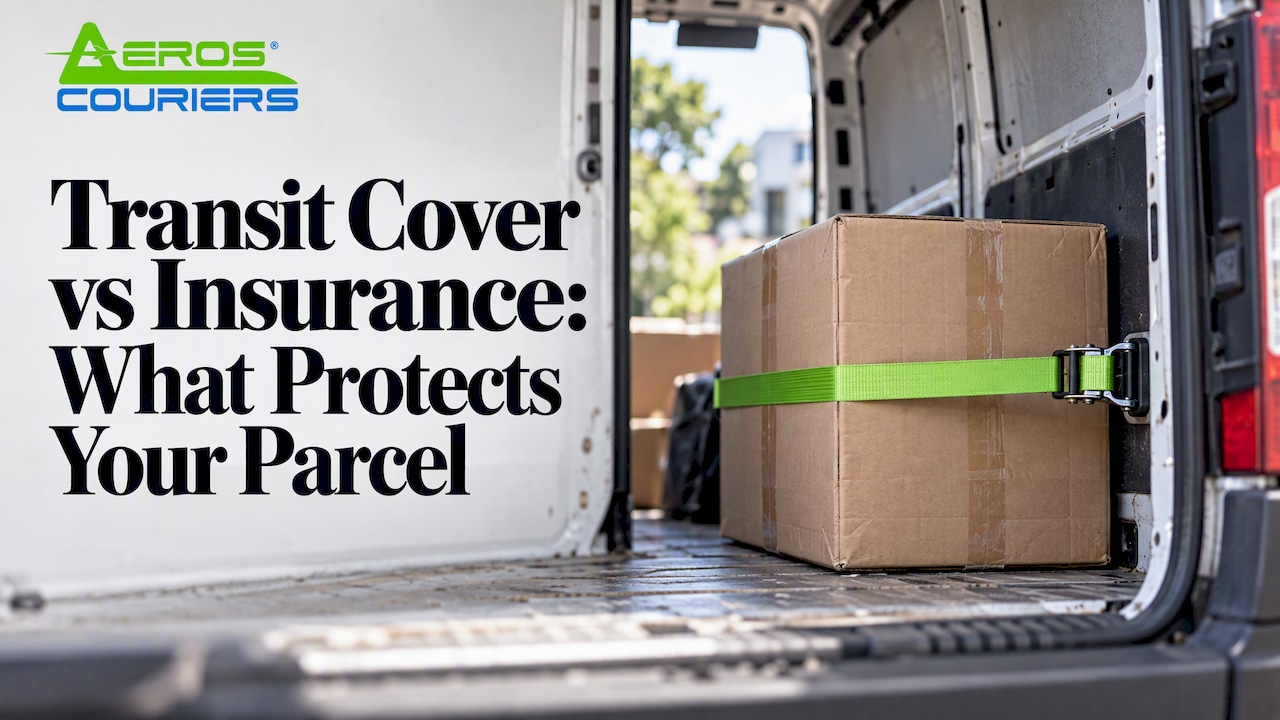
“Transit cover” and “insurance” are often used as if they mean the same thing. They don’t. Transit cover is insurance, but it is a specific kind: it protects goods while they move. Your general business policy usually doesn’t, and a carrier’s liability terms are not insurance at all. If you ship anything you couldn’t comfortably write off, the difference decides whether a lost parcel costs you a hassle or the full value of the goods.
This guide explains the three layers people mix up, what each one excludes, and how to decide what to buy for a single high-value shipment or a steady flow of orders.
TL;DR
- Transit cover (goods-in-transit insurance) is an insurance policy that protects the owner of the goods against loss or damage while they are being moved.
- Standard premises-based business insurance generally stops covering goods once they leave your premises, according to business.gov.au.
- A carrier’s liability limit is a term in its contract, not a policy you hold. It often pays far less than the goods are worth.
- For one-off or occasional high-value shipments, per-consignment cover can make more sense than an annual policy.
- Always read the Product Disclosure Statement (PDS) for exclusions, caps and excess before you rely on any cover.
Table of Contents
- What transit cover actually is
- Transit cover vs insurance: the three layers people confuse
- What transit cover usually excludes
- Electronics and other high-value items
- How to cover one high-value shipment
- Our view at Aeros
- Booking a parcel with cover in mind
- Making a claim: what to do before and after
- FAQ
- Sources
What transit cover actually is
Transit cover goes by several names: goods-in-transit insurance, transit insurance, cargo insurance, transport insurance. They all describe insurance that protects goods against loss or damage while they are being moved over land, sea or air. business.gov.au describes it as distinct from standard contents or building insurance, which generally does not cover goods once they have left the business premises.
It is built for movement-related risks such as collision, theft and natural disasters. Marsh Australia, for instance, describes cover for stolen cargo where goods were reasonably secured, such as inside a locked vehicle.
The key point is who it protects. Transit cover protects the owner of the goods. It pays you back for the stock, equipment or item you lost, usually up to a sum insured. It doesn’t depend on whether anyone was at fault.
Transit cover vs insurance: the three layers people confuse
When a parcel goes missing, three different things might respond. Only one is certain to be insurance for your goods.
| Layer | What it is | Who it protects | Typical weak point |
|---|---|---|---|
| General business or contents insurance | A policy covering your premises, equipment and stock | You, at specified locations | Usually doesn’t follow goods once they leave your premises |
| Carrier liability | Terms in the consignment note limiting what the carrier will pay | The carrier first | Caps often sit well below the real value of the goods |
| Transit cover | A policy specifically for goods while moving | You, as owner of the goods | Exclusions, caps and conditions in the PDS |
The label “insurance” gets attached to all three in casual conversation. That is where the trouble starts.
General business insurance
A contents or stock policy is written around a place: your shop, warehouse or home office. Once a parcel is on a truck, the place-based logic breaks down. If your business moves stock or equipment regularly, check your policy wording for any transit extension, and ask your broker directly instead of assuming.
Carrier liability
Many owners treat a carrier’s standard liability as if it were insurance. AJG Australia advises small and medium businesses that ship goods to customers not to rely on their transport operators’ insurance, and notes that many claims for loss or damage in a carrier’s care are denied. The carrier’s cover exists mainly to protect the carrier.
The liability limits usually live in the fine print of the consignment note. If you’ve never read one closely, our guide to what a consignment note is and what it commits you to is a good place to start.
Consumer law is not a policy
The Australian Consumer Law requires services to be delivered with due care and skill. That is a legal standard, not a pot of money. The Australian Financial Complaints Authority (AFCA) offers a free dispute service for small businesses, but it cannot make an insurer pay for an event the product you bought never contemplated. Proving a failure to meet a guarantee can also be slow and frustrating. Cover bought in advance beats an argument after the fact.
What transit cover usually excludes
This is the part readers search for most: the exclusions. Wording varies by insurer, so treat the list below as questions to ask, not a promise about any policy.
- Packing. Many policies expect goods to be packed to a reasonable standard. Poorly packed items are a classic reason for a refused claim.
- Specific goods. Perishables, fragile items, cash, jewellery, or second-hand and used goods are commonly restricted or excluded. AJG notes that broad policies can leave out perishable goods and specialised transport modes, which is why a broker assessment helps.
- Theft conditions. Cover may depend on goods being reasonably secured. Goods left unattended in a vehicle can be treated very differently.
- Caps and excess. There may be a maximum per consignment, a maximum per vehicle, and an excess you pay on each claim.
- Mode and route. A policy written for road freight may not cover sea or air legs. Marine cargo insurance is aimed at goods moving between ports, while inland transit cover is for domestic road and rail journeys.
- Start and end points. Cover typically applies between defined points, such as loading to delivery. Storage or delays between legs can fall outside it.
ASIC’s review of insurance sales found that staff-provided information can be oversimplified, and urges consumers to study the Product Disclosure Statement to understand caps and limitations. That review looked at home insurance, but the lesson carries over: the PDS is the contract, and a friendly phone call is not.
Electronics and other high-value items
Electronics are where the gap between carrier liability and real value bites hardest. A laptop, camera or phone can be worth more than a carrier’s default compensation limit, and they are attractive to thieves. Three habits help:
- Declare the real value. Declaring a low value to save money can leave you under-covered. Whatever cover you choose, the sum insured should match replacement cost.
- Keep proof. Hold the invoice, photos of the item and packaging before it ships, and the tracking record. Claims run on evidence.
- Check the exclusions for your item type. Used electronics, refurbished stock and items without original packaging are the usual sticking points.
If you’re shipping something expensive and rare, such as art, prototypes or specialist equipment, speak to a transport insurance broker before you book. They can see exclusions in a policy that a comparison table won’t show.
How to cover one high-value shipment
You don’t need an annual contract to protect a single consignment. Some specialist providers sell per-consignment freight insurance that applies from the moment goods are loaded until they are delivered. Their published FAQs describe domestic cover of up to $100,000 per consignment and often no excess, though you should confirm current terms and conditions on the provider’s own PDS. Cover generally has to be arranged before the goods move.
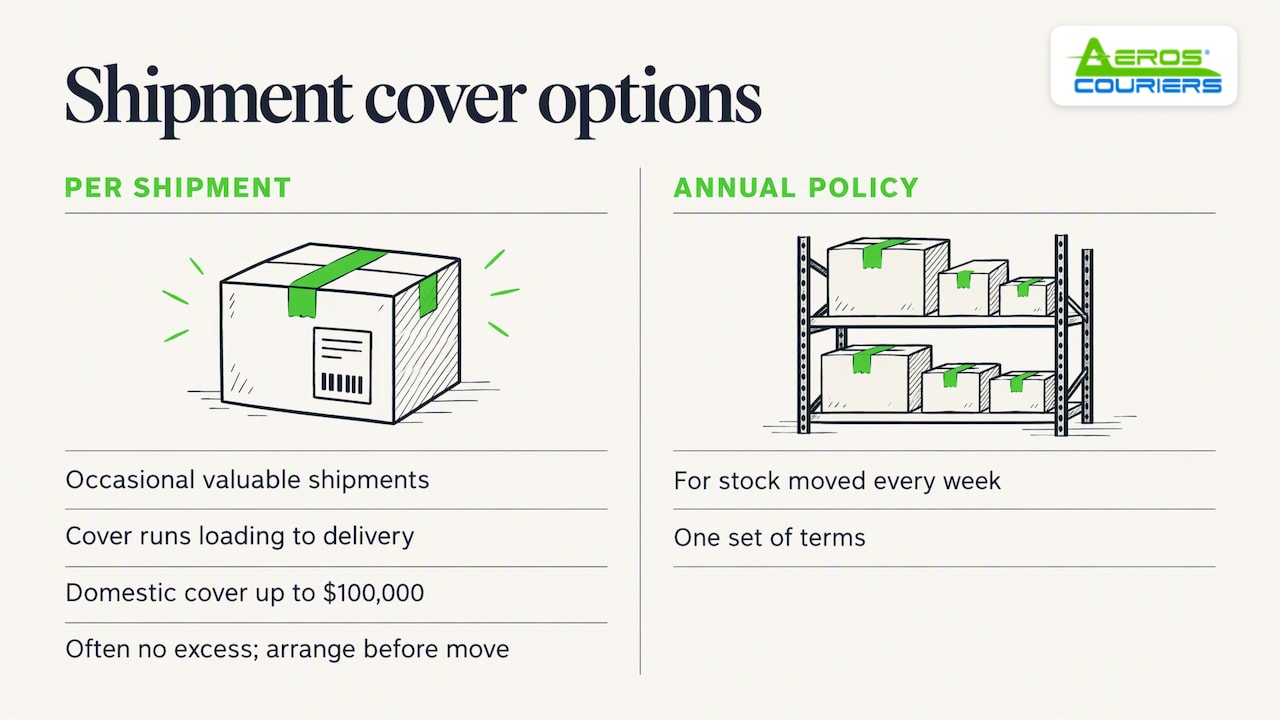
That model suits small sellers and individuals who ship valuable items now and then. An annual policy usually makes more sense when you move stock every week and want one set of terms to rely on.
A quick way to decide
| Your situation | Sensible starting point |
|---|---|
| Occasional high-value parcel | Per-consignment cover, or cover offered at booking |
| Regular stock movements, mixed values | Annual goods-in-transit policy through a broker |
| Low-value orders, cheap to replace | Carrier terms plus your own risk tolerance, with the cost of a replacement worked out in advance |
| Interstate or air freight of valuable goods | Confirm the policy covers every leg and mode |
For interstate moves, the leg-by-leg detail matters. Our guide to interstate transport in Australia covers how those journeys work.
Our view at Aeros
We talk to small businesses and individuals every day who assumed a parcel was covered and found out otherwise after something went wrong. Our experience is that the problem is rarely a lack of insurance products. It’s a lack of clarity at the moment of booking.
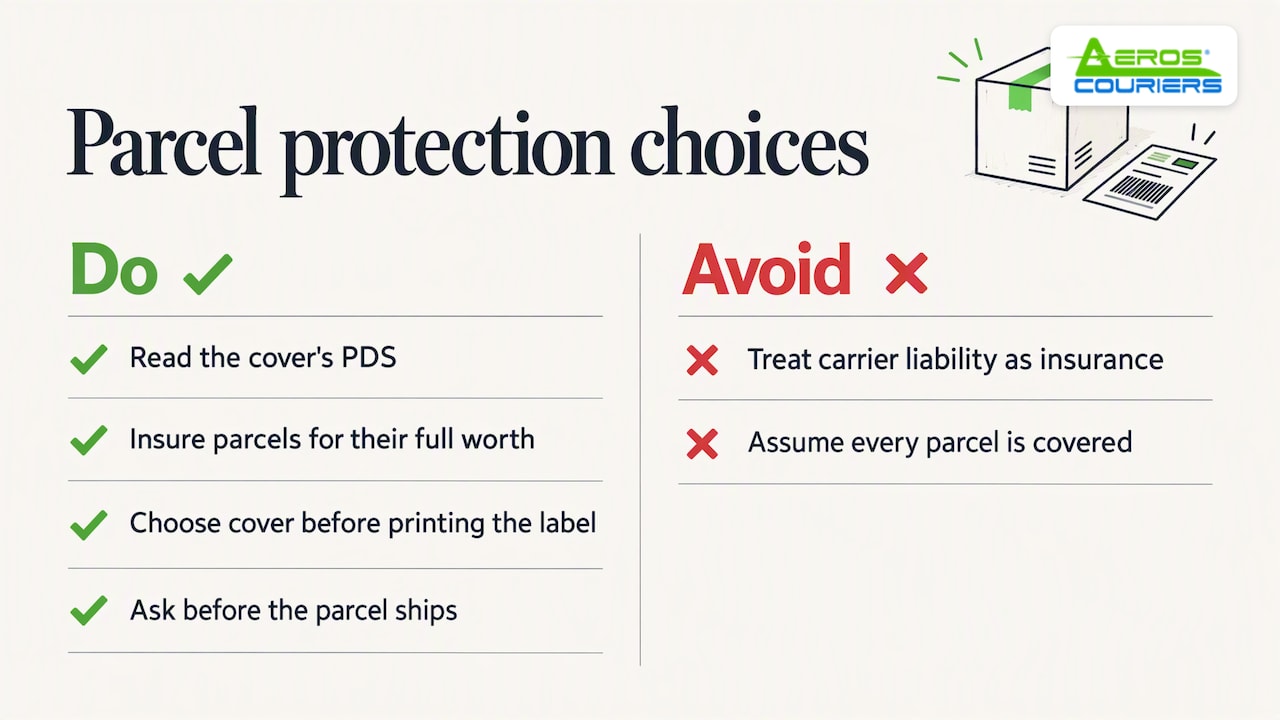
That’s why we think the cost of shipping should be plain: flat, transparent pricing with no fuel surcharges or handling fees, so the number you see is the number you pay. Cover should be treated the same way. Decide what a lost parcel would really cost you, then pick the protection to match, before you print the label.
Our view is simple. Don’t treat a carrier’s liability as your insurance. Do read the PDS of whatever you buy. And when a parcel is worth more than you could comfortably lose, insure it for what it is worth. Our team is Australian-based and reachable by a real person, so if you’re unsure how your parcel should be booked, ask us before it ships.
— Aeros
Booking a parcel with cover in mind
On Aeros you can compare rates from major carriers, book door-to-door pickup, print your label and track the shipment, with insurance among the options on the platform. If you’re sending something valuable, start with our parcel delivery service for parcels up to 25kg, or compare and book freight for larger consignments. Rates for parcels start from $4.90.
If you sell online and want the wider picture on costs, see our guide to ecommerce shipping costs in Australia.
Making a claim: what to do before and after
A claim is won or lost on preparation.
Before shipping
- Photograph the item and the packed box.
- Keep the invoice and the booking confirmation.
- Record the declared value and the cover you selected.
If something goes wrong
- Report the loss or damage as soon as you know, and check the notification window in your policy and consignment terms.
- Keep all packaging for damaged goods.
- Lodge the claim with the party that actually holds your cover, whether that’s the insurer or the provider of the cover you booked.
- If an insurer declines a claim and you think the decision is wrong, a small business can take it to AFCA, which lists denied insurance claims among the disputes it handles.
Both sides owe each other the duty of utmost good faith. That means being honest about the value and nature of what you shipped, as well as expecting clear information about exclusions.
FAQ
What is transit cover?
Transit cover is insurance that protects goods against loss or damage while they are being moved. It is also called goods-in-transit insurance. It is separate from standard contents or building insurance, which generally doesn’t cover goods once they leave your premises.
Is transit cover the same as the carrier’s insurance?
No. A carrier’s liability is set by its contract terms and is designed to limit what the carrier pays. AJG Australia advises businesses not to rely on it. Transit cover you hold yourself protects you as the owner of the goods.
Does my business insurance cover parcels in the post or with a courier?
Often not. Place-based policies are written around your premises. Check your policy wording for a transit extension and ask your broker or insurer in writing, because the answer differs from policy to policy.
How do I ship high-value items in Australia safely?
Declare the true value, pack to a good standard, keep photos and invoices, and arrange cover for the full replacement cost before the parcel moves. For very valuable or unusual goods, talk to a transport insurance broker first. Then book a tracked service so you have a clear record of where the item is.
Sources
- Types of business insurance | business.gov.au
- SMEs’ Guide to Insurance Cover for Goods in Transit | AJG Australia
- Goods in transit insurance | Marsh Australia
- Marine and Cargo Insurance | AJG Australia
- Freight Insurance FAQs
- ASIC Report REP 415
- How AFCA can help small businesses and sole traders
Recommended
- Insurance for Courier: A Quick Guide to Secure Shipping in Australia
- A Guide to Insurance for Couriers in Australia
- Unpacking the In Transit Meaning for Australian Shipping
Courier quotes, tracking and support
Ready to send a parcel? Compare the available services for your postcodes, parcel dimensions and weight. For an existing delivery, use your consignment number to check tracking or ask our team for help.