







Express shipping suits time-critical orders, last-minute gifts and anything perishable, while standard shipping suits routine, non-urgent parcels where cost matters more than speed. Mode of transport largely explains the gap: national postal networks typically run express as air freight and standard as road-based services, which is why express usually wins on speed but not always on value. The right pick depends on what happens if the parcel arrives two days later than expected.
TL;DR:
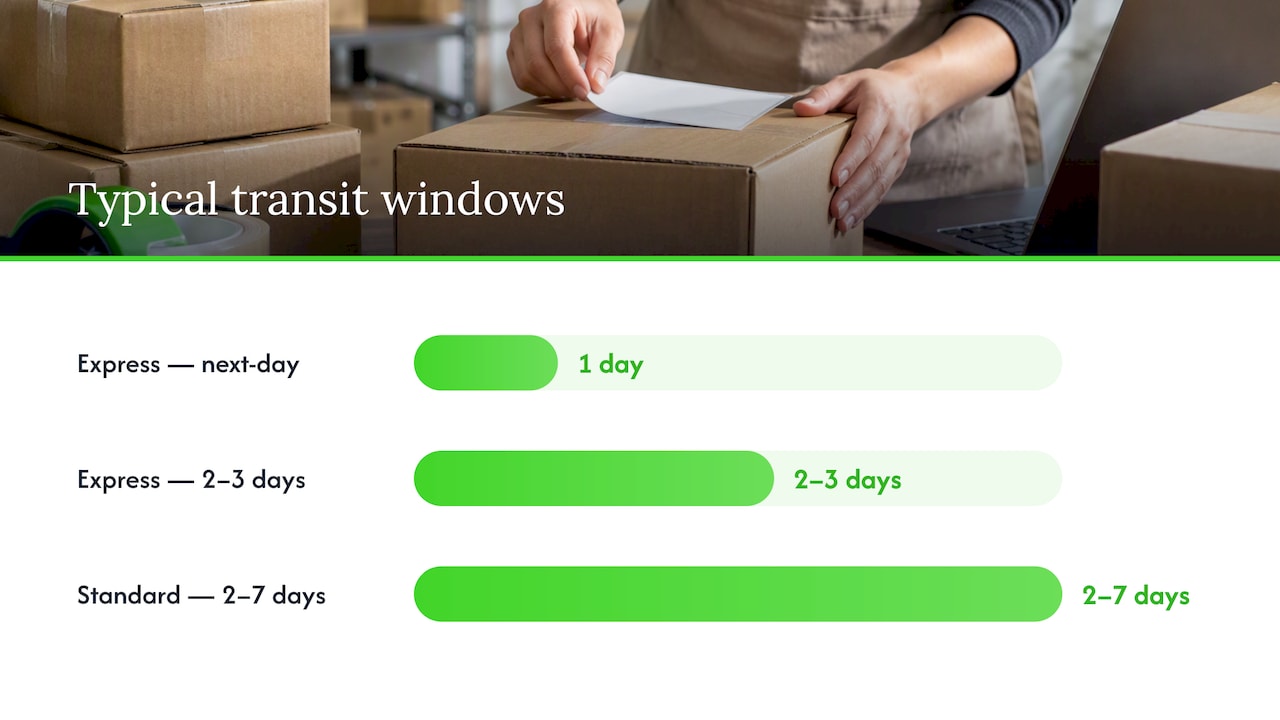
- Express shipping uses air freight and priority handling, typically delivering within one to three days, while standard shipping relies on road networks and takes two to seven days.
- The main cost driver is transport mode, with air delivering a speed premium and incurring higher fees, especially for longer distances and larger parcels.
- Shipping costs increase with distance, weight, size, and additional charges like fuel surcharges or peak-season premiums, making predictability key for budgeting.
- Standard delivery can match express times on short, local routes, especially for low-value or routine parcels without urgent deadlines.
- Prioritizing predictable delivery windows over speed improves customer satisfaction more effectively and helps control costs.
Table of Contents
- How express and standard differ in transit and handling
- What actually drives the price you pay
- When express is worth it and when it is not
- Cutting cost without defaulting to express every time
- How Aeros approaches transparent pricing and speed
- Does package size and weight change your options?
- Comparing reliability: loss, damage and delay risk
- Does the shipping speed you choose affect the environment?
- What service levels do different carriers actually offer?
- Why predictable delivery beats occasional speed
- Ready to compare your shipping options?
- Where these figures and claims come from
- Sources
- FAQ
How express and standard differ in transit and handling
The core difference between express and standard shipping is not marketing, it is logistics. Postal and courier networks typically move express parcels by air and prioritise them through sorting facilities, while standard parcels travel by road on scheduled, consolidated routes. That single choice of mode explains most of the speed gap you see on a checkout page.
On domestic retail examples outside Australia, standard delivery commonly runs 2 to 7 business days while express ranges from next-day to 2 to 3 business days, though exact windows vary by carrier and route. Express parcels also tend to get scanned more frequently through the network, giving you finer-grained tracking, while standard parcels may only scan at major checkpoints.
Handling priority matters too. Express shipments typically jump the queue at sorting hubs and get loaded onto the next available flight or priority run, whereas standard parcels wait for a scheduled truck route that might consolidate several deliveries before departing.
There is one common exception: short metro runs. When sender and receiver sit in the same city or region, standard road transport can match or nearly match express transit times, because the flight leg that usually justifies the express premium never comes into play.
Key operational differences to expect:
- Transport mode: express often flies, standard usually travels by road.
- Sorting priority: express parcels are typically processed and loaded first.
- Scan frequency: express shipments tend to have more tracking checkpoints.
- Route consolidation: standard parcels may share a truck run with many other deliveries, adding stops.
What actually drives the price you pay
Shipping price is not random. It is built from a handful of measurable inputs, and understanding them lets you predict cost before you get a quote.
- Distance and transport mode. A parcel moving interstate by air costs more to move than one travelling a short road route, and that speed premium is the single biggest line item in an express fee.
- Weight and dimensional size. Carriers price in bands, and an oversized but light parcel can be charged on its dimensional weight rather than its actual weight, which catches out a lot of first-time shippers.
- Accessorial charges. Fuel surcharges, peak-season premiums and rural or remote delivery fees can sit on top of the base rate, sometimes doubling the quoted price if they are not disclosed upfront.
- Guaranteed delivery or refund options. A money-back guarantee or a fixed delivery window adds a cost because the carrier is committing resources to protect that promise.
Parcel volumes spike hard in predictable windows. Peak weeks in 2024 saw more than 9.5 million parcels delivered nationally, which pushes both prices and transit reliability in the wrong direction for shippers who have not planned around it. That volume surge is also why express rates tend to firm up in the lead-up to major retail events: capacity gets scarce exactly when demand for speed is highest.
Understanding these levers is the difference between guessing at a shipping quote and predicting one. If you want a breakdown of how these components combine in practice, our guide to courier prices walks through worked examples.
When express is worth it and when it is not
Not every parcel needs to fly. The decision usually comes down to what happens if the delivery is late, not how much you would prefer it to arrive sooner.
Choose express when the shipment is genuinely time-critical: a last-minute gift, a perishable item, a client sample tied to a deadline, or a return that needs to beat a refund window. In these cases, the cost of being late (a lost sale, a spoiled product, a frustrated customer) outweighs the shipping premium.
Choose standard when the order is routine, heavy, low in value, or has a predictable lead time the customer has already accepted. Paying an express premium on a $15 item with no urgency attached rarely makes financial sense.
Customer experience matters here too. Retail research suggests that predictable delivery windows and clear tracking do more for satisfaction than raw speed, which means a well-communicated standard delivery can outperform a rushed express one if the customer knows exactly what to expect.
A simple rule to apply per shipment:
- High cost-of-delay, low shipment volume: pay for express.
- Low cost-of-delay, routine volume: default to standard.
- Uncertain value or fragile contents: consider standard plus shipping protection rather than paying for speed you do not need.
- Customer-facing deadline: communicate the standard window clearly rather than assuming express is required.
Cutting cost without defaulting to express every time
You do not need to choose between slow and expensive. A few habits shift the balance without touching your delivery promise.
Pro Tip: Batch your outgoing parcels into a single daily dispatch instead of booking shipments as orders trickle in, since consolidated volume often unlocks better rates than one-off bookings.
- Consolidate orders: grouping multiple parcels into one dispatch reduces per-parcel handling costs.
- Use earlier cut-off times: booking before a carrier’s daily cut-off can shift a shipment into a cheaper, less time-pressured tier.
- Try partial express: paying for priority only on the final leg of a journey can capture most of the speed benefit at a fraction of full express cost.
- Compare rates before booking: a rate comparison platform shows you the spread between carriers before you commit.
Negotiating volume discounts is worth pursuing once your shipping frequency climbs, since most carriers have tiered pricing that only becomes visible when you ask. For more low-cost sending tactics, see our guide on the cheapest way to send a parcel.
How Aeros approaches transparent pricing and speed
Aeros Couriers was built around the idea that a shipping decision should not require guesswork about hidden fees. Pricing is quoted without fuel surcharges or handling add-ons layered on afterward.
- Transparent pricing: the quoted rate is the rate you pay, with no surprise surcharges.
- Route optimisation: technology-driven routing aims to keep transit times competitive on both express and standard options.
- Active parcel monitoring: shipments are tracked through the network rather than only scanned at major checkpoints.
- Rewards and support: a rewards programme and responsive customer support help reduce effective costs for shippers who book regularly.
For customers weighing express against standard, the practical approach is to check both prices side by side before booking rather than assuming one is always better value. You can see how the numbers compare for your parcel using the shipment rate tool, and read more about express-specific service options in our guide to courier express.
Does package size and weight change your options?
Size and weight affect express and standard shipping differently, and the gap widens as parcels get bigger. Express carriers typically charge on dimensional weight (a calculation based on volume rather than actual mass) more aggressively than standard services, because air cargo space is limited and priced accordingly. A large but light parcel, like a lampshade or a bulky garment, can trigger a dimensional weight charge on express that would not apply on a road-based standard service.
Heavier parcels also compress the price advantage of standard shipping. Once a parcel crosses into a higher weight band, the express premium as a percentage of total cost often shrinks, because both services are pricing off a similar base weight charge. This is why it is worth checking actual quotes for heavy items rather than assuming standard is always cheaper.
Oversized parcels can also face handling restrictions on express services that do not apply to standard freight, since irregular shapes can be harder to load efficiently onto priority flights. If you are shipping something bulky and not urgent, standard delivery paired with proper packaging is usually the more practical route, both for cost and for reducing handling risk in transit.
Comparing reliability: loss, damage and delay risk
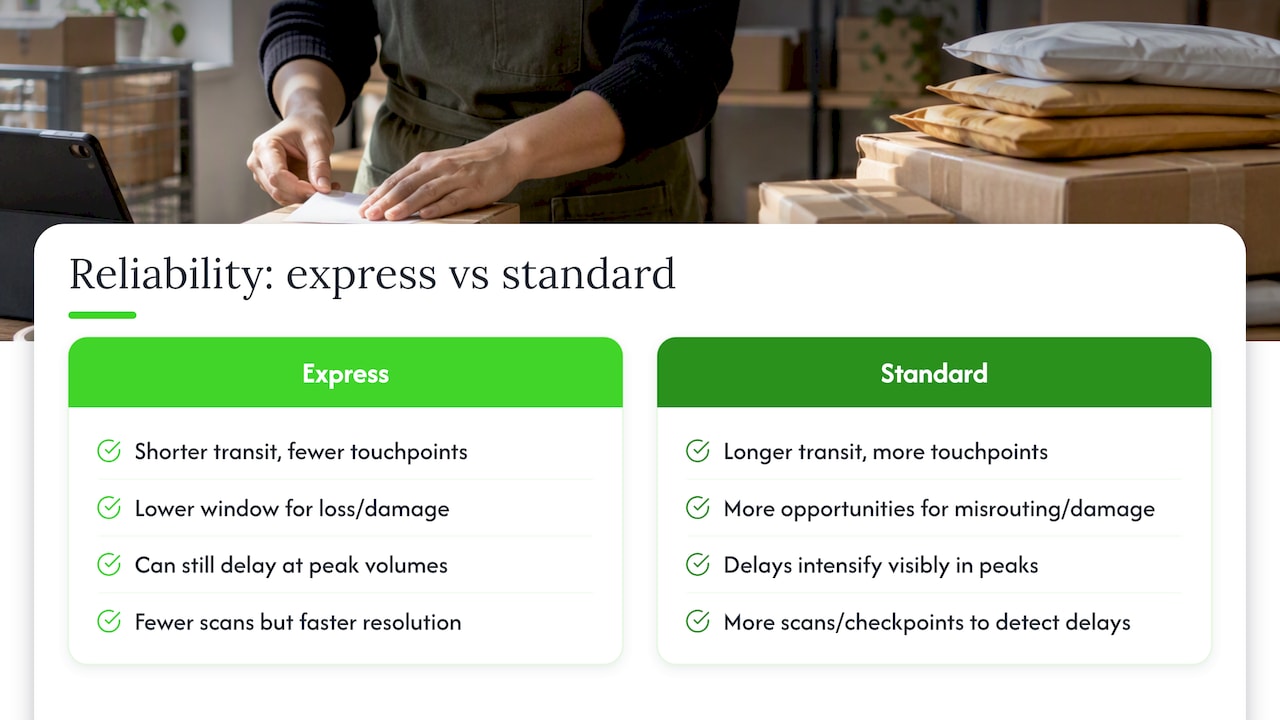
Express and standard shipping carry different risk profiles, though neither is immune to problems. Express shipments generally spend less time in the network and pass through fewer handling touchpoints, which can reduce the window for loss or damage simply because the parcel moves faster from pickup to delivery.
Standard shipments, by consolidating multiple parcels onto shared road routes, involve more handling steps and longer dwell times at sorting facilities. More touchpoints mean more opportunities for a parcel to be misrouted or damaged, though it also means more scanning checkpoints exist to catch a delay early.
Delay risk climbs for both services during peak periods. When parcel volumes spike, as they did during peak weeks in 2024 with more than 9.5 million parcels moving nationally, even express services can slip outside their usual window because network capacity is stretched. Standard services tend to absorb these delays more visibly, since they were built with less time buffer to begin with.
For high-value or fragile shipments, adding shipping protection is a more reliable safeguard than assuming a faster service is automatically a safer one. Insurance and clear tracking reduce your exposure regardless of which speed tier you choose.
Does the shipping speed you choose affect the environment?
Transport mode is the main reason express and standard shipping differ environmentally, not just operationally. Because express relies more heavily on air transport while standard uses road-based networks, the two services typically carry a different emissions profile per parcel, with air freight generally understood to be more emissions-intensive per kilogram moved than road transport.
Standard shipping also benefits from consolidation. Multiple parcels sharing a single truck route spread the environmental cost of that trip across more deliveries, while express shipments are more likely to be prioritised individually or in smaller batches to hit tighter time windows.
None of this means express is never the sensible choice. A genuinely time-critical shipment, like a perishable item or an urgent replacement part, may justify the trade-off. But for routine, non-urgent orders, choosing standard is generally the lower-impact option simply because of how the transport mode and consolidation work. If minimising environmental impact matters to your business, defaulting to standard for anything without a real deadline is a straightforward way to act on that preference.
What service levels do different carriers actually offer?
Not every “express” or “standard” service means the same thing across carriers, and the variation matters when you are comparing quotes. Some carriers offer a genuine same-day tier on top of standard express, aimed at urgent local deliveries, while others only distinguish between two broad tiers: a faster, air-prioritised service and a slower, road-based one.
Coverage also varies. A carrier’s express service might guarantee next-business-day delivery in metro areas but revert to a longer, less predictable window for regional or remote addresses, even though it is still labelled “express” on the price list. This is one reason it pays to check the specific delivery window attached to a quote rather than assuming the service name tells you everything.
Platforms that let you compare multiple carriers side by side make this variation easier to manage, since you can see actual transit windows and prices rather than relying on a single carrier’s own labelling. Aeros offers Express, Same Day and Air courier solutions alongside standard parcel delivery, which gives shippers a way to match the service level to the actual urgency of each parcel rather than defaulting to whichever option a single carrier promotes hardest.
Why predictable delivery beats occasional speed
The instinct to reach for express on every urgent-feeling order is usually a mistake. What most customers actually reward is knowing when their parcel will arrive, not receiving it as fast as physically possible. A retailer that consistently under-promises and over-delivers on a standard window builds more trust than one that occasionally rushes an order and leaves the rest inconsistent.
A workable rule for small shippers: default to standard for every order, and reserve express for a defined, narrow set of exceptions (perishables, last-minute gifts, contractual deadlines). This keeps costs predictable and customer expectations calibrated, rather than letting speed become the default promise you cannot always keep.
— Aeros
Ready to compare your shipping options?
Once you know whether a parcel needs express or standard, the next step is checking what that actually costs. Aeros Couriers offers transparent pricing with no fuel surcharges or handling fees hidden in the fine print, so the price you see when comparing express against standard is the price you pay.
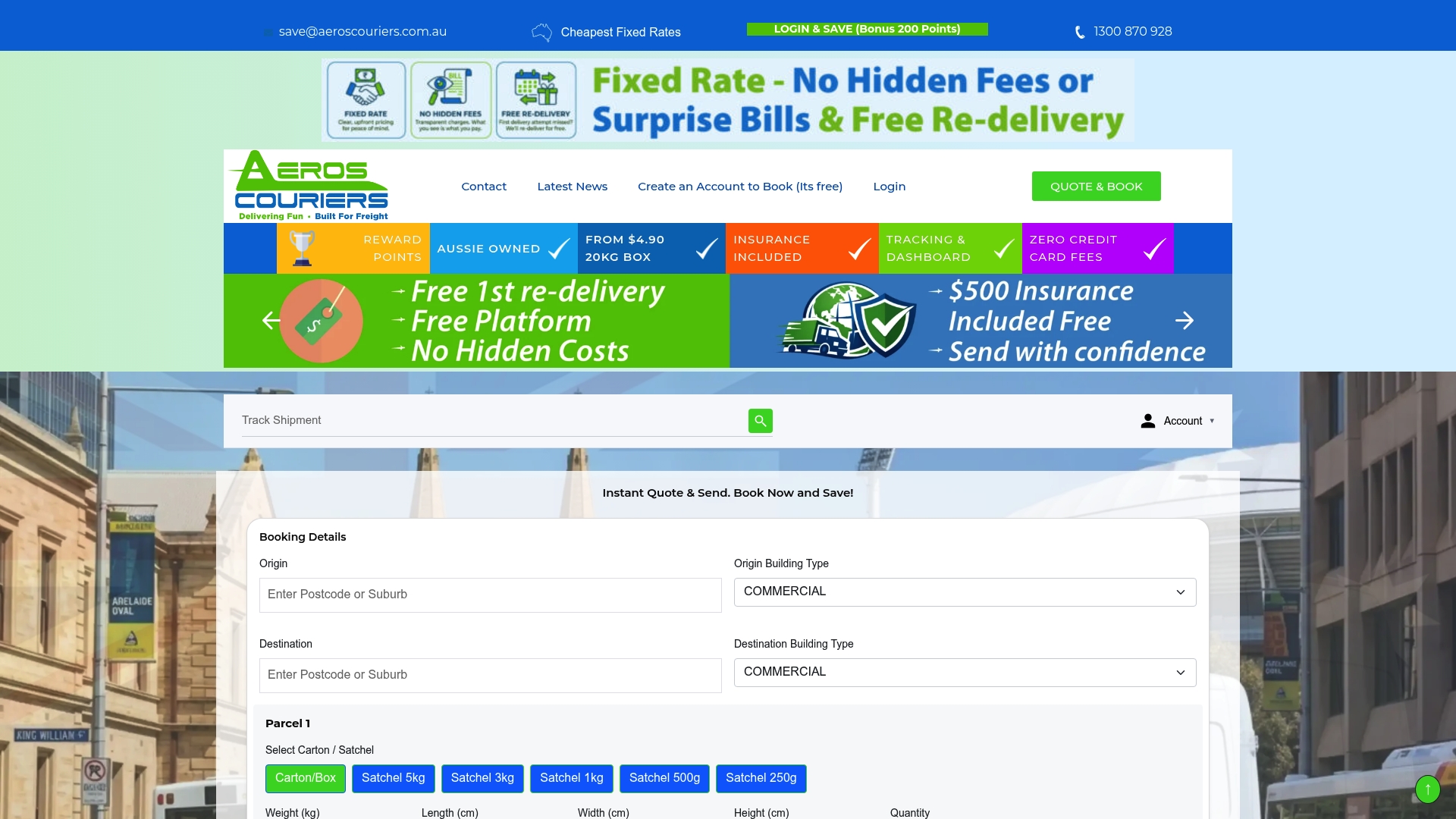
Route optimisation and active parcel monitoring apply across both service levels, and a rewards programme adds further savings for shippers who book regularly. If you want to see the real difference between express and standard for your next parcel, compare rates now using the shipment rate tool.
Where these figures and claims come from
These sources back the data and claims used throughout this guide:
- List of national postal services: background on how postal networks split express and standard delivery by transport mode.
- Delivery experience success research: benchmarking on delivery expectations and customer satisfaction.
Sources
FAQ
Which is faster, standard or express shipping?
Express shipping is generally faster because it typically uses air transport and priority sorting, while standard shipping relies on scheduled road routes. On short metro runs, the two can be close in speed since the flight leg that usually creates the gap is not needed.
How long does express delivery usually take?
Transit times vary by carrier and route, but retail examples show express delivery commonly ranging from next-day to 2 to 3 business days, compared with 2 to 7 business days for standard. Check the specific window quoted for your route, since carrier definitions of “express” are not standardised.
Is it worth it to pay for express shipping?
Express is worth paying for when the cost of a late delivery, a missed deadline, a spoiled perishable or a frustrated customer outweighs the shipping premium. For routine, non-urgent, or low-value parcels, standard shipping usually delivers better value for the same outcome.
How much faster is express shipping than standard?
The gap depends on route and carrier, but retail examples show standard running 2 to 7 business days against express at next-day to 2 to 3 business days. The difference narrows significantly on short, same-city routes where road transport can nearly match air.
