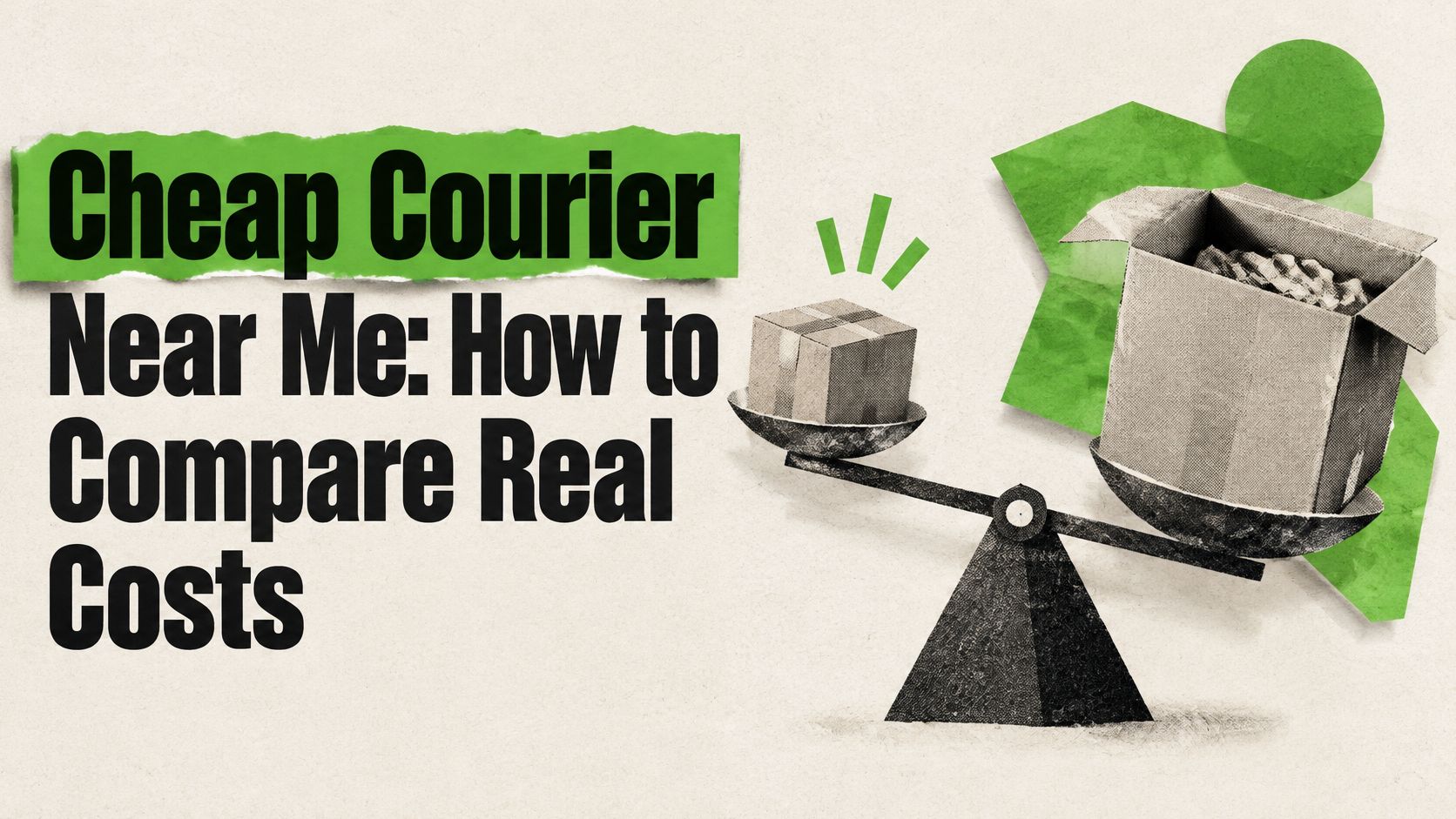
Your parcel's taped shut, the address is ready, and you've searched for a cheap courier near me. A promising price appears, but after entering the delivery details, the total changes. You're left wondering whether you've missed something or whether sending a simple box really needs to be this complicated.
You don't need to become a freight specialist to make a good booking. You need a clear way to compare the whole delivery, not just the price that first caught your eye.
Why the Cheapest Quote Is Not Always the Cheapest Courier
A low advertised rate can be a useful starting point. It isn't necessarily the price for your parcel, your pickup address or your recipient's postcode.
Consider a home seller sending a boxed item interstate. The initial price may relate to a different parcel size or delivery zone. Once the seller adds the actual dimensions, residential address and required service, they're comparing a different job.
That doesn't automatically make the quote unreasonable. It means the headline price wasn't enough information to make a decision.
Compare the job you actually need
This guide focuses on cartons, satchels and parcels within Australia, from nearby deliveries to Australia-wide shipping. Pallets aren't part of the comparison. The aim is fast, dependable parcel delivery at the lowest suitable price, rather than paying for services your shipment doesn't need.
There's a substantial retail backdrop to these everyday bookings. The Australian Bureau of Statistics recorded seasonally adjusted online retail sales of A$3,921.0 million in December 2023, indicating the scale of online commerce behind Australian delivery demand, although retail sales aren't parcel counts (ABS online retail figures).
Practical rule: Don't compare advertised prices until each quote describes the same parcel and delivery requirements.
If you're still identifying suitable services, ServeApps' guide can help you choose a local parcel provider. Start with suitability, then compare complete quotes. That order makes the final choice much easier.
How to Think About Cost per Successful Delivery
At the supermarket, the biggest pasta packet isn't always the cheapest choice. You check the unit price because the shelf price alone doesn't tell you how much value you're getting.
Apply that same thinking to courier bookings. The useful measure is cost per successful delivery, not cost per booking.
Define success before comparing prices
For your purposes, a successful delivery means the parcel arrives intact, within the agreed timeframe, without avoidable extra charges. A bargain booking becomes less attractive if you have to arrange another delivery or replace damaged goods.
Landed cost, as used here, means the complete cost of getting your parcel to its destination. Compare it by postcode and parcel type, including transport charges, applicable surcharges, packaging and any selected delivery options.
For a business reviewing completed shipments, the calculation is straightforward:
Add the delivery-related costs, then divide by the number of successful deliveries.
For an individual sending a parcel, you won't have a history to calculate. Instead, use the same principle as a decision test: does the quoted total cover a realistic path to a successful arrival?
A regional box delivery shouldn't be judged against an advertised metro satchel price. They're different jobs. Likewise, a service without the delivery arrangements you need isn't equivalent to one that includes them.
Use this question when assessing a reliable courier: If this parcel arrives exactly as planned, what will I have paid in total? Then ask what you'd owe if delivery couldn't be completed.
Quote Factors That Quietly Change Your Final Price
Measure the parcel after packing it, not before. The courier needs the outside dimensions of the finished package, including any bulges, rather than the dimensions of the item inside.
Think of a suitcase on a plane. A large, light suitcase still occupies space. A roomy carton creates the same issue: its scale weight doesn't describe all the space needed to carry it.
Weight and space both matter
Australia Post charges domestic parcels weighing more than 5 kg and up to 22 kg using whichever is greater, actual weight or cubic weight, together with the destination. That's why a large lightweight box can cost more than expected (Australia Post parcel charging guidelines).
Don't assume every courier uses identical rules. Enter the measurements into the relevant quote tool and check the resulting charge. Choose a snug carton with enough protective packaging, rather than removing cushioning just to make the box smaller.
For suitable items, fixed-price satchels provide another benchmark.
Prepaid Satchel Prices by Size
| Satchel size | Price (AUD) |
|---|---|
| Extra small | $10.55 |
| Small | $12.05 |
| Medium | $16.40 |
| Large | $20.70 |
| Extra large | $24.95 |
These are Australia Post's published domestic prepaid satchel prices, not universal courier rates. Confirm the item meets the selected service's conditions before using a satchel as your comparison.
Check the remaining inputs
Before booking, confirm:
- Measurements and weight: Use the sealed parcel's actual details.
- Address and access: Identify residential or commercial premises and any collection difficulties.
- Additional charges: Ask whether fuel, rural delivery or redelivery fees apply.
- Insurance: Check inclusions, exclusions and packaging requirements.
Retailers can use Supply Automate's shipping cost estimates for e-commerce brands during planning, then estimate shipping cost for the actual consignment before committing.
Checking Local Pickup and Australia-Wide Coverage
A courier can operate near you without offering every service at your address. Local pickup coverage and destination coverage are separate checks.
Think of a bus timetable. A city route might have frequent departures, while an outer-area route requires more planning. Courier availability can vary in a similar way, so a service that suits a capital-city sender may require different arrangements for a regional household.
Road transport carries almost 80% of Australia's non-bulk freight, underlining its importance to everyday parcel movements across the country (BITRE Australian freight statistics). That national reach doesn't mean every postcode has identical pickup windows or transit options.
Confirm both ends of the journey
Enter the full origin and destination details when checking a local courier service. A nearby town name or general region isn't a substitute for the actual delivery postcode.
Ask these practical questions:
- Pickup availability: Can the service collect from your home or business, and during what window?
- Handover arrangements: Must someone be present, and where should the labelled parcel wait?
- Drop-off alternatives: Is there an approved drop-off option if collection doesn't suit?
- Destination access: Does the service reach the recipient's address directly, or require another arrangement?
Australia-wide coverage describes reach. Your postcode-specific quote should explain how that reach applies to your parcel.
If either address sits outside a metro zone, read the service conditions before assuming the usual city arrangements apply. Check public-holiday impacts and ask about unclear access requirements before paying. A confirmed handover plan is more useful than a broad promise of national coverage.
Matching Delivery Timing to What Customers Expect
Choose the timing tier that meets the need, rather than automatically buying the fastest service or the cheapest one.
Australia Post's eCommerce research found 56% of Australians ranked free shipping as their top delivery-experience priority, while most online shoppers expected delivery within two to five days. Those findings make a useful case for balancing delivery cost with a credible arrival estimate (Australia Post eCommerce Report 2025).
For a retailer, standard delivery can protect margin when it meets the customer's deadline. Express becomes more sensible when the item is urgent, the recipient needs it for a particular occasion, or a missed arrival would undermine the purchase.
Promise the service you can book
Publish estimated arrival information separately for metro, outer-regional and remote destinations. Use the service's actual estimate, and make clear whether the timeframe describes transit after dispatch rather than time from placing the order.
Don't turn an estimate into a guarantee unless the booked service explicitly provides one.
- Standard delivery: Choose it when the available timeframe comfortably meets the recipient's needs.
- Express delivery: Pay the premium when the faster available service solves a genuine deadline.
- Tracking updates: Give recipients shipment details so they can follow progress and prepare for arrival.
The express versus standard shipping comparison can help you assess that choice. Pair the timing decision with correctly prepared packaging and clear delivery instructions. Speed alone won't fix a parcel that isn't ready for collection or an address the driver can't access.
Comparing Booking Options and Where Aeros Couriers Fits
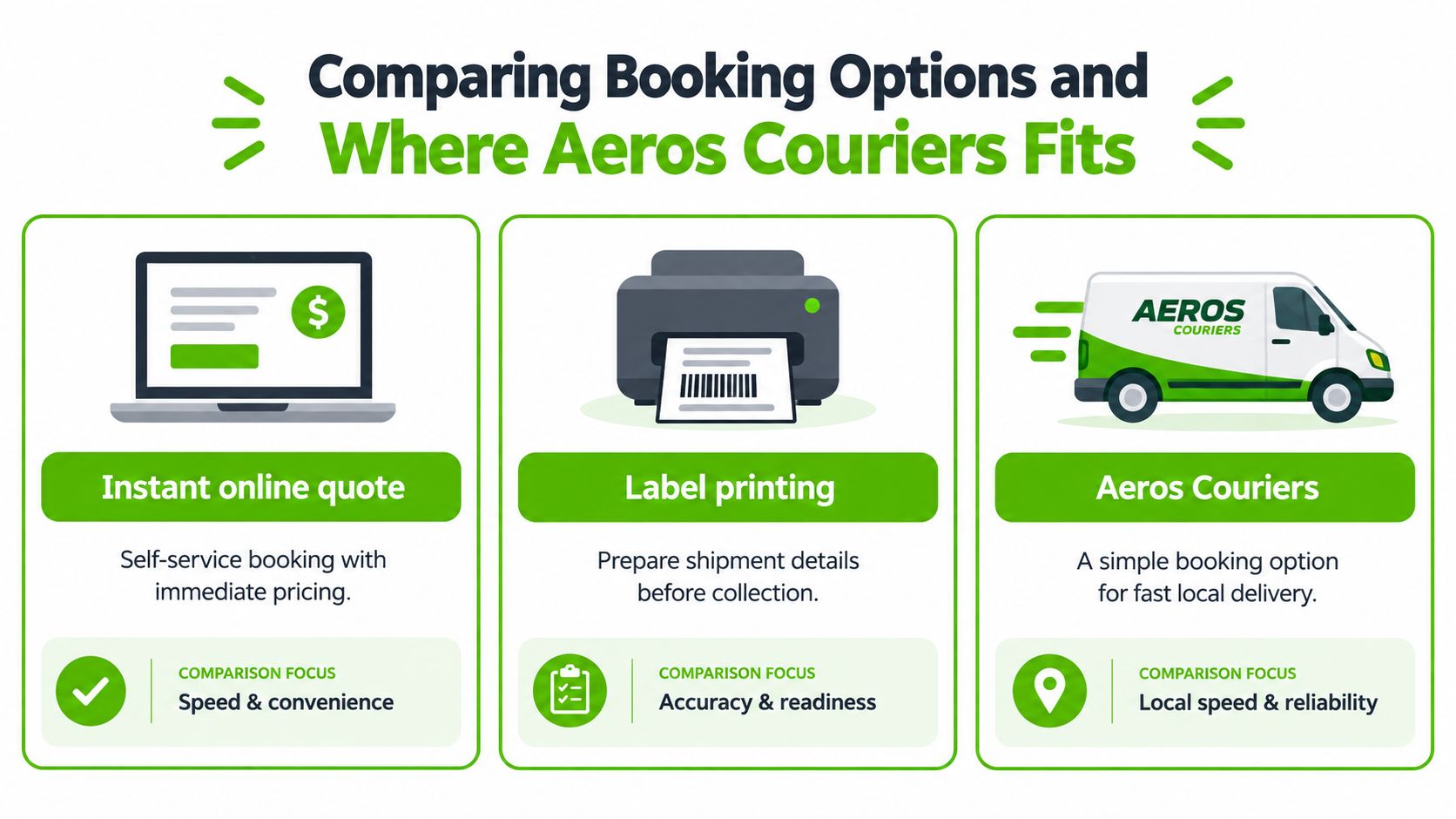
Self-service booking suits a straightforward parcel when you know its measurements and delivery requirements. A support conversation is more useful when the shape, access arrangements or service conditions leave you uncertain.
Label printing is part of preparing a booking, not a separate transport service. Whichever booking method you use, check that the label matches the parcel and address.
| Comparison point | Online self-service | Support-assisted booking |
|---|---|---|
| Price transparency | Review the total and selected extras before paying | Ask for clarification of charges |
| Insurance | Read the displayed cover and conditions | Discuss whether the item is eligible |
| Tracking | Check how shipment updates are accessed | Ask how to follow the delivery |
| Delivery flexibility | Review available checkout options | Clarify unusual handover needs |
| Preparation | Enter details and print labels yourself | Resolve uncertainties before finalising |
Where the platform fits
Aeros Couriers is one option for this workflow. Its courier comparison and booking platform provides instant quotes, booking in minutes, label printing and job tracking through a simple dashboard.
Freight insurance is included, with optional signature on delivery. Read the insurance conditions rather than treating included cover as protection against every possible event.
The platform shows metro estimates and regional considerations at checkout, awards reward points on orders, and provides local support through a 1300 number. For this parcel-focused comparison, assess the available carton and satchel services against your shipment.
Use the online process when the details are clear. If you're unsure whether an unusual box or difficult collection address is suitable, contact support before booking. Don't guess just to get through checkout.
Real Booking Scenarios for Cheap Parcel Delivery
These are illustrative situations, not measured customer results. Each shows how a different sender could apply the same decision method without assuming there's a universal cheapest service.
A home seller sending a satchel interstate
A seller has a compact, securely packed item and no urgent deadline. Their sensible starting point is an eligible fixed-price satchel, compared with a live parcel quote for the same destination.
The economical choice is the suitable service with the lower complete price. There's no reason to buy express merely because the parcel is travelling interstate.
An online retailer dispatching cartons
A small retailer sends orders from one location to metro and regional customers. They should quote each destination using its own carton details, rather than treating every order as an average shipment.
Self-service booking can suit these repeatable dispatches. The retailer can select standard or express against each customer's delivery promise, then keep the labels and tracking references matched to the correct orders.
A household sending to a remote postcode
A household has a box ready for a recipient outside a major centre. The most useful first step is confirming the available delivery arrangement, not choosing the lowest initial result.
If the checkout information leaves that arrangement unclear, support-assisted clarification is the sensible booking choice.
A slightly less convenient booking process can be worthwhile when it prevents an unsuitable service selection.
The household can then agree on a workable timeframe with the recipient before paying. That's a more useful saving than securing a low price for a service that doesn't fit.
Booking Your Cheapest Reliable Courier Today
You've done the important work when you can explain why a quote suits your parcel. You don't need to find the lowest advertised price anywhere in Australia. You need the lowest suitable total for this shipment.
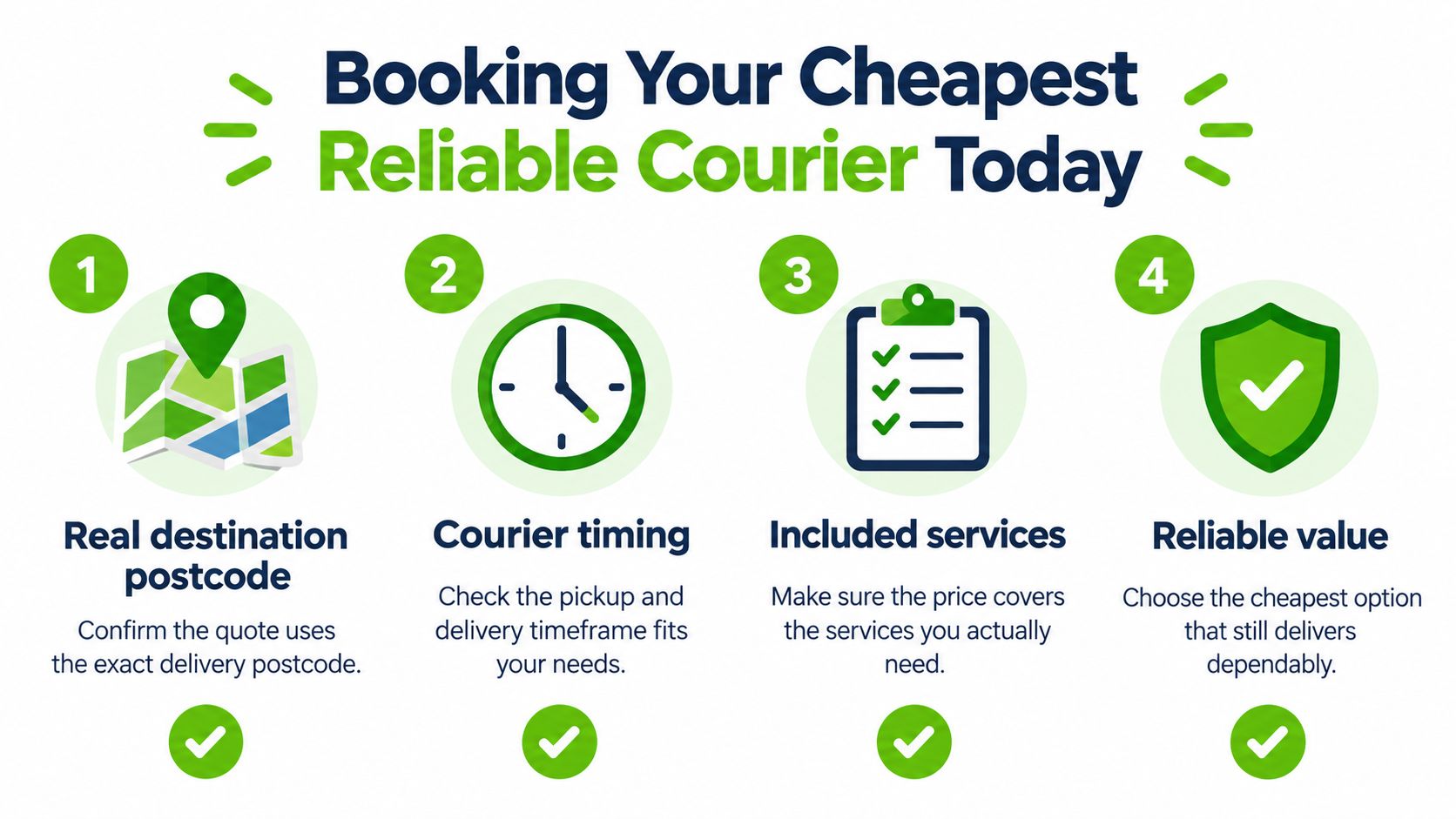
Before paying, apply a final decision test.
- Real destination postcode: Confirm the quote uses the recipient's exact postcode and address type, not a nearby metro location.
- Correct weight and dimensions: Check that the entered details describe the sealed parcel you'll hand over.
- Suitable timing: Make sure collection and estimated delivery align with what you've promised the recipient.
- Included protection and visibility: Confirm insurance and tracking are included, and understand their conditions.
Make the booking with confidence
If a detail doesn't pass the test, pause and clarify it. Keep a copy of the booking confirmation, attach the correct label securely and have the parcel ready for the agreed handover.
An instant quote gives you a concrete option to assess. For straightforward parcels, you can proceed online and book in minutes; for unresolved questions, use the 1300 support number shown on the provider's website.
You're not trying to outsmart the delivery network. You're giving the provider accurate information and choosing a service that matches the job. That's a practical, repeatable way to keep parcel delivery affordable.
Get instant quotes, print labels and track your local or Australia-wide parcel delivery through Aeros Couriers, with freight insurance included. Enter your packed box or satchel details to compare suitable options, or use the website's 1300 number for local support before booking.
Courier quotes, tracking and support
Ready to send a parcel? Compare the available services for your postcodes, parcel dimensions and weight. For an existing delivery, use your consignment number to check tracking or ask our team for help.