
Insuring a parcel in Australia usually costs a small fraction of the goods’ value. Expect a few dollars for an everyday parcel and roughly 0.3% to 1% of declared value for larger freight. The exact figure depends on how much you declare, what you send, and whether the cover comes from the carrier, a booking platform or a separate insurer. This guide shows how each option is priced, where the gaps are, and how to decide what your shipment needs.
TL;DR
- Carrier cover for parcels is normally priced per $100 of declared value, so a $300 item costs far less to protect than to replace.
- Standalone freight and goods in transit policies are generally priced as a percentage of shipment value, typically in the 0.3% to 1% range for freight.
- Basic carrier liability is limited. Check the terms before assuming a lost or smashed parcel will be refunded in full.
- Your Australian Consumer Law rights as a buyer sit alongside any shipping insurance, so a seller cannot simply point to the courier.
- With Aeros Couriers you compare rates and book online, with transparent pricing and no fuel surcharge or handling fees. Check the cover shown on your quote before you pay.
Table of Contents
- What “courier insurance” actually means
- What courier insurance costs in Australia
- Do you need extra cover at all?
- Where small businesses get caught out
- How to compare options without being fooled by the headline price
- Our perspective: price the risk, not the fear
- Booking a parcel with cover through Aeros Couriers
- Making a claim: a short checklist
- Frequently asked questions
- Sources
What “courier insurance” actually means
The phrase covers three quite different products, and mixing them up is the main reason people overpay or end up uncovered.
1. Carrier liability. Most carriers include a limited amount of compensation in the price. It is a goodwill or contractual limit, not an insurance policy tailored to your goods. It often has conditions around packaging, item type and how you lodge a claim.
2. Optional transit cover (the add-on at checkout). This is the “insure my shipment” tick box. You declare a value and pay a small charge to raise the amount you can claim if the parcel is lost or damaged.
3. Goods in transit or freight insurance. A separate policy, often arranged through a broker or insurer, covering your stock or freight whichever carrier moves it. Business.gov.au lists goods in transit among the types of business insurance and recommends talking to a licensed broker, insurer or adviser.
There is a fourth product that shows up in search results for this phrase: insurance for courier drivers, such as commercial motor, public liability and income protection. That is cover for people who deliver, not for the parcel you send. If you are a sender, you can ignore it.
What courier insurance costs in Australia
Prices vary by product, but they follow two patterns.
Per-$100 pricing on parcels
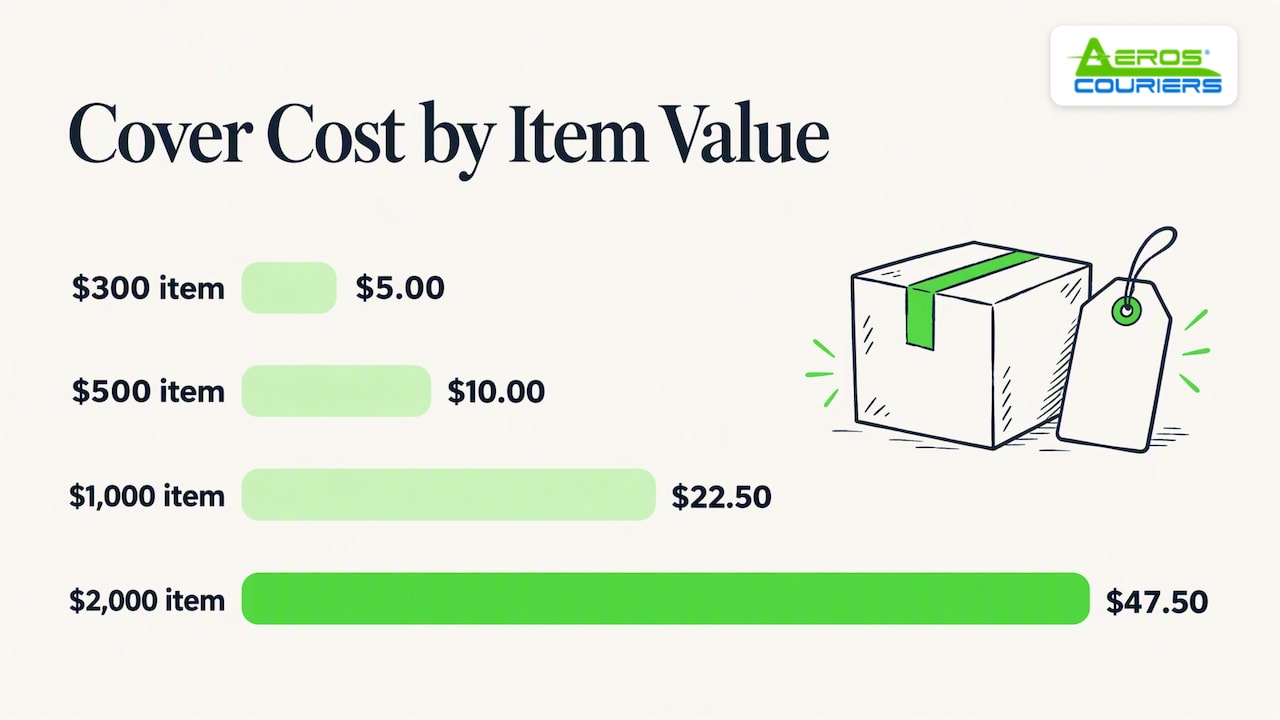
For everyday parcels, optional cover is usually a flat amount per block of declared value. Some carriers include the first $100 of cover at no charge and then add a couple of dollars for each further $100, up to a cap in the low thousands. At that kind of rate, a $300 item costs about $5 to protect and a $1,000 item around $22.50. The exact rate, the cap and the exclusions differ by carrier and product, so read the terms at the point of booking.
The maths is simple enough to do on the back of an envelope:
| Declared value | Illustrative cost at $2.50 per extra $100 (first $100 free) |
|---|---|
| $100 | $0 |
| $300 | $5.00 |
| $500 | $10.00 |
| $1,000 | $22.50 |
| $2,000 | $47.50 |
Those figures are an example of the per-block method, not a quote from any provider, and not Aeros pricing.
Percentage pricing on freight
For pallets, crates and high-value consignments, cover is normally a percentage of the value. One Australian freight guide puts typical freight insurance at 0.3% to 1% of shipment value, which would mean $60 to $200 on a $20,000 pallet of electronics. Treat that as a ballpark rather than a quote. Insurers set the rate from the risk, and a minimum premium may apply to small consignments.
What pushes the price up or down
- Declared value. The biggest driver. Declare the replacement cost of the goods, and consider whether you include freight charges in that figure.
- Type of goods. Electronics, jewellery, alcohol and fragile items such as glass or ceramics attract higher rates or exclusions. Used goods, perishables and cash are often excluded entirely.
- Route and mode. Interstate road freight, remote deliveries and air freight carry different risks. Inefficiencies in the supply chain such as extra handovers and delays also raise the odds of damage or loss, and the cost of freight forwarding inefficiencies tends to show up eventually in what you pay.
- Packaging. Many policies reject claims where packaging was clearly inadequate, so poor packing can cost you more than the premium saves.
- Volume and claims history. Businesses shipping regularly can sometimes negotiate a better rate through an annual goods in transit policy than by buying cover parcel by parcel.
Do you need extra cover at all?
Not every parcel does. Business.gov.au’s shipping guidance explains that shipping or delivery insurance covers you if a package is lost or damaged in delivery, and advises reading your delivery company’s terms and conditions before buying extra cover. That is the right order of operations: find out what you already have, then pay only for the gap.
A practical rule of thumb:
- Replacement cost is less than what the included cover pays. Skip extra cover. A $40 phone case does not need it.
- Replacement cost is above the included limit but modest. Buy the add-on. The few dollars are cheaper than the dispute.
- You ship valuable or fragile stock regularly. Price a goods in transit policy and compare it with the per-parcel total over a year.
- The goods are irreplaceable, such as artwork, prototypes or one-off items. Talk to a broker about specified item cover, and photograph everything before sealing the box.
What you can and cannot lean on from consumer law
If you sell online, insurance is not your only protection and not your only obligation. Under Australian Consumer Law, a buyer’s right to a remedy for faulty goods cannot be removed by your terms and conditions. The ACCC took action against a retailer for misleading statements about consumer guarantee rights, including telling customers their rights were limited to 72 hours. The practical lesson for sellers: do not tell a customer to chase the courier when their order arrives broken. You may need to put it right first and then claim against the carrier or your insurer. That is a good reason to make sure the claim route is easy and the cover is enough.
Where small businesses get caught out
Three patterns come up again and again.
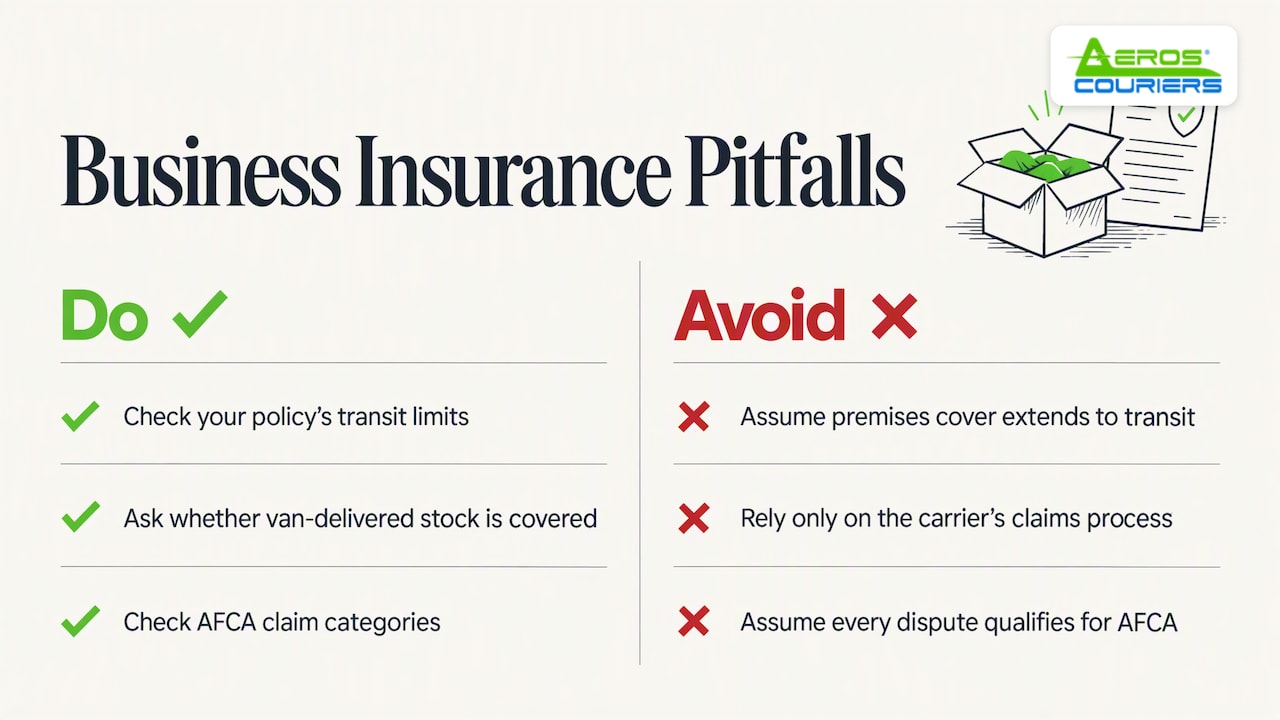
Assuming the general policy covers transit. ASIC has warned that small businesses can be underinsured because they assume their existing policy covers more than it does, and it urges owners to check the limits of their cover. A standard business pack policy may cover stock on your premises but not in a courier’s van. Ask your broker in plain words: “Is stock covered while it is being delivered to my customers, and up to what value per parcel?”
Relying on the carrier’s claims process alone. Carrier compensation depends on the carrier’s own rules and timelines. A separate goods in transit policy works differently, because you claim against your insurer and not through the courier’s process.
Not knowing where to complain. If an insurer rejects a claim, small businesses can take some insurance disputes to the Australian Financial Complaints Authority. AFCA’s small business page lists the kinds of insurance claims it can consider, such as accidental damage and theft, and also notes categories it cannot. Know which side of that line your policy sits on before you need it.
How to compare options without being fooled by the headline price
When you line up two quotes, look beyond the dollar figure.
| Check | Why it matters |
|---|---|
| Maximum cover per parcel | A cheap add-on capped at a low figure does not protect a high-value item |
| What counts as the claimable value | Replacement cost, invoice price, or cost price can differ by a lot |
| Exclusions | Used goods, fragile items, electronics, perishables and inadequate packaging are common |
| Claim deadline | Some providers give only a short window after delivery or the expected delivery date |
| Evidence required | Photos, invoices, packaging and tracking history are routinely requested |
| Excess | Some policies take a fixed amount off every payout |
| Who pays and how fast | Refund to you, credit, or payment to the receiver |
Also be wary of a low base shipping rate that gains fees at checkout. Fuel surcharges, handling fees and remote-area charges can change the real price of a booking more than the insurance line does. Our guides to Australian courier prices and courier costs for your business break down what to watch for.
Our perspective: price the risk, not the fear
We see two mistakes with shipping insurance, and they pull in opposite directions. Some senders insure everything at the maximum, so that a $15 add-on rides on a $30 item. Others insure nothing, then discover that a $1,200 order has a $100 compensation ceiling.
The fix is a habit rather than a product. Before you book, ask three questions: what would it cost me to replace this, what does the included cover pay, and how long would a claim take me to chase? If the answers show a gap, close it with the smallest, clearest option that covers the real value.
We built Aeros Couriers around transparent pricing for the same reason. You should know the full cost of a shipment, cover included, before you pay, with no fuel surcharges or handling fees added on later. For small and medium businesses shipping every day, those unglamorous extras are what decide whether a parcel is profitable. Insurance should be a line you understand, not a surprise.
— Aeros
Booking a parcel with cover through Aeros Couriers
Aeros Couriers is an online platform for sending parcels up to 25kg anywhere in Australia. You compare rates from major carriers instantly, book door-to-door pickup, print your own label and track the shipment. Express and same-day options are available, and there are no ongoing subscription fees, since you pay per shipment.
Insurance is part of the service. Our insurance for courier guide explains how cover works on a booking, and the quote screen shows what applies to your parcel before you pay. If you want to see the numbers first, start with a shipment rate or book a parcel delivery. Heavier or palletised loads can be compared and booked under freight. Our rewards program can also take dollars off future bookings, and our Australian support team is available if something goes wrong.

Making a claim: a short checklist
Whichever cover you use, the steps that protect a claim are the same.
- Before sending: photograph the item, the packaging and the sealed box. Keep the invoice or proof of value.
- At booking: declare the true value and keep the confirmation showing the cover amount.
- On delivery: have the receiver note visible damage straight away and photograph it, including the outer carton.
- Within the claim window: lodge the claim with the tracking number, photos and invoice. Do not throw away the packaging until the claim is settled.
- If the claim is rejected: ask for the reasons in writing. For an insurer’s decision on a policy, small businesses and individuals can consider a complaint to AFCA, subject to its rules.
Frequently asked questions
How much does it cost to insure a parcel in Australia?
For everyday parcels, optional cover is commonly priced per $100 of declared value, often only a few dollars for items worth a few hundred. For freight, a typical range is 0.3% to 1% of the shipment’s value. Check the exact rate and cap on your quote.
Is parcel insurance worth it?
It is worth it when the cost of replacing the goods is above the compensation already included with the service. If the item is cheap or the included cover already matches its value, you can usually skip it. For regular high-value shipping, compare a goods in transit policy with per-parcel cover.
Can I add insurance after I have booked?
That depends on the provider, and many only offer cover at the time of booking. Decide on cover before you pay, and keep the confirmation that shows the declared value.
Does my business insurance already cover goods in the courier’s van?
Not necessarily. Many general business policies cover stock at your premises but need a goods in transit extension for items being delivered. Ask your broker or insurer, and get the answer in writing.
Who pays if a parcel I sold arrives damaged?
As the seller, you are responsible to your customer under Australian Consumer Law, and your terms cannot remove those rights. You can then claim against the carrier’s cover or your own insurance, which is why the cover amount matters.
Sources
- Types of business insurance, business.gov.au
- Shipping, business.gov.au
- Koala Living pays penalties for false or misleading statements about consumer guarantee rights, ACCC
- Is your small business insured for storms, floods, bushfires and other natural disasters?, ASIC
- How AFCA can help small businesses and sole traders, AFCA
- Freight forwarding inefficiencies, FreightSuite
Recommended
- Courier Prices: Compare Total Cost, Not Headline Rates in Australia
- Courier Companies in Australia: A 2026 Shipping Guide
- Australia’s Courier Prices Explained A Practical Guide
- Compare Courier Prices in Australia to Find the Cheapest Rates
Courier quotes, tracking and support
Ready to send a parcel? Compare the available services for your postcodes, parcel dimensions and weight. For an existing delivery, use your consignment number to check tracking or ask our team for help.