


Figuring out Australian courier prices can seem like a bit of a maze, but it really just comes down to a few core things. The final price tag for sending a parcel within Australia is almost always a mix of its size and weight, how far it has to go, and how quickly you need it there. Getting a handle on these key pieces is the first step to making smarter shipping choices that don't break the bank.
How Australian Courier Prices Are Actually Calculated
Ever looked at a shipping quote and wondered where that number came from? It's not just pulled out of thin air. The price is a carefully calculated figure that reflects the resources—fuel, time, and vehicle space—needed to get your item from A to B safely and on schedule.
Think of it like booking a taxi. The cost depends on how much luggage you’re taking (your parcel's size), how far you're travelling (the distance), and whether you want a standard trip or a priority ride (the delivery speed).
This guide will pull back the curtain on what really goes into your final shipping quote. By understanding the mechanics, you'll have a clear framework for seeing where your money is going, whether you’re a business shipping daily or just sending a one-off gift.
The Key Factors That Determine Your Courier Quote
At its heart, every courier quote is a blend of several moving parts. Knowing what they are is essential before you can even begin to estimate your costs. The table below breaks down the main components that every carrier, from the big names to local operators, uses to price a job.
| Pricing Factor | How It Works | Impact on Your Final Cost |
|---|---|---|
| Parcel Size & Weight | Carriers look at both the dead weight (what it weighs on a scale) and the cubic weight (the space it takes up). They charge based on whichever is greater. | Large but light items can cost more than small, heavy ones because they take up more room in the van. |
| Travel Distance | This is the journey from the collection postcode to the delivery postcode. The further it travels, the more it costs in fuel and driver time. | A delivery across town will always be cheaper than sending the same item interstate. |
| Delivery Speed | You're paying for priority. Express, same-day, or overnight services jump the queue and require more dedicated resources. | A standard road service might take 3-5 days and is the budget-friendly option, while an overnight air service will carry a significant premium. |
This is the fundamental pricing model used right across the country. It has to be, given how much the Australian courier market has boomed alongside e-commerce. In fact, the number of courier businesses shot up by nearly 89% between 2016 and 2022 alone. That's a lot of parcels moving around!
Once you see how these elements—size, distance, and speed—work together, the costs on your shipping invoice start to make a lot more sense. This clarity is your best tool for finding ways to save money and ship more efficiently.
Want to see it in action? The best way to get a feel for it is to plug in your own details. Head over to our tool and you can calculate your potential shipping charges right now. You’ll quickly see how a small tweak to your packaging or a more flexible delivery timeline can make a real difference to the price.
The Secret Language of Shipping: Cubic vs. Actual Weight
When it comes to courier prices in Australia, there’s one concept that trips up more people than any other: the difference between actual weight and cubic weight. Honestly, getting your head around this is the single most important step to avoiding nasty surprises on your invoice and accurately estimating shipping costs. It's the secret language of the entire logistics industry.
Imagine you need to send two different items, and both weigh exactly five kilograms on the scales. One is a compact box of steel bolts, and the other is a massive box filled with lightweight foam. On paper, they’re identical. But in the back of a delivery van, they couldn't be more different.
The small box of bolts takes up barely any room, leaving space for hundreds of other parcels. That large box of foam, however, eats up a huge amount of valuable cargo space. Because a courier's real limitation is the size of their vehicle, they have to charge for the space an item occupies, not just how heavy it is.
Understanding the Cubic Weight Calculation
This is where cubic weight (also called volumetric weight) comes into play. It’s a clever calculation that converts a parcel's dimensions—its length, width, and height—into an equivalent weight. Carriers will figure out both the actual weight (what the scales say) and the cubic weight, and here’s the key: their final price will be based on whichever number is higher.
This is why a parcel’s physical size, along with travel distance and delivery speed, forms the core of any courier quote.
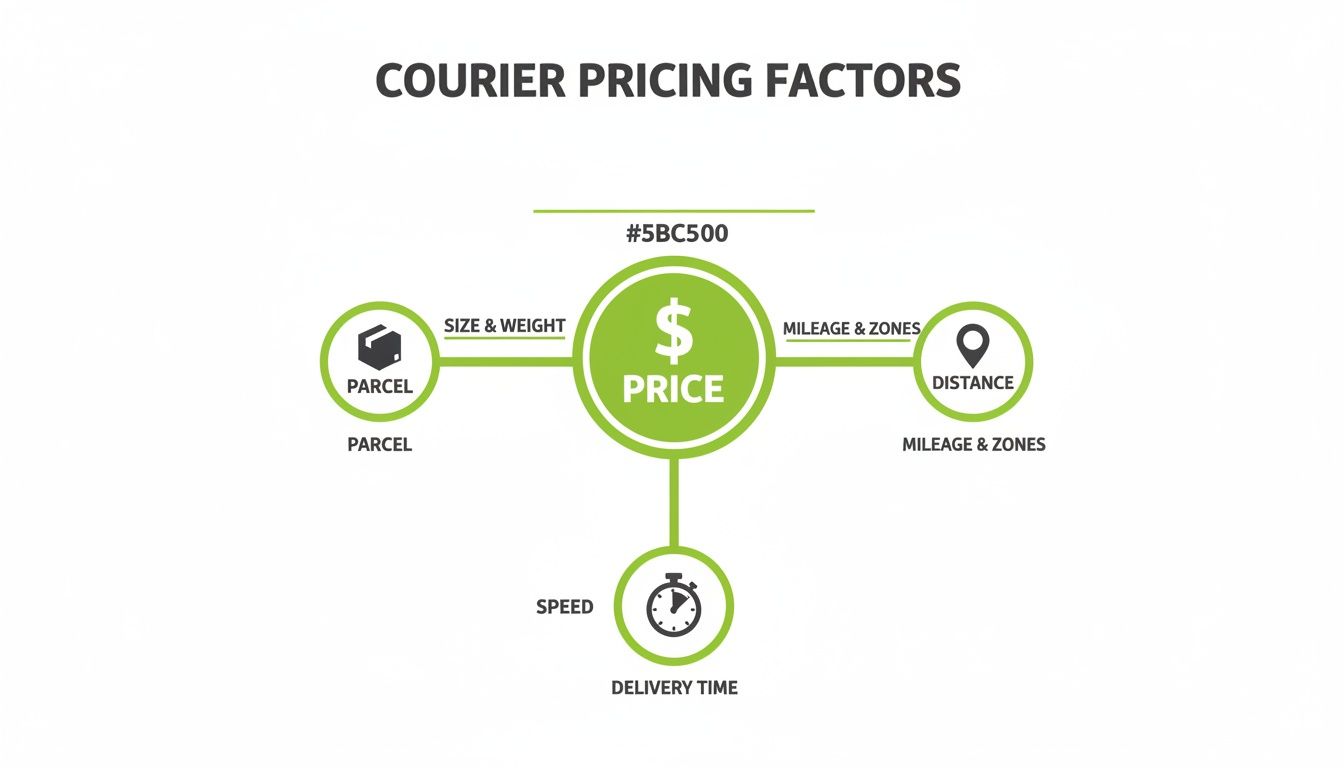
The big takeaway here is that a parcel's physical attributes are a primary cost driver, often mattering just as much as how far it's travelling.
The rule of thumb is simple: The bigger the box, the higher its cubic weight. A large, light item will almost always be charged based on its dimensions, not its actual weight.
This explains why sending something bulky but light, like a decorative lamp or a set of pillows, can sometimes cost more than a small, heavy box of books. You aren't just paying for the effort to lift the item; you're paying for the real estate it occupies on its journey across town or interstate.
How to Calculate and Manage Cubic Weight
Calculating cubic weight is actually pretty straightforward once you know the formula. While different couriers might use slightly different conversion factors, the standard industry method in Australia is consistent.
To find the cubic weight of your parcel in kilograms, you just use this formula:
(Length in metres) x (Width in metres) x (Height in metres) x 250 = Cubic Weight (kg)
Let’s run through a quick, practical example:
- Parcel Details: You have a box that is 40cm long, 30cm wide, and 30cm high.
- Actual Weight: It weighs 5 kg on your scales.
- Convert to Metres: First, convert those dimensions: 0.4m x 0.3m x 0.3m.
- Calculate Cubic Volume: 0.4 x 0.3 x 0.3 = 0.036 cubic metres.
- Calculate Cubic Weight: 0.036 x 250 = 9 kg.
In this case, the courier is going to charge you for a 9 kg parcel, not the 5 kg actual weight, because the cubic weight is greater.
Understanding this simple calculation is crucial for anyone who ships regularly. For a more detailed walkthrough and to try our handy tool, check out our guide on how to calculate cubic weight for your shipments. Mastering this one concept lets you choose the right-sized packaging and helps you stop overpaying on every single consignment you send.
Real-World Examples of Australian Courier Prices
Talking about things like cubic weight and distance is one thing, but nothing hits home like seeing the numbers on the screen. Let's ground these concepts in reality and look at what you might actually pay to send common items around Australia.
These are, of course, ballpark figures. The final price tag will always move around depending on the carrier you choose, the fuel levy at the time, and how fast you need it there. Still, these examples give you a solid, practical idea of how size, weight, distance, and speed all mix together to produce your final quote.
Sample Courier Price Estimates for Local Australian Shipping
To give you a clearer picture, here’s a table with some typical price ranges for sending satchels, cartons, and pallets between different Australian locations. It’s a great way to get a quick feel for what to budget for different types of shipments.
| Shipment Type | Route Example | Estimated Standard Price Range | Estimated Express Price Range |
|---|---|---|---|
| Small Satchel (3kg) | Sydney CBD to Melbourne CBD | $10 – $18 | $25 – $45 |
| Medium Carton (10kg) | Brisbane, QLD to Toowoomba, QLD | $15 – $25 | $30 – $55 |
| Heavy Pallet (250kg) | Perth, WA to Adelaide, SA | $350 – $550 | $700 – $1,000+ |
As you can see, the jump from a standard road service to an express option is significant, especially for heavier freight. Let's break down each of these scenarios.
Satchel Delivery Between Major Cities
A small satchel is the bread and butter of e-commerce shipping, perfect for things like documents, clothing, or books. Let's take the busiest shipping lane in the country: Sydney to Melbourne.
- Shipment: A 3kg satchel.
- Route: Sydney CBD to Melbourne CBD (around 878 km).
- Standard Road Service (2-4 days): You’re looking at a cost somewhere between $10 and $18 for a standard, reliable road service.
- Express Overnight Service (1-2 days): Need it there tomorrow? The price jumps to between $25 and $45.
Right away, you can see the premium you pay for speed. If the delivery isn't urgent, sticking with a standard service can easily save you over 50%.
Carton Delivery to a Regional Area
Shipping outside the big metro hubs changes the game. Sending a medium-sized box from a capital city to a regional town is a daily task for many businesses, so let's see how that looks.
- Shipment: A 10kg medium carton (think electronics or parts).
- Route: Brisbane, QLD to Toowoomba, QLD (a much shorter 125 km).
- Standard Road Service (1-2 days): This shorter trip will often cost between $15 and $25.
- Express/Priority Service (Next day): To get it there faster, expect to pay $30 to $55.
It's interesting, isn't it? Even though the distance is way shorter than Sydney to Melbourne, the cost to a regional centre can be quite similar. That's the "last mile" complexity at play—it simply costs more to service areas outside the main transport arteries.
A good rule of thumb: the further a destination is from a major airport or depot, the more a regional surcharge will influence the final price. This effect is even more pronounced for remote locations.
Pallet Delivery Across the Country
When you're moving bulk stock, heavy items, or machinery, you're in the world of pallet freight. This is where the costs really scale up, and the difference between standard and express becomes massive.
- Shipment: A 250kg standard pallet (1.2m x 1.2m x 1.0m).
- Route: Perth, WA to Adelaide, SA (a huge 2,700 km trek).
- Standard Road Service (5-8 days): Getting a heavy pallet across the Nullarbor is a serious logistical job. You should budget for somewhere in the $350 to $550 range.
- Express/Priority Service (3-5 days): Need to speed that journey up? It's a premium service, and the cost will likely climb to $700 to $1,000+.
Hopefully, these examples give you a much more practical feel for Australian courier prices. Of course, the best way to know for sure is to get a live quote. You can use a dedicated tool to estimate your shipping costs and instantly compare all the service options for your specific parcel. It’s the quickest path to finding the right balance between cost and speed.
Uncovering the Hidden Costs in Your Shipping Bill
The price you see on an initial courier quote often isn't the final number you'll pay. While the core cost is straightforward—based on weight, distance, and speed—a whole host of surcharges can sneak onto your invoice, turning a great deal into a budget blowout. Getting a handle on these potential "hidden costs" is the key to managing your shipping spend effectively.
Think of these charges like the extra line items on a utility bill. They aren't there to be deceptive; they're simply the carrier passing on direct costs for events or market shifts that fall outside a standard, problem-free delivery. The secret is knowing what they are so you can take steps to sidestep them.

The Ever-Present Fuel Surcharge
The most common addition you’ll see on any shipping bill is the fuel surcharge. This isn't a fixed fee. It's a variable percentage added to your base rate that moves up and down, often monthly, to mirror the fluctuating price of diesel and petrol at the bowser. When it costs the courier company more to run their vans and trucks, this surcharge goes up to cover that extra expense.
This surcharge is a standard, unavoidable part of logistics in Australia. Rising operational costs have directly shaped courier pricing, with fuel being a huge factor. The industry, which swelled to an estimated AUD 13.7 billion in 2025, has widely adopted fuel surcharges based on terminal gate prices to manage this volatility. For a deeper dive into these trends, check out the comprehensive research on Australian Courier Pick-up and Delivery Services.
So, while you can't eliminate the fuel surcharge, just knowing it exists helps you get a much clearer picture of your total shipping cost.
Other Common Surcharges to Watch Out For
Beyond fuel, several other fees can inflate your final bill. The thing is, these are almost always triggered by specific, preventable issues that pop up during the pickup or delivery process.
Here are the usual suspects you’ll come across:
- Futile Pickup Fee: This one stings. It’s charged when the courier shows up to collect your parcel, but it isn’t ready or can't be found. The fee covers the driver's wasted time and fuel.
- Redelivery Fee: If the driver tries to deliver a package but no one's there to sign for it (and there’s no authority to leave it), they have to come back. That second attempt costs money, and it’s passed on to you.
- Manual Handling Fee: Couriers rely on high-speed, automated conveyor belts to sort parcels. If your item is an awkward shape (like a tube or a ball), poorly packed, or too fragile for the machinery, it has to be sorted by hand. That extra labour comes with a fee, typically around $10-$15.
- Incorrect Declaration Fee: This happens if you under-declare your parcel's weight or dimensions. When the depot's automated scanners flag a difference, you'll be charged an adjustment fee plus the extra cost for the true size and weight.
The good news is that unlike the fuel surcharge, most of these additional costs are entirely within your control. With a bit of careful planning and accurate information, you can avoid them completely.
How to Avoid Unnecessary Fees
Keeping your shipping costs predictable is all about preparation. Being proactive lets you sidestep the common traps that lead to those nasty surprise charges on your invoice.
First, double-check that your parcel is ready to go before you even think about booking the pickup. Make sure it’s properly packaged, labelled, and sitting in a clear, accessible spot for the driver.
Second, think about the delivery address. If you're not 100% sure someone will be home, tick the "Authority to Leave" option when booking. This gives the driver the green light to leave the parcel in a safe spot, completely wiping out the risk of a redelivery fee. You can learn more about how this works by reading our insights on achieving no courier redelivery fees.
Finally, accuracy is your best friend. Always use a standard, rectangular box whenever you can to avoid manual handling fees. Most importantly, carefully measure and weigh your packed parcel and declare those exact figures when you book. A small investment in a good set of scales can save you a fortune in adjustment fees down the track.
Actionable Strategies to Reduce Your Courier Costs
Knowing how courier prices are calculated is one thing, but actually putting that knowledge to work is where you’ll see the savings pile up. The truth is, there's no single magic trick to lowering your shipping spend. It's about making a series of smart, informed decisions that add up over time. From the platform you use to how you pack your goods, every small tweak can make a big difference to your bottom line.
This is where we move from theory to action. With a few practical strategies under your belt, you can take real control of your shipping budget, cut down on waste, and make sure you’re getting the best possible value every single time you send a parcel in Australia.
Access Wholesale Rates Without the Volume
For most small and medium-sized businesses, the biggest roadblock to cheaper shipping is volume. Major carriers keep their best rates for the big players—the ones shipping thousands of parcels a month. This often leaves smaller businesses paying standard retail prices. But you don't need a massive shipping account to get a better deal.
Platforms like Aeros Couriers work by buying shipping services in bulk, unlocking wholesale prices that are then passed directly on to you. That means you can get a much lower price than going directly to a carrier's website, even if you only ship a handful of items a week.
Using a comparison and booking platform gives you immediate access to discounted rates from multiple carriers. This one change alone can lead to instant savings of 20-40% compared to booking direct, without locking you into any contracts or minimum volume commitments.
Master Your Packaging to Beat Cubic Weight
As we’ve already seen, cubic weight is often the real driver of your final courier price. The best way to fight back is to get smart with your packaging. A smaller box isn't just a smaller box; it's a direct cut to your chargeable weight and, ultimately, your cost.
Here’s how to nail it:
- Use the Smallest Box Possible: Always pick a box that fits your item snugly, with just enough room for padding. Don't use a huge box for a small item—you’re literally paying to ship air.
- Cut Boxes Down to Size: If you can’t find the perfect fit, don't be afraid to modify a larger box. Trimming it down shrinks its dimensions and, with it, its cubic weight.
- Use Satchels for Soft Goods: For anything non-fragile like clothing or documents, courier satchels are your best friend. They come with a fixed price based on size and are completely immune to cubic weight calculations.
These simple moves directly tackle the biggest variable in your shipping quote. To see how this plays out in the real world, you can easily compare courier rates in Australia and see the savings for yourself.
Consolidate and Schedule for Efficiency
Another powerful way to save is to think about how and when you ship. Drip-feeding multiple small parcels to the same destination on different days is a fast way to burn through your budget. Instead, get into the habit of consolidating your shipments.
If you’ve got several orders heading to the same address, packing them into one larger carton can be dramatically cheaper than sending them as separate items. This strategy cuts down on the total number of consignments, saving you on base charges and fuel surcharges for each parcel.
At the same time, plan your pickups. Booking them sporadically is costly and messy. Try to batch your orders and schedule a single pickup for all your outgoing parcels for the day or every couple of days. This not only streamlines your own workflow but also avoids the dreaded futile pickup fee if a parcel isn't quite ready.
Protect Your Bottom Line with Smart Features
Finally, look beyond the base shipping cost and think about the add-ons that protect you from nasty surprises. Two of the most important are freight insurance and loyalty rewards.
- Included Freight Insurance: Never underestimate the cost of a lost or damaged parcel. It’s rare, but it happens. Many booking platforms like Aeros Couriers include freight insurance as a standard part of every booking. This built-in protection means you don't have to buy it separately and can ship with peace of mind, knowing your financial risk is covered.
- Loyalty and Reward Programs: If you're shipping regularly, that spend should be working for you. Aeros Couriers offers reward points on every single dollar you spend, which can be redeemed for over 10,000 branded merchandise items. This turns a necessary business cost into a tangible perk, letting you get marketing materials, staff uniforms, or office supplies that further offset your operational costs.
For a deeper dive, there are plenty of expert strategies to reduce shipping costs available that offer more in-depth solutions. By combining wholesale rates, smart packaging, efficient scheduling, and protective features, you can build a shipping strategy that’s not just cheaper, but also stronger and more resilient.
What's Next for Courier Prices in Australia
If there's one thing you can count on, it's that the cost of shipping in Australia isn't going to sit still. A few powerful forces are at play, meaning that courier prices will remain a dynamic and critical line item in any business budget. Getting a handle on these trends is the key to building a smart, long-term shipping strategy that won't catch you by surprise.
The biggest driver? E-commerce, without a doubt. As more of us click "add to cart," the sheer demand for parcel delivery services just keeps climbing, putting constant pressure on every courier network in the country. While more volume can create efficiencies, it also forces carriers to pour money back into their infrastructure, tech, and people—all costs that eventually filter down into the price of sending a parcel.
Key Trends Shaping Future Costs
On top of soaring demand, we're also dealing with stubborn operational costs. Things like unpredictable fuel prices, rising wages, and the simple expense of keeping a modern fleet of vehicles on the road directly affect what couriers need to charge to stay afloat. These aren't just temporary blips; they're the new economic reality, and they show up in both base shipping rates and those pesky surcharges.
Then there’s our growing impatience. The expectation for same-day or next-day delivery is completely reshaping the logistics game. This isn't just about drivers going a bit faster; it requires far more complex and expensive express networks to make it happen.
As we all get used to getting our stuff faster, the price gap between express and standard services will likely widen. You'll pay a clear premium for speed, while standard, more patient delivery options might become even more budget-friendly.
A Growing and Maturing Market
The Australian courier market is on a solid growth trajectory, forecast to expand from USD 12.33 billion in 2026 to a hefty USD 15.72 billion by 2031. This isn't just growth for growth's sake; it shows a maturing industry where pricing is a tug-of-war between fierce competition and the non-negotiable costs of providing a reliable service. Shipments within Australia will continue to make up the bulk of this, making savvy domestic pricing strategies more crucial than ever. For a deeper dive, check out this Australian CEP market analysis.
By keeping an eye on these key forces—the e-commerce boom, rising operational costs, and the ever-present need for speed—you can start to anticipate where courier prices are headed. This puts you in a much better position to adapt your shipping habits, stay efficient, and keep your budget under control.
Your Top Questions About Aussie Courier Costs, Answered
If you’ve ever stared at a shipping quote and scratched your head, you’re not alone. Getting to the bottom of how courier prices work can be tricky. Let's clear up some of the most common questions and give you the inside track on shipping smarter.
Why Is My Big, Light Box So Expensive to Ship?
This is a classic shipping puzzle, and the answer is almost always cubic weight (you might also hear it called volumetric weight). Couriers aren't just charging for how heavy your item is; they're charging for the space it takes up in their van or truck.
Think about it: a massive box of lightweight cushions takes up the same room as several smaller, heavier packages. That space is valuable real estate. Carriers will calculate both the actual dead weight and the cubic weight of your parcel and charge you based on whichever is higher. This is exactly why a big box of styrofoam can cost more to send than a small, dense box of machine parts.
A simple way to picture it is that you’re paying for the 'footprint' your item leaves on the truck, not just the effort it takes to lift it. The smaller you can make that footprint, the more you'll save.
How Do I Find the Absolute Cheapest Courier Price in Australia?
There's no single magic bullet for the cheapest price, but it's definitely achievable by combining a few smart strategies.
- Shop Around with Wholesale Rates: Don't just go direct to one carrier. Use a comparison platform that pulls in discounted, wholesale quotes from multiple couriers at once. It’s like having an industry insider do the bargain hunting for you.
- Pack Tighter: We've said it before, but it’s the golden rule. Get rid of empty space. Use the smallest box possible for your item to keep that cubic weight down.
- Be a Stickler for Details: Measure and weigh your packed item accurately. Guessing might seem faster, but it's a surefire way to get hit with surprise adjustment fees later on.
- Go Standard, Not Express: Unless your delivery is genuinely urgent, stick with a standard road service. It’s always going to be worlds cheaper than an overnight or express option.
What’s This Fuel Surcharge All About? Can I Get Out of It?
A fuel surcharge is a fee couriers add on to cover the ever-changing price of petrol. It’s typically a percentage of your base freight charge and gets adjusted (usually monthly) to keep up with what's happening at the pump.
Sadly, you can't avoid this one. It’s a standard, non-negotiable cost baked into the logistics industry here in Australia. It’s how carriers handle one of their biggest overheads. The good news? A transparent quoting tool will always show you an all-inclusive price, so that fuel levy is already built into the figure you see, with no nasty surprises.
Is It Always More Expensive to Send Parcels to Regional Areas?
Yep, pretty much. Sending a package to a regional or remote town will nearly always cost more than sending the same item between, say, Sydney and Melbourne.
The reason is simple logistics. Regional routes mean longer drives, less frequent delivery runs, and more ground to cover between drops. All of this adds to the courier's operational costs, and that gets passed on in the shipping price. A good quoting system automatically accounts for this, so the price you’re quoted for a regional delivery is the final price you'll pay.
Ready to stop guessing and start saving? With Aeros Couriers, you get instant access to wholesale rates from Australia's top carriers, all on one simple platform. Compare quotes, book your shipment in minutes, and see how much you can save on your next delivery. Get your free quote now!
