Real time parcel tracking shows you where a parcel was last scanned and what happens next. It is not a live dot moving along a road. Most Australian tracking is built on scans at pickup, depot, truck and doorstep, so it is only as current as the last scan. This guide explains what you can expect to see, how alerts work, how to avoid fake delivery texts, and what to do when tracking goes quiet.
TL;DR
- Most parcel tracking updates when a carrier scans the parcel, so “real time” really means “as of the last scan”.
- A new tracking number can take up to 24 hours to show anything. Wait a day before you worry.
- Genuine couriers will not demand urgent payment through a text link. Go to the official website or app directly instead.
- If a parcel is stuck or marked delivered but missing, contact the sender first. When the sender arranged the delivery, they are responsible for chasing the carrier.
- With Aeros Couriers you can track a booking from one page, whichever carrier handles the parcel.
Table of Contents
- What “real time” means for a parcel
- What you will see on a tracking page
- Where to find your tracking number
- Why tracking sometimes stalls or looks wrong
- SMS and email alerts: how to tell a real one from a scam
- Proactive alerts: what senders and recipients can expect
- What to do when a parcel will not show up
- Our perspective: tracking is only useful if someone acts on it
- Ship with tracking built in
- Tips for a smoother tracked delivery
- FAQ
- Sources
What “real time” means for a parcel
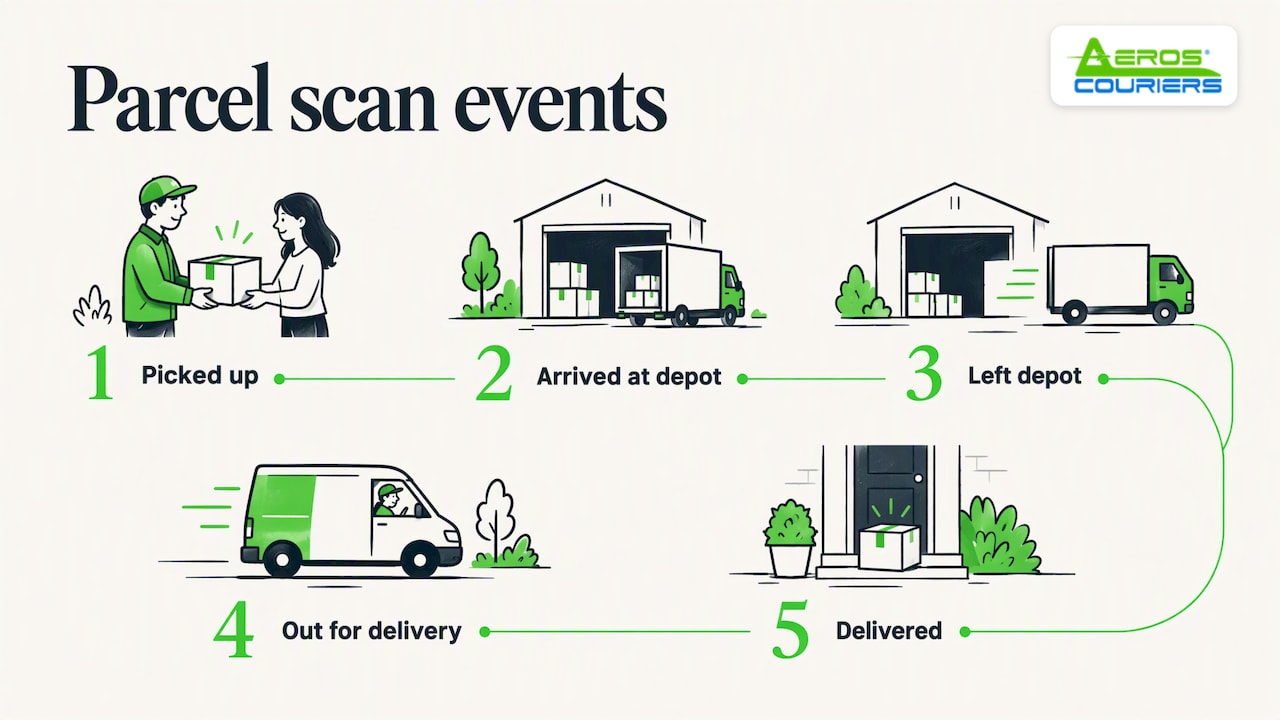
When people search for live tracking, they usually picture a delivery van on a map. That exists for some last-mile services, but for most parcels the picture is a trail of events: picked up, arrived at a depot, left the depot, out for delivery, delivered.
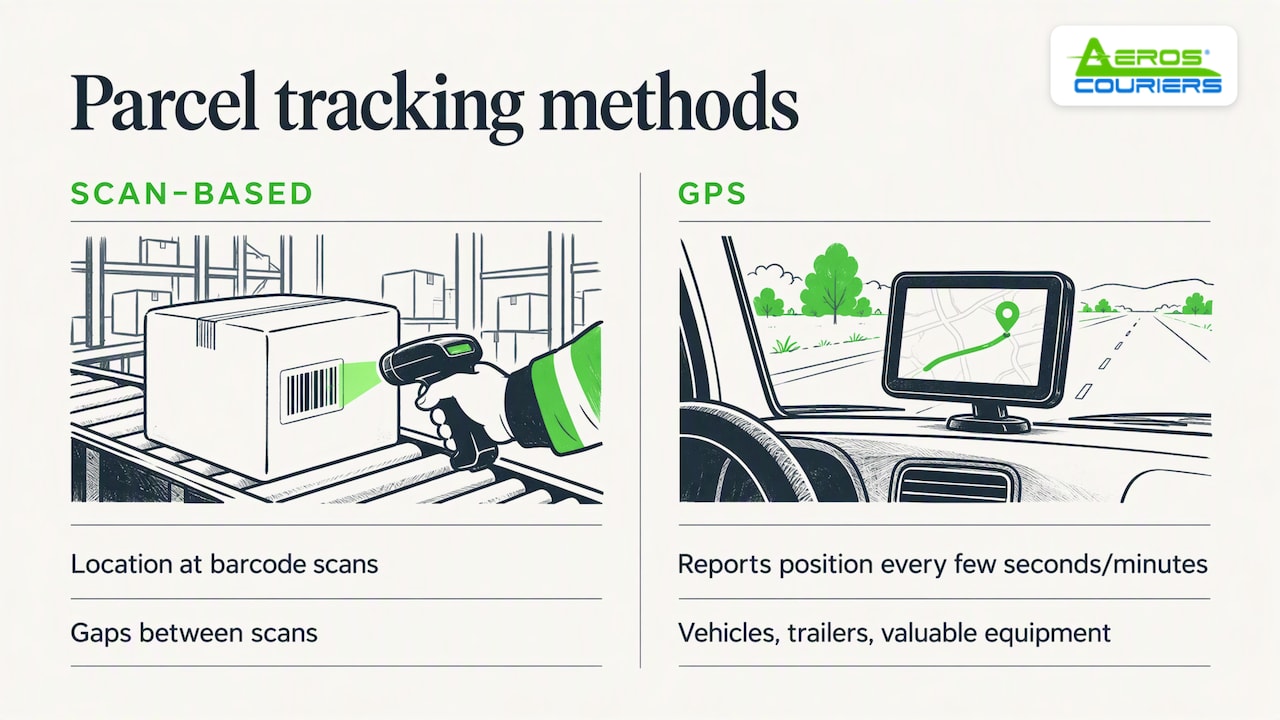
Each event is created when someone or something scans the parcel barcode. Between scans, nothing is reported. A parcel on a long-haul truck between Melbourne and Perth may show the same status for many hours, and that is normal.
Tracking tools that pull data from several carriers add another layer. Parcel’s own help page notes that real-time notification services often rely on direct carrier integration, and that updates can be limited by the carrier’s own processing speed. In plain terms, an app can only show you what the carrier has already recorded.
Scan-based tracking versus GPS tracking
GPS tracking is a different technology. A GPS unit reports its own position every few seconds or minutes, which suits vehicles, trailers and valuable equipment. If you want to understand how that kind of location data works, this small equipment GPS tracking guide is a good place to start.
Standard parcels do not carry a GPS unit. That is why the trail is made of scans rather than a continuous line, and why the quality of your tracking depends on how often the parcel is scanned along the way.
What you will see on a tracking page
The wording differs between carriers, but the stages are similar.
| Stage | What it usually means | What to do |
|---|---|---|
| Label created or pending | The sender has booked, but the carrier has not scanned the parcel yet | Wait. A first scan can take up to a day |
| Picked up or received | The parcel is with the carrier | Nothing, this is the first real scan |
| In transit | The parcel is moving between depots or cities | Be patient on long routes |
| Out for delivery | The parcel is on the vehicle for the final leg | Make sure someone can receive it |
| Delivered | The carrier recorded the drop-off | Check the porch, neighbours and parcel lockers |
| Delay or attempted delivery | Something stopped the delivery | Follow the instructions on the tracking page |
The exact status names belong to each carrier, so read the carrier’s own explanation if a label looks unfamiliar.
How often does it update?
There is no single refresh rate. Updates arrive when a scan happens or when a tracking tool next checks the carrier. The practical rule is that tracking tends to become more detailed near the end of the journey, as the parcel passes through fewer, shorter steps: arrival at the local depot, loading, and delivery.
Where to find your tracking number
A tracking number normally appears in one of three places:
- The confirmation or dispatch email from the seller or courier.
- The receipt or label if you sent the parcel yourself.
- Your account on the seller’s site or courier platform.
If you bought from an online shop and have no number, ask the seller. We cover that situation in what to do when you have no tracking number.
When you book through Aeros, the number is on your booking confirmation and on the printable label, and you can paste it into our tracking page.
Why tracking sometimes stalls or looks wrong
Most tracking problems are not lost parcels. They are gaps in information.
The number is new
A retailer’s support page explains that a recently issued shipping confirmation may take up to 24 hours before tracking updates, and says to contact customer service if problems continue after two business days. That matches what we see: a number that says “not found” on the day it was issued is usually just early.
The number is typed wrongly
Check for letters that look like digits, such as O and 0, and for missing characters. Copy and paste from the email rather than retyping.
The parcel changed hands
Some journeys involve more than one carrier. A parcel may travel with one operator and be handed to another for the last leg. Tracking tools have to follow that handoff, and some stop updating after a long period of inactivity or once they reach a final status. If your tracking seems frozen after a handoff, try the number with the carrier that is delivering the final leg, or ask the sender which one that is.
Long gaps on long routes
Parcels moving between capital cities, or to regional and remote areas, can legitimately go many hours between scans. A quiet tracking page alone is not proof of a problem.
SMS and email alerts: how to tell a real one from a scam
Text alerts are useful. They tell you when a parcel is on its way, so you can be home or arrange a safe place. They are also the favourite disguise of scammers.
The ACCC warns that delivery scams often create urgency to push you into clicking a link that leads to a fake site built to steal personal or financial details. The same release reports 5,690 parcel delivery scam reports to Scamwatch between January and October 2025.
The National Anti-Scam Centre’s advice is simple. It says couriers will not demand urgent payment through a text message link, and it recommends the “Stop. Check. Protect.” approach: go to the official website or app yourself rather than clicking.
A practical checklist:
- Were you expecting a parcel? If not, treat the message as suspect.
- Is there a fee request? A message asking for a small redelivery or customs payment by link is a warning sign.
- Does the message pressure you? Deadlines like “pay within 24 hours” are a classic trick.
- Can you check independently? Type the courier’s web address yourself, or open its app, and enter your tracking number there.
- Did you already click? Contact your bank straight away and report it to Scamwatch.
The habit that protects you most is never to use the link in the message. Your tracking number works on the official page without it.
Proactive alerts: what senders and recipients can expect
Proactive tracking means the system tells you when something changes, instead of you checking. For recipients, that usually means a notice when the parcel is dispatched, when it is out for delivery and when it is delivered. For senders, the useful alerts are the exceptions: a delivery attempt that failed, a delay, an address problem.
What matters is what you do next:
- Failed delivery attempt: check whether the carrier will redeliver or hold the parcel for collection, and confirm the address is complete, including unit number and any access instructions.
- Delay notice: check the revised timeframe. If the delay is long, tell the recipient before they ask.
- Address problem: correct it with the sender or carrier as quickly as possible, because parcels often sit idle until it is resolved.
- Delivered but not found: look around the property, ask neighbours, then contact the sender with your order number and address.
Senders who ship regularly gain the most from this. A customer who hears about a delay from you rarely contacts support angry. A customer who finds out by waiting often does.
What to do when a parcel will not show up
Start with the tracking page, then work outwards.
- Check the status and last scan date. If it is recent, wait.
- Wait 24 hours if the tracking number is new or has not moved.
- Contact the seller if the parcel looks stuck, is marked delivered but is missing, or has no useful tracking. CHOICE advises giving the retailer your order number and address.
- Know who is responsible. According to CHOICE’s guidance, when a retailer sent the parcel and it has not arrived, the retailer is responsible for following up with the carrier. You should not have to chase the carrier yourself.
- If you were the sender, contact your courier with the tracking number, pickup address and delivery address. If you booked with insurance, keep the paperwork handy.
Our perspective: tracking is only useful if someone acts on it
We built Aeros around a simple belief. A tracking page that tells you a parcel is “in transit” is not much help to a small business with a customer waiting. What helps is a clear price at booking, a label that works, active monitoring while the parcel moves, and a person you can reach when something goes wrong.
Tracking is also an honest-expectations tool. We would rather tell you that a scan-based trail has gaps than promise a live map we cannot deliver. For most parcels, the most reliable picture is the last scan, and the most useful thing you can do with it is decide quickly whether to wait or to ask.
For senders, the cost of a parcel is not just the rate. It is the time spent answering “where is my order?” That is why we pair transparent pricing, with no fuel surcharges or handling fees added later, with tracking and local support. A predictable bill and a visible journey let you plan the rest of your day.
— Aeros
Ship with tracking built in
If you send parcels up to 25kg anywhere in Australia, you can compare carriers and book on our parcel delivery service page. Rates start from $4.90, pricing is transparent with no hidden fuel or handling fees, and each booking comes with a printable label and shipment tracking. You can check the cost of a specific route first with our shipment rate tool, and Express and Same Day options are available when time matters.
Tips for a smoother tracked delivery
- Use a full address. Include unit numbers, building names and a phone number the driver can call.
- Label clearly. Place the label flat on the largest surface, never over a seam, and remove old labels from reused boxes.
- Send the number straight away. Give recipients the tracking number the moment you book, so they do not have to ask.
- Choose a safe delivery option. If nobody is home during the day, redirect the parcel to a workplace or ask for a collection point.
- Keep your confirmation. It holds the order details you need if you have to lodge a query.
If you want to learn how individual carriers present their tracking, we have written separate guides on StarTrack-style national tracking and freight tracking for road carriers.
FAQ
Is real time parcel tracking really live?
Usually not in the sense of a moving map. Most tracking updates when the parcel is scanned, so you see the last recorded event. Between scans, there can be quiet periods, especially on long interstate routes.
Why does my tracking number say it cannot be found?
The most common reason is timing. A new number can take up to 24 hours to appear in the carrier’s system. If it still shows nothing after two business days, check the number for typing errors and contact the seller.
How do I know a delivery text is genuine?
Do not rely on the link. The National Anti-Scam Centre says couriers will not demand urgent payment through a text message link, so open the courier’s official website or app yourself and enter the tracking number there. If a message asks for payment or personal details, report it to Scamwatch.
Who is responsible if my online order never arrives?
If the retailer arranged the delivery, CHOICE says the retailer is responsible for following up with the carrier. Contact them with your order number and delivery address, and let them handle the claim.
Sources
- Parcel: Real-Time Notifications
- House: My tracking number is not valid. What can I do?
- ACCC: Expecting a delivery during the holiday sales? Stop and think, don’t click the link
- National Anti-Scam Centre: Keep this festive season stress free with scam safety checks
- CHOICE: Delayed deliveries and parcels, what are your rights?
- Moto Watchdog: Small equipment GPS tracking guide
Recommended
Courier quotes, tracking and support
Ready to send a parcel? Compare the available services for your postcodes, parcel dimensions and weight. For an existing delivery, use your consignment number to check tracking or ask our team for help.