
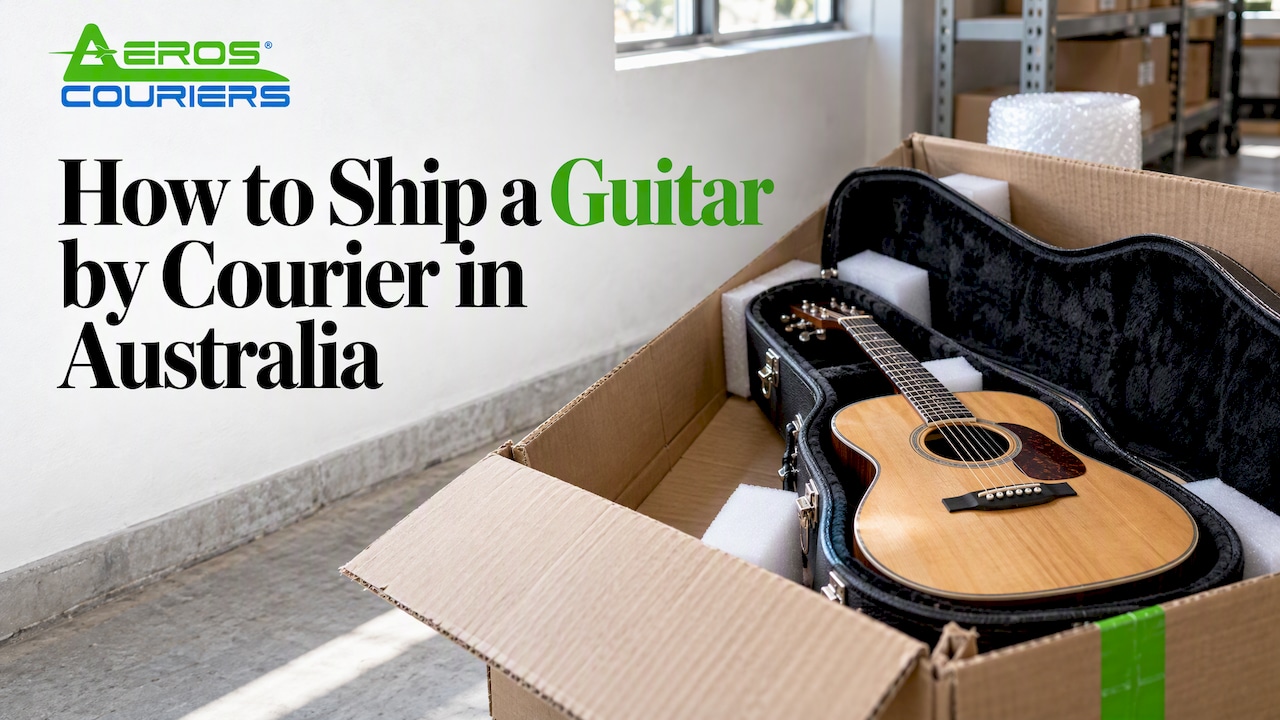
To ship a guitar by courier in Australia, pack it in its hard case, put that case inside a snug outer box with no empty space, loosen the strings slightly, and book a courier that accepts long, fragile parcels with tracking and cover. Do not assume the cheapest label will work. A guitar is long, light for its size and easily damaged, so the box dimensions matter as much as the weight.
This guide walks through the whole job: choosing a case or box, packing step by step, working out what size you are really shipping, how cover and your legal rights work, and how to book. It is written for people selling a guitar online, buying one interstate, sending one to a repairer, or moving a gigging instrument between cities.
TL;DR
- Pack the guitar in a hard case, then put the case in a second, snug outer box. A guitar in a soft gig bag alone is not safe for a courier network.
- Measure the finished box (length, width, height) and weigh it before you book. Length is usually what limits your options, not weight.
- Declare the real value and the real size. Wrong dimensions lead to re-billing, and an undeclared value can leave you short if something goes wrong.
- If you sold the guitar, you are the one the buyer comes to for a damaged item under Australian Consumer Law, so cover and packing are your protection.
- Compare rates for the actual box size on Aeros Couriers, with tracking and no fuel surcharge or handling fees added at checkout.
Table of Contents
- Why guitars are harder to ship than most parcels
- What you need before you pack
- How to pack a guitar for courier collection
- Measure the finished box, not the guitar
- What it costs to ship a guitar
- Cover, damage and who is responsible
- Perspective: what we see when guitars go through a booking platform
- Book your guitar shipment
- Choosing between service types
- Common mistakes to avoid
- FAQ
- Sources
Why guitars are harder to ship than most parcels
A typical online parcel is a compact box that sits flat on a conveyor belt. A guitar is the opposite. An acoustic in its case is often around a metre long, with a thin neck joint, a fragile headstock and a hollow body that can crack under a point load. Electric guitars are sturdier in the body but have the same weak spot: the neck, particularly just behind the nut and where the neck meets the body.
Three things tend to go wrong:
- Headstock snaps. The guitar shifts inside the case, and the headstock takes the force of a drop.
- Case crushed. Other parcels are stacked on a long, thin box that has no rigid outer layer.
- Box rejected or re-billed. The label says one size and the parcel measures another, so the carrier adds a charge or refuses it at the depot.
All three are avoidable with packing and accurate booking details. None is solved by paying more for a faster service alone.
What you need before you pack
Gather these first so you are not improvising with the courier at the door.
- A hard case that fits the guitar properly. Flight cases and moulded hard cases are best. A cheap foam case is better than nothing but should not be your only protection.
- A strong outer carton (double-wall corrugated) a little bigger than the case, or a purpose-made guitar box. Many music shops and instrument sellers will give away or sell the boxes their stock arrives in.
- Bubble wrap, kraft paper or foam sheets to fill every gap.
- Strong packing tape, at least 48 mm wide.
- A soft cloth or acid-free tissue to put between the strings and the fretboard.
- A marker or printed labels: “Fragile” and “This way up”.
- A tape measure and kitchen or luggage scales.
- Your phone, for photos.
How to pack a guitar for courier collection
The principle is simple: the guitar must not move inside the case, and the case must not move inside the box. If you can shake the parcel and feel or hear anything shift, it is not ready.
1. Photograph the guitar first
Take clear, dated photos of the front, back, sides, headstock, neck joint and any existing marks, plus the serial number. If a claim is ever needed, these are your evidence of condition before the trip. Photograph the packed box too.
2. Slacken the strings a little
Ease the tension by a turn or two on each tuning peg, so the neck is not under full load while the instrument is jolted around. Do not remove the strings entirely unless the guitar’s maker or your repairer advises it, and never cut tension on a guitar with a truss rod issue without advice from a luthier. If the guitar has a floating tremolo, check with a technician before changing anything.
3. Protect the fretboard and headstock
Place a folded soft cloth or tissue between the strings and the fretboard so the hardware cannot dent the wood. Wrap the headstock in a layer of soft padding, then a layer of bubble wrap. Take care that nothing rubs on the finish: some nitrocellulose finishes react with certain rubbers and plastics, so use cloth against the guitar and bubble wrap on top of that.
4. Fill the case so the guitar cannot shift
Lay the guitar in the case and fill every void around the body and neck with soft material, particularly under the headstock and around the neck. Close the case and gently tilt it. Nothing should move. Latch it, and tape the latches shut so they cannot spring open.
5. Add a second layer: the outer box
The case is not a shipping box. Wrap it in bubble wrap or foam, then fit it in a rigid outer carton with at least 5 cm of cushioning on every side where space allows. A snug fit keeps the overall dimensions down, but never at the cost of crushing the padding.
The same logic of padding every gap and immobilising the item applies to other awkward, easily damaged things. If you want to see it applied to something else long and delicate, this French-language guide to packing bicycles for a move shows the method of protecting vulnerable parts and stopping movement inside the load.
6. Seal, label and keep a copy
Tape all seams in an H pattern on top and bottom. Mark “Fragile” and “This way up” on more than one side. Put a second copy of the delivery address inside the box. Remove any old labels or barcodes from a reused carton, because a leftover barcode can send the parcel to the wrong place.
Measure the finished box, not the guitar
This is where most guitar shipments go wrong. Couriers price and accept parcels on the packed dimensions and on whichever is greater: actual weight or cubic weight (volume converted to a notional weight). A long, light box can be charged as a much heavier parcel.
- Measure length, width and height of the sealed box in centimetres, at the longest and widest points, including any bulging.
- Weigh the packed parcel.
- Round up, not down. If the box is 109.5 cm long, enter 110.
- Enter exactly those numbers when you book.
Length limits vary by service. Some postal parcel services have set maximum lengths of around a metre, which rules out many acoustics and some packed electrics, and the limits can change, so check the current rule for any service you consider. Commercial couriers generally take longer items, but may price them as oversize. That is why it pays to quote the actual dimensions upfront rather than guess and be re-billed later.
Typical packed sizes
These are rough ranges from common practice, not carrier rules. Measure your own.
| Instrument | Typical packed length | Notes |
|---|---|---|
| Electric guitar in hard case, boxed | about 100 to 115 cm | Neck and headstock need the most padding |
| Acoustic or classical guitar in hard case, boxed | about 110 to 125 cm | Dreadnoughts and jumbos are bulkier |
| Bass guitar in hard case, boxed | about 125 to 140 cm | Longer scale length, so a longer box |
| Ukulele or small travel guitar, boxed | about 60 to 90 cm | Often fits standard parcel services |
What it costs to ship a guitar
There is no single price, because the cost depends on the packed size, the cubic weight, the distance between pickup and delivery, and the speed you choose. A Sydney to Melbourne run costs less than a Sydney to Perth one, and a remote address costs more than a capital city address. Be wary of any article that gives a flat figure for “a guitar”.
What you can control:
- Box size. Trimming 10 cm off a dimension through a tighter, neater pack can drop you into a cheaper size band.
- Speed. Standard service is cheaper than express. Same-day is only worth it for a gig tomorrow or a time-sensitive sale.
- Pickup versus drop-off. Door-to-door collection saves you a trip with an awkward box in the car.
- Hidden add-ons. Fuel surcharges, handling fees and oversize fees can add up on a long parcel. Ask for the all-in price before you pay.
Aeros Couriers rates start from $4.90 for parcels up to 25 kg, but that headline is for standard small parcels. A boxed guitar is a larger parcel, so enter its real size and weight to see the actual rate across the carriers on the platform.
Cover, damage and who is responsible
Insurance is where guitar owners most often get caught out. There are two separate questions: what the courier’s cover pays, and what the law gives you.
Check the fine print on carrier cover
CHOICE has looked at add-on protection and found it often falls short of what it seems to promise. In its example, one carrier’s complementary warranty limits liability to AUD$1,000 per consignment and excludes the first $100 of loss, and reporting windows can be short. If your guitar is worth more than that cap, standard included cover will not make you whole. Declare the full value and buy extra cover where the limit is lower than the instrument’s worth, and note any time limit for reporting damage.
If you sold the guitar
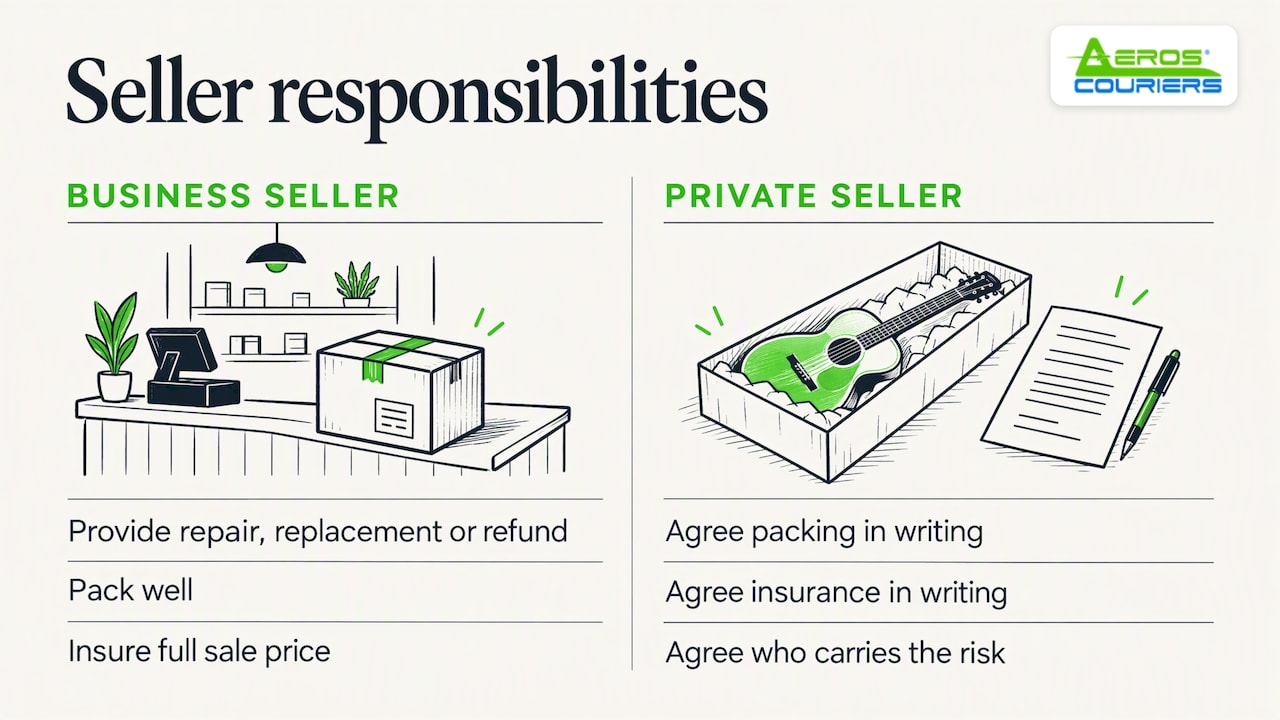
Under the Australian Consumer Law, a buyer who receives goods damaged in transit is entitled to a remedy: repair, replacement or refund. According to CHOICE, the business or online store that sold the goods should provide the remedy, not send the customer off to chase the courier. That guidance is about businesses selling to consumers. If you are a shop or a regular online seller, treat it as your responsibility: pack well and insure for the full sale price, because you will be the one refunding. If you are a private seller, the position is different, so agree on packing, insurance and who carries the risk in writing before the guitar leaves.
If something arrives damaged
- Do not discard the box or padding.
- Photograph the outer box, the case and the guitar before moving anything.
- Note the damage on the delivery, where the driver is present.
- Report it to the courier or platform straight away. Some carriers set short notification windows.
- Keep your pre-packing photos, the receipt and the tracking record together.
Perspective: what we see when guitars go through a booking platform
We built Aeros Couriers around one frustration: you get a cheap-looking price, then fuel surcharges, handling costs and oversize fees arrive after the fact. Guitars are the sort of parcel where that happens, because they are long and fragile and people guess at the dimensions.
Our view is that for an instrument you should do three things in this order. First, pack to a standard you would trust if it were your own guitar, because no cover replaces a headstock that did not break. Second, measure what you have actually built and enter those numbers, because honest dimensions are what keep the price you saw the price you pay. Third, compare carriers on that real size rather than picking a name you recognise, since the best option for a 118 cm box between two capital cities is not always the best for a regional delivery.
We also think sellers should treat cover as part of the sale, not an optional extra. A guitar that arrives broken costs far more in refunds, time and reputation than the extra premium. And because you can track the parcel and reach a real person quickly if something looks off, small problems get fixed before they become claims.
— Aeros
Book your guitar shipment
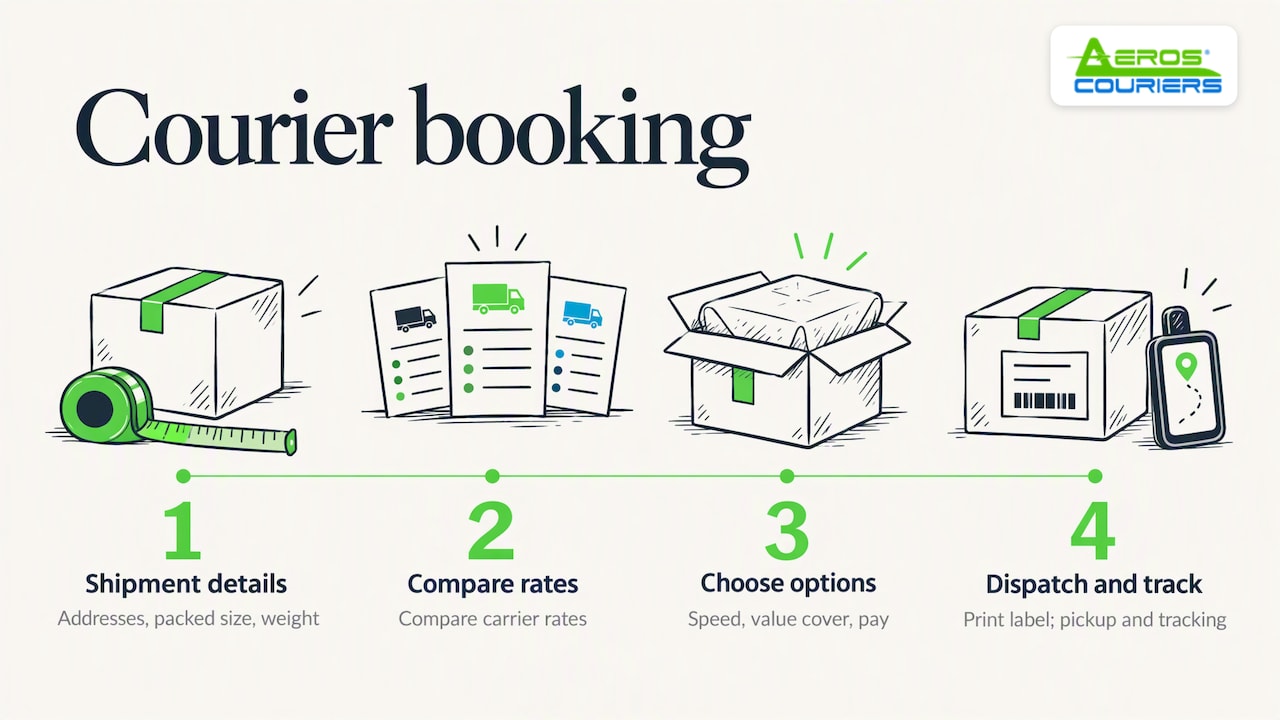
When the box is sealed and measured, the booking takes a few minutes. With Aeros Couriers you enter the pickup and delivery addresses, the packed size and weight, compare rates from top carriers side by side, choose standard, express or same-day, add cover for the guitar’s value, then print your label and have the parcel collected from your door. You pay per shipment, with no subscription, and you can follow it with tracking until it is delivered. Our rewards points can also bring the cost of later bookings down, which helps if you ship regularly.
Compare rates and book a courier for your guitar, or see our parcel delivery service page for how standard parcels work.
Choosing between service types
The right speed depends on why you are sending the guitar.
| Situation | Sensible choice | Why |
|---|---|---|
| Selling a used guitar to a buyer interstate | Standard with tracking and full-value cover | Cost matters, but so does proof of delivery |
| Gig or recording session in a few days | Express | Shorter transit, fewer handling points |
| Same city, urgent (repair pickup, last-minute loan) | Same-day courier | One driver, minimal handling |
| Moving a collection to a new city | Several boxed guitars, booked as separate parcels or as freight | Price each box properly and cover the combined value |
If you are sending something much bigger, such as a drum kit or a stack of amps, our guide to sending big parcels cheaply in Australia covers what changes. For a wider look at who delivers what across the country, see our overview of courier companies in Australia.
Common mistakes to avoid
- Shipping the guitar in its case alone. Cases are built to be carried, not stacked under parcels.
- Leaving a gap at the headstock. This is the most common point of failure.
- Guessing dimensions. Under-declaring leads to re-billing or a refused parcel.
- Skipping photos. Without them a claim is your word against a carrier’s.
- Leaving accessories loose. Capos, picks, straps and cables can scratch the finish. Bag them and pack them away from the body.
- Sending to an address nobody is home at. A long box often needs a signature. If the address needs to change after booking, read our note on changing a courier delivery address: the first step is usually the seller.
- Forgetting the buyer’s side. If you are buying, ask the seller for photos of the packing and the tracking number before dispatch.
FAQ
Can I send a guitar without a case?
It is possible, but it carries the most risk. If there is no case, build the protection yourself: wrap the body in thick foam or bubble wrap, support the neck so it cannot flex, and use a rigid, snug box. Tell the courier the contents are fragile and take out cover for the full value.
How long does it take to ship a guitar within Australia?
It depends on the route and the service. Between major capitals, standard parcels commonly take a few business days, and regional or remote addresses take longer. Express shortens that, and same-day is limited to within a metro area. The booking page shows the estimated transit for your route before you pay.
Do I need to insure my guitar?
Yes, for anything of real value. Included cover often has a per-consignment cap and exclusions, so compare its limit against what the guitar is worth, and add cover if there is a gap. Keep your photos, receipt and tracking details, since you will need them for any claim.
Can I ship a guitar overseas the same way?
International shipping adds customs paperwork, destination rules and different cover terms, so the steps here cover the packing but not the paperwork. Check the destination country’s import requirements before you send, particularly for instruments with timber or other restricted materials.
What if the guitar arrives damaged?
Photograph everything before touching it, keep all the packaging, and report the damage immediately. If you were the seller, your buyer’s rights under Australian Consumer Law apply to you, so start the remedy for them while you pursue the carrier or cover.
Sources
Recommended
- Courier Companies in Australia: A 2026 Shipping Guide
- Send Big Parcels Cheap in Australia a 2026 Guide
- Choosing Your Ideal Australian Courier Company
Courier quotes, tracking and support
Ready to send a parcel? Compare the available services for your postcodes, parcel dimensions and weight. For an existing delivery, use your consignment number to check tracking or ask our team for help.