
To schedule a courier pickup, you need five things: the pickup and delivery addresses, the parcel’s weight and dimensions, a service level (standard, express or same day), a contact number, and a label printed and stuck on the parcel. Enter them into a booking form, choose a date, and have the parcel ready at an accessible spot. The details that cause trouble are small ones: a wrong weight, a locked gate, or a parcel that isn’t packed when the driver arrives.
This guide walks through the process step by step, shows how to avoid failed pickups and the fees that follow, and covers return pickups.
TL;DR
- Book with the final weight and dimensions. Wrong measurements are a common cause of extra charges after pickup.
- Pack, label and place the parcel before the pickup window opens, and give the driver clear access and a phone number.
- Compare rates before you book. A flat, all-inclusive price protects your margin better than the lowest headline rate.
- For returns, book the pickup from the customer’s address using a prepaid label, and keep the tracking number.
- If a parcel is lost or damaged, Australian Consumer Law rights still apply, so keep your booking record.
Table of Contents
- What you need before you book
- Step by step: scheduling a pickup
- Choosing the right service for the pickup
- Avoiding failed pickups and the fees that follow
- Scheduling a return pickup
- Compare the price before you schedule
- Our view: the booking should be the easy part
- Book a pickup with Aeros
- If something goes wrong
- FAQ
- Sources
What you need before you book
A pickup booking takes a couple of minutes if you have the details to hand. Most delays start with a missing detail.
- Pickup address. Include the unit or suite number, the business name and any access notes, such as “roller door at rear, ring the bell”. Residential and business addresses are sometimes priced differently, so be accurate about which one it is. Our guide to residential delivery surcharges explains how that works.
- Delivery address. A full street address and postcode, plus a phone number for the receiver if you have one.
- Weight and dimensions. Weigh the packed parcel, not the item. Measure length, width and height of the outer box.
- Contents and value. You need these to choose cover and to avoid shipping items a service won’t carry.
- Contact details. A mobile number that will be answered on the day. A driver who can’t reach you can’t collect.
- A date and a service level. Standard, express or same day, depending on how fast it needs to arrive.
Why the weight matters so much
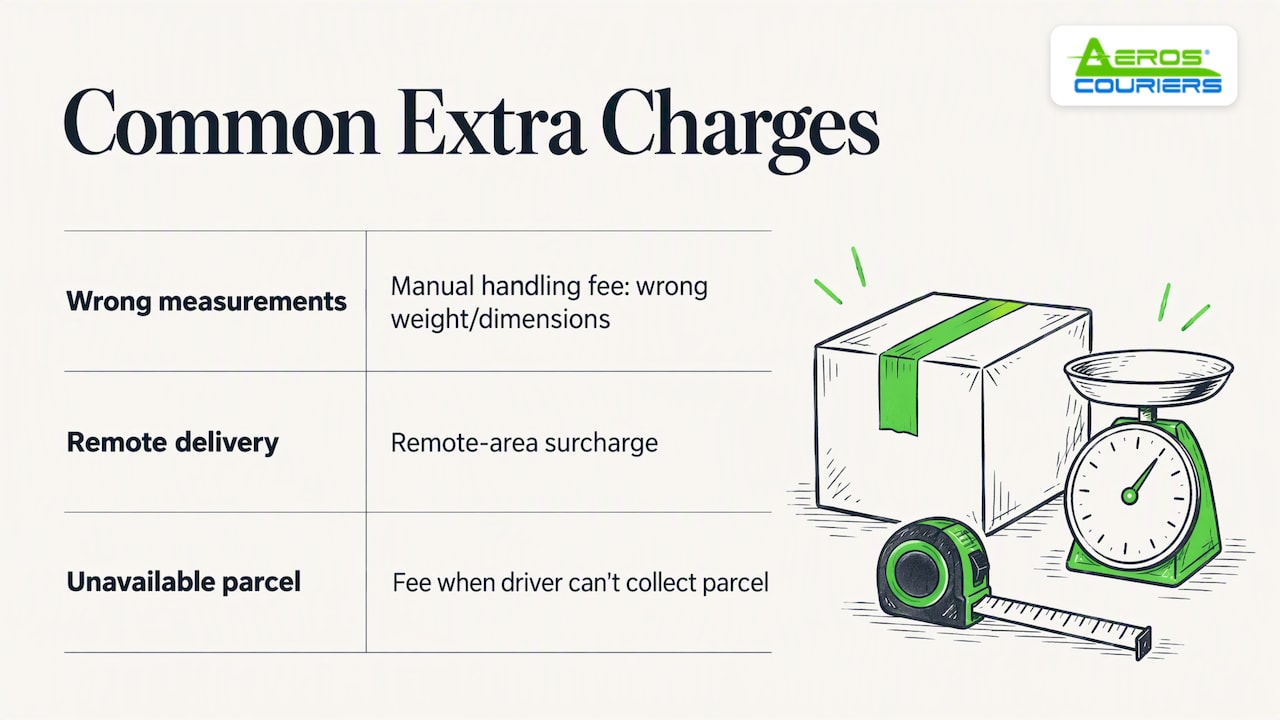
Carriers re-measure parcels in their depots. Common extra charges include manual handling fees for incorrectly declared weights or dimensions, as well as remote area surcharges and fees when a driver arrives but can’t get the parcel. A kitchen scale and a tape measure cost less than one correction fee.
Step by step: scheduling a pickup
The screens differ between providers, but the order is nearly always the same.
- Enter the pickup and delivery details. Start with postcodes and the parcel’s weight and size, so the quote is based on real numbers.
- Compare the options. Look at price, speed and what’s included. On our platform you can compare rates and book a courier in one place, instead of requesting quotes from several carriers.
- Choose the pickup date. Book as early as you can if the parcel has to move the same day. Express and same day services are more time-sensitive than standard ones.
- Add contact and access notes. Gate codes, reception instructions and the best phone number go here.
- Pay and confirm. Keep the confirmation and the tracking number.
- Print the label. Attach it flat on the largest face of the box, with no tape over the barcode. If you have an old label on a reused box, remove it or cover it completely.
- Have the parcel ready. Put it somewhere the driver can reach without having to find you, such as the front counter, the mailroom or just inside the door.
If you are comparing options for the first time, this walkthrough of the compare-and-book process shows what to look for.
Choosing the right service for the pickup
The service level decides when the driver turns up and how quickly the parcel arrives. Match it to the job rather than defaulting to the fastest option.
| Situation | Usually the right choice | Why |
|---|---|---|
| Routine customer orders | Standard parcel delivery | Lowest cost, predictable timing |
| A customer needs it sooner | Express | Faster transit for a higher price |
| A missed deadline, urgent documents or a part | Same day | Collected and moved the same day within the service area |
| Long distance or time-critical freight | Air courier | Speed across large distances |
| Oversized or heavy items | Freight | Built for pallets and bulky goods |
We offer parcel delivery, express and same day options, along with air courier and freight, so you can choose per shipment instead of locking into one carrier. If you send between states often, our interstate courier guide explains how timing and price vary on long routes.
Avoiding failed pickups and the fees that follow
A failed pickup costs time and sometimes money. The research behind this article lists futile delivery fees, charged when a driver arrives but can’t get the parcel, as one of the common hidden charges in Australian shipping. Terms differ between carriers, so read the conditions of whichever service you book. These habits keep you out of trouble.
- Pack the night before. A parcel that’s still being packed when the driver arrives is the classic failed pickup.
- Treat the window as a window. A booked time is often the earliest the driver may arrive, not a guaranteed arrival time. Be ready from the start of it and stay reachable until the end.
- Make access obvious. Unlock gates, tell the front desk, and put the parcel where it can be seen. If you work from home, mention the dog.
- Use a sturdy box and good fill. Our own advice is to pack as if the parcel will be dropped once. If you are reorganising your packing area, a tidy shelving setup helps, and this guide to optimising a store room has useful ideas on keeping boxes and stock where you can find them.
- Don’t understate the weight. It will be corrected, and you may be billed for the difference.
- Answer the phone. Drivers call from unknown numbers. Save time by adding “courier” to your voicemail message if you can’t answer.
Scheduling a return pickup
Returns are the same process in reverse, with a few differences.
If you are a business sending a return label to a customer:
- Book the shipment with the customer’s address as the pickup address and yours as the delivery address.
- Send the printable label to the customer by email, along with a short note: put the item in a box, tape it, attach the label, and be home at the pickup time.
- Ask them to confirm the pickup date, and send them the tracking number so both of you can follow it.
If you are an individual returning an online purchase:
- Check the seller’s returns policy for who pays and which service to use.
- Book the pickup from your address, or use the seller’s prepaid label if one was provided.
- Keep the receipt, tracking number and photos of the packed item until the refund lands.
What if the goods are faulty? Under Australian Consumer Law, consumers can seek remedies when goods or services fail to meet a consumer guarantee. The ACCC has noted that sellers can’t tell consumers that delivery charges are not refundable when they have a legal right to compensation for foreseeable loss. If a seller refuses, contact your state or territory consumer protection agency or the ACCC.
Compare the price before you schedule
The pickup is easy to book. The price is where people lose money. Fuel surcharges are applied as a percentage of the total charge, and they follow fuel indices with a lag, so the same parcel can cost more next month with no change in volume. The same article reports that some carriers’ contract customers have seen increases in these surcharges during 2026.
That is why business.gov.au suggests judging couriers on how easy it is to get a quote and on their shipping times, among other factors, not only the lowest headline rate. A cheap base price with add-ons is not a cheap price.
Before you confirm, ask:
- Is this the final price, or will fuel, handling or residential charges be added?
- Is insurance included, and up to what value?
- Can I track the parcel from pickup to delivery?
- Who do I talk to if the driver doesn’t turn up?
Our guides to the cheapest way to send a parcel and satchel and parcel rates go deeper on keeping the cost down.
Our view: the booking should be the easy part
We built Aeros Couriers around a simple idea: scheduling a pickup shouldn’t require a pricing degree. Most of the complaints we hear about couriers aren’t about the driver. They’re about the bill: extra charges that weren’t in the quote, and no one to call when something goes wrong.

So we do three things differently. We show transparent, all-inclusive pricing with no hidden fees such as fuel surcharges or handling costs. We let you compare rates from major carriers before you commit, so you aren’t tied to one provider. And we keep real people on the support line, so a missed pickup gets a quick answer rather than a ticket number.
For small businesses, our advice is to treat pickups as a routine, not a daily scramble. Pick a regular packing time, keep labels printed in advance where you can, and book each shipment with accurate measurements. The fewer exceptions you create, the fewer fees and delays you see. Our rewards points also lower the cost of future bookings, which helps if you ship every week.
— Aeros
Book a pickup with Aeros
If you’re ready to ship, enter your parcel details on our booking page. You get instant rate comparison, door-to-door pickup, printable labels, shipment tracking, insurance and Australian customer support, with parcels up to 25kg covered by our parcel delivery service. No subscription is needed: you pay per shipment. You can also see how our parcel delivery works before you book.
If something goes wrong
Sometimes a parcel is collected and then lost or damaged. Your rights don’t depend on the courier’s terms. In 2023 the ACCC announced that the national postal carrier and its express arm would pay about $2.9 million in compensation to businesses after incorrectly denying some claims for lost or damaged parcels. The lesson for any sender is to keep records:
- the booking confirmation and tracking number
- photos of the parcel and contents before sealing
- proof of value, such as an invoice
- the date and time of every conversation with the courier
Lodge a claim promptly and in writing. If you are refused and you think the refusal is wrong, ask for the reason in writing and consider contacting the ACCC or your state consumer agency.
FAQ
How far ahead should I schedule a courier pickup?
For standard services, book at least a day ahead so the driver can be allocated to your area. For same day, book as early in the day as you can, since the cut-off differs by service and location. Check the cut-off shown at booking.
Can I reschedule or cancel a booked pickup?
Usually yes, if you do it before the driver is on the way. Rules and any fees depend on the service you choose, so check the booking terms and contact support as soon as your plans change. Don’t just leave the parcel and hope.
Do I need to be home for a courier pickup?
Not always, but someone must be reachable, and the driver must be able to get to the parcel. Many senders leave parcels at a reception desk or just inside a door with permission noted in the booking. If the driver can’t collect, you may face a failed pickup fee and a rebooking.
How do I schedule a return pickup for a customer?
Book the shipment with the customer’s address as the pickup point and yours as the destination, then email them the printable label. Tell them to pack the item, attach the label and be available in the pickup window. Share the tracking number so you can see when it’s collected.
What can’t I send by courier?
Dangerous goods, such as certain batteries, aerosols and flammable liquids, are usually restricted or need special handling, and each service has its own list. Check the prohibited items list for the service before you book. If the goods are unusual or oversized, freight may be a better fit.
Sources
- Average Australian ecommerce 3PL cost by state, 2026 (Eightx)
- Carrier fuel surcharges are rising (Starshipit)
- Shipping (business.gov.au)
- Australia Post to pay about $2.9 million in compensation to businesses for lost or damaged parcels (ACCC)
- Koala Living pays penalties and will compensate consumers (ACCC)
Recommended
- Your Guide to a Fast and Easy Platform to Compare and Book a Courier
- Your Guide to Seamless Auspost Courier Pick Up
- Courier Companies in Australia: A 2026 Shipping Guide
- Australia’s Ultimate Guide to Couriers for Your Business
Courier quotes, tracking and support
Ready to send a parcel? Compare the available services for your postcodes, parcel dimensions and weight. For an existing delivery, use your consignment number to check tracking or ask our team for help.