Stop chasing the cheapest base rate. That's the popular advice behind most requests for a pallet freight quote, and it's also the fastest way to choose the wrong carrier. A low line-haul number that excludes fuel, GST, access charges and unloading tells you almost nothing about what you'll pay. It only tells you who left the most out.
The better question is simpler and harder at the same time. What is the landed, all-in total for a fully measured load, on this lane, to this exact delivery site? Once you ask it that way, quoting gets encouragingly predictable. You measure first, you disclose the site conditions upfront, and you compare totals instead of headlines. If your load turns out to be boxes that fit parcel limits, you may not need pallet freight at all, and that's good news worth finding out before you book.
Choosing Between a Pallet and a Parcel
A pallet is not automatically the right choice for a large order. Aeros Couriers handles boxes, satchels and multi-box orders, as well as palletised freight. Choose the service that fits the packed load and delivery site.
For parcels, the Australia Post size and weight guidelines give standard maximums of 22 kg, 105 cm maximum length and 0.25 cubic metres total volume. Loads outside those limits need another freight option. If a multi-box order can be split into cartons within parcel limits, compare that route with pallet freight before booking.
| Criteria | Parcel or box | Palletised freight |
|---|---|---|
| Weight | Up to 22 kg per parcel (Australia Post standard) | Quoted for the packed pallet load |
| Size | 105 cm length and 0.25 cubic metres volume (Australia Post standard) | Quoted for the packed pallet dimensions |
| Pricing basis | Greater of actual or cubic weight, plus destination | Depends on route, packed dimensions, weight and selected service |
| Best for | Cartons, satchels and small multi-box orders | Full or part pallet loads |
Why carton size changes the parcel price
For parcels in your own packaging, the Australia Post guide to sending parcels within Australia says charges are based on whichever is greater: actual weight or cubic-weight equivalent, together with the destination. A smaller carton can therefore cost less to send even when its contents weigh the same. Compare freight costs for bulk shipping boxes before settling on a packaging format, since carton dimensions and the number of boxes affect which route fits the order.
Aeros Couriers offers freight from $4.90 to send a box up to 25kg, for eligible shipments. The price depends on the route, packed dimensions, weight and selected service.
Check transit before you promise a date
Transit time depends on the destination. The Australia Post domestic sending options describe Express Post as its fastest nationwide parcel option, generally taking 1 to 3 business days. Next-business-day delivery is limited to its network, which covers capital cities excluding Darwin, Perth CBD and some major regional centres.
Regular Parcel Post generally takes 2 to 6 business days, according to the Australia Post parcel delivery guide. The stated ranges are roughly 2 to 4 days within a state and 3 to 6 days interstate. Check the destination postcode before promising a delivery window.
Practical rule: If the load needs a forklift, a dock or two people to lift safely, compare pallet freight. If it fits parcel limits in sensible cartons, compare parcel services.
For a palletised load, follow this guide to wrapping a pallet for shipping. Measure and weigh each parcel fully packed, including its packaging, before requesting a quote.
Gather and Measure the Load Before You Quote
The lowest base rate is the wrong number to compare. A useful pallet quote covers a fully measured load on a specific route, with the pickup and delivery site details stated clearly. Record the information below before requesting prices.
| Field | What it changes | Example |
|---|---|---|
| Pickup and delivery postcodes | Identifies the route, such as metro, regional or interstate | Sydney 2000 to Melbourne 3000 |
| Site type | Helps identify access requirements at each end | Warehouse dock versus residential driveway |
| Pallet count and footprint | Describes the number and size of the shipping units | 2 pallets, each 1165 × 1165 mm |
| Total packed height | Allows the carrier to check its height and oversize rules | 1450 mm, including the pallet |
| Gross weight including pallet | Provides the full shipment weight for the quote | 260 kg of goods plus the pallet |
| Stackability and fragility | Indicates how the load can be carried and handled | Stackable cartons versus fragile goods |
| Tail-lift or unloading needs | Identifies equipment or access requirements | Delivery site with no forklift or loading dock |
Start with the postcodes and building type at both ends. A business address with a dock and a residential driveway are different delivery conditions. Note any appointment window or access restriction too, so the quote reflects the actual job.
Next, measure the complete palletised load. Include the pallet, goods, packaging and wrap in the packed height and gross weight. Check the carrier's current pallet weight, height, oversize and wrapping rules before booking. Limits differ between networks, and a load outside the selected carrier's freight profile may be refused at pickup, with the freight charge and a futile pickup fee applying.
Prepare the pallet so the quote survives pickup
Use the same load details for every quote. Measure carefully, record any special handling needs and check that the selected carrier accepts the shipment as described.
- Weigh the complete unit. Include the pallet, goods and packaging. Product weight alone does not describe the shipment being collected.
- Measure the packed dimensions. Record the full length, width and height, including packaging and wrap. Use the cubic weight formula to understand how dimensions can affect a freight calculation.
- Check carrier limits. Confirm the current weight, height, oversize and wrapping rules for the network you plan to book. Do this before accepting a quote.
- Keep the load stable and within the pallet footprint. Secure the goods to the pallet, avoid overhang and place heavier cartons low.
- Mark stackability and fragility. Tell the carrier if the load cannot have freight stacked on top or needs careful handling.
- Record access details. Note forklift or tail-lift requirements, dock hours and appointment windows on the booking.
Turn the audit into one sheet
Put the origin and destination postcodes, building types, pallet count, footprint, packed height, gross weight, stackability and access needs on one sheet. Send the same details with every quote request. If the inputs differ, the prices are not a like-for-like comparison.
Before paying, review the available service options and check that the booking reflects the shipment details and delivery conditions you supplied. A reliable comparison is based on the same fully measured load and the same route, not just the lowest starting price.
What Actually Moves the Price of a Pallet
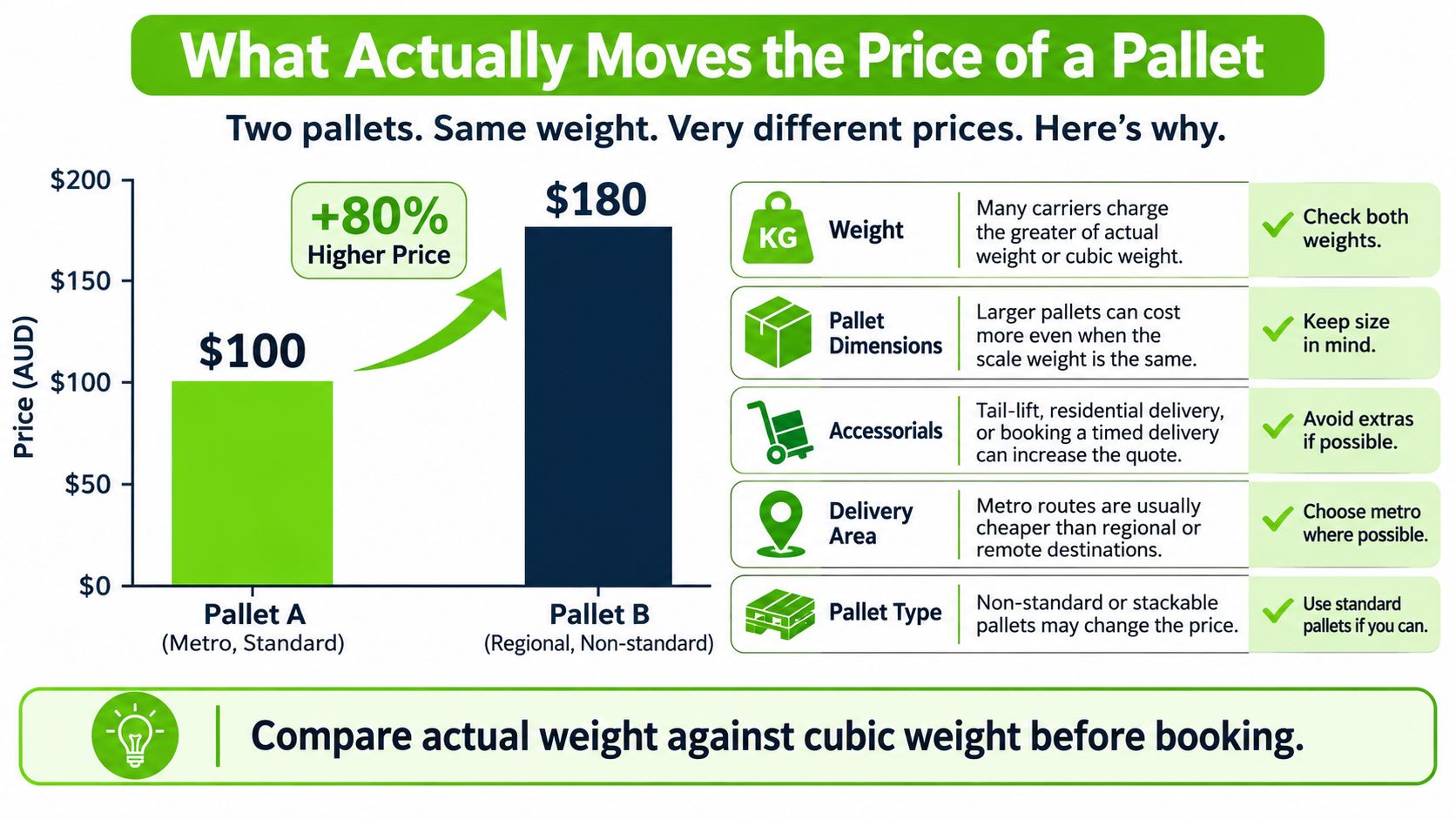
The lowest base rate is often the wrong number to compare. A useful pallet quote is the landed total for a fully measured load, travelling on a specific lane to a specific delivery site.
Carriers may price by the greater of actual weight or cubic weight. A light, bulky pallet can therefore cost more than its scale weight suggests because it takes up more deck space. Reducing the load's height or excess packaging can lower the chargeable volume, if the goods can still be packed safely.
Lane and direction matter too. Recent Australian freight-cost reporting puts metro, same-state pallet rates well below distant-state rates, with east-coast-to-Perth freight often higher when return loads are scarce. A consolidated service may cost less than a faster option because the carrier can fill the truck more efficiently. The Australian pallet freight cost guide also outlines common pricing factors and access charges.
Reported benchmarks, read carefully
The ranges below are reported benchmarks, not a particular carrier's rates. Treat them as a sense-check, since the final price depends on the lane, shipment and delivery requirements.
| Cost driver | Reported range (AUD) | What it means |
|---|---|---|
| Metro, same state | 21.80 to 26.90 per pallet | Before fuel surcharge |
| Distant state (interstate) | 166.90 to 345.90 per pallet | Before fuel surcharge |
| East coast to Perth | About 200 to 500 or more per pallet | Scarce return loads can push rates up |
| Tail-lift | About 30 to 80 | May apply when the site has no dock or forklift |
| Residential delivery | About 30 to 70 | May apply to home or non-commercial addresses |
| Hand unloading | About 50 to 150 | May apply when the site has no unloading equipment |
| Sydney to Melbourne worked example | 150 base, about 24% fuel surcharge and GST | Example total near 204, before access charges |
The Sydney-to-Melbourne row is a worked example, not a current rate: it assumes a $150 base, a 24% fuel surcharge and GST, for an estimated total of about $204. Actual charges depend on the quote and its assumptions. For parcel pricing, Aeros Couriers' guide to courier costs explains how route and shipment details affect the quote.
Ask each carrier whether the figure is a line-haul rate or a landed total. Confirm which access charges apply and whether fuel and GST are included. A quote is useful for comparison only when it covers the same load, lane and delivery site.
Comparing Quotes Without Hidden Costs
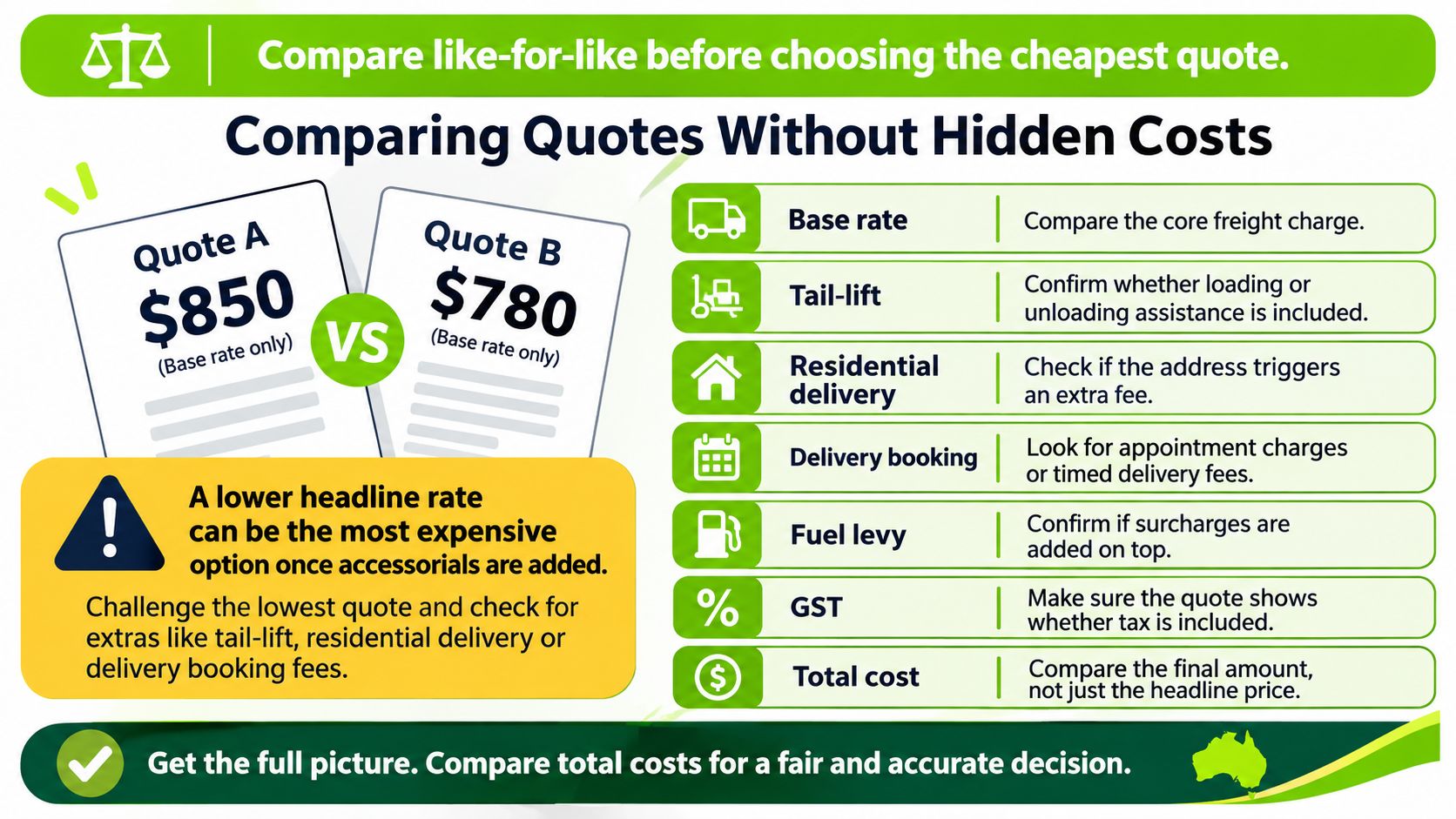
The cheapest headline rate is often the most expensive quote you can accept. A base rate that excludes tail-lift, residential delivery, hand unloading and re-delivery doesn't save you money. It just moves the cost to an invoice you can't refuse. Compare totals, built from identical inputs, and the picture changes fast.
A pallet freight quote is rarely an all-in price, and The Quote Yard's NSW pallet delivery cost guide explains that pallet quotes are commonly calculated using the greater of actual weight or cubic weight, with cubic conversion often set at 250 kg per cubic metre. The same source identifies tail-lift fees of roughly $30 to $80, residential surcharges of $30 to $70 and hand-unloading fees of $50 to $150. Add fuel surcharges, GST, storage, toll recovery and failed-delivery charges, and the "cheap" quote can finish well behind an honest one.
Send every carrier the same measured sheet, then run this checklist against each response. If you want a structured method for the exercise itself, learning how to break down supplier price quotes into their component lines makes side-by-side comparison far more reliable.
- Fuel surcharge: Is it included, and at what percentage?
- GST: Is it shown separately or already in the total?
- Access fees: Are residential or limited-access charges applied, and how much are they?
- Unloading: Is tail-lift or hand unloading covered, or charged on top?
- Failed delivery: What's the re-delivery rule, and what does a second attempt cost?
- Storage and tolls: Are storage and toll recovery included anywhere in the fine print?
- Insurance and signature: Is cover included, and is a signature required or optional?
On our parcel side, we keep this simple on purpose. No fuel or handling fees are added to the quoted freight, there are no platform costs and no hidden costs, and you pay only for your freight. Our page on no fuel charges and no hidden costs sets that out in plain terms. That transparency is exactly what you should demand from any pallet carrier too.
Two disciplines protect you after booking. First, track the variance between estimate and final invoice by lane and charge type. Lanes where estimates keep rising point to a postcode rule or a manual-review threshold that needs tightening, and fixing it once saves money on every future shipment. Second, confirm the freight fits the carrier's profile before pickup. Goods found to be outside the carrier's freight profile may be refused at pickup, with the freight charge and a futile pickup fee applying. A five-minute check beats paying for a truck that drives away empty.
Compare totals, not rates. Price certainty is worth more than a low number with asterisks.
Get a Landed Quote Before You Book
The lowest base rate is often the wrong number to compare. Get a landed total for the fully measured load, on the specific route and delivery site, before you book.
For cartons within parcel limits, enter the pickup and drop-off details, packed dimensions and weight to get an instant quote. The Aeros Couriers shipping rate calculator shows available options; the customer dashboard keeps freight together in one place.
For a load that needs a pallet, Aeros Couriers also supports palletised freight. Enter the load and delivery details for a quote, then compare the landed total with two or three other pallet carriers. Check that each quote covers the same load and delivery site, including whether access and unloading are required. A commercial dock and a residential driveway can produce different costs.
The test that actually matters
Check that the quote reflects the actual delivery site and states which charges are included. For cover on higher-value road freight, understand the difference between carrier liability and insurance, and review marine cargo insurance coverage in Australia as a separate topic before choosing cover.
Hold every quote to the same test: does it match the measured load, the delivery site and the total payable? If any detail is uncertain, confirm it before booking. A quote based on accurate measurements and specific delivery details is more useful than a low headline rate.
For parcel freight, Aeros Couriers adds no fuel or handling fees to the quoted freight and has no platform costs or hidden costs. Customers pay only for their freight.
Courier quotes, tracking and support
Ready to send a parcel? Compare the available services for your postcodes, parcel dimensions and weight. For an existing delivery, use your consignment number to check tracking or ask our team for help.