
Choose same day when the parcel is urgent, time-bound or high-value and the cost is justified by what is at stake. Choose next day for almost everything else. In Australia, next day is the better default for most small businesses and individuals: it costs less, it covers more postcodes, and it gives the courier a full working day to plan the route. Same day earns its price when a missed deadline costs you more than the extra fee.
This guide explains what each service actually means, where the gaps in reliability are, what you should expect to pay, and a simple way to decide for each parcel you send.
TL;DR
- Same day means pickup and delivery within the same business day, usually metro only and with an early booking cut-off. Next day means delivery on the next business day.
- Next day is cheaper and available to more addresses, so it suits routine orders, restocking and gifts.
- Same day suits urgent documents, replacement parts, medical or event items, and customer promises you cannot afford to break.
- Fast does not always mean on time: Australian industry research found 30% of same-day deliveries arrive late.
- Check the cut-off, the coverage area, the tracking and the total fee before you book, not just the headline price.
Table of Contents
- What same day and next day delivery mean in Australia
- How the two services work behind the scenes
- Cost: what you pay for speed
- Reliability: faster is not always on time
- Which one should you choose?
- Disadvantages of same day delivery
- Is next day shipping the same as next day delivery?
- What to check before you book
- Our perspective
- Compare and book your delivery
- FAQ
- Sources
What same day and next day delivery mean in Australia
The two terms sound precise but different providers use them differently, so it helps to start with a common yardstick. One Australian shipping platform’s developer documentation on service levels groups delivery into four tiers: standard (1 to 4 business days), express (next business day), priority (same day) and on demand (within three hours).
In plain terms:
- Same day: the courier collects and delivers on the day you book. You normally need to book before a morning or midday cut-off, and the route is usually limited to a metropolitan area.
- Next day (express): the courier collects today, or you drop the parcel off, and it arrives on the next business day. “Business day” matters: weekends and public holidays do not count, so a Friday booking commonly lands on Monday.
- On demand: a driver is dispatched straight away for a delivery within hours. It is the fastest and the most expensive tier.
A common mix-up is between dispatch and delivery. “Same day dispatch” means the parcel leaves the sender today. It says nothing about when it arrives. “Next day delivery” is a promise about arrival. When you compare options, read which of the two the provider is actually promising.
How the two services work behind the scenes
Same day is an operational feat. Industry guidance on the subject says same-day fulfilment depends on stock positioned close to the customer and local carriers with fast, reliable pickup and delivery. There is no time to move a parcel through a long network of depots and linehaul trucks. It has to be collected, sorted if at all, and driven directly to its destination.
That is why same day is mostly a local service. Any business that promises fast local delivery needs the right setup behind it: prepared stock, a driver nearby and a tight handover. If you want to see what that discipline looks like in a very different industry, local food delivery operations show how freshness and distance push everything towards short, well-planned routes.
Next day works differently. The parcel enters a network that consolidates freight overnight, moves it between cities or suburbs, and delivers it the next morning or afternoon. Consolidation spreads the cost over many parcels, which is exactly why next day is cheaper. It is also why it can reach more places: regional and interstate addresses are served by the overnight network, while same day almost never is.
What determines when your parcel arrives:
- Booking cut-off: book after it and your same-day job becomes next day.
- Pickup window: the courier needs time to reach you before the delivery run.
- Distance and zone: inner metro is quick, outer suburbs and regional areas are slower or excluded.
- Parcel size and weight: oversized or heavy items may need a different vehicle.
- Address quality: a missing unit number or a closed reception can undo a delivery attempt.
Cost: what you pay for speed
Speed carries a premium, and the pattern is consistent across Australian sellers. The figures below come from retailers and are about how they charge customers for delivery, not courier rates, but they show the typical gap between the two speeds.
| Seller type | Next day / standard | Same day |
|---|---|---|
| Online retailer, Sydney metro | A$0 on A$69 or more, A$4.99 for A$20 to A$68.99, A$7.99 under A$20 (before a A$2.50 service and packaging fee) | A$5 on A$69 or more, A$9.99 for A$20 to A$68.99, A$12.99 under A$20 (before the same A$2.50 fee) |
| Gift and flower seller | From A$9.95 (next business day) | From A$15.95 (same day VIP), from A$25.95 for three-hour express |
| Large online marketplace | Not applicable | Free on eligible subscriber orders over A$49 in selected areas, A$9.99 for eligible subscriber orders under A$49, A$12.99 per eligible order for non-subscribers |
The lesson is not the exact dollar figure. It is that same day typically adds a few dollars to a parcel at retail scale, and considerably more when it is a bespoke courier job with a driver assigned to your parcel.
Check the fees around the fee
The advertised delivery price is rarely the whole bill. The retailer above adds a service and packaging fee on top of delivery. A national supermarket’s delivery subscription page says same-day and next-day orders can qualify for a A$0 delivery fee with a A$75 minimum spend, but bag fees and service fees may still apply. A consumer organisation’s comparison of rapid grocery delivery, last updated 23 October 2025, found delivery charges from A$5 to A$11.32 in its test basket, and item prices on third-party apps averaging 11% above in-store prices.
The same habit applies to couriers. Before you book, ask:
- Is there a fuel surcharge, residential delivery fee or handling fee on top of the quote?
- Is there a charge for redelivery, redirection or a PO Box address?
- Is insurance included, or an add-on?
- Does the price change if the parcel is bigger than you declared?
The gift seller mentioned above, for example, lists A$25.95 for redelivery or redirection and A$10 for cancellations or last-minute changes. Those extras can turn a cheap-looking delivery into an expensive one.
Reliability: faster is not always on time
This is the part many same-day versus next-day articles skip. Industry research suggests that speed and punctuality pull in different directions. The Freightability Report 2026, as reported by a parcel industry publication, found that 30% of same-day deliveries arrive late and 27% of next-day shipments miss their service commitments, compared with a 19% failure rate for standard freight.
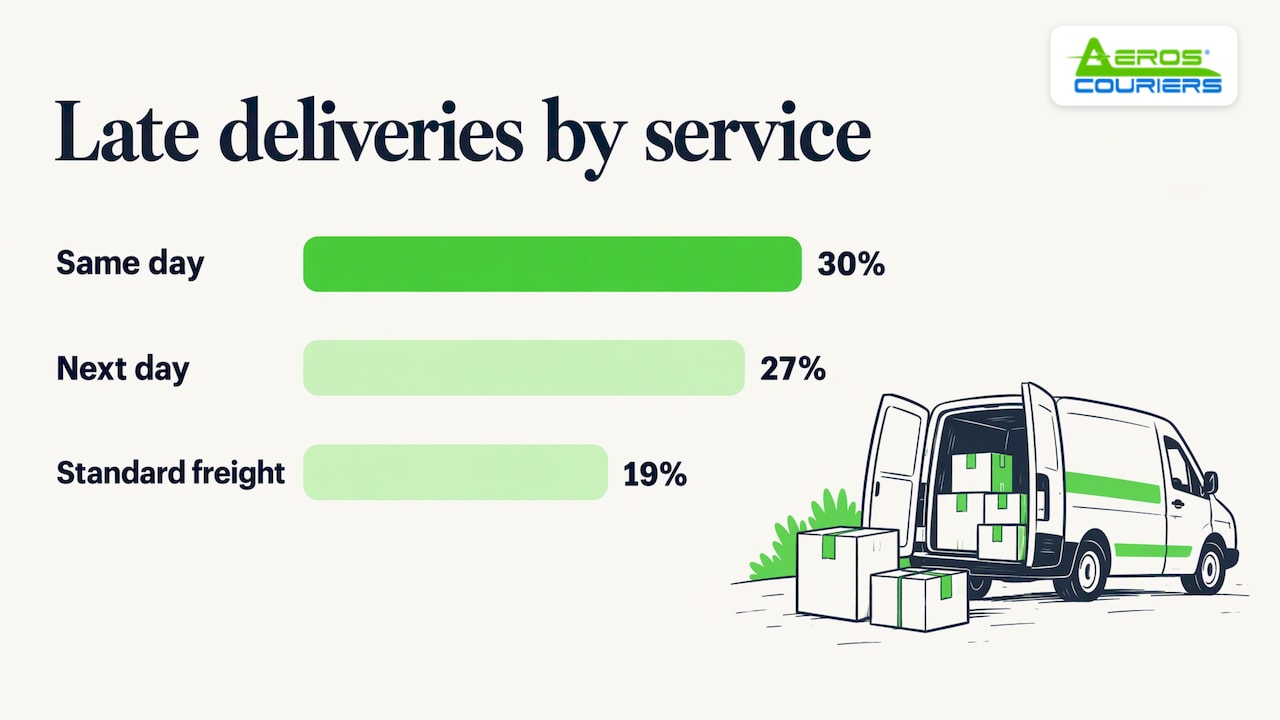
The same coverage quotes the report’s commentator saying that in a business-to-business setting customers value reliability over extreme speed, because a missed window leads to costs such as rescheduled labour. That is worth taking seriously if you run a trade business, a clinic or a shop that books staff around deliveries.
What this means in practice:
- A fast service with a poor track record is worse than a slightly slower one that arrives when promised.
- Pick the speed that you can plan around. A reliable next day delivery lets you schedule staff, unlike a same-day promise that slips to late afternoon.
- Look for live tracking and a human you can contact. When something goes wrong at 2 pm on a same-day job, you need an answer in minutes, not a ticket queue.
Which one should you choose?
Use this quick test for each parcel.
Choose same day if:
- A deadline is fixed and a miss has a real cost, such as a signed contract, a spare part holding up a job, or an event item.
- The parcel is high value and you want it out of circulation fast.
- A customer has been promised delivery today and the order is within your metro area.
- The item is perishable or time-sensitive.
Choose next day if:
- The parcel is a standard customer order, a restock or a gift with a date a day or more away.
- You are sending to outer suburbs, regional towns or another city.
- You are shipping frequently and watching margins.
- The parcel is heavy or awkward, where the premium for same day rises quickly.
For most small online sellers the sensible setup is next day as the default, with same day offered as a paid upgrade for customers who want it. That protects your margin and still lets you say yes to urgent requests. For clothing sellers, we cover how to set that expectation in our guide to clothes next day delivery.
Worked example: a small online shop
Say you sell homewares from a Sydney warehouse. Most orders are A$40 to A$120 and go to customers across the country. Offering free same day to everyone would eat your margin and you could not honour it outside metro areas anyway. Offering next day as the standard, and same day as a paid option for Sydney postcodes before a morning cut-off, keeps promises you can actually keep. Customers who need it pay for it, and customers who do not are not forced to.
Worked example: a tradesperson or clinic
A plumber needs a replacement valve at a job site by 3 pm. The cost of a second callout and a idle afternoon is far higher than the fee. Same day is the right call, and it is worth booking early in the morning to leave room for the pickup window.
Worked example: an individual sending a gift
A birthday is on Saturday and it is Wednesday. Next day delivery leaves two spare days. Booking same day would add cost with no benefit. Book next day, check the tracking, and keep same day in reserve if something delays the parcel.
Disadvantages of same day delivery
It helps to name the trade-offs so you can plan around them rather than be surprised.
- Limited coverage: it is almost always restricted to metro areas.
- Early cut-offs: a booking in the afternoon often rolls into next day.
- Higher price per parcel: you pay for a dedicated or near-dedicated run.
- Tight windows: a missed handover has less room to recover than it would over two days.
Every one of these is manageable with good planning. Book early, confirm the address and have someone available to receive the parcel. A courier with live tracking and real people on support makes the difference when a same-day job needs a quick fix.
Is next day shipping the same as next day delivery?
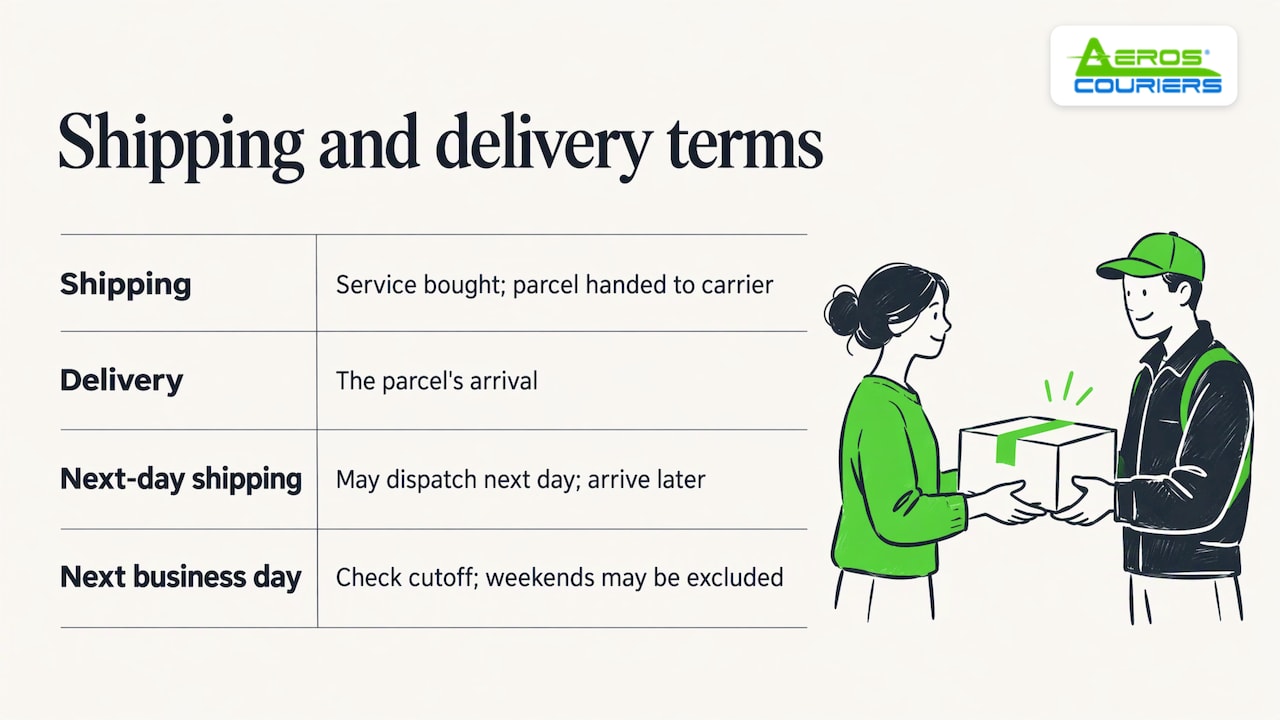
Not quite. Shipping describes the service you buy and the handover to a carrier. Delivery is the event of the parcel arriving. A seller advertising “next day shipping” may mean the order is dispatched the next day, with delivery a couple of days after that. If arrival date matters, look for the phrase “next business day delivery” and the cut-off time, and check whether weekends or public holidays are excluded.
What to check before you book
- Cut-off time: the latest time you can book for the speed you want, and whether it differs by city.
- Coverage: whether both your pickup and the delivery postcode are inside the service area.
- Weight and size limits: parcels have limits, and exceeding them changes the price or the service.
- Total price: the full amount including any surcharges, not the first number you see.
- Tracking: live status updates so you and your customer are not guessing.
- Insurance: what is covered, up to what value, and what you need to declare.
- Support: how fast you can reach a real person when a delivery goes wrong.
We have city-specific guides if you want the local detail: next day delivery in Sydney, next day delivery in Melbourne, and our overview of same day courier service in Australia.
Our perspective
Most delivery decisions are made on the headline price and the headline speed. We think the better questions are what the final cost will be and how likely the parcel is to arrive when promised.
That is why we built our service around transparent pricing. Our approach is no hidden fees such as fuel surcharges or handling costs, so the price you compare is the price you pay. We compare rates from major carriers in one place, which means you can look at same day, express and next day side by side for the same parcel instead of guessing.
We use technology for route optimisation and active parcel monitoring, because reliability matters as much as speed. When a delivery needs attention, you can reach a person quickly. Our rewards points can also lead to further savings on future bookings, which suits small businesses that ship often.
Our advice is simple: make next day your everyday setting, and keep same day ready for the parcels where time truly decides the outcome.
Aeros
Compare and book your delivery
If you are weighing speed against cost for a particular parcel, the quickest way to settle it is to see both options priced together. Aeros Couriers is an online courier and freight platform for parcels up to 25kg Australia-wide, with express and same day options, instant rate comparison, door-to-door pickup, printable labels, shipment tracking and Australian customer support.
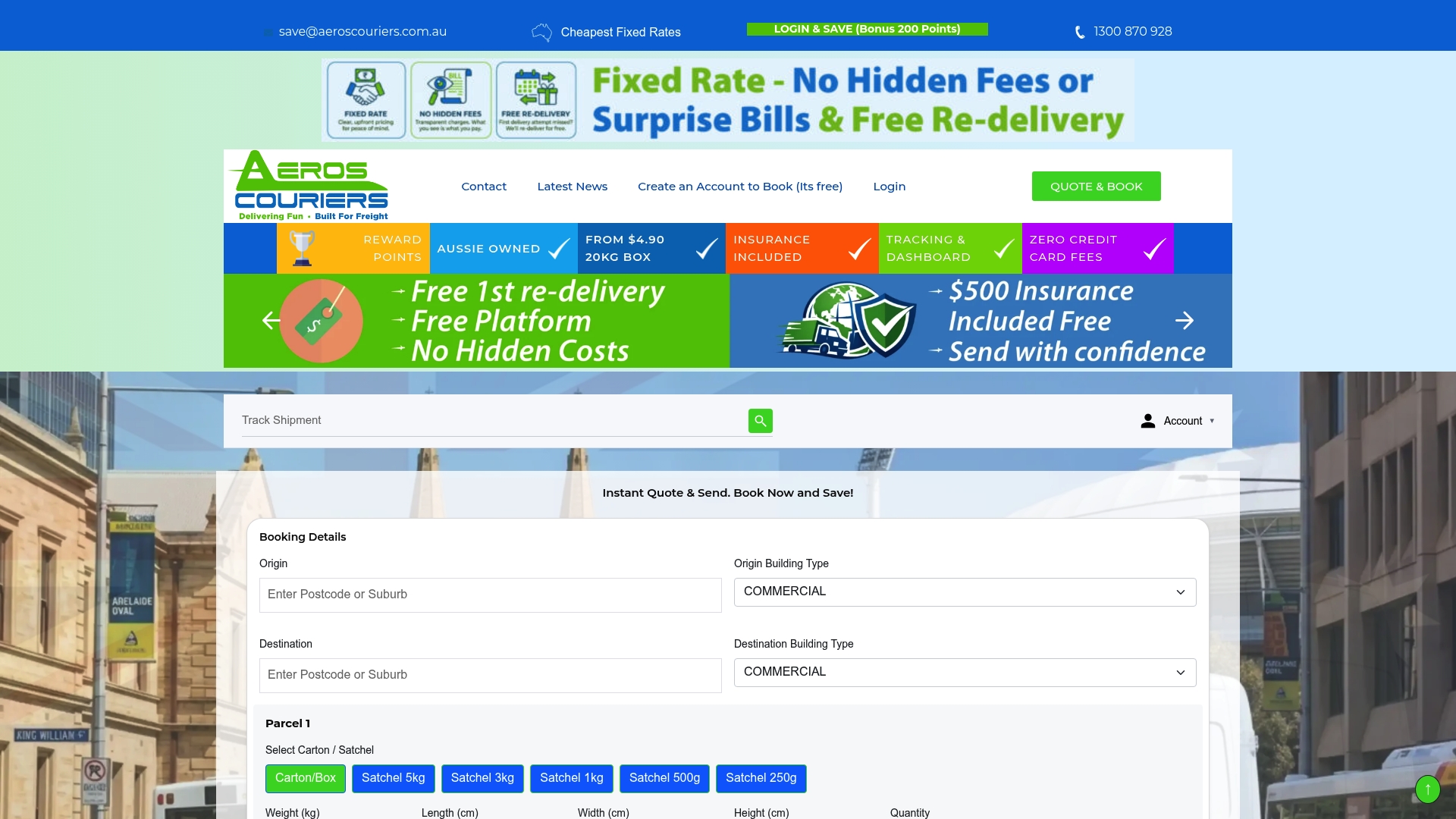
You pay per shipment with no subscription. Compare rates and book on Aeros Couriers, or look at our express courier service page for fast box and parcel deliveries across the country.
FAQ
What is same day shipping?
Same day shipping means the parcel is collected and delivered on the same day you book it. It normally requires a booking before a morning or midday cut-off and is usually limited to metropolitan areas. If you book after the cut-off, the job generally becomes next day.
What are the disadvantages of same day delivery?
It costs more per parcel, covers fewer addresses and has early cut-offs. Reliability can also be an issue: the Freightability Report 2026 found 30% of same-day deliveries in Australia arrive late. Booking early, giving a complete address and choosing a courier with live tracking reduces the risk.
Is next day shipping the same as next day delivery?
Not always. Shipping can refer to when the parcel is handed to the carrier, while delivery is when it arrives. Look for wording such as next business day delivery, and check how weekends and public holidays are treated, since they usually do not count as business days.
Should small businesses offer same day delivery?
Most should offer next day as the standard and same day as a paid upgrade for metro customers. That keeps your margin intact and lets you meet urgent requests. Offering same day free to everyone is hard to sustain and hard to honour outside city areas.
Sources
- Service levels, developer documentation
- Same-Day Delivery Technology Guide
- Same-Day Delivery Upgrade, Sydney Metro
- Same Day and Overnight Delivery, Amazon Customer Service
- Delivery Info and Same Day Service Guide, Edible Blooms
- Woolworths Delivery Unlimited
- Grocery delivery costs compared, CHOICE
- Report finds express deliveries in Australia increasingly missing deadlines
Recommended
- Next Day Delivery Sydney: Costs, Cutoffs & Coverage (2026)
- Next Day Delivery Sydney: Cutoffs, Coverage and Courier Options
- Next Day Delivery Melbourne: Cut-Off Times, Costs and Suburbs
- Clothes Next Day Delivery: A 2026 Guide for Aussie Brands
Courier quotes, tracking and support
Ready to send a parcel? Compare the available services for your postcodes, parcel dimensions and weight. For an existing delivery, use your consignment number to check tracking or ask our team for help.