Pickup means a driver collects your parcel from your door. Drop-off means you carry it to a carrier’s counter, locker or drop box yourself. Pickup wins when you send several parcels, heavy boxes or anything on a deadline. Drop-off wins when you send the odd parcel and already pass a handover point on your daily run. The right choice depends on volume, weight, timing and what the handover costs you in time and fuel.
This guide explains how each option works, where the real differences sit (cut-off times, tracking, fees and effort), and how to decide as an individual, a small business or an online seller in Australia.
TL;DR
- Pickup: a driver collects from your home or business. It saves travel time and suits multiple parcels, heavy items and busy schedules.
- Drop-off: you deliver the parcel to a carrier location or receptacle. It suits occasional senders who are already out and about.
- Timing: a parcel handed over after a location’s last dispatch time may not start moving until the next business day, so the cut-off matters more than the hour you book.
- Cost: compare the full price of each option, including any pickup fee and the cost of your own trip, not just the headline rate.
- Decision rule: if you ship more than a couple of parcels a week, or any single parcel is awkward to carry, book a pickup.
Table of Contents
- What pickup and drop-off actually mean
- How courier pickup works
- How parcel drop-off works
- Pickup vs drop-off: the differences that matter
- Which is right for you?
- Fees and surcharges to check in Australia
- What to check before you choose
- Our perspective
- Book your pickup with Aeros Couriers
- A worked example: one week, two senders
- Common mistakes to avoid
- FAQ
- Sources
What pickup and drop-off actually mean
The two terms describe who does the first leg of the journey.
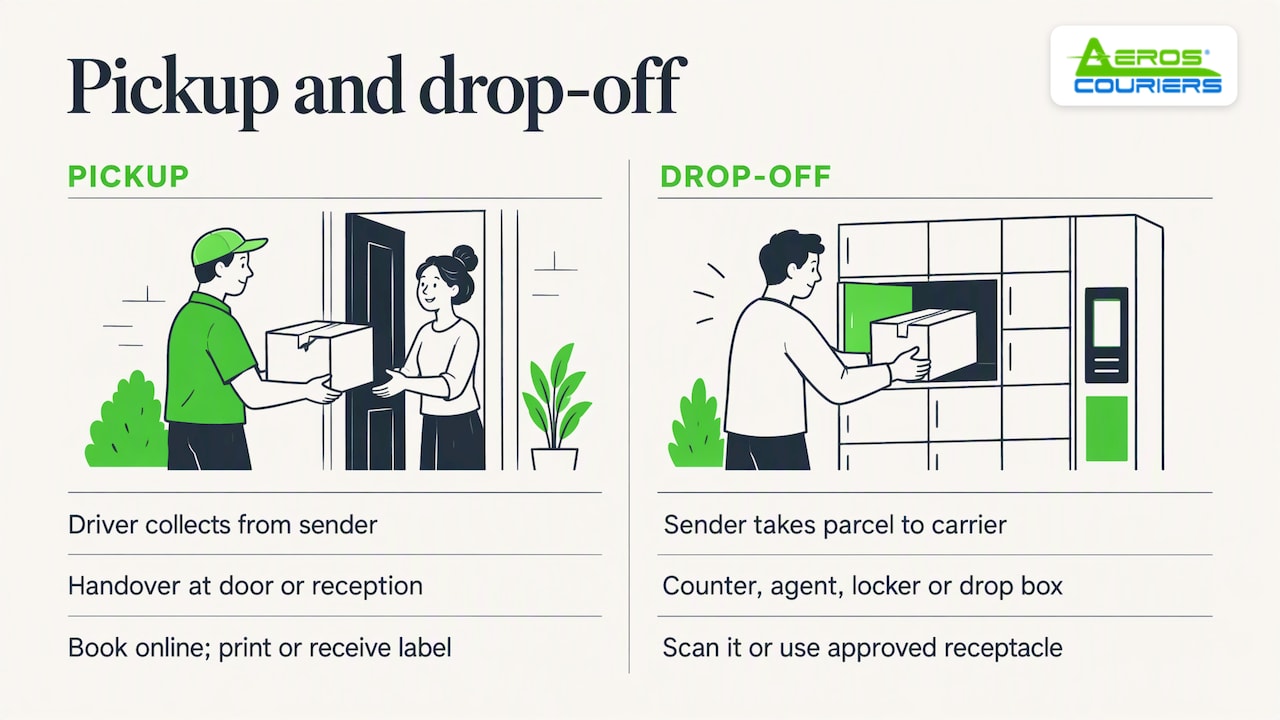
With a courier pickup, the carrier’s driver comes to the sender to collect the parcel, rather than the sender taking it to the carrier. You book online, print or receive a label, pack the parcel and hand it over at your door or reception.
With drop-off, you take the parcel to the carrier yourself. That might be a post office counter, a staffed agent such as a newsagent or convenience store, a parcel locker or a drop box. Once it is scanned in or left in an approved receptacle, the carrier becomes responsible for moving it.
A quick note on spelling, because it trips people up. “Pick up” and “drop off” are verbs (we pick up the parcel, you drop off the parcel). “Pickup” and “drop-off” are nouns or adjectives (book a pickup, find a drop-off point). A drop-off point is simply any place where a carrier accepts parcels from the public.
Neither option is faster in the air or on the road. Once the parcel is in the network, the journey is the same. The differences sit in the first step: who does the work, when the parcel is scanned and how soon it starts moving.
How courier pickup works
A pickup follows a simple pattern, and the sender’s preparation decides whether it goes smoothly.
- Get a price and book online. Enter the pickup and delivery postcodes, the weight and the dimensions. Choose a service level (standard, express or same day) and a pickup date.
- Pay and receive your label. You usually print it at home or the office. If you have no printer, check whether your booking offers another way to label the parcel.
- Pack and label the parcel. Seal it, put the label flat on the largest face and remove or cover old barcodes.
- Be available during the pickup window. Windows are commonly a block of the business day. Either be there or leave clear instructions, such as “parcel is on the front desk” or “left inside the gate”.
- Hand over and track. The driver scans the parcel, which starts your tracking history.
What to have ready:
- The parcel sealed and labelled before the window opens, not when the driver knocks.
- Accurate weight and dimensions. Declaring a lighter or smaller parcel than the real one is a common cause of later price adjustments.
- A contact number, access details for gated properties or buildings, and the best door or dock to use.
- Anything fragile packed to survive being handled in a network, not just a single trip.
If you want a full walkthrough, our guide on how to schedule a courier pickup in Australia covers booking steps and timing, and our page on booking a home courier pickup with the final price upfront is useful for people shipping from a residential address.
How parcel drop-off works
Drop-off puts you in charge of the timing. The steps are:
- Book and pay for the shipment (or buy a prepaid satchel or box if the carrier sells them).
- Print the label and pack the parcel.
- Find a drop-off point that accepts your carrier and your parcel size. Not every location takes every service, and oversized or heavy items may be refused at some agents.
- Check the opening hours and the last dispatch time. This is the detail people skip.
- Hand the parcel over to staff or place it in a locker or drop box, and keep your receipt or confirmation.
Drop-off points include post offices, licensed agents inside shops, parcel lockers and drop boxes. Network operators in Australia have been expanding the lockers available around shopping centres and train stations, which makes out-of-hours drop-off easier than it used to be. Availability depends on the carrier you booked, so check that your chosen service accepts parcels at the location you have in mind.
One point about tracking. After a drop-off, your tracking may show only that the carrier has the package but has not moved it yet. The next scan, showing it heading to a processing facility, is when movement truly begins. If a parcel sits on that first status for a day, it is usually waiting for the next collection from the drop-off point, not lost.
Pickup vs drop-off: the differences that matter
| Factor | Pickup | Drop-off |
|---|---|---|
| Effort | Low: pack, label, hand over at your door | Higher: travel, queue or locker, return trip |
| Timing control | Set by the pickup window you book | Set by your own schedule and the location’s hours |
| Cut-off risk | Handled by the booking date and window | Parcels handed in after the last dispatch time may wait until the next business day |
| Heavy or bulky parcels | Driver collects from the door | You must lift, load and carry |
| Several parcels | One visit collects everything | Multiple items to carry, sometimes a size limit per visit |
| Out-of-hours option | Depends on the service window | Lockers and drop boxes can be used any time they are open to the public |
| Tracking start | First scan at collection | First scan at the drop-off point |
| Possible extra costs | A pickup fee on some services | Your own travel time and fuel |
Convenience
Pickup removes the trip. For a home-based business, that can be an hour a day returned to you. For an individual sending one gift, the saving is smaller, and a ten-minute walk to a locker may be perfectly fine.
Timing and cut-off times
This is where drop-off most often goes wrong. A drop-off location has a last dispatch time, and a parcel handed over after it may not begin transit until the next business day. Arrive at 4:50 pm on a Friday and your parcel may sit until Monday, even though your booking said “next day”.
Pickup has its own cut-off, usually a booking deadline for same-day collection, but once the driver has the parcel it is already in the network. For urgent sends, especially same-day and express services, pickup removes your own travel from the critical path.
Tracking
Tracking is available whichever way you hand the parcel over, but the story begins at a different moment. With pickup, the first scan happens at your door. With drop-off, it happens at the counter, locker collection or the next network scan. Senders who keep customers informed, such as online shops, tend to prefer pickup because the dispatch status is consistent and the parcel does not depend on a shopfront staff member scanning it promptly.
Cost
Pickup can carry a fee on some services and drop-off usually does not, but that is only half the picture. Drop-off costs you travel time and fuel, and for a business, your own time has a price. For several parcels, one pickup booking is almost always cheaper than repeated trips.
Compare the all-in price. A cheap headline rate that adds a pickup surcharge, fuel levy or handling fee later is not cheap. We return to this below.
Which is right for you?
A general rule: pickup suits senders with several packages, heavy boxes or no time to make the trip, and drop-off suits occasional shippers who pass a carrier location anyway. Here is how that plays out for real senders.
Individuals
- One parcel a month, small and light: drop-off. A locker or counter near your usual shops costs you nothing extra.
- A large or heavy item such as a boxed appliance, a bike or a stack of books: pickup. Carrying it to the car, then to the counter, is more effort than the booking.
- A gift with a date on it: pickup or an early-day drop-off, so the cut-off cannot catch you.
- You work long hours or have limited mobility: pickup, because the handover happens at your door.
Small businesses
- Two to five parcels a week: the crossover zone. If your orders cluster into one batch a day, one pickup beats daily trips. If they trickle in, a weekly drop-off run can work.
- Regular daily volume: pickup. A consistent window turns shipping into a routine task and keeps the packing bench clear.
- Tradies, trade suppliers and workshops sending parts or tools: pickup, because the items tend to be heavy and awkward.
Our small business courier guide goes deeper on matching services to volume.
E-commerce sellers
Online sellers live and die by dispatch speed and consistency. Customers see your handling time before they see your product photos. Pickup gives you a predictable collection, a clear dispatch scan and room to pack the next batch while the driver loads the last one. Drop-off remains useful as a backup when a pickup window is missed, or for a single urgent return or replacement.
If you also move larger consignments, such as pallets or cartons for wholesale, a freight option may fit better than parcel services. This overview of road freight and courier options explains how to think about the next step up from parcels.
Fees and surcharges to check in Australia
No single rule covers every carrier, so treat this as a checklist of things to read before you pay:
- Pickup fee: some services charge for collection, some include it, and bulk or contract arrangements often change the terms. Ask whether the price you see includes the pickup.
- Fuel surcharge: a percentage added to the base rate by some carriers. It can quietly change which option is cheapest.
- Handling or residential fees: extra charges for oversized, non-standard or hard-to-reach addresses.
- Weight and size adjustments: if the carrier measures a larger parcel than you declared, you can be billed the difference, whichever way you hand it over.
- Remote-area charges: rural and remote postcodes may cost more at the delivery end. This applies to both pickup and drop-off bookings.
- Missed pickup: if no one is there when the driver arrives, you may be charged or have to rebook. Leave clear instructions.
The cleanest way to avoid surprises is to book through a platform that shows the final price before you pay. Our guide to booking a courier online without overpaying lists the questions to ask, and the cheapest way to send a parcel in Australia explains how weight, distance and service level interact.
What to check before you choose
Run through these six checks in under two minutes:
- How many parcels, and how heavy? More than a couple, or anything you would not carry one-handed, points to pickup.
- What is the deadline? If the parcel must move today, find the booking cut-off for pickup or the last dispatch time of your drop-off point.
- Where is the nearest accepting location? Confirm it takes your carrier, your service and your parcel size, and check its hours.
- What is the all-in cost? Add any pickup fee and your own travel to the price. Compare it to a single total, not a headline rate.
- Will someone be there? For pickup, you need a person or clear instructions at the address. For a business, ask a colleague to cover the window.
- Is the parcel insured? Check what cover is included and whether the declared value matches the contents, whichever handover method you use.
Our perspective
Most senders do not choose pickup or drop-off on principle. They choose whatever they did last time, then find out about cut-off times and surcharges the hard way.
We built Aeros Couriers around the idea that the handover method should be a choice about your day, not a gamble with your budget. That is why we show the cost from a range of carriers up front and keep pricing transparent, without hidden extras such as fuel surcharges or handling costs. When you compare prices, you are comparing the number you will pay.
Our advice for most small businesses is simple. If shipping is part of your daily routine, book pickups and take the trip out of your week. If you send the odd parcel and enjoy a walk to a locker, drop-off is fine, as long as you know the cut-off. The best option is the one you can do reliably, because a missed cut-off costs more than any fee.
We also hear from customers who have been burned by add-on charges after they booked. Our answer is to make the price clear before payment, track the parcel actively and have real people ready to respond if something goes wrong.
— Aeros
Book your pickup with Aeros Couriers
If pickup is the right answer for you, Aeros Couriers lets you compare carriers instantly, book door-to-door collection and print your label online. We handle parcels across Australia, with express and same-day options, shipment tracking, insurance and rewards points you can put towards future savings. There is no subscription: you pay per shipment.

See your price and book a parcel delivery service, or check the shipment rate before you decide. For more detail on how collection works, read our parcel pickup service guide.
A worked example: one week, two senders
Numbers make the trade-off clearer. These are illustrative situations, not quotes.
Sender A runs a small candle shop from home. She ships about ten parcels a week, mostly under 2 kg, in two batches. A drop-off run takes around 30 minutes round trip each time, so roughly an hour a week, plus fuel and the risk of arriving after the last dispatch time on busy days. Booking one pickup per batch removes the trip entirely. She packs in the morning, leaves the parcels by the door and the driver scans them. Her saved hour goes into product photos and customer messages.
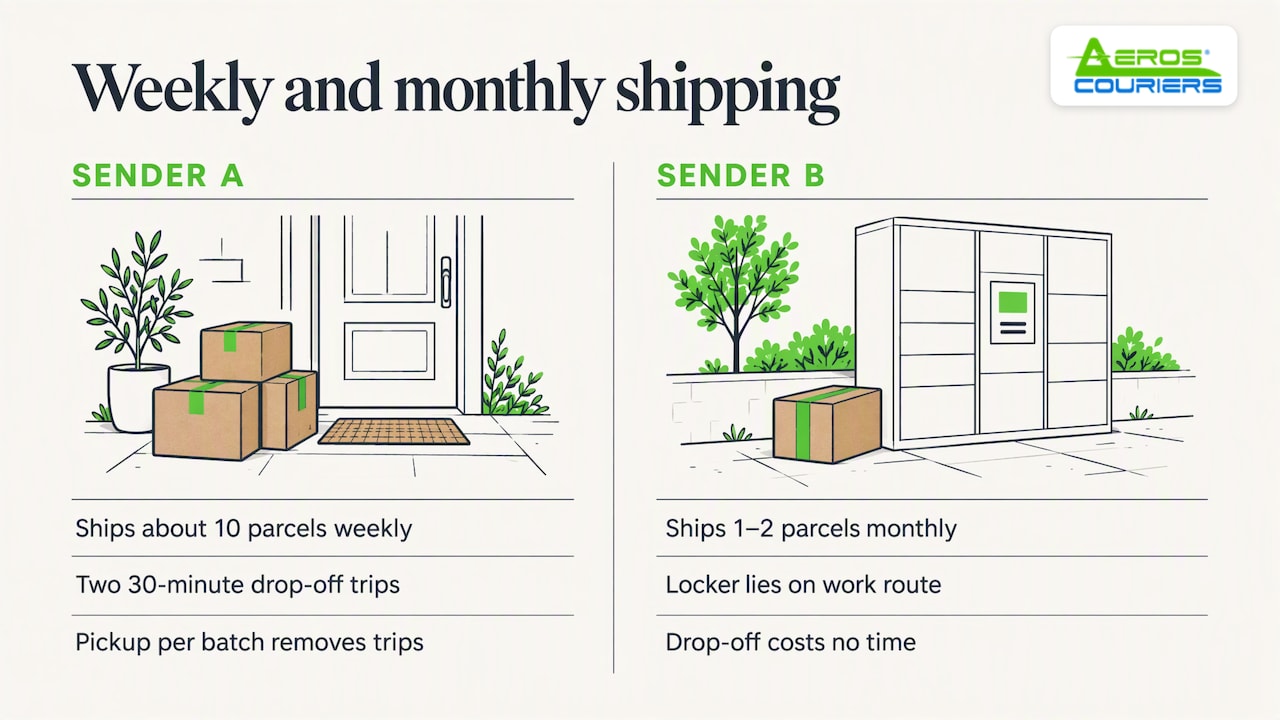
Sender B sells vintage books occasionally. He ships one or two parcels a month and walks past a parcel locker on his way to work. For him, drop-off costs nothing in time. He books online, prints the label and drops the parcel in on the way. A pickup would add little, and a pickup fee, if the service charged one, would be pure cost.
The same rule explains both cases: count the trips you would make, not just the parcels you send.
Common mistakes to avoid
- Dropping off at the last minute. Arrive well before the last dispatch time, particularly on Fridays and before public holidays.
- Booking pickup without preparing. A parcel that is not ready when the driver arrives can mean a missed collection and a delay of a day or more.
- Declaring the wrong dimensions. Measure the packed parcel, not the item inside it.
- Assuming every location takes every service. Confirm the location accepts your carrier and parcel type.
- Ignoring tracking updates. A “drop-off” or “received” status just means the carrier has the parcel. If it does not change after the next collection time, contact support.
- Choosing on headline price alone. Add all fees and the cost of your own time before comparing.
FAQ
Is courier pickup more expensive than dropping a parcel off?
Not always. Some services charge a pickup fee and others include collection in the price, so read the total before you pay. Remember that drop-off costs you travel time and fuel, which can outweigh a small pickup fee if you send several parcels.
Does a drop-off parcel travel slower than a picked-up one?
Once a parcel is in the network, it moves the same way. The difference is the starting point: a parcel handed over after a location’s last dispatch time may wait until the next business day. Check the cut-off time and drop off earlier in the day.
What is a drop-off point?
A drop-off point is any location where a carrier accepts parcels from senders. That can include a counter, a licensed agent, a parcel locker or a drop box. Confirm that it accepts your carrier, service and parcel size before you travel.
What should I do if nobody is home for the pickup?
Leave clear instructions when you book, such as a safe place or a reception contact, and keep your phone on during the window. If a pickup is missed, rebook as soon as you can and check whether a fee applies.
Which is better for an online shop?
Pickup is usually better once you ship regularly, because it gives a predictable dispatch scan and saves daily trips. Drop-off still works for the occasional single parcel or a one-off return.
Sources
Recommended
- Your Guide to Seamless Auspost Courier Pick Up
- Parcel Pickup Service Australia: Book, Pack and Track
- How to Find a Reliable Courier for Your Australian Business
- Finding the Best Courier for Small Business in Australia
Courier quotes, tracking and support
Ready to send a parcel? Compare the available services for your postcodes, parcel dimensions and weight. For an existing delivery, use your consignment number to check tracking or ask our team for help.