The most popular advice about shipping boxes double wall sellers love to repeat is simple, and it's often wrong: two walls beat one, so always upgrade. That's a comforting rule if you're selling board. It's a costly rule if you're paying for parcels.
A double-wall carton can save a heavy, fragile parcel on a rough regional run. It can also waste money on soft clothing, hide a loose product that rattles itself to pieces, and inflate your cubic weight charge until a light box bills like a heavy one. You're not buying a label. You're buying fit, compression strength, dry board and honest dimensions. Get those four right and you'll protect goods across Australia without paying to ship air. Get one wrong and an extra wall won't rescue you.
This guide stays with local and Australia-wide cartons and parcels at the cheapest sensible price. No pallets, no building stacks for forklifts. Just fast box and parcel delivery, packed properly the first time.
When Double Wall Beats a Single Wall Carton
Double-wall is not always safer. Start there, because that one idea will save you more money than any bulk box discount. A double-wall shipping box earns its keep when your parcel is heavy, fragile or likely to be stacked and knocked about. It's wasted money when the carton is mostly air.
Work boots protect your feet on a building site. They don't make a beach walk better, and boots two sizes too big will trip you up. Cartons work the same way. The right protection in the wrong size still fails.
Choose by the goods, not the label
Bunnings' packaging guidance notes that flute type and board thickness affect strength, while the Box Compression Test (BCT) measures a carton's ability to withstand stacking during storage and transport. That guidance also warns that excessive empty space allows products to move and increases damage risk. In plain terms, a large double-wall box can perform worse than a correctly sized single-wall carton with suitable internal protection.
That warning shapes the whole choice. Product weight, dimensions, stacking, void space, handling and moisture matter more than wall count alone. Use the table to find your row before you think about price, print or branding. If presentation matters once the size is right, you can browse printed packaging options to see how a correctly sized carton can also carry your brand well.
Double-wall or single-wall for Australian parcels
| Parcel situation | Choose | What makes it work | Watch-out |
|---|---|---|---|
| Soft goods under about 5 kg | Single-wall | Snug carton, void fill, taped seams | Extra wall rarely pays |
| Dense goods about 10 to 20 kg | Double-wall | BC flute and a higher ECT | Cubic weight if the carton is oversized |
| Fragile ceramics or glass | Double-wall plus cushioning | Inner wrap so nothing can shift | Wall count alone does not stop breakage |
| Multi-day regional route, heavy or stacked | Double-wall | Strong board and a dry handoff | Humidity can erase the gain |
| Large carton with big empty space | Smaller single-wall or double-wall | Cut voids before adding board | A big double-wall can cost more and protect less |
Walk the rows with real parcels
Say you're sending folded apparel under about 5 kilograms in a tight carton. Stay single-wall, fill the small gaps, and tape the seams. The clothes can't punch through the liner, and an extra wall adds cost and bulk without adding useful protection.
Now picture books, hardware or bottled pantry lines at roughly 10 to 20 kilograms. That dense load presses outward on the panels and downward when other parcels sit on top. Move to double-wall, ideally BC flute with a higher ECT rating, and keep the carton snug so the corners can do their work.
Ceramics and other breakables need a different mindset. Two flutes won't stop a loose mug swinging inside the box and striking the wall from within. Choose double-wall plus inner cushioning around every piece, with no movement when you shake the closed carton gently. If you want a step by step method for wrapping each item, our guide on how to pack fragile items for courier delivery walks through the layers in order.
Practical rule: If you can hear or feel the contents shift, you don't need a thicker wall first. You need a smaller carton or better cushioning.
Multi-day regional routes favour double-wall only when the carton will be stacked or the contents are heavy. Distance alone doesn't crush boxes. Handling, weight from above and damp conditions do.
The last row is the one most listings skip. An oversized double-wall carton with large voids can protect less than a smaller, well-filled single-wall box, and it can cost more once unused space lifts cubic weight. Cut the void before you add board.
Australia Post specifies corrugated cardboard construction with a minimum 3 mm outer-shell width for sturdy packaging, and its supplier requirements state cartons must be strong enough to prevent collapse or product damage throughout storage, transport and delivery, according to the Australia Post parcel freight preparation guide. Treat that as your floor, not your finish line. Match your goods to one row now, then size and rate the carton properly.
How a Double Wall Board Is Built
Picture a sandwich made of springs, not a solid brick. That's the easiest way to understand corrugated board, and it explains why a light box can be surprisingly strong.
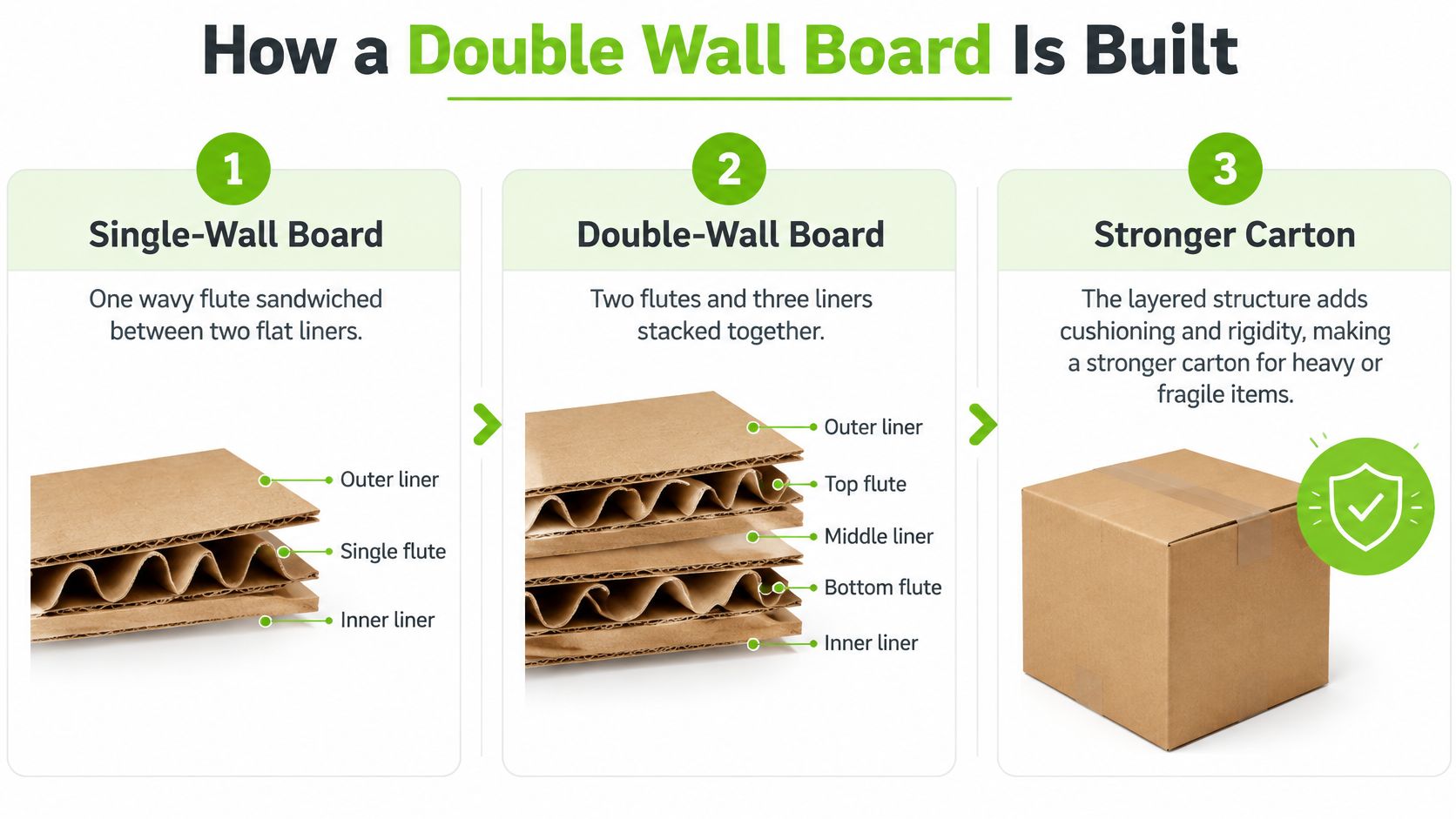
Single-wall board is one wavy layer, called a flute, glued between two flat sheets called liners. Double-wall board stacks two flutes and three liners together. A common parcel single-wall in B flute is about 3 millimetres thick, while a typical double-wall is about 6 to 7 millimetres. The waves create air pockets that absorb knocks, and the flat liners hold those waves upright so they don't fold sideways.
Say you're holding offcuts from two cartons at a packing bench. Bend the thin one and it flexes easily. Bend the thicker one and it resists, because the second set of springs shares the load. That extra stiffness is what you're paying for.
The names you'll see on a spec sheet
B flute has finer, closer waves and gives a smoother outer face that prints neatly. C flute is taller, so it offers a little more cushioning and compression strength. Most double-wall shipping cartons combine them as BC flute, with a flatter outer face over a taller inner wave.
Don't stop at the letters. Liner weight still decides much of the result. A heavy liner on a single-wall board can resist punctures better than a thin recycled liner on a cheap double-wall board. That's why "double wall" on a listing isn't a grade. It's only a description of how many wavy layers are inside.
Two quick checks keep you out of trouble:
- Note the flute letters: Ask for B, C or BC in writing, not just "strong board".
- Note the board thickness: Confirm about 3 mm for light single-wall or about 6 to 7 mm for typical double-wall.
- Ask about the liner: A sturdier outer liner helps with scuffs, tape grip and puncture resistance.
This layered build also sits inside a very large Australian recovery stream. A NSW material-flow study published through PMC found Australia placed approximately 2,538,700 tonnes of corrugated cardboard packaging on the market in 2020 to 21, while New South Wales accounted for about 874,700 tonnes. Your double-wall box isn't a separate disposal category. It's a higher protection format within that same fibre system, which is why clean and dry matters later.
If your parcel is bulky as well as heavy, check size as carefully as board build, especially before you look at ways to send big parcels cheaply. Once you can name the flute and liner, you're ready to turn that build into a strength number you can order.
ECT and Compression Ratings That Decide Strength
Two numbers turn that sandwich of springs into something a supplier can quote. Learn what each one measures and you'll rarely overbuy board again.
Edge Crush Test, or ECT, presses a small piece of board on its edge until it crushes. It's the number most carton makers print, commonly 32, 44, 48 or 51 ECT. Box Compression Test, or BCT, crushes the finished, empty carton from top to bottom. That's much closer to what stacking in a depot asks of your box.
They don't always agree, and the reason is simple. A high ECT board made into a very wide carton can still buckle, because a large unsupported panel loses stiffness as it gets bigger. Think of a sheet of ice on a small pond compared with a wide lake. The material is the same, but the wide span flexes first.
A buying shorthand you can use today
Use these bands as a starting point for ordinary Australian parcels, not as a guarantee for every product. Fit and cushioning still sit on top of the rating.
Working board bands for parcel cartons
| Board | Typical ECT | Approx. thickness | Best parcel job |
|---|---|---|---|
| Light single-wall, B flute | 32 ECT | About 3 mm | Light snug cartons |
| Heavy single-wall | 44 ECT | About 4 mm | Mid-weight cartons with little void |
| Standard double-wall, BC flute | 48 ECT | About 6 mm | Most protected everyday parcels |
| Heavy double-wall | 51 ECT | About 7 mm | Dense loads near parcel weight caps |
Read the table like a ladder. 32 ECT suits snug light parcels where nothing dense is pressing on the walls. 44 ECT covers mid-weight cartons when the fit is tight and voids are small.
48 ECT BC double-wall is the everyday protected parcel for many sellers. It handles heavier contents and depot stacking better than light board without jumping to the thickest option. 51 ECT suits dense loads heading toward parcel weight caps, where panel bulge and corner strength matter on every handling.
A burst rating tells you about a sharp puncture pushing through the board. It doesn't tell you how the carton copes with a stack sitting on it for days.
What to ask before you commit
Don't order "double-wall, medium, strong". Ask for three things in one line: ECT, flute combination and carton dimensions. For a valuable product line, also ask for a BCT result at the product mass with your actual internal cushioning inside. Australian packaging laboratories can run transport condition performance testing against recognised methods including ASTM, ISO, TAPPI and ISTA, covering drop, vibration and compression checks.
That testing matters because damage is rarely one dramatic event. It's usually a drop, then vibration that loosens the fit, then weight from above. A lab sequence copies that order better than a single squeeze test.
Protection also has limits you should understand before you rely on cover. Reading how insurance for courier shipments works helps you separate good packing from wishful thinking. Insurance doesn't replace board strength, and board strength doesn't replace honest packing.
Specify a row from the table, not the marketing label. When you can say "48 ECT, BC flute, snug fit", you've given a supplier something measurable. That's when shipping boxes double wall choices stop being guesswork.
Size the Carton Before Cubic Weight Does
A stronger wall still has to fit a parcel network, and it still has to be priced fairly. Many good packing decisions end up becoming expensive ones.
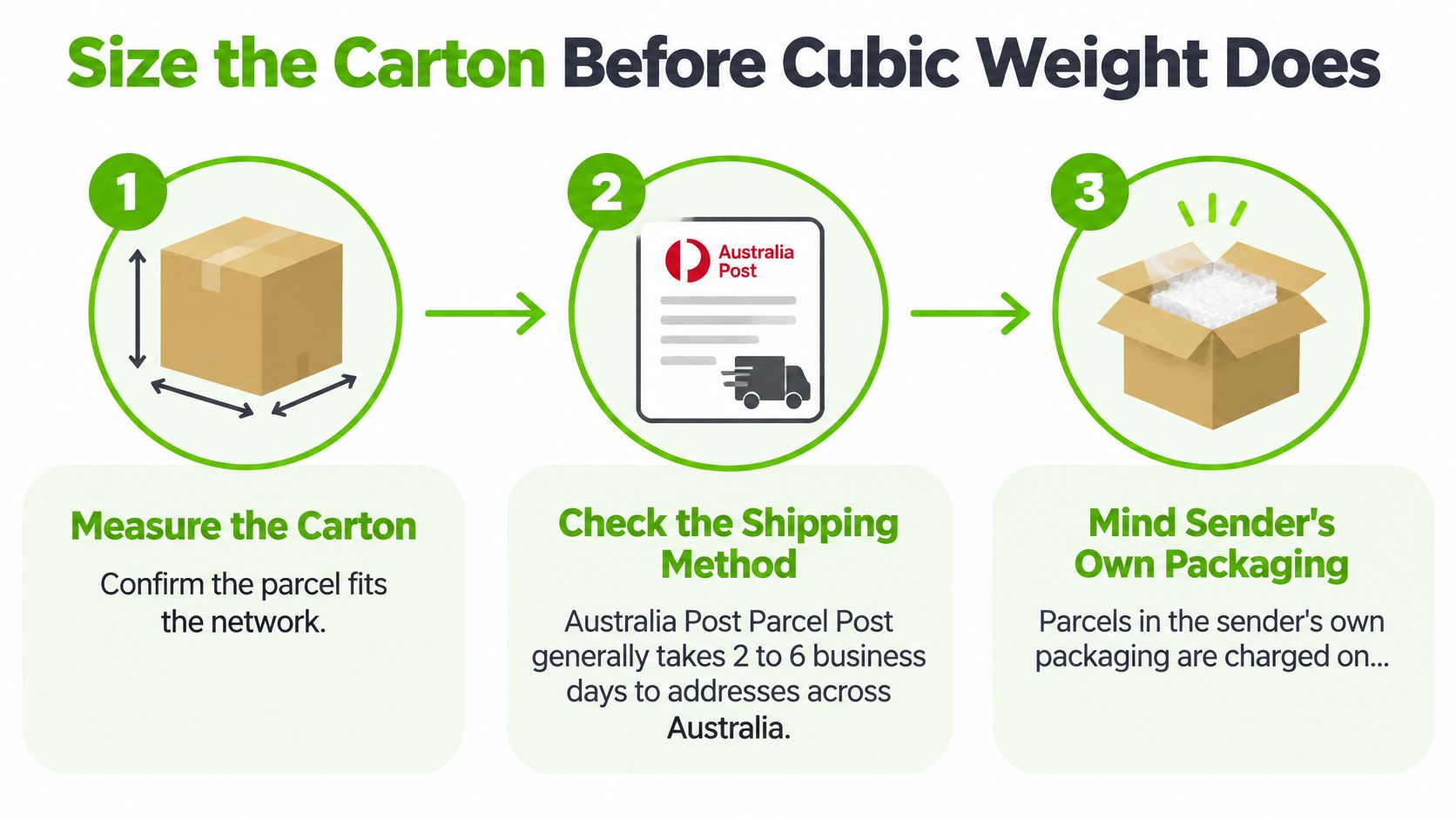
According to Australia Post's Parcel Post information, Parcel Post generally takes 2 to 6 business days and covers addresses across Australia. Parcels using the sender's own packaging are charged according to the greater of actual weight or cubic weight, plus destination. Domestic parcels can be sent up to 22 kg, with a maximum length of 105 cm and a maximum volume of 0.25 cubic metres.
Read that charge rule twice. If your light product sits in a huge double-wall carton, you may pay for the space, not the scale weight. Tough board protects goods. Oversized board can tax you for air.
Australia Post own-packaging parcel limits
| Rule | Limit or method | Why it matters for double-wall |
|---|---|---|
| Parcel Post timing | Generally 2 to 6 business days Australia-wide | Strength has to survive the longer regional runs |
| Charge basis | Greater of actual weight or cubic weight, plus destination | A light oversized carton can cost like a heavy one |
| Maximum weight | 22 kg | Heavy double-wall loads must stay under the cap |
| Maximum length | 105 cm | A long carton can fail even if weight is fine |
| Maximum volume | 0.25 cubic metres | Extra board plus empty space can blow the limit |
Measure only the finished pack
Don't measure the empty box from a supplier listing and hope. Pack it exactly as it will travel, tape it, then work through these steps. We ask customers to have parcels measured and weighed fully packed, including packaging, before quoting, because that's the parcel the network handles.
- Measure length, width and height in centimetres: Measure the packed box to the largest point, including any bulges, tape ridges or protruding parts.
- Weigh the whole parcel: Include the carton, cushioning, tape and labels before you quote.
- Estimate cubic weight: Multiply length by width by height in centimetres, then divide by 4000. Our cubic weight formula guide shows the working if you want to check your maths.
- Compare the two weights: If cubic weight is higher, shrink the carton or remove empty space rather than adding more board.
- Declare the true outer size: Charges apply if a box is declared smaller than its actual size, so honesty is also the cheapest option.
Here's a worked example. A 40 × 30 × 30 cm double-wall carton has a cubic weight of 40 × 30 × 30 ÷ 4000, which equals 9 kg. If the packed contents weigh only 3 kg on the scale, the parcel is charged on the 9 kg cubic figure.
Now repack the same goods snugly into a 30 × 25 × 20 cm carton. The cubic weight becomes about 3.75 kg. You've kept the same board idea and protection, but you're now billed on about 3.75 kg instead of 9 kg. That's real savings created with a tape measure, not a discount code.
Shrink the box before you thicken the wall. Removing air usually saves more money than changing board grade.
Bottles show this sizing lesson well because dividers, neck protection and empty headspace all fight for room. If you're packing drinks, Carbon 6 Brewing's beer box guide is a useful reference for how bottle cartons balance protection with a compact outer size.
Keep this to cartons and fast parcels Australia-wide, not pallet building. Quote only after both postcodes and the honest packed size are known. That's how you chase the cheapest price without guessing.
Humidity and the Strength You Thought You Bought
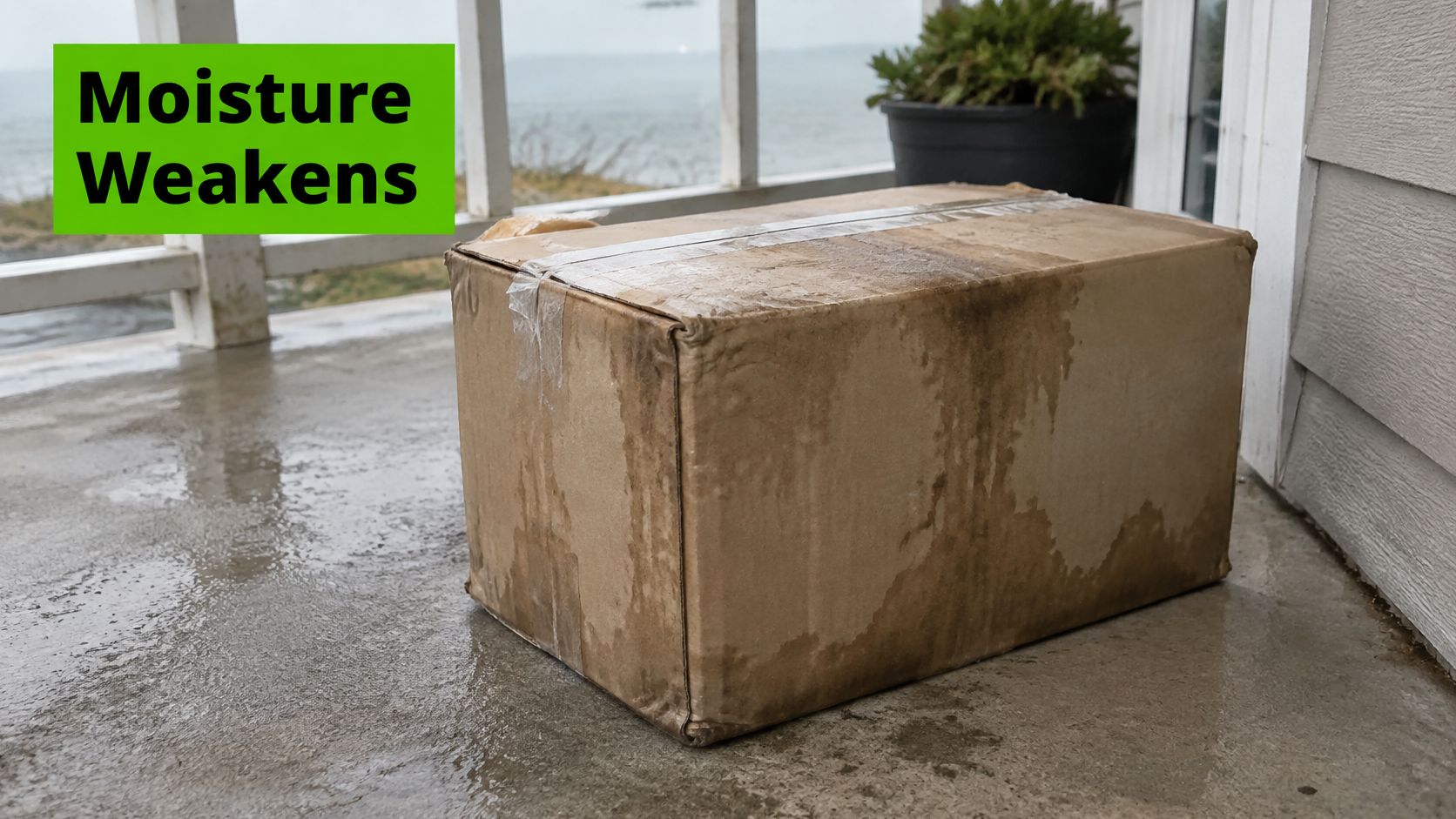
Dry board is strong board. Wet board is a promise you already paid for, fading on a veranda.
Corrugated fibre drinks moisture from humid air, damp floors and rain. As the flutes soften, the carton loses compression strength, so panels bow and corners fold under loads they carried easily when dry. A double-wall carton left on a coastal porch, in a damp warehouse or in a hot delivery van can surrender much of the stacking strength that made it look like the safe choice.
Australian parcel life makes that ordinary. You've got coastal humidity, regional runs, outdoor pickups and temperature swings between a cool depot and a hot delivery vehicle. The box never needs to be soaked to weaken. Repeated damp air alone softens the springs inside the wall, the same way a dry sponge and a wet sponge both hold their shape but only one pushes back.
What extra board can and cannot do
Extra flutes improve puncture resistance and dry stacking strength. They don't replace a moisture plan, and they don't make an oversized carton sustainable. That distinction matters because sellers often reach for thicker board when the actual problem is where the parcel waits for pickup.
The Australian Glass and Winegrowing packaging guideline recognises single, double and triple wall corrugated fibreboard and recommends considering shrink or stretch wrap to reduce moisture changes and possible contamination or damage during storage and distribution.
For ordinary parcels, keep cartons indoors and off wet decks until the courier collects. In a damp season or on a coastal route, add a light stretch or shrink wrap around the finished carton. Wrap works like a raincoat here. Pull it so tight that the panels bow inward and it becomes a clamp instead, preloading the walls before the journey even starts.
- Store flat cartons dry: Keep unused boxes away from exterior walls, mops and leaking pipes.
- Stage packed parcels under cover: A dry handoff protects the rating you paid for.
- Wrap lightly when needed: The wrap sheds rain; it should never squeeze the box.
- Right-size first: Less board and less air usually beat extra board wrapped tightly.
Now weigh the trade-off. One avoided damage claim can justify stronger board for a fragile, valuable item. For a light, soft product, extra fibre plus extra cubic centimetres may only create waste and a higher charge. A clean, dry, right-sized carton stays easy to recycle. A soaked, tape-heavy, oversized one fights the whole idea.
Pallet wrapping sits outside this parcel advice. Your practical standard is simpler and stronger: double-wall plus a dry handoff, never double-wall instead of one.
Check Dangerous Goods Then Book Australia Wide
A stronger carton works like a sturdier suitcase: it protects ordinary contents well, but it cannot turn itself into an approved container for regulated goods. Check the goods before you choose the box, and you will never book a parcel that should not travel in a standard carton.
Double-wall construction does not automatically satisfy Australian dangerous-goods packaging rules. For regulated items such as aerosols, chemicals, paints or batteries, the Australian Dangerous Goods Code guidance on inner packaging performance requires packaging to meet set performance requirements and, except where an exemption applies, to be tested and approved by a competent authority. Cartons count among the packaging types covered, so the approval applies to the box itself as well as to what sits inside it.
A conventional double-wall carton can be a sound outer for ordinary goods and still fall short as certified dangerous-goods packaging. The tested system is the whole pack: compatible inner receptacles, leak prevention, cushioning, closure security, and resistance to the pressure, puncture and impact that normal transport can produce. Inner packagings must be secured and cushioned so they cannot break, be punctured or leak, and liquid packagings must resist internal pressure that can develop on the road or in the air.
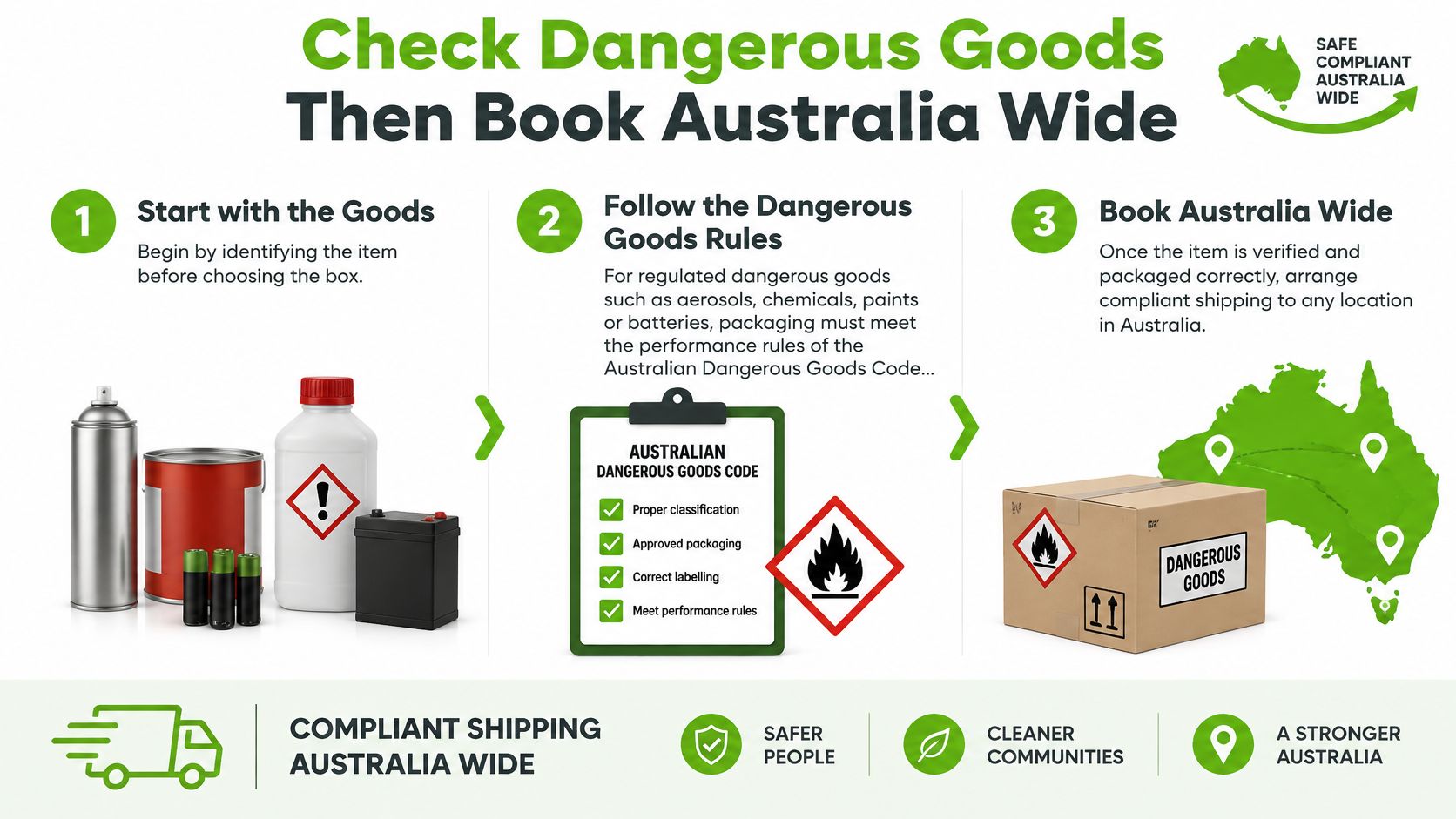
Treat a tested configuration as fixed. Swapping the liner, inserts or tape can invalidate it even when the new box looks stronger, because the approval covers the exact combination that passed testing. If your goods are regulated, stop before booking and use the approved packaging instruction and certification. Our overview of hazardous goods classification helps you recognise when an item needs that closer check.
Know the cover boundary too. Insurance does not cover dangerous goods, fragile items such as glass and other breakables, or boxes that are poorly packaged or not packed properly. Cover reaches $500 per consignment and relies on proof of purchase plus photo proof of the box contents, and shipments worth more than AUD $50,000 must be reported to the carrier before dispatch. Good packing is the condition that keeps every other protection meaningful.
Book the ordinary parcel in the right order
Once you have confirmed the goods are ordinary, booking takes minutes. The same discipline applies at any distance: whether you send stock to a customer or plan interstate delivery for bridesmaid gifts, the postcode, timing and packed-size checks are identical.
- Match the board to the contents: Choose single-wall, double-wall or double-wall plus cushioning from the grades in this guide.
- Use the smallest honest carton: Protect the goods without leaving large voids.
- Measure and weigh the packed parcel: Measure length, width and height to the largest point, bulges included, and weigh it fully packed, then compare actual weight with cubic weight before you pay. Declaring a box smaller than its real size triggers charges.
- Enter both postcodes: Have the collection and destination postcodes, packed dimensions and weight, each address type (residential or commercial) and any access requirements ready for an instant quote.
- Pay, print and place the label: Attach it flat on the box with accurate pickup and delivery addresses, clear of old barcodes and tape joins. Reused barcodes and insufficient addresses each draw a fee.
- Hand over a dry parcel: Keep it covered and ready for pickup.
Check the parcel boundary before you tape the box. The maximum box size is 80 cm length, 60 cm width and 60 cm height, with a maximum dead weight of 20 kg, and goods above that size incur further charges based on the item. Within eligible services, boxes up to 25 kg can be sent from $4.90, with the final price set by route, packed dimensions, weight and selected service. Items that arrive poorly packed also attract a $2.50 re-packaging cost, so the carton choice you make now is the cheapest part of the whole job.
This guide has stayed with cartons and parcels, though the same platform also handles satchels and palletized freight when a consignment outgrows a box. For an ordinary parcel, the saving comes from the right carton, honest measurements and a fast booking rather than from a bigger box. Choose shipping boxes double wall where the goods call for them, and you will send with confidence every time.
Pack your next parcel in the smallest carton that protects it, measure and weigh it fully packed, then book fast local or Australia-wide delivery with Aeros Couriers. You'll get an instant quote from your postcodes and packed dimensions, print your label in minutes, and hand over a dry, ready parcel for pickup. Start your quote today and pay for protection, not wasted space.
Courier quotes, tracking and support
Ready to send a parcel? Compare the available services for your postcodes, parcel dimensions and weight. For an existing delivery, use your consignment number to check tracking or ask our team for help.