
You can get bulk shipping discounts in Australia in three ways. You can use a business account that discounts by spend, negotiate a contract once your volumes are steady, or book through a platform that has already pooled volume with major carriers. Which one suits you depends on how many parcels you send, how heavy they are and where they go. This guide covers how each route works, what volumes are expected and which charges to check before you compare rates.
TL;DR
- Discounts in Australia come as spend-based bands, negotiated contract rates, or pooled rates through a booking platform.
- Negotiated carrier contracts are usually aimed at senders with steady volume, often cited as 150+ parcels a month, so smaller senders need another route.
- Parcel weight, cubic size, destination and speed move your price as much as the discount does.
- Compare the total cost, including surcharges, not the headline rate.
- At Aeros Couriers you can compare rates from major carriers and book parcels up to 25kg with no subscription.
Table of Contents
- How bulk shipping discounts work in Australia
- What volumes do you need to qualify?
- Price increases change the maths
- What actually drives your parcel price
- Charges to check before comparing bulk rates
- How to negotiate if you have the volume
- Bulk discounts without a contract
- Our perspective
- Book discounted parcel delivery with Aeros Couriers
- A simple way to choose your route
- FAQ
- Sources
How bulk shipping discounts work in Australia
A bulk discount is a lower price per parcel in return for sending more, or sending more predictably. Carriers value volume they can plan around, so the discount is tied to what you ship, not just how much.
In practice the discount arrives in one of three forms:
- Spend-based bands. A business account gives you a percentage off the standard rate. The band moves up as your spend over a recent period rises. There is usually no contract.
- Negotiated contract rates. The carrier sets a rate card for you based on your annual volume, weight profile and destinations. You get the lowest rates, but you need volume to qualify.
- Pooled platform rates. A courier platform books huge volumes across many senders, then passes the lower rates on to each sender, including those who ship a handful of parcels a week.
The third route is the one most small senders overlook. If you are sending 20 parcels a week, you do not have the leverage to negotiate, but you can still benefit from someone who does.
What volumes do you need to qualify?
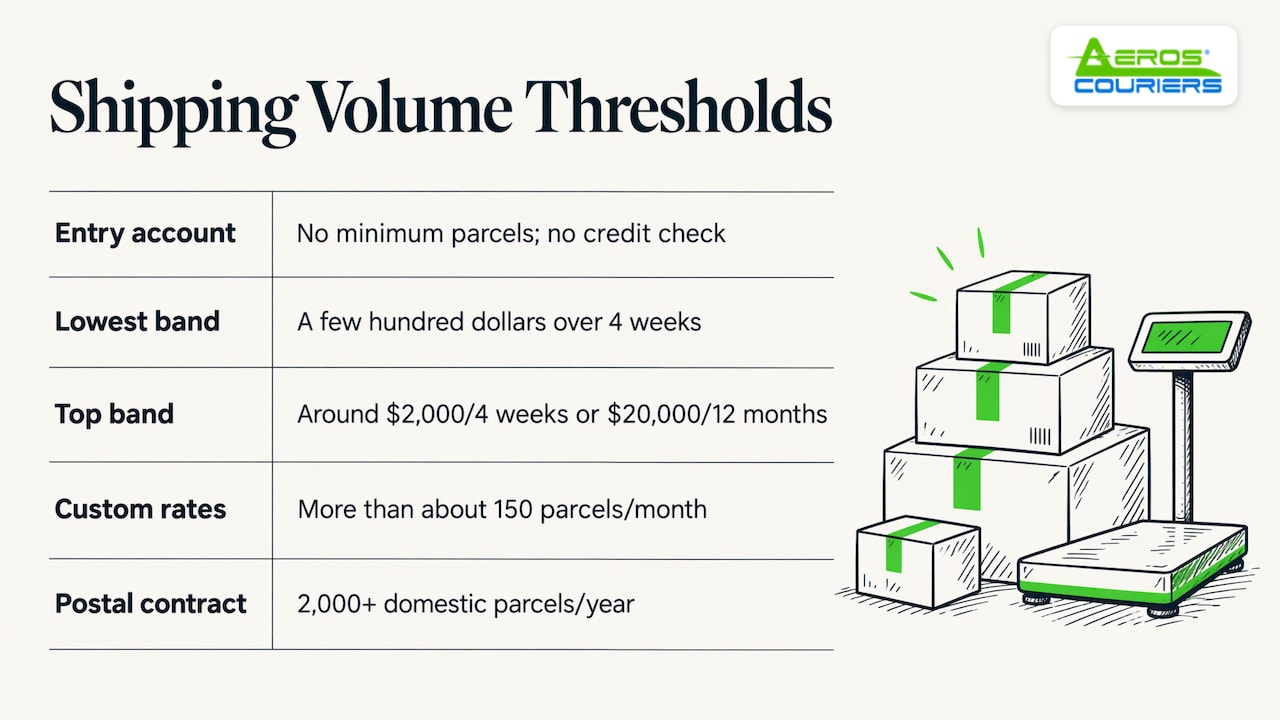
There is no single national threshold. Entry-level business accounts usually take anyone, with no minimum parcel count and no credit check. The discounts then grow with spend. Published guidance on those bands describes the lowest band starting at a few hundred dollars of spend over four weeks, and the top band starting at around $2,000 over four weeks or $20,000 over 12 months, as reported in this account guide.
Full contracts are a different matter. Carriers commonly look at senders who ship more than about 150 parcels a month on a consistent basis before they discuss custom rates, and they weigh how predictable the volume is, how fast it is growing and where the parcels go. Contract tiers for the national postal carrier are reported to need 2,000 or more domestic parcels a year, according to one ecommerce comparison. Treat these as guides and confirm the current terms with each carrier.
That leaves a wide gap. A sender at 30 to 50 parcels a week is too big for retail pricing to feel fair, yet too small for a contract. A small business owner described this squeeze in a 2026 SmartCompany piece: about $19,290 spent on postage in a year, roughly $1,500 a month, at an average of $9.28 a parcel. That is the profile where pooled rates matter most.
Price increases change the maths
Percentage discounts are only as good as the rate they come off. Standard domestic and international parcel rates from the national postal carrier rose on 1 July 2026, and because business account discounts are a percentage off those standard rates, the base is now higher even though the bands are unchanged.
The lesson is to compare the final price per parcel for your own profile, not the size of the discount. A 30% discount on a high base can cost more than a 15% discount on a low one.
What actually drives your parcel price
Before you chase a discount, understand what you are discounting. Four things set the base price.
Weight and cubic size
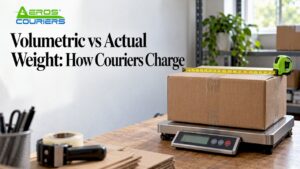
Carriers charge on the greater of actual weight and cubic weight. Cubic weight is worked out from the parcel’s outside dimensions: length × width × height in metres, multiplied by the carrier’s conversion factor. One national carrier uses 250 kg per cubic metre, and other couriers can use different factors.
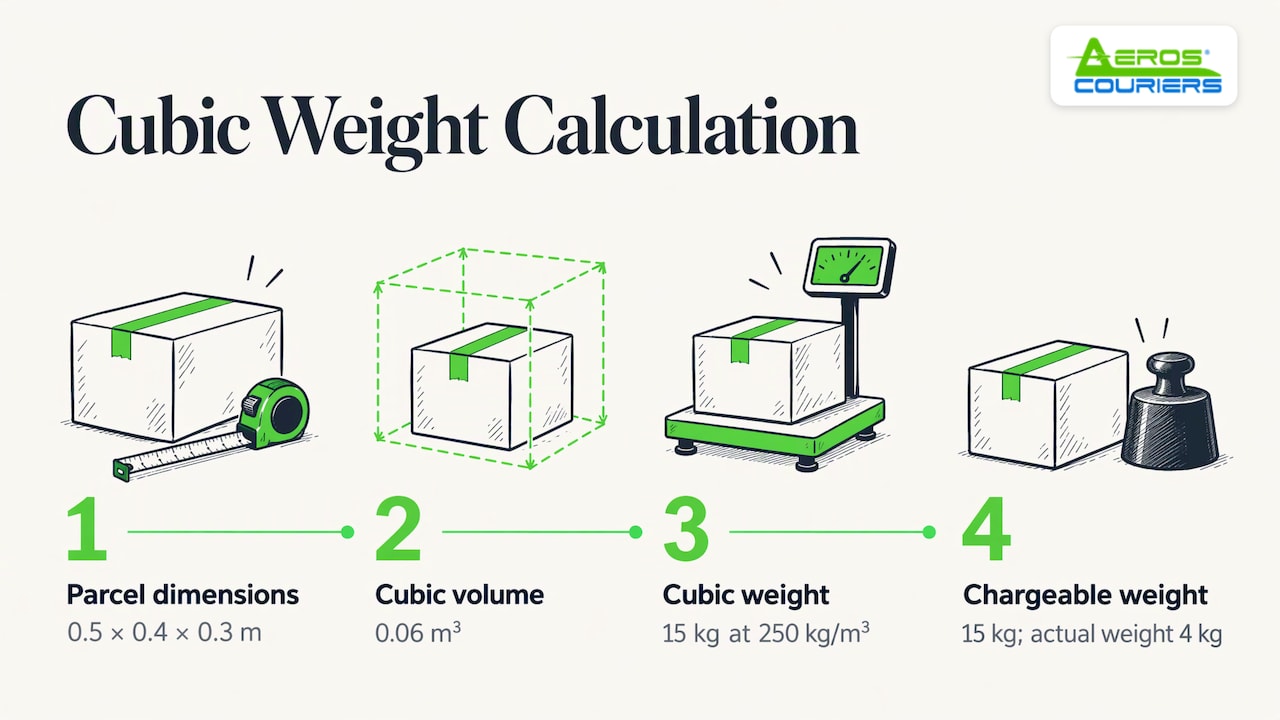
A worked example: a box measuring 0.5 m × 0.4 m × 0.3 m is 0.06 cubic metres. At 250 kg per cubic metre, that is 15 kg of cubic weight. If the contents weigh 4 kg, you pay for 15 kg. Switching to a snug box half the size would roughly halve that charge.
Destination
Metro-to-metro is the cheapest lane. Regional and remote destinations cost more, and some carriers add remote-area charges on top. If most of your customers are in Sydney, Melbourne and Brisbane, your blended cost will be lower than a seller shipping to rural postcodes. This is why a discount band quoted as a headline figure can mislead: the same band is worth far less on a rural lane.
Delivery speed
Standard, express and same-day are priced differently, and the gap is large over short distances. Most small senders do best by shipping standard as the default and keeping express for time-critical orders.
Pickup, labels and extras
Door-to-door pickup, signature on delivery, insurance and residential delivery can each change the total. Our guide to residential delivery surcharges explains how those fees appear and how to plan for them.
Charges to check before comparing bulk rates
Two quotes can look identical at the top and differ by 15% at checkout. Check this list line by line.
| Charge | What to ask |
|---|---|
| Fuel surcharge | Is it included in the rate or added later? |
| Handling or oversize fees | At what size or weight do they apply? |
| Residential delivery | Is there an extra fee for home addresses? |
| Remote-area delivery | Which postcodes, and how much? |
| Redelivery | What do you pay if a delivery fails? |
| Insurance | Is cover included, and up to what value? |
| Cubic weight factor | What conversion factor is used? |
Australian consumer law also sits on your side here. The ACCC treats revealing extra fees late in an online purchase as misleading drip pricing, so businesses are expected to show the total price clearly. When you compare, favour providers that show one all-in price before you pay.
For a deeper look at how rates are built, see our guides to post parcel rates and ecommerce shipping costs.
How to negotiate if you have the volume
If you do ship at contract scale, preparation decides the result.
- Gather six months of data. Include parcel count by month, weights, dimensions and destination mix. This is the evidence carriers want, and it is the basis of any like-for-like comparison, as carrier comparison guidance points out.
- Project growth. Carriers price predictability. Show your forecast for the next 12 and 24 months.
- Contact the right team. Go to business development or account management, not the general customer service line, as one ecommerce consultancy advises.
- Bring competing quotes. Quotes from other carriers or platforms are your leverage.
- Negotiate the extras. Remote-area, oversize and redelivery fees can matter as much as the base rate.
This route takes time, and the result is a rate card tied to one carrier. If your volumes fluctuate, a platform that compares several carriers can keep your options open.
Bulk discounts without a contract
Most small businesses and individuals sit below contract thresholds, and that is fine. Three habits will lower your cost per parcel regardless of volume.
- Right-size your packaging. Cubic weight rewards snug boxes. Measure your top five products and pick the smallest box that protects them.
- Batch your bookings. Booking in one session with one pickup keeps your admin time down and makes your volume easier to compare over time.
- Book through pooled rates. Our guide to getting the cheapest rate on satchels and parcels walks through matching the parcel type to the service.
If you also move pallets or furniture locally, hourly benchmarks help you judge quotes. Current Sydney truck and driver prices show what a dedicated vehicle costs per hour, which is useful when deciding between a courier and your own run.
For heavier items, see how to send big parcels cheaply across Australia.
Our perspective
Most advice on bulk shipping assumes you already have bulk. We built Aeros Couriers for the senders who do not: small businesses, online sellers and individuals who ship a few parcels a week and still want a fair rate.
Our approach is to compare rates from major carriers in one place, so you see the options for your parcel and pick one. Our pricing is designed to be transparent, with no hidden fees such as fuel surcharges or handling costs, so the price you see is the price you plan around.
We also think support matters more than most senders expect until something goes wrong. That is why we offer responsive Australian customer support, active parcel tracking, included insurance and a rewards program that can reduce the cost of future bookings.
Volume discounts should not be a club for large senders. Pooled rates, clear pricing and a simple booking flow are how we make them available to everyone.
Aeros
Book discounted parcel delivery with Aeros Couriers
If you want carrier rates without negotiating a contract, you can compare and book with us online. We cover Australia-wide parcel delivery up to 25kg, with express and same-day options, door-to-door pickup, printable labels, shipment tracking and insurance. There is no subscription: you pay per shipment.

Start with our parcel delivery service page, check your price on the shipment rate page, or use compare and book couriers for freight. Our rewards program can bring further savings on later bookings.
A simple way to choose your route
Use your weekly parcel count as a starting point.
| Weekly parcels | Likely best route |
|---|---|
| 1 to 10 | Pooled platform rates; no account to maintain |
| 10 to 50 | Pooled platform rates, or a business account if your spend reaches higher bands |
| 35+ with steady growth | Start gathering data for a contract conversation, while using comparison to benchmark |
Revisit this every quarter. Your mix of weights and destinations will change, and so will carrier pricing. Our business postage account guide and Australian courier companies guide can help you review your set-up.
FAQ
Can a small business get bulk shipping discounts?
Yes. Entry-level business accounts generally have no minimum parcel count, and discounts rise with your spend. A courier platform that pools volume across senders can also give you lower rates at any size. Compare the total cost for your own parcels.
How many parcels do I need to negotiate a carrier contract?
There is no fixed rule. Published guidance commonly points to consistent volumes above roughly 150 parcels a month, and carriers also weigh predictability, growth and destination mix. Prepare six months of data before you approach one.
Why is my parcel more expensive than its weight suggests?
Carriers charge on the greater of actual weight and cubic weight. A large, light box is billed on its size. Measure the outside of the packed parcel and use a smaller box where you can.
What fees should I look for in a bulk shipping quote?
Check for fuel, handling, residential delivery, remote-area and redelivery charges, plus insurance terms. The ACCC expects total prices to be clearly disclosed, so ask for one all-in figure before you book.
Sources
- Online florist ordered to pay $1 million (ACCC)
- MyPost Business bands and eligibility
- Best shipping rates Australia 2026 carrier comparison
- Contract vs retail rates for Shopify stores
- SmartCompany: shipping costs for a small business
- Parcel rate changes from 1 July 2026
- Negotiating shipping rates guidance
- Cubic weight explained
- Sydney truck and driver prices
Recommended
- Ecommerce Shipping Costs in Australia: Cut Freight Expenses
- Unlock the Best Post Rate Australia for Your Shipments
- Discover how to get the cheapest rate with satchels and parcels in Australia.
- Send Big Parcels Cheap Australia-Wide: Your 2026 Guide
Courier quotes, tracking and support
Ready to send a parcel? Compare the available services for your postcodes, parcel dimensions and weight. For an existing delivery, use your consignment number to check tracking or ask our team for help.