The most popular advice on this topic is also the most dangerous. People tell you to check that a forwarder is insured, get the certificate of currency, and move on. That certificate won't tell you who pays when your box goes missing between Sydney and Brisbane, or whether you'll recover the invoice value or a fraction of it. Freight forwarder insurance requirements aren't a single tick box. They're a set of different policies answering different questions, and the gap between them is where small businesses lose money. Get this clear and you can ship fast, ship cheap, and still sleep well.
Freight Forwarder Insurance Requirements at a Glance
Read the cover map before you read the sales pitch. In Australia there is no single universally compulsory policy for forwarders. What applies depends on your role, your vehicles, your contracts, and whether you arrange cover for customers. Six cover types do most of the work for local box and parcel operations.
| Cover type | What it protects | Legal status | Typical limit or requirement |
|---|---|---|---|
| Logistics liability (freight forwarder liability) | Forwarder's legal liability for physical loss or damage to customer goods in its care | Not a universal statutory requirement; set by contract | Limit of indemnity based on maximum accumulated cargo value |
| Public liability | Third-party injury and property damage | Contract-driven; varies by customer | Approximately AUD 10 million to AUD 20 million in many Australian transport agreements |
| Compulsory third-party (CTP) | Personal injury arising from registered vehicle use | Mandatory for each registered motor vehicle in each state | Set by the state scheme; freight loss falls outside it |
| Workers compensation | Employee injury at work | Required for employers under state schemes | Set by the applicable state scheme for employers |
| Commercial motor | Forwarder-owned vehicles and their damage | Depends on vehicle ownership | Agreed or market value of each owned vehicle |
| Goods-in-transit or cargo cover | Value of the customer's goods while in transit | Generally the customer's responsibility; forwarder arranging it may need an AFSL or authorised third party | Declared or insured value per shipment |
Why the split matters
Liability insurance protects the forwarder when it is legally responsible. Cargo insurance protects the value of your goods. Those are different promises, and the difference decides who pays for a lost box.
Work it through on a consignment. If a forklift punctures a crate at the depot and the forwarder is liable, the logistics liability policy responds up to its limit of indemnity. If the crate instead disappears on a subcontracted leg and fault can't be pinned on the forwarder, that same liability policy may pay nothing. Recovery then falls to whatever cargo cover was arranged on the goods, or to the carrier's standard terms.
Public liability draws the most questions in contract reviews. Transport agreements commonly demand limits in the tens of millions of dollars, a figure that dwarfs the value of most parcels. CTP sits beside it as a separate obligation, mandatory for every registered motor vehicle in each state, and it addresses personal injury arising from vehicle use rather than loss or damage to freight. A big public liability limit tells you nothing about what your missing consignment is worth.
The question is never "is the forwarder insured." The question is which policy responds to your shipment.
For sea legs, the framework includes the Carriage of Goods by Sea Act 1991 and the Limitation of Liability for Maritime Claims Act 1989. You don't need to memorise statutes for domestic parcels, but the lesson they carry applies everywhere: contractual liability can be capped well below the value of the goods.
How to use this map
Hold each row against your own contracts and policy schedules. Ask for six things in writing: the limit of indemnity, the exclusions, the excess, the declared value, subcontractor coverage, and the claims deadline. Each one changes what you recover. A low excess means little if the declared value sits below the invoice. Full cover on the forwarder's own trucks means little if the linehaul leg runs through a subcontractor the policy never names.
A forwarder that can't produce those six items is offering a logo and a promise. Fixing that before you book is the cheapest protection you can buy.
Liability Cover Versus Cargo Insurance
Two different parties, two different payouts. A forwarder's liability cover pays when the forwarder is legally responsible and you can prove it. A cargo policy protects the insured value of the goods themselves, subject to its exclusions and conditions. One defends the forwarder's balance sheet. The other defends yours.
Concrete benchmarks help. For domestic parcels, Australia Post's Parcel Post page states that Parcel Post and Express Post include compensation of up to $100 for eligible loss or damage, and senders can purchase Extra Cover for the specified item value, up to $5,000 or part thereof. Parcel Post delivery is estimated at 2 or more business days, which suits most fast domestic sending, but speed doesn't lift the compensation cap.
| Shipment route | Included recovery | Optional or higher cover | Use it when |
|---|---|---|---|
| Australia Post Parcel Post | Compensation up to $100 for eligible loss or damage | Extra Cover up to $5,000 for the specified item value | Item value is above $100 |
| Australia Post Express Post | Compensation up to $100 for eligible loss or damage | Extra Cover up to $5,000 for the specified item value | Time-critical item value is above $100 |
| Declared-value cargo policy | Insured value stated for the consignment | Higher declared value agreed before the goods move | Consignment value exceeds any carrier limit |
A worked local example
Say you're sending an $800 item to a customer in Melbourne with no optional cover. If it's lost and eligible, the included compensation caps at $100. You carry the remaining $700. The freight price was low, but your exposure wasn't.
That's the trap with low-cost box and parcel shipping. Included cover is a floor, not full protection. The three recovery routes are included carrier compensation, optional extra cover per item, and a declared-value cargo policy for the consignment. Each step up costs a little more and removes a lot more risk.
If you're weighing terminology, this breakdown of transit cover versus insurance is worth reading before you set your store policy.
Decision rule: When the item value exceeds the included amount, buy the extra layer for that consignment. Don't assume the freight charge buys you full recovery.
That's a significant change. You're no longer hoping. You're matching cover to value, shipment by shipment.
Setting Limits, Excess and Declared Value
Set the limit from your worst day, not your average day. Your limit of indemnity should reflect the maximum accumulated cargo value at risk at one time. A courier holding peak-season stock in a depot needs a higher limit than a quiet Tuesday average suggests.
The TT Club guidance on revised standard trading conditions for freight forwarders in Australia makes the core point clearly. Standard trading conditions may cap recovery by weight, package, consignment value, or another agreed amount, policy schedules should state an adequate limit of indemnity based on the maximum accumulated cargo value, not merely average shipment value, and cover should respond while goods are in the forwarder's or subcontractor's care, custody, or control for reward.
| Schedule item | What to confirm | Red flag |
|---|---|---|
| Limit of indemnity | Based on maximum accumulated cargo value, not average shipment | Limit is below your peak stock value |
| Excess | Amount you pay before recovery | Excess is higher than the value of a typical consignment |
| Declared value | Insured value stated per consignment | Declared value is below replacement cost |
| Subcontracted carriers | Cover applies to road, air, depot and sub-haulier stages | Cover ends at your own vehicle |
| Temperature-sensitive goods | Whether temperature variation is covered and in which environments | Wording is silent on temperature |
| Excluded commodities | Named exclusions such as dangerous goods or high-value items | Your product appears on the exclusion list |
| Notice deadline | Days allowed to notify the insurer after loss | Deadline is shorter than your claims team's response time |
The two rows that catch people out
Excess is the amount you pay before recovery starts. If the excess sits above the value of a typical small consignment, the policy won't help you on most losses, however good it looks on paper. Run the maths against your real order values.
Declared value should match replacement cost unless your contract says otherwise. Declaring wholesale cost to save a few dollars leaves you short when you have to remake or repurchase stock at today's prices. I would declare what it costs to make the customer whole.
Temperature-sensitive goods need special care. Cover is often specialised and limited to specified environments such as road, rail, container, warehouse, or cold-storage settings. If your wording is silent, assume you have a gap until someone confirms otherwise in writing.
Before your first booking, request the full policy wording, not only the certificate of currency. Then compare the schedule against your customer contract. If you need numbers for a specific shipment, you can get a shipping insurance quote and test the declared value against the limit before you commit.
Chain of Responsibility Duties That Affect Cover
Insurance doesn't operate in a vacuum. Under Chain of Responsibility provisions in the Heavy Vehicle National Law in participating states, and under work health and safety duties, each party that influences a transport task carries its own legal duties. What each party did before the goods moved decides two things: whether a regulator can act, and whether the cargo owner's policy pays out.

Who owes what
- Sender: Declare accurate weight, value, contents, and dangerous goods. Undisclosed goods can void or limit recovery.
- Packer: Use packaging suited to the contents and weight. Weak cartons and loose fill are a common ground for denial.
- Carrier: Stay within vehicle and load limits and secure the load. Overloading or an unsecured load can breach policy conditions.
- Forwarder or booking business: Keep bookings, labels, and delivery records accurate. Inconsistent records weaken any claim.
- Receiver: Note visible damage on delivery. Damage that isn't noted is hard to prove later.
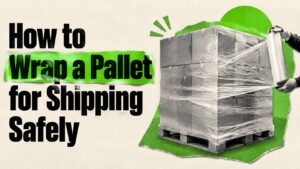
Even for box and parcel work, the same discipline applies, and the guide on how to wrap a pallet for shipping covers load security principles that carry over to cartons. For parcels, that means a carton that holds its shape, internal cushioning that stops movement, and tape sealing every seam. Aeros Couriers handles cartons, satchels and palletised freight, and insurers read the packaging evidence the same way across all three.
How a single lapse ends a claim
Dangerous goods booked as general freight is the clearest case. The carrier doesn't know, the depot doesn't know, and the policy may exclude the item entirely. An understated weight is quieter: the price, the handling method, and the declared value stop matching, and the inconsistency surfaces the moment someone checks the booking against the damage report. A receiver signing clean for a crushed carton because the driver is in a hurry does the same damage at the other end.
Each lapse hands the insurer a reason to pause, and the two exposures run on separate tracks. A Chain of Responsibility breach can bring regulator penalties against whichever party broke the duty. The cargo claim is a different question, decided by the policy wording and the evidence on file, and a lapse anywhere in the chain can give the insurer grounds to reduce or refuse payment.
Write the process down. Declarations, packaging checks, and delivery notation done the same way every time will protect more claims than any premium increase.
None of this requires new spend. The discipline sits in how you declare, pack, label and sign, which means you control it today with a checklist taped to the packing bench.
Compliance Requirements by Operation Type
Start with the split that decides who pays: your liability cover responds to claims that your forwarding or delivery service caused loss, while cargo cover attaches to the goods and is generally the customer's responsibility to arrange. If you arrange that cover for a customer, treat it as regulated activity: you need an Australian Financial Services Licence or an authorised third party, a position reflected in Marsh's transport insurance market trends coverage for Australia. Offering insurance at checkout can be financial-services work.
Plenty of freight still moves with no cargo policy behind it, so never assume a box is covered because it is moving. Carrier liability can be capped by weight under standard terms, which hurts light, expensive parcels: a small carton of electronics or jewellery can lose far more than a weight-based limit returns. Keep the party with the financial interest in the goods aligned with the party named to claim, and read the standard terms before booking.
| Operation | Insurance to hold | Cargo cover position |
|---|---|---|
| Forwarder booking third-party carriers | Logistics liability and public liability | Customer arranges cargo cover unless you arrange it through an AFSL holder or authorised third party |
| Own-vehicle courier delivery | Public liability, CTP, commercial motor and workers compensation | Confirm goods-in-transit wording in the customer contract |
| Online seller shipping cartons and satchels | Carrier liability plus declared-value cover for higher-value items | Cover each shipment by value; check any weight-based limit |
| Small high-value consignments | Declared-value cargo cover per consignment | Included carrier cover is usually insufficient |
| Temperature-sensitive goods | Specialist cargo cover addressing temperature variation | Limited to the environments named in the policy wording |
| Dangerous goods | Disclose, package and label as required, and confirm policy treatment | Exclusions can apply; check before booking |
Reading your row honestly
An online seller shipping cartons and satchels concentrates risk in order value, not vehicle ownership. A satchel of jewellery or electronics needs declared-value thinking. If you run your own vehicles, the stack widens to CTP, commercial motor and workers compensation, and the customer contract decides the goods-in-transit position.
Residential delivery deserves its own evidence habit. Record a signed scan or a dated photo at the door at handover, because an unattended doorstep is where loss disputes start. For dangerous goods, work through hazardous goods classification before you book, not after a depot rejects the parcel.
Goods-in-transit cover is usually imposed by contract or tender rather than statute. Read the contract you signed, not the one you assume exists. Your row in the table is a starting point; the contract is the authority.
How to Lodge a Claim Step by Step
Buying the policy is the easy part. Evidence and procedure decide whether it pays. Treat the claim as a file you build from the moment something looks wrong.
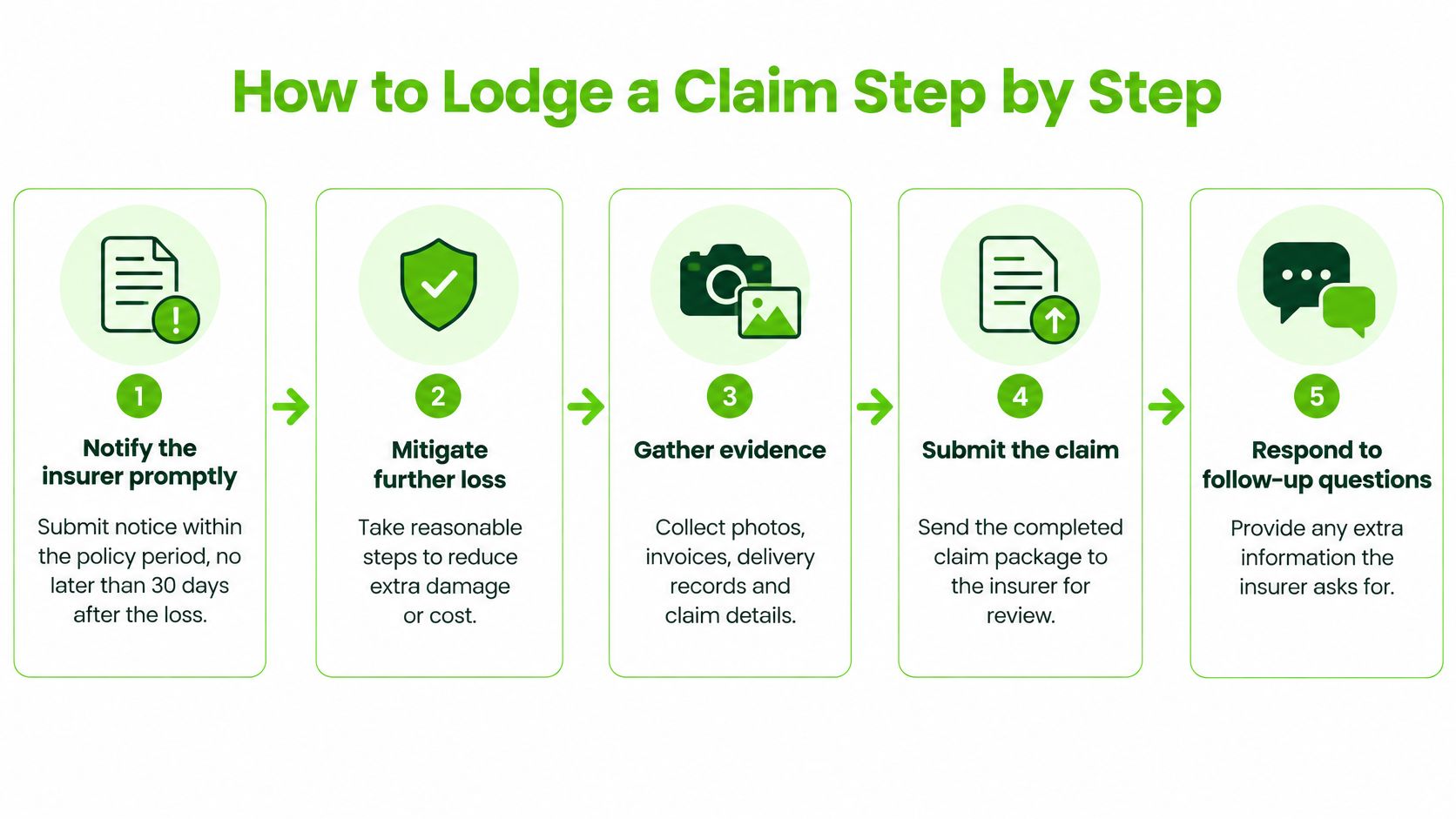
The NTI Marine Liability Protect wording for freight forwarders and logistics liability sets the discipline. Insured parties must mitigate further loss, avoid admitting liability or promising payment without insurer consent, notify the insurer promptly, and provide records, and one policy requires notification no later than 30 days after the loss or damage.
The sequence that works
- Notify promptly: Tell the insurer within the policy's notice period. Late notice gives the insurer a procedural reason to resist before merits are even discussed.
- Mitigate further loss: Secure damaged goods, separate them from sound stock, and stop further movement where it's safe. Letting damage spread undermines your credibility and your recovery.
- Don't admit liability: Respond warmly to your customer, but don't promise payment or a refund amount without insurer consent. You can say you're lodging a claim today and will update them by a set time.
- Gather the records: Pull together the invoice, booking confirmation, declared value, packaging photographs taken before sealing, label, carton or item count, delivery scan, damage notation, correspondence, and proof of loss.
- Lodge in one bundle: Send the complete file together and note the date each document was provided. Piecemeal claims stall.
- Track every contact: Keep a simple log of dates, names, and what was agreed. It keeps follow-ups short and factual.
The e-commerce dilemma
You may need to refund your buyer before the carrier claim resolves. Do it if your store policy requires it, but record the refund as a separate event and agree any settlement position with the insurer. Don't let a well-meant refund become an admission about who caused the loss.
A complete claim file at submission tells the whole story without phone tag. What was sent, what it was worth, how it was packed, when it moved, and what arrived. If you're setting up your own courier operation, this guide to insurance for couriers helps you build that file habit from day one.
Why Claims Get Declined and How to Respond
Most declined claims aren't bad luck. They trace to a small set of causes you can predict and prevent. The most common one in parcel work is inadequate packaging. Goods arrive damaged in a carton that was never fit for their weight, and the insurer points to the box, not the journey.
Pack to the contents and the weight, every time. Double-wall cartons for heavier items, cushioning that stops internal movement, and photographs taken before sealing. Those photos turn an argument into evidence.
The other repeat offenders
- Undisclosed dangerous goods: Contents weren't declared at booking. Prevention is boring and effective, declare every item accurately on the booking record.
- Excluded commodities: The item sits inside a policy exclusion you never read. Check exclusions before you book high-value or fragile stock, not after a loss.
- Value above the limit: The declared value exceeds the cover limit, or no value was declared at all. Declare per consignment and match it to the limit before the label prints.
- Full-value expectation: The sender assumes included cover repays the full invoice. Compare item value with both the limit and the excess before you ship.
Each cause matters for the same reason. The insurer isn't judging your intentions. It's applying wording to facts, and these facts are the ones wording is built around.
A decline letter is information, not a verdict on your business. Read it forensically and it will tell you exactly what to fix.
Responding to a decline
Ask for the written reason if you haven't received one. Identify the exact policy clause relied on. Then classify the problem. Is it an exclusion, a breached condition, or an evidence gap?
Exclusions are hard to move. Evidence gaps often aren't. If packaging photos, a delivery notation, or a declared-value record exists somewhere in your system, you can reframe the claim with the missing records and a short factual cover note. Conditions sit in between, so get advice before you concede.
Then change the process that produced the decline. One prevented repeat is worth more than one recovered claim, and your future self will thank you for the ten minutes it takes.
Confirm Your Cover Before Every Booking
Make this a sixty-second habit before you press book. It's where freight forwarder insurance requirements stop being theory and start protecting your margin.

- Note value, weight, and postcodes: Australia Post's post charges guide shows domestic pricing uses postcode-based destination zones such as New South Wales N1 and N2, South Australia S1 and S2, and Tasmania T1, so an accurate instant quote needs exact pickup and delivery postcodes, not just state names.
- Compare value with included cover: Check the included carrier compensation and any weight-based limit against the item's value.
- Decide on extra cover: Buy the extra layer or declare a higher value for that consignment when the numbers don't line up.
- Check exclusions and dangerous goods: Confirm the item isn't excluded and is declared correctly.
- Choose packaging that fits: The Australia Post Parcel Post guide explains that parcels up to 5 kg in eligible packaging are charged at a national flat rate based on package size, while other parcels are assessed on whichever is greater, actual weight or cubic weight, with cubic weight calculated as parcel volume in cubic metres multiplied by 250. Compact boxes cut both cost and damage risk.
- Keep the record: Save the booking with the declared value and your packaging photographs together.
The plain-English truth is worth repeating to your team. "Insurance included" does not necessarily mean full-value protection, a distinction drawn out in Sprintlaw's freight forwarding agreement check, because a forwarder's liability may be capped by kilogram, package, consignment, or freight charges. Ask four questions every time. What's the insured amount, what's the excess, what is excluded, and what's the claim deadline?
If policy documents feel dense, coverage insights from For The Public Adjusters offer a useful plain-language way into reading limits and exclusions. Then ask your forwarder for the written cover schedule and check it against your quote. You've got this. One careful minute per booking beats one painful loss per quarter.
Ready to ship boxes and parcels Australia wide at low cost, with your cover confirmed before every booking rather than assumed after a loss? Aeros Couriers gives you instant quotes, fast booking, and clear options for local and national deliveries, so you can match value, packaging, and protection on every consignment. Visit today, run your next quote with postcodes, weight, and declared value in hand, and send it with confidence.
Courier quotes, tracking and support
Ready to send a parcel? Compare the available services for your postcodes, parcel dimensions and weight. For an existing delivery, use your consignment number to check tracking or ask our team for help.