
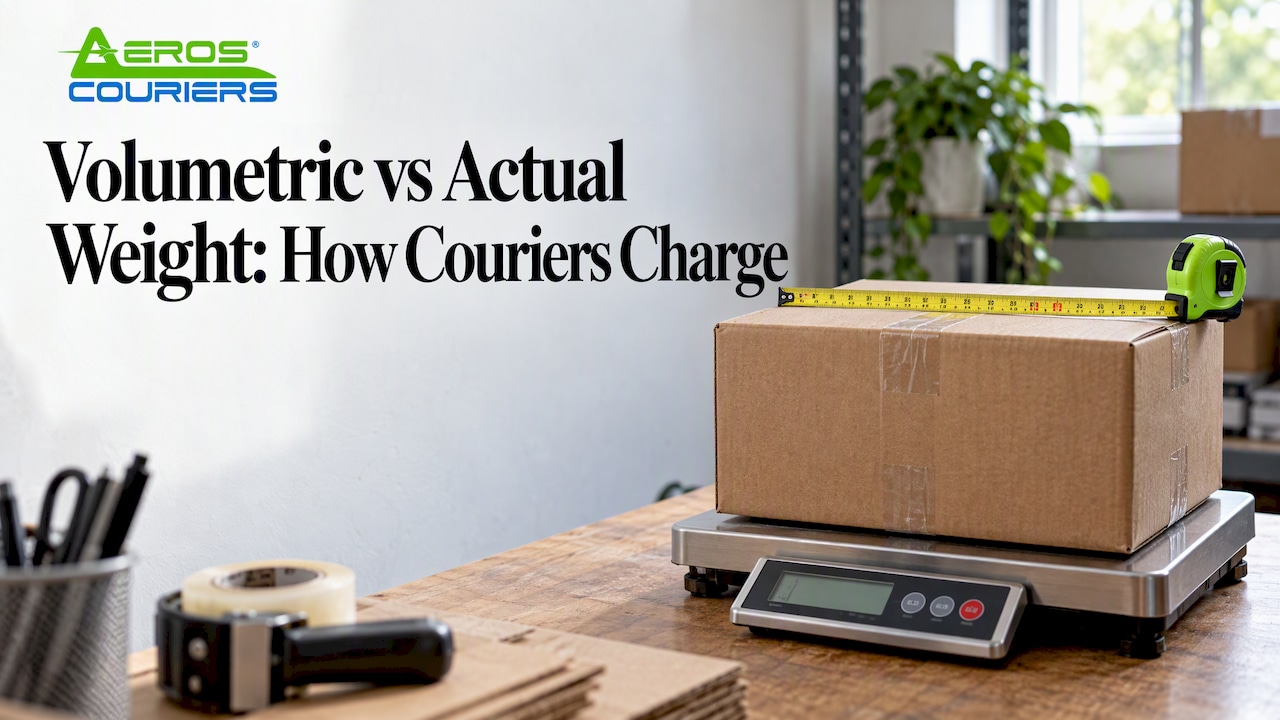
Actual weight is what your parcel reads on the scales. Volumetric weight, also called cubic weight, is a calculated figure based on the space the parcel takes up. Couriers charge you for whichever number is higher. In Australia, most domestic parcel pricing treats 250 kg per cubic metre as the break-even point, so a large, light box is often billed well above what it weighs.
This guide shows you how to work out both numbers, which one you will pay for, and how to pack so the bigger one stops costing you money.
TL;DR
- Chargeable weight is the greater of actual weight and volumetric weight. You never pay for the lower one.
- For most Australian domestic parcels, cubic weight in kg = length × width × height in cm ÷ 4,000 (the same as 250 kg per cubic metre).
- Air freight commonly uses a bigger divisor, such as 6,000 (about 167 kg per cubic metre), so check the divisor before you compare quotes.
- Measure the outside of the packed parcel, not the product. Padding and oversized cartons are what push you into cubic charges.
- Right-size the box before you book, and enter the real dimensions every time. Wrong dimensions lead to re-weighing and adjustments.
Table of Contents
- Actual weight and volumetric weight: what each one means
- Why couriers charge for space, not just weight
- How to calculate cubic weight
- Worked examples: which weight gets charged?
- The break-even density
- Mistakes that trigger unexpected charges
- How to shrink your chargeable weight
- What to check on any courier’s rate page
- Compare and book with the real dimensions
- Freight and pallets: a different density rule
- FAQ
- Sources
Actual weight and volumetric weight: what each one means
Actual weight (also called dead weight or gross weight) is the physical mass of the packed parcel: product, box, tape and padding. A set of kitchen scales or a postal scale gives it to you.
Volumetric weight is not a physical weight at all. Measurement Canada describes dimensional weight as a theoretical value rather than a physical weight, used to recover the cost of moving cargo that takes up a lot of room. Australian carriers call the same idea cubic weight. The terms are interchangeable in everyday shipping: volumetric weight, dimensional weight, cubic weight and volume weight all describe the same calculation.
The courier then compares the two numbers and bills the chargeable weight, which is simply the larger of the two.
| Term | What it is | How you get it |
|---|---|---|
| Actual weight | Physical mass of the packed parcel | Scales |
| Volumetric / cubic weight | Space the parcel occupies, expressed as kg | Length × width × height ÷ divisor |
| Chargeable weight | The weight your price is based on | Whichever of the two is higher |
Why couriers charge for space, not just weight
A delivery van, a plane hold and a sorting-centre shelf all run out of room before they run out of weight capacity when the freight is bulky. Two parcels that both weigh 2 kg are not equal for the carrier if one is a small padded satchel and the other is a box the size of a microwave.
The same logic appears in air cargo. An ACCC-hosted analysis of IATA Resolution 502 explains that aircraft capacity is limited by both lifting weight and available volume, so low-density cargo is converted into a standard weight for charging. Domestic road parcels follow the same principle: if you take up the space, you pay for the space.
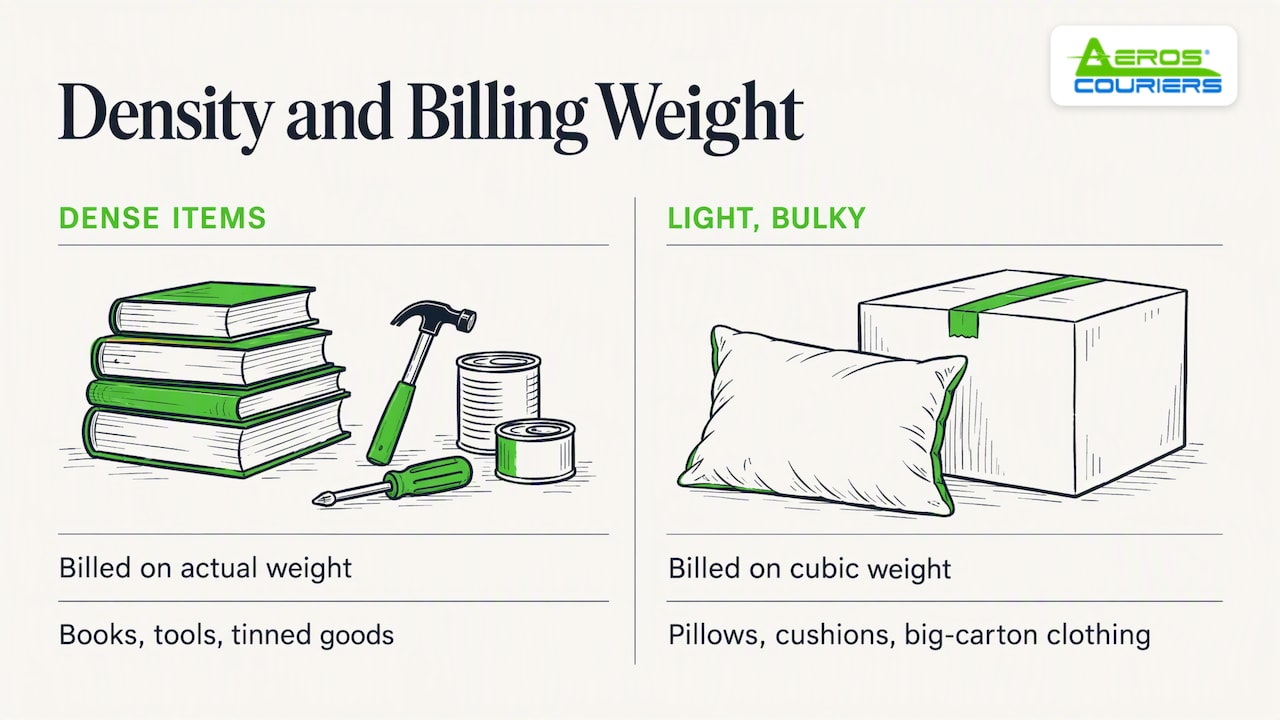
The practical effect is that density decides everything. Dense items (books, tools, tinned goods, small electronics) tend to be billed on actual weight. Light, bulky items (pillows, cushions, clothing in a big carton, hats, plastic homewares, empty frames) tend to be billed on cubic weight.
How to calculate cubic weight
You need three measurements of the packed parcel, taken at the widest point of each side, and one divisor.
Step by step
- Pack the parcel first. Measure the finished package with padding and tape, not the item.
- Measure length, width and height in centimetres. Round up to the next whole centimetre unless your carrier states a different rule.
- Multiply length × width × height to get cubic centimetres.
- Divide by the divisor. For most Australian domestic parcels that is 4,000.
- Weigh the parcel in kilograms.
- Compare. The bigger figure is your chargeable weight.
If you prefer metres, multiply length × width × height in metres and then by 250. A 50 × 30 × 40 cm parcel is 0.5 × 0.3 × 0.4 = 0.06 m³, and 0.06 × 250 = 15 kg. In centimetres: 60,000 ÷ 4,000 = 15 kg. Same answer.
The 250 kg per cubic metre factor is the standard conversion described for Australian parcel cubic weight calculations on contract parcel services, which is why 4,000 is the number most Australian senders should reach for first.
Where 4,000, 5,000 and 6,000 come from
The divisor is a density assumption. A smaller divisor means the carrier assumes denser freight and is stricter on bulky parcels.
| Divisor | kg per cubic metre | Typical use |
|---|---|---|
| 4,000 | 250 | Domestic road parcels in Australia |
| 5,000 | 200 | Common international express standard |
| 6,000 | about 167 | Air freight, following the IATA low-density ratio |
That last row answers a common question: why is 1 cubic metre treated as 167 kg? One cubic metre is 1,000,000 cm³, and 1,000,000 ÷ 6,000 is roughly 166.7. The ratio comes from the IATA low-density rule, which uses 6,000 cubic centimetres per kilogram to calculate the rate. Road carriers in Australia usually use the stricter 250 kg/m³ instead. For a deeper look at how the three factors differ, see our guide to Australia’s cubic weight formula.
Worked examples: which weight gets charged?
These examples use the 4,000 divisor for domestic road parcels. Your carrier’s own rules always take priority, so treat the numbers as a method, not a quote.
Example 1: a light, bulky box
You ship two cushions in a 50 × 40 × 30 cm carton. Packed weight is 2.5 kg.
- Volume: 50 × 40 × 30 = 60,000 cm³
- Cubic weight: 60,000 ÷ 4,000 = 15 kg
- Actual weight: 2.5 kg
- Chargeable weight: 15 kg
You pay for six times what the parcel weighs.
Example 2: a small, heavy box
You send hand tools in a 25 × 20 × 20 cm box. Packed weight is 8 kg.
- Volume: 25 × 20 × 20 = 10,000 cm³
- Cubic weight: 10,000 ÷ 4,000 = 2.5 kg
- Actual weight: 8 kg
- Chargeable weight: 8 kg
Here the scale wins and cubic weight never comes into play.
Example 3: same item, right-sized box
A 3 kg pair of boots is packed in a 45 × 35 × 30 cm shoe-shop carton, then repacked into a 35 × 25 × 20 cm box.
| Big carton | Right-sized box | |
|---|---|---|
| Dimensions | 45 × 35 × 30 cm | 35 × 25 × 20 cm |
| Volume | 47,250 cm³ | 17,500 cm³ |
| Cubic weight (÷ 4,000) | 11.81 kg | 4.38 kg |
| Actual weight | 3 kg | 3.2 kg |
| Chargeable weight | 11.81 kg | 4.38 kg |
Repacking cut the chargeable weight by almost two thirds, with no change to the product.
Example 4: the same box by air
Take the 50 × 40 × 30 cm cushion carton from Example 1. With an air-freight divisor of 6,000, cubic weight is 60,000 ÷ 6,000 = 10 kg, not 15 kg. The same parcel can have a different chargeable weight depending on the service and the divisor behind it. That is why comparing quotes only works when you enter the same dimensions into each one.
The break-even density
There is a tipping point where actual and cubic weight are equal. For Australian road parcels it is 250 kg per cubic metre, which is the same as 250 grams per litre of box volume. A 10-litre box (about 30 × 20 × 17 cm) needs to hold at least 2.5 kg before the scale takes over from the tape measure.
A quick check you can do without a calculator:
- Work out the box volume in litres (cm³ ÷ 1,000).
- Divide by four.
- If the packed parcel weighs less than that number in kilograms, you are being charged on cubic weight.
For the 60,000 cm³ cushion box that is 60 litres ÷ 4 = 15 kg. The parcel weighs 2.5 kg, so it is well into cubic territory.
Mistakes that trigger unexpected charges
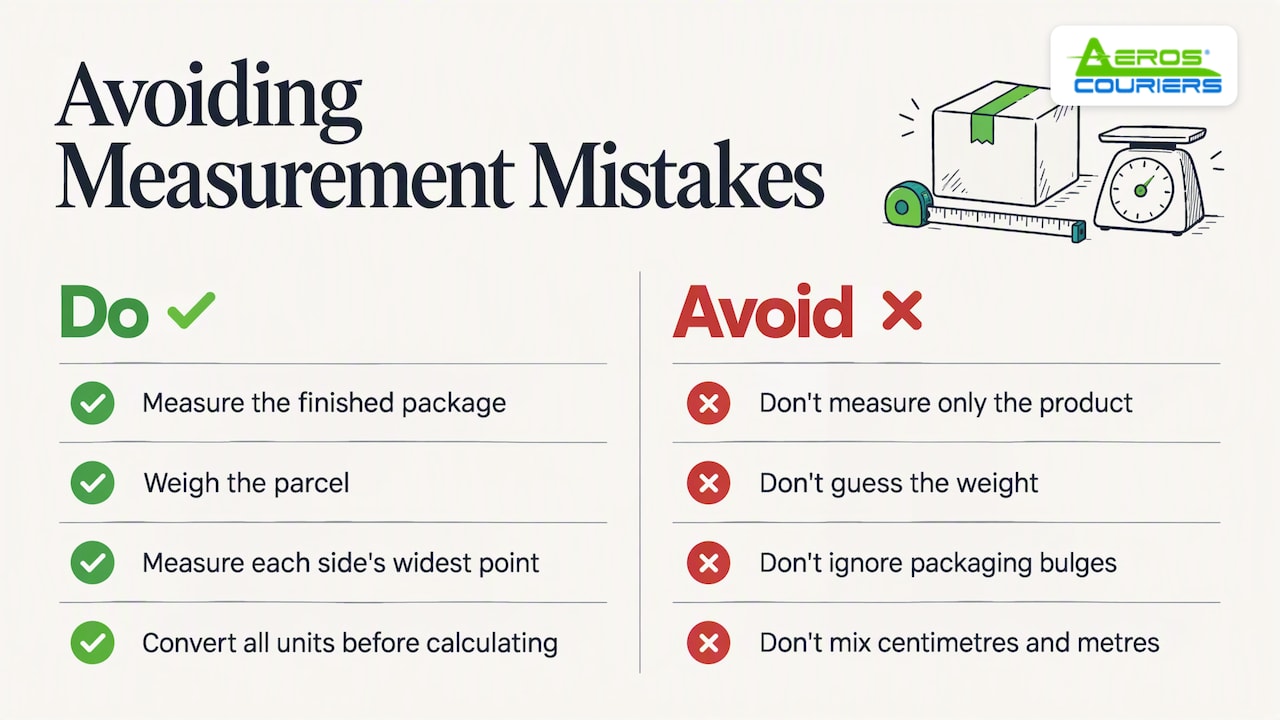
Measuring the product, not the package. A 20 cm vase in a 35 cm box ships as a 35 cm parcel. Always measure the finished package.
Guessing the weight. Round-number guesses are the usual cause of adjustments. Weigh it.
Ignoring bulges. Soft packaging bulges when filled. Measure the widest point of each side, because that is what a depot scanner or tape sees.
Mixing units. Centimetres and metres in the same formula give nonsense. Convert everything first.
Forgetting rounding. Carriers differ in whether they round dimensions up to the next centimetre and the final weight up to the next half or whole kilogram. Check the rule on your carrier’s rate page, because a 0.1 kg difference can tip you into the next price band.
Cylinders and irregular shapes. Tubes, rolled items and oddly shaped goods are measured by their bounding box, the smallest rectangular box that would contain them. A round tube is charged as if it were square.
Comparing quotes with different dimensions. If one quote used a tidy 30 × 20 × 15 cm and another used what you actually packed, the difference is not the carrier’s pricing.
How to shrink your chargeable weight
You control the volume far more than you control the weight. These changes work for most small businesses and home sellers.
- Right-size the carton. Keep a few box sizes in stock instead of one big one. The goal is a snug fit with just enough protection.
- Use satchels for soft goods. Clothing, linen and soft toys compress. A padded bag or poly mailer with no rigid walls often beats a carton.
- Cut void fill. Packing paper and moulded inserts protect better than cubic metres of air. Fewer centimetres on each side compounds quickly: shaving 5 cm off each side of a 40 cm cube cuts the volume by more than 30%.
- Flat-pack where you can. Frames, shelving and furniture kits ship flatter and denser.
- Choose packaging with the carrier’s formula in mind. Reducing material also helps the environment, and there are good ideas on plastic-free packaging choices that often make for slimmer parcels too.
- Consolidate carefully. Several small items in one correctly sized box usually cost less than several boxes, provided the combined parcel stays dense.
- Know your SKUs. For an online shop, record the packed dimensions and weight of every product once, then use those figures for every quote and label.
For more ways to cut costs beyond packaging, see our guides on reducing shipping costs for a small business and ecommerce shipping costs in Australia.
What to check on any courier’s rate page
Before you book, look for these six items. They explain nearly every surprise weight-based charge.
- The divisor or conversion factor (4,000, 5,000, 6,000 or a carrier-specific number).
- Maximum parcel weight and dimensions. Parcels over the limit move to freight pricing.
- Rounding rules for centimetres and kilograms.
- Whether cubic weight is applied to every parcel or only above a size threshold.
- Re-weigh and re-measure policy, including adjustment charges if your declared figures are wrong.
- Extra charges such as fuel levies, handling fees, residential delivery or remote-area fees, and GST treatment. Our courier rate card guide explains how to read these lines, and the courier prices explainer covers how they add up.
Note that a low headline rate per kilogram means little if the carrier then adds levies on top of a cubic weight that is three times the scale weight. Always compare the final total for the same box.
Our view: pay for the parcel, not for the air around it
At Aeros we see the same pattern again and again: a sender books a parcel at the weight on the scales, then discovers the carrier charged for the size of the box. The price is not the problem. The surprise is.
That is why we built our platform around transparent pricing. Our approach is to show a rate you can compare across carriers before you commit, with no fuel surcharges or handling costs added afterwards. When you enter the packed dimensions and weight up front, the chargeable weight is already part of the rate you see.
Our advice is simple: measure the packed parcel, enter exactly what you measured, and test a smaller box before you book. Small changes in box size are often the cheapest saving available to a small business, and they cost nothing.
Aeros
Compare and book with the real dimensions
If you already know your parcel’s packed size and weight, you can see what each option costs for that exact box. Aeros lets you compare rates across major carriers, choose between standard, express or same-day delivery, print your label and track the shipment through to delivery, with Australian customer support if something goes wrong.

Enter your packed dimensions on our parcel delivery service page to compare, or use the shipment rate page for a quick figure. Heavier or palletised loads can be handled through freight booking.
Freight and pallets: a different density rule
Once a load is on a pallet, the rules often change. Road freight frequently uses a cubic metre as the pricing unit, with a conversion such as 250 kg per cubic metre applied to compare against actual weight, and air freight uses the 6,000 divisor discussed above. The logic is the same, but the thresholds and minimum charges differ between parcel, road freight and air freight, so check which service you are pricing.
Two habits help with freight in particular. First, measure the pallet including the load overhang, because a carton that sticks out 5 cm on each side adds to the cubic volume. Second, tell the carrier about stacking limits. Loads that cannot be stacked may be charged for the vertical space above them as well.
If you also send parcels through the postal network, our overview of postal charges for parcels shows how weight bands and size limits work there, and our piece on cheap interstate courier options helps when distance is the larger cost.
FAQ
Is cubic weight the same as volumetric weight?
Yes. Cubic weight, volumetric weight, dimensional weight and volume weight all describe a weight figure calculated from a parcel’s size rather than measured on scales. Australian carriers usually say cubic weight. International and air freight providers more often say volumetric or dimensional weight.
What is the cubic weight formula in Australia?
For most domestic parcels it is length × width × height in centimetres divided by 4,000, which equals length × width × height in metres multiplied by 250. A 40 × 30 × 30 cm box is 36,000 cm³, so its cubic weight is 9 kg. Individual carriers can set their own rules, so confirm the factor on the rate page you are using.
Do I pay for actual weight or volumetric weight?
You pay for whichever is higher. If a 2 kg parcel has a cubic weight of 9 kg, it is priced as a 9 kg parcel. If a 9 kg parcel has a cubic weight of 2 kg, it is priced as 9 kg because the actual weight is greater.
Why is 1 cubic metre treated as 167 kg?
That figure comes from the air freight ratio of 6,000 cm³ per kilogram. One cubic metre is 1,000,000 cm³, and dividing by 6,000 gives about 167 kg. Australian road parcels more commonly use 250 kg per cubic metre.
How can I avoid being charged for cubic weight?
Pack in the smallest box that still protects the item, use satchels for soft goods, and keep void fill to a minimum. Then enter the real packed dimensions when you book, so the quote matches what the carrier measures.
Sources
- Information Bulletin: Dimensional Weight, Measurement Canada
- Detailed analysis of IATA Resolution 502 (low density cargo), ACCC public register
- Cubic weight calculation for Australian parcels, Sellerdash help centre
- Plastic-free shipping and pack-out photos, Greet ‘n Grow
Recommended
- Australia’s Cubic Weight Formula: 250, 5,000, or 6,000?
- Australia’s Courier Prices Explained A Practical Guide
- The Cheapest Way to Send a Parcel in Australia
- Courier Prices: Compare Total Cost, Not Headline Rates in Australia
Courier quotes, tracking and support
Ready to send a parcel? Compare the available services for your postcodes, parcel dimensions and weight. For an existing delivery, use your consignment number to check tracking or ask our team for help.