A courier service collects a parcel from a sender, moves it through a managed network, tracks each stage and delivers it to the recipient, usually faster or more flexibly than standard letter mail.
If that's the job, why can the same box cost less to send across a city than to a regional town, even when both bookings say express? You're buying more than transport. You're booking space on a managed route, with a particular deadline, delivery address and set of handling conditions.
For Australian households and businesses, understanding those differences makes fast, affordable shipping easier to choose. The focus here is domestic shipping within Australia: boxes, satchels and parcels, not international deliveries or pallets.
Defining a Courier Service in Plain Terms
A Melbourne online seller sending a boxed order to Adelaide is booking more than a vehicle trip. The courier service matches the parcel with a route, delivery speed and destination. Those choices shape both the price and the delivery commitment.
Standard post works like a scheduled bus route, serving established stops. A courier is more like a taxi booked for a specific journey, although affordable parcel services usually share vehicle space with other shipments. The parcel's size and destination can affect how well it fits the route, while a tighter delivery deadline may call for a different service.

From mail delivery to managed parcel networks
Australia Post's history traces Australia's postal foundations to Isaac Nichols becoming Sydney's first postmaster in 1809. It also records the Melbourne Mail Exchange's mechanised parcel-handling plant, Australia Post Courier's launch with approximately 100 small radio-controlled vans, and Express Post's introduction of guaranteed next-business-day delivery within its network.
The practical distinction depends on the shipment and the service commitment:
- Standard post uses scheduled mail networks, with ordinary letter services generally offering estimated delivery times.
- Parcel couriers arrange boxed shipments around a chosen service and route, with tracking to show progress.
- Heavy freight covers pallet loads and handling arrangements beyond the box-and-parcel services discussed here.
For Shopify sellers, customer updates can be part of the dispatch process. A texting guide for Shopify merchants explains SMS messages, a channel sellers may use to share parcel updates.
In plain terms, a courier service coordinates a parcel's journey according to its size, destination and delivery commitment. That managed route is why two parcels can have different prices and arrival times, even when both are sent by courier.
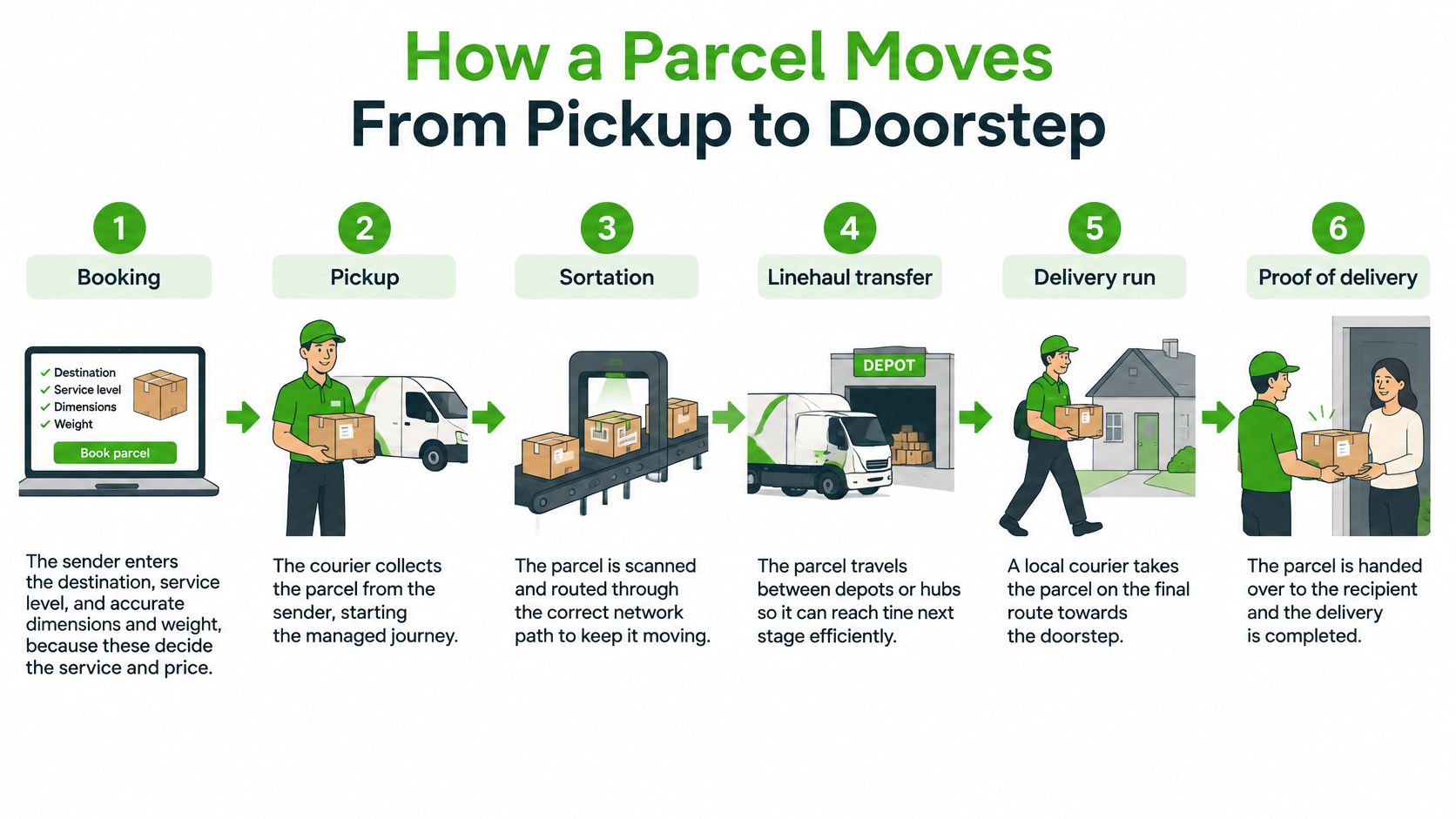
How a Parcel Moves From Pickup to Doorstep
A parcel often makes several handovers before it reaches the recipient. The collection van brings it into a courier network, where shipments travelling in similar directions are grouped and sent between depots. This managed route helps share transport costs, while each handover can affect the parcel's progress.
The managed journey
Booking starts with the packed parcel. Enter the destination, service level, outer dimensions and weight. These details help determine which services can accept the parcel and what the booking costs. Measure the packed item rather than estimating.
Pickup connects your address to the network. A driver collects from an eligible residential or commercial location, with timing tied to local routes and depot cut-offs. Have the sealed, labelled parcel ready and accessible. A guide to arranging a parcel pickup can help you prepare for collection.
Consolidation gives the parcel its onward route. At a depot, staff scan the label and group the parcel with shipments heading towards the same destination. Shared loads help keep delivery affordable, though the parcel may pass through several hands.
Line-haul moves grouped shipments. Vehicles carry parcels between cities and regional hubs on scheduled departures. If a parcel misses a departure, its onward journey may take longer, even when a faster service was selected.
Sorting creates the final delivery run. At the destination depot, staff allocate the parcel to a local route. The driver delivers it or records an exception, such as an inaccessible property or an absent receiver.
Tracking records progress and outcome. Scans show operational handovers, and the final record confirms delivery or an unsuccessful attempt. Tracking is not necessarily live GPS. A gap between scans can mean the parcel is travelling between hubs.
Accurate booking details reduce manual corrections, failed attempts and unexpected charges. The route also depends on where the parcel is going: a driver serving neighbouring businesses can cover a run differently from one visiting widely separated properties. For businesses planning incoming stock, turning business needs into purchase orders can connect purchasing decisions with expected delivery needs.
Same-Day, Express and Economy Models Compared
Choose the service by the deadline, not by the most impressive name. A same-day booking, an express parcel and an economy shipment can all be sensible choices, but they solve different problems.
Same-day means collection and delivery within the same business day, usually inside a metropolitan service area. It generally costs most because the operator has less flexibility to fit the job into shared routes.
Express aims for next-business-day delivery where the selected network covers the route. Economy trades speed for a lower price, with a typical planning window of two to five business days depending on distance. These are service-model descriptions, not promises for every Australian address; check the actual booking offer.
Courier models compared
| Model | Typical Delivery Window | Best For | Relative Cost | Service Commitment |
|---|---|---|---|---|
| Same-day | Within hours of pickup, usually metro only | Urgent documents, spare parts and time-critical orders | Highest | Delivery window set at booking |
| Express | Next business day where the route is covered | Time-sensitive online orders and interstate boxes | Mid to high | Next business day where offered, estimate elsewhere |
| Economy | Two to five business days, with longer routes requiring more time | Non-urgent parcels, restocking and bulk sends of separate boxes | Lowest | Estimate only, no guaranteed date |
A service commitment is what the carrier agrees to provide. An estimated arrival date helps you plan, but it isn't automatically a guarantee with compensation if the parcel arrives later.
The express versus standard shipping comparison can help you assess those trade-offs before choosing a booking.
Match the model to the consequence of delay
Suppose you have a 3 kg box that needs to travel interstate and arrive by Friday. Express is a sensible candidate, provided the booking's collection cut-off and destination coverage support that deadline. If the receiver needs it at opening time, ask specifically about the delivery window rather than assuming next-business-day means early morning.
Now consider boxed restock for a regional shop that can wait a week. Economy may be the better purchase because the shop has enough stock to keep trading while the parcel travels.
Practical rule: Pay for speed when the cost of delay is greater than the difference in delivery price.
A lower quote isn't good value if it misses an important deadline. Equally, paying for express on every routine shipment can consume money that would be better spent on packaging or stock.
Who Uses Couriers and Why
A birthday parcel to a relative, an online order to a customer and a replacement part for a regional branch all need a route from sender to recipient. Couriers manage that route, and the service chosen affects its cost, timing and delivery risk.
Different senders, recognisable needs
- Online retail: A home-based seller sending 3 kg boxes to buyers in four states each week needs a dispatch process that can be repeated. Tracking lets buyers check progress without asking the seller for updates.
- Individual shipping: Someone sending a birthday parcel interstate needs a realistic arrival expectation and proof of delivery, particularly if the recipient lives in an apartment building.
- Multi-site business shipping: A company moving replacement parts and boxed returns between its head office and two regional branches benefits from consistent booking details. Clear addresses, labels and collection arrangements help staff avoid repeated follow-up emails.
For a small business, choosing a courier service in Australia means considering how the booking process will work beyond a single parcel. Could another staff member enter the details correctly during a busy dispatch period? A repeatable process reduces avoidable mistakes.
Check what the parcel contains
A box can look ordinary while holding batteries, aerosols or chemicals that need carrier approval or specific handling. Check the courier's acceptance rules before booking; retail packaging alone does not confirm that an item is suitable for ordinary transport. A dangerous goods driver training course concerns driver training, while the courier's own rules determine whether it will accept the parcel.
Across these examples, the sender needs a price before booking, a usable label and a tracking record afterwards. The route matters: a parcel going to a regional branch can carry different timing and delivery risks from one travelling between metro addresses. Choose a service that fits the parcel, destination and consequence of delay.
Cost Factors and Parcel Size Limits
Measure the finished package before comparing prices. Courier pricing considers the space your box occupies as well as its weight, so a compact carton can be cheaper to transport than a bulky one holding the same contents.
Australia Post's domestic Parcel Post pricing information states that customer-owned parcels up to 5 kg use actual or cubic weight, whichever is greater, parcels above 5 kg up to 22 kg use destination-based pricing, and oversized parcels accepted into the network may attract a $100 GST-inclusive Over Maximum Limits Fee in addition to the normal delivery charge.
Parcel weight and size bands
These Australia Post reference bands explain the pricing principle. They aren't universal acceptance limits for every courier.
| Parcel Measure | How It Is Priced | What to Watch |
|---|---|---|
| Up to 5 kg | Greater of actual weight or cubic weight | A large, light box can cost more than its scale weight suggests |
| Above 5 kg to 22 kg | Destination-based pricing | Check the exact destination zone rather than carrying over a lighter-parcel quote |
| Over maximum limits | Normal delivery charge plus a $100 GST-inclusive Over Maximum Limits Fee if accepted and the fee applies | Oversize freight should not be booked as an ordinary parcel |
Cubic weight translates occupied space into a billable weight using the carrier's calculation. For example, a bulky pack weighing 1.5 kg may fill a large carton and cost more than its scale weight suggests. You don't need to guess the calculation if the quoting tool accepts accurate dimensions.
A cheap quote based on the wrong box measurements isn't a cheap delivery. It's an incomplete price.
What changes the total
Review the main cost drivers in this order:
- Size and weight determine acceptance and billable weight.
- Destination zone affects the route and delivery coverage.
- Service level sets the urgency you're paying for.
- Collection and delivery type can introduce access requirements or residential-service charges.
- Add-ons such as signature on delivery or additional insurance change the final total.
Use a sound carton with enough room for protective material, but avoid unnecessary empty space. Immobilise the contents, tape the seams securely and measure the outside after sealing, including any bulges.
The guide to sending big parcels cheaply can help you assess packaging choices without treating an oversized item as an ordinary box. Pallets aren't part of this parcel service.
If the package changes after quoting, update the booking or rebook before collection. Compare the all-in total, not just the initial rate displayed before service options and applicable charges.
Regional, Remote and Metro Delivery Realities
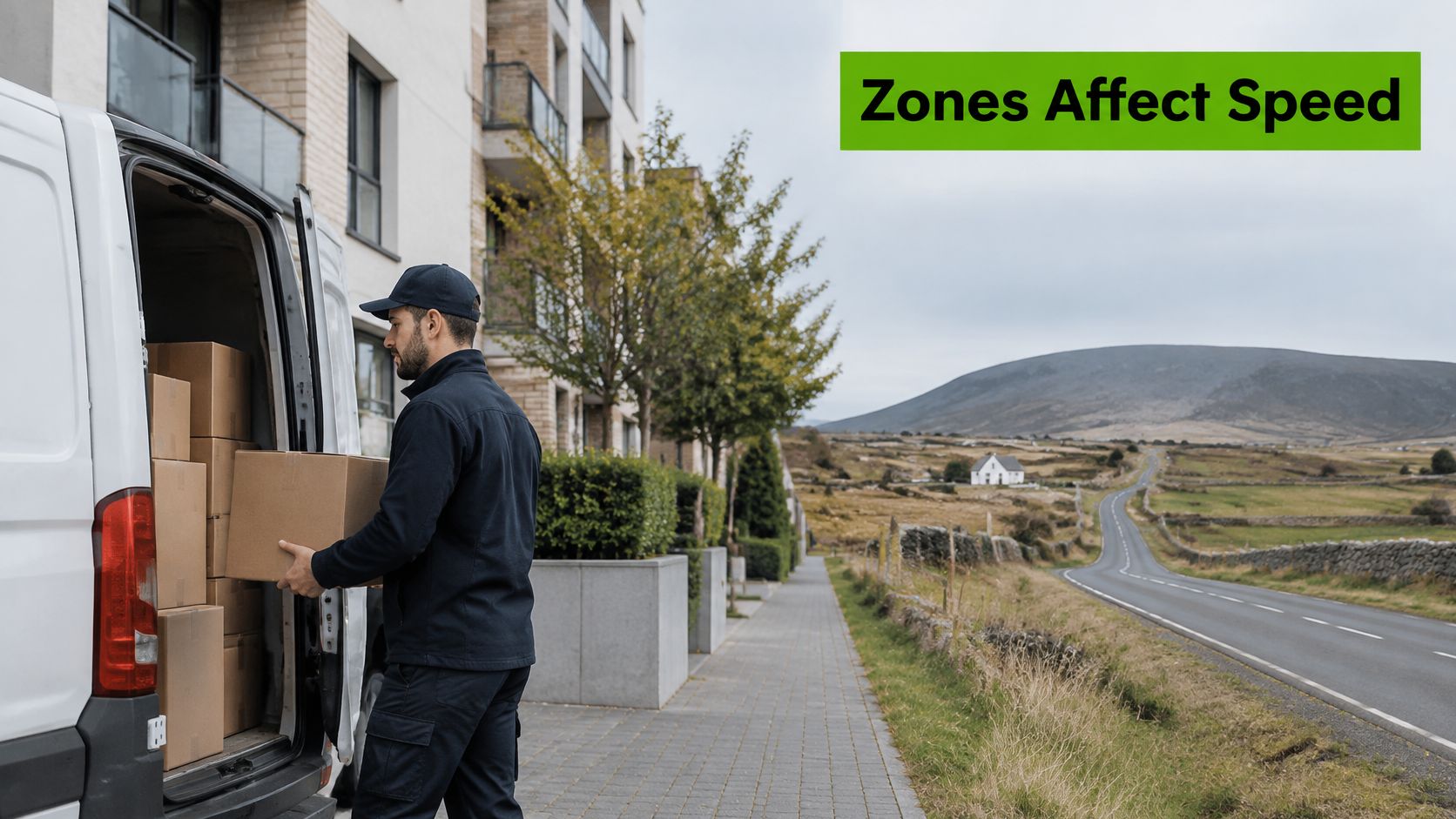
The same parcel doesn't necessarily travel at the same speed or price everywhere in Australia. A metropolitan address and a remote property can require very different delivery arrangements, even when the cartons are identical.
An Australian Parcels Industry Forum submission to the ACCC states that rural and regional parcel demand is growing faster than metropolitan demand, while regional services remain slower and more expensive; it also argues that limited competition leaves regional businesses with fewer choices.
What the delivery zones mean
- Metro generally describes addresses within a carrier's established city network.
- Outer metro covers city fringes where collection and delivery coverage may be less frequent.
- Regional destinations often involve onward transport through a regional hub.
- Remote addresses may require longer journeys, additional transfers or arrangements with a local delivery operator.
These boundaries are carrier-specific. A town's postcode doesn't tell you everything about a property outside town, so enter the full address rather than relying on a nearby suburb's quote.
Ask address-specific questions
Before booking, confirm:
- Collection coverage Can the courier collect from this town and this particular property?
- Address type Is the delivery residential or commercial, and when can someone receive it?
- Missed delivery Will the driver reattempt, leave the parcel with permission or take it to a collection point?
- Additional charges Are fuel, remote-area or redelivery charges included in the quote?
For a Northern Territory shipment, a Darwin-to-Alice-Springs delivery guide gives route-specific context rather than assuming a city delivery model applies.
Weather, scheduled onward departures and an absent receiver can change the arrival day. Unless the selected service explicitly guarantees delivery, treat its quoted transit time as an estimate.
For a regional destination, compare the quoted time and total cost for the exact address. The cheapest and fastest options aren't always the same.
Communicate that expectation before dispatch. A customer who understands the likely delivery window can make a better purchasing decision than one given an unrealistic promise.
Choose the Right Courier for Your Next Parcel
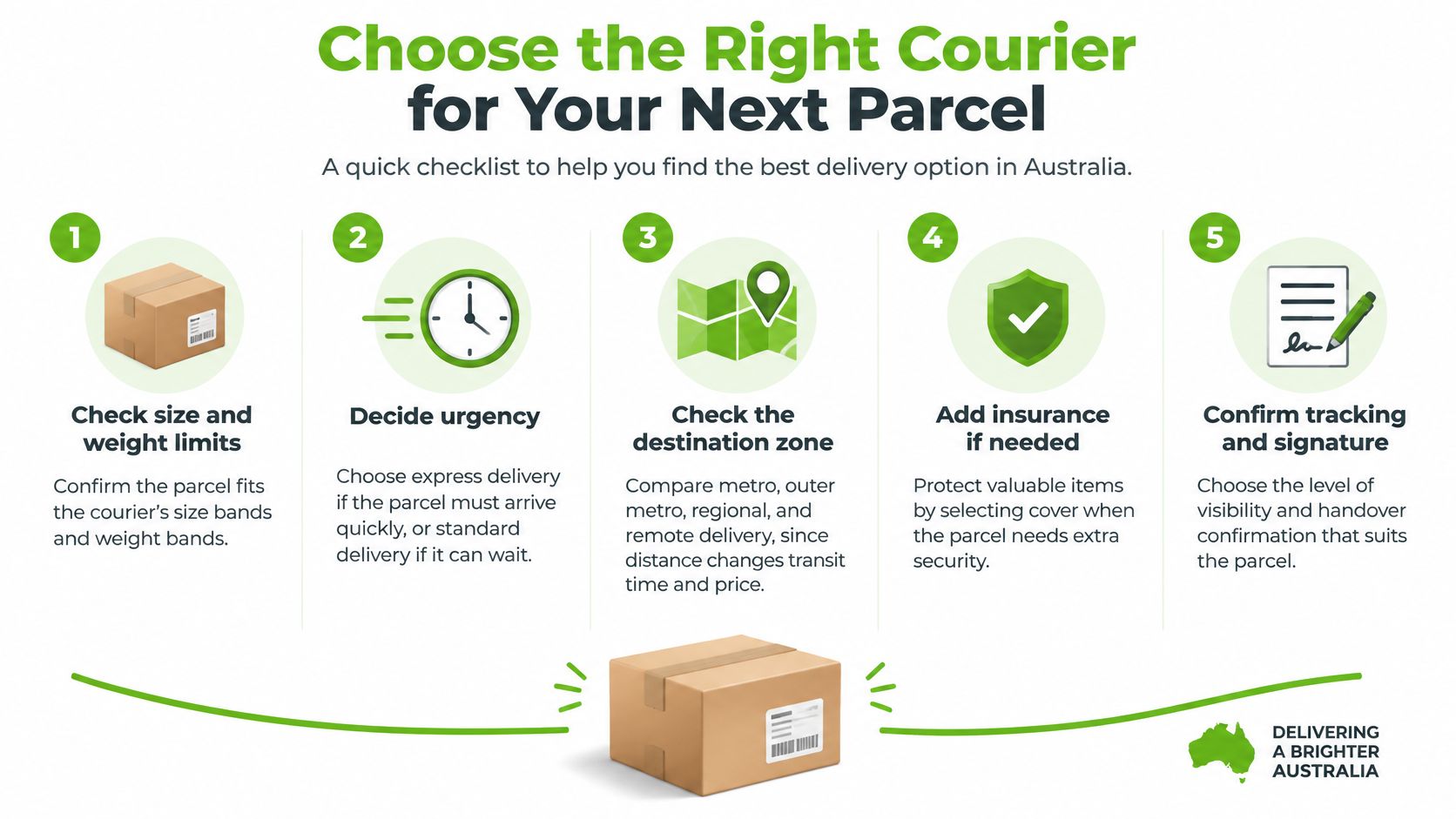
A suitable courier booking starts with the parcel and the delivery need. Check the packed dimensions and weight, set the latest acceptable arrival day, and compare services that cover both addresses. The same parcel can cost more or take longer when the route, delivery speed or destination changes.
- Check size and weight limits Confirm the packed parcel qualifies for the selected service.
- Decide urgency Set the latest acceptable arrival day and distinguish a firm deadline from a preference.
- Check the destination zone Verify coverage for the full collection and delivery addresses.
- Review insurance Check included cover, exclusions and claim requirements before adding protection for valuable goods.
- Confirm tracking and signature Choose recipient alerts and handover confirmation that suit the contents.
A practical domestic parcel option
Aeros Couriers is an Australian-owned platform for local and Australia-wide shipping of cartons, satchels and palletized freight. Flexible carrier selection and wholesale bulk purchasing help keep rates among the cheapest in the market. Customers can get instant quotes, book online, print labels and track jobs in a dashboard, without an account application or card charges.
Freight insurance is included. Optional signature on delivery is available, and metro estimated arrival times and regional considerations appear at checkout. These details help you compare the service against your deadline and destination before booking.
Every order earns reward points redeemable through partner merchandise providers on over 10,000 branded items. Responsive local support is available through a 1300 number.
Book the parcel you actually have
Describe the shipment accurately. Use the sealed package's measurements, identify its contents and flag anything that may need approval. A quote based on the parcel you are sending is more useful than one based on rough estimates.
The right choice balances total cost, route and delivery need. A low displayed rate is only useful if the service accepts the parcel and covers the address. Request an instant quote with the packed parcel's measurements and destination, then keep the selected service details with your order records for any customer enquiry.
Aeros Couriers offers local and Australia-wide shipping with online quotes, printable labels and tracking. Compare the available services for your parcel and deadline before booking.
Courier quotes, tracking and support
Ready to send a parcel? Compare the available services for your postcodes, parcel dimensions and weight. For an existing delivery, use your consignment number to check tracking or ask our team for help.