







A delivery exception means a carrier has logged an unexpected problem that has stopped or delayed a parcel on its scheduled route. It usually signals a short delay rather than a lost package. Check the tracking note and its timestamp first: that message tells you the specific cause and often what happens next.
TL;DR:
- Most delivery exceptions are temporary and resolve within a few business days once the cause, like address issues or access problems, is addressed.
- International shipments with customs holds depend on paperwork processing and can last longer, but repeated or extended tracking stalls may indicate a lost parcel.
- Carrier support is fastest when you screenshot the original exception message, verify your address, and have your tracking number ready before contacting support.
- Precautionary measures such as clear instructions, accurate address details, and tracking notifications reduce the likelihood of exceptions occurring.
- Active parcel monitoring services, like Aeros, provide faster alerts and direct support, helping to resolve exceptions without constant manual tracking.
Table of Contents
- Delivery exception explained: types and what each label means
- Common causes with real examples (what typically triggers an exception)
- What to do next: a step by step checklist to resolve the exception
- How long a delivery exception typically takes and does it mean the parcel is lost
- How carriers generally handle exceptions and how to read tracking statuses
- How to reduce the chance of delivery exceptions
- How Aeros handles delivery exceptions
- When to stay patient and when to push for quicker action
- How Aeros can help with tracking and resolving delivery exceptions
- Sources
- FAQ
Delivery exception explained: types and what each label means
Not every exception is the same problem wearing a different label. Some carriers separate “shipment exception” from “delivery exception”: the first covers issues earlier in transit, like sorting or routing errors at a depot, while the second refers specifically to last mile problems once the parcel is out for delivery. Knowing which one you are looking at helps you read the rest of the tracking note correctly, a distinction confirmed by the logistics glossary definition of a delivery exception, which lists address inaccuracies, access issues, weather delays, damaged goods, failed attempts and customs holds among the common triggers.
Once you have narrowed it to a delivery stage issue, the specific wording on your tracking page tells you how urgent it is and whose action it needs.
- Missed delivery attempt: the driver tried to deliver but nobody was available. Usually resolved with a redelivery request or by collecting from a depot.
- No access: the driver could not reach the door because of a locked gate, security building or restricted business hours. Needs updated access instructions from you.
- Address incorrect or incomplete: the system flagged a mismatch or missing unit number. Requires the recipient or sender to confirm the correct address.
- Weather delay: a storm, flooding or extreme heat has slowed the network. Usually resolves itself once conditions improve, no action needed.
- Damaged in transit: the driver or depot noted visible damage. Often triggers a claim process rather than continued delivery.
- Customs hold: for international parcels, documentation or duty payment is outstanding. Needs sender or recipient paperwork before it can move again.
The first three usually need something from you. The last three are more often handled by the carrier or, in the case of customs, by whoever is named on the paperwork.
Common causes with real examples (what typically triggers an exception)
Most exceptions trace back to one of five situations, and the tracking note usually hints at which one you are dealing with.
Address errors and incomplete details cause a large share of exceptions. A missing apartment number, an outdated address on an old order, or a typo in the street name can all stop a driver from finding the drop-off point.
Access restrictions are common in dense housing and commercial precincts. Gated apartment blocks, offices with strict reception hours, and businesses that close before the courier arrives all produce “unable to access” notes.
Operational issues sit largely outside your control. Severe weather, a breakdown affecting a delivery vehicle, or a parcel mis-sorted at a depot all show up as exceptions even though nothing about your address or instructions was wrong.
Damage noted by the driver appears as a specific exception category, separate from a standard delay. It typically pauses delivery while the carrier assesses whether the parcel is still fit to send on or needs to be returned.
Customs and documentation issues affect international shipments specifically. Missing invoices, incorrect declared values or unpaid duties will hold a parcel at the border regardless of how accurate the delivery address is.
- Check whether the note mentions the address, access or a physical description of the parcel: that tells you which of the five categories you are in.
- International parcels held at customs need action from whoever is named on the customs declaration, not necessarily the recipient.
Pro Tip: Screenshot the exact tracking wording the moment you see it. Carrier support lines resolve queries faster when you can read the note back to them verbatim.
What to do next: a step by step checklist to resolve the exception
Work through these steps in order. Most exceptions resolve at step three or four without needing to escalate further.
- Read the full tracking note and its timestamp. The wording usually names the cause and sometimes a suggested action; the timestamp tells you whether this just happened or has been sitting unresolved for days.
- Verify your delivery address and contact details. Confirm the unit number, street name and postcode are current, and check that the phone number and email on the order are ones you actually monitor.
- Contact the carrier with your tracking number ready. Have the exception wording, the date it appeared and your correct address details prepared before you call or message, so the agent can act immediately rather than asking you to repeat information.
- Contact the sender or seller if the carrier says sender action is needed. Customs documentation, authorisation to release a parcel, or a replacement invoice usually has to come from whoever shipped the item, not from you.
- Arrange redelivery, pickup or updated delivery instructions. Most carriers let you choose a new delivery date, nominate a depot pickup, or leave authority to leave at a safe location.
- Record every reference number and screenshot. Save the case number from each call, the date you spoke to someone, and a screenshot of the tracking page at the time. If the parcel never turns up, this record is what a claim or refund process will ask for.
If your carrier’s tracking page has stopped updating altogether rather than showing a specific exception, treat that as its own problem. A guide to what to do when Australia Post tracking is not updating covers the difference between a stalled scan and a genuine exception, which matters because the fix is different for each. If you have signature on delivery enabled, check how that setting interacts with redelivery: a guide to signature on delivery explains how a signature requirement can itself trigger a missed attempt exception if nobody is home.
How long a delivery exception typically takes and does it mean the parcel is lost
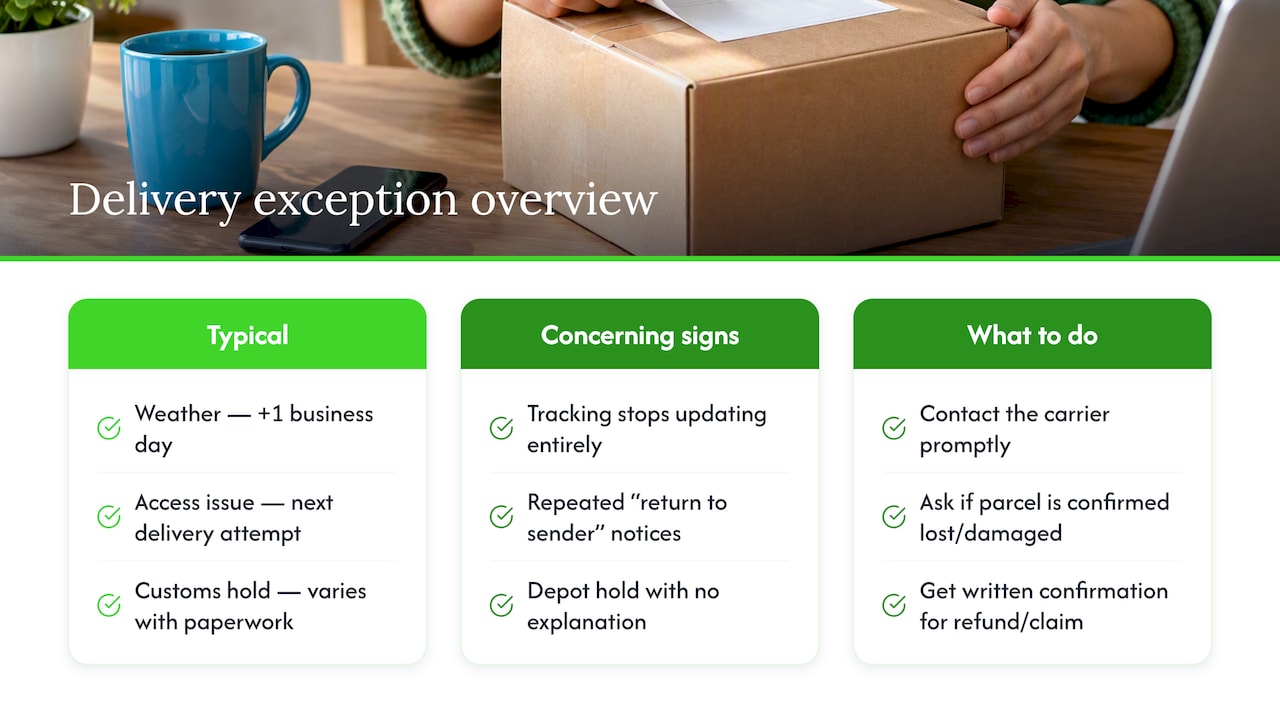
Most delivery exceptions are temporary and clear within a few additional business days once the underlying cause is fixed, according to the logistics glossary on delivery exceptions. A weather delay might add a day. An access issue might resolve on the next attempt. A customs hold can run longer, since it depends on paperwork moving between the sender and the border authority.
An exception becomes genuinely concerning when the tracking page stops updating entirely for an extended stretch, when you receive repeated “return to sender” notices on the same parcel, or when a depot hold drags on with no explanation. At that point, waiting quietly is no longer the right move.
If you have followed the checklist above, contacted the carrier, and still have no resolution or firm timeline, ask directly whether the parcel is confirmed lost or damaged beyond delivery. That answer determines whether you are looking at a redelivery, a refund, or an insurance claim, and it is worth getting in writing rather than relying on a verbal assurance.
How carriers generally handle exceptions and how to read tracking statuses
Tracking pages mix two different kinds of updates, and knowing which one you are reading changes how much detail to expect. System-generated statuses come from scanning equipment at depots and on delivery vehicles: they are quick, automatic and often generic, things like “in transit” or “exception logged”. Manual driver notes are typed by a person on the ground and tend to carry more specific detail, like “gate locked” or “business closed”.
Behind the scenes, most exceptions follow a similar workflow: the system logs the issue the moment a scan or driver report flags it, the depot or support team investigates what caused it, and the outcome is either another driver attempt, a hold at the depot pending more information, or a final status like delivered, returned or cancelled.
- System-generated statuses update automatically and are usually vague by design, meant to flag a category rather than explain the full story.
- Manual driver notes carry more useful detail but only appear when a driver actually logs one, which does not happen for every exception.
- Vague tracking pages often improve once you call the carrier directly, since phone support can see internal notes that never make it to the public tracking page.
Real-time tracking tools that pull directly from carrier systems, rather than relying on periodic scan updates, tend to surface exception detail faster. A direct courier tracking overview explains how that kind of live visibility differs from the standard tracking page most carriers offer by default.
How to reduce the chance of delivery exceptions
Prevention mostly comes down to giving the carrier accurate, specific information before the parcel ever leaves the depot.
- Format and verify the address in full, including unit or suite numbers, before confirming the order, since a missing number is one of the most common triggers for an address exception.
- Add clear delivery instructions at checkout, such as gate codes, preferred drop points or business hours, so the driver has what they need on the first attempt.
- Choose signature settings deliberately. Requiring a signature adds security but also raises the chance of a missed attempt exception if nobody is available; an authority to leave option avoids that trade-off for low-risk parcels.
- Package fragile or international items properly, with sturdy packaging and correctly attached labels and customs paperwork, since damage and documentation issues both show up as exceptions later.
- Turn on tracking notifications so you see an exception the moment it is logged rather than days later.
Pro Tip: For international parcels, attach a copy of the invoice inside the box as well as on the outside label. A duplicate copy inside speeds up customs checks if the outer label is damaged or removed.
Practical packaging habits for parcels heading interstate or overseas are covered in more detail in a guide to parcel delivery tips, including how to size and label a box so it moves through sorting without triggering a manual check.
How Aeros handles delivery exceptions
Active parcel monitoring and route optimisation can help flag exceptions early rather than letting them sit unnoticed at a depot. Customers can update delivery instructions or escalate an issue directly through support channels, avoiding multiple carrier call centres.
Transparent, all-inclusive pricing means the cost you see at booking is the cost you pay, even if a parcel needs a redelivery attempt. Direct human support can help resolve exceptions quickly, and some rewards programmes provide ways to offset future shipment costs while customers wait on a resolution. These are key benefits to look for: transparent pricing, active monitoring technology, and accessible support.
When to stay patient and when to push for quicker action
Most exceptions are routine friction, not a sign anything has gone seriously wrong. A weather delay, a single missed attempt or a brief depot hold usually clears on its own within a day or two, and chasing it constantly rarely speeds anything up.
Push harder when the parcel is perishable, high value or time-sensitive, or when the tracking page has gone silent for several days with no new note. At that point, gather your reference numbers, screenshots and the original tracking wording before you call, since a claim or refund process will ask for exactly that evidence.
A short escalation checklist: confirm the cause in the tracking note, contact the carrier once with everything ready, wait a defined period such as two business days for a response, then escalate again or lodge a formal claim if nothing has moved.
— Aeros
How Aeros can help with tracking and resolving delivery exceptions
If you would rather not manage carrier calls and redelivery requests yourself, Aeros gives you a direct line to support built around active monitoring rather than a generic tracking page. 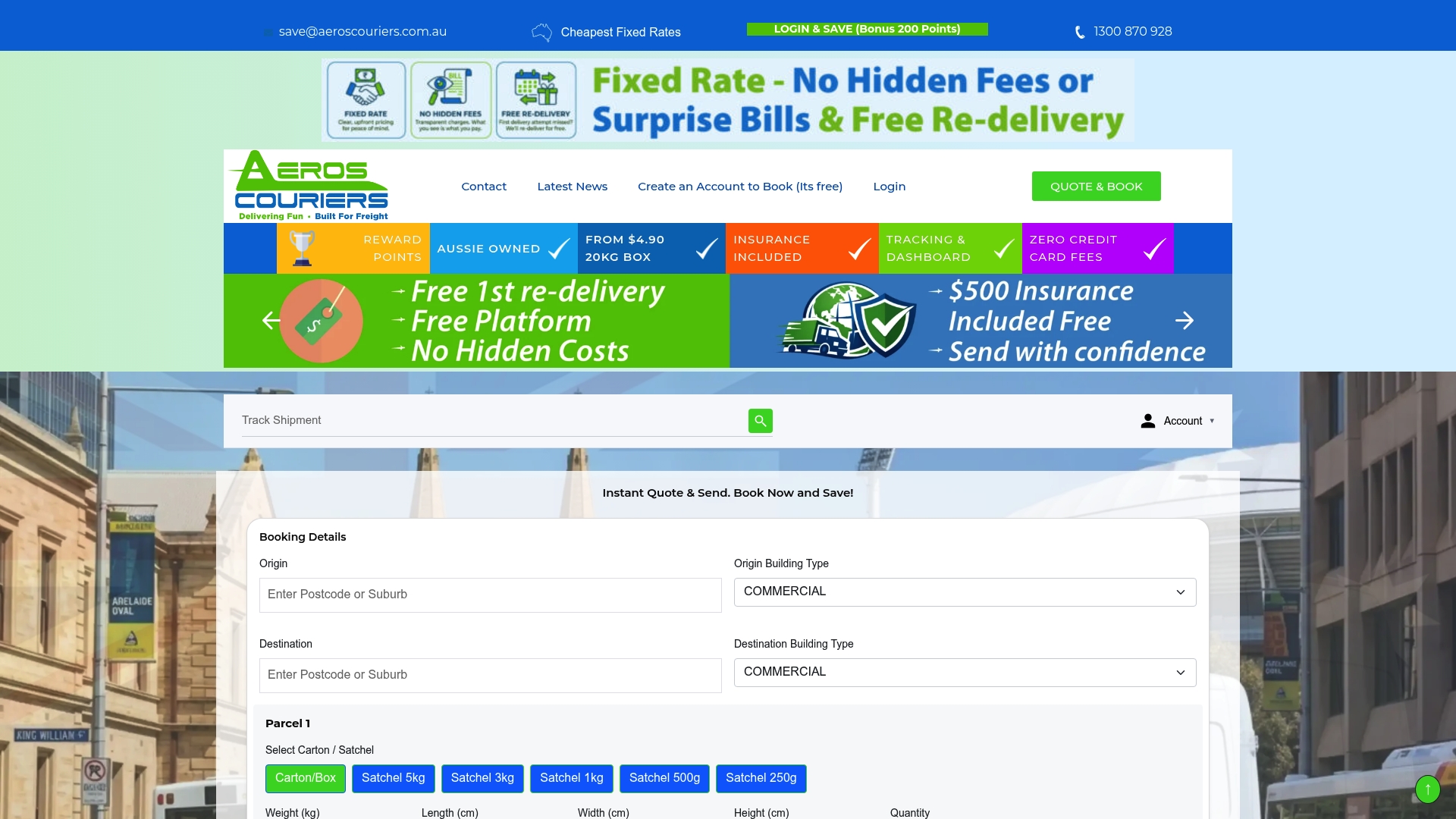
- Active monitoring flags an exception as soon as it is logged, instead of leaving you to check a tracking page manually.
- Direct support access means you speak to someone who can act on the issue, not a queue.
- Reroute and redelivery options are arranged through the same platform you booked with, without extra paperwork.
Pricing is transparent without hidden surcharges, and bookings may earn rewards that can be used toward future shipments. If you want to compare carrier rates and book a parcel with monitoring built in, you can compare and book couriers directly through Aeros.
FAQ
What do I do if my package has a delivery exception?
Read the tracking note carefully first, since it usually names the specific cause and sometimes a suggested next step. If the cause needs your input, such as a wrong address or missing access instructions, contact the carrier with your tracking number ready and correct the detail directly.
How long does a delivery exception take to resolve?
Most delivery exceptions clear within a few additional business days once the cause is addressed, according to the logistics glossary definition. Customs holds and repeated access issues can take longer, since they depend on paperwork or a successful delivery attempt.
Does a delivery exception mean the parcel is lost?
No, a delivery exception on its own usually means a temporary delay rather than a lost parcel. It only becomes a genuine concern if tracking stops updating for an extended period or you receive repeated return to sender notices, at which point it is worth asking the carrier directly for a status confirmation.
How long does a shipment exception last with a courier?
Timelines vary by carrier and cause, but most exceptions are resolved within a short number of business days once the underlying issue, such as an access problem or address correction, is sorted. If a hold extends well beyond that with no update, contacting the carrier with your tracking number is the fastest way to get a clear answer.
