You've packed a customer's order, measured the box and found a delivery price that works. Then the booking asks about dangerous goods, and you're left wondering whether the batteries, paint or cleaning product inside needs a special form.
The reassuring part is that you don't need to guess. Finding the right dangerous goods declaration form in Australia starts with identifying the contents and the transport mode, not downloading the first blank template you find. For fast, affordable domestic box and parcel deliveries, getting that decision right before booking is more useful than fixing rejected paperwork at pickup.
Which Declaration Each Shipping Mode Needs
There is no single dangerous goods declaration form for every Australian shipment. Road transport documents, air declarations and maritime paperwork serve different purposes. The WorkSafe WA dangerous goods transport documents guide sets out the road-document information, including classification, packaging and quantity details.
Declaration required for each shipping mode
| Mode or service | Document | Who completes it | Trigger |
|---|---|---|---|
| Road, local or interstate | Transport document for each consignment | Consignor | Any dangerous goods carried by road |
| Air cargo | Shipper's Declaration | Shipper, with qualified packer | Dangerous goods sent as cargo by air |
| Air cargo, no dangerous goods | Dangerous goods statement | Shipper | Confirms no dangerous goods are present |
| Sea, packaged goods | Multimodal Dangerous Goods Form, AMSA Form 250 or IMDG Chapter 5.4 document | Trained person | Packaged dangerous goods carried by sea |
| Domestic parcel that may fly | Aviation Security and Dangerous Goods Declaration | Sender | Any parcel that may travel by air |
The mode decides the paperwork, and the carrier still decides acceptance. Australia Post's sending dangerous goods guidance explains that qualifying exempt goods do not require a Dangerous Goods declaration, so check the exemption criteria rather than assuming a small carton is exempt.
With Aeros Couriers, the sender must present a full description of goods that are or may be explosive, flammable or otherwise dangerous before tendering them. Non-compliant dangerous goods can attract an additional fee or be refused, and Aeros Couriers may destroy, dispose of, abandon or render harmless goods it believes may become dangerous without compensation.
For domestic sea movements, Marine Order 41 requires compliant dangerous-goods documentation completed by an appropriately trained person. A sea form does not replace air paperwork when the shipment changes mode.
Choose the service before the template
For an ordinary local or interstate box, establish whether it will use road freight or may fly. A road consignment's transport document must remain available in the vehicle cabin, rather than existing only in your booking account.
If the shipment also crosses borders, the customer completes the customs declaration and attaches documents such as the certificate of origin, health certificate, commercial invoice, packing list, import licence and any exemption certificate to the consignment note. Teams standardising that paperwork may review automating international shipping documents, then apply the same discipline to the Australian dangerous-goods document required by the chosen mode.
Start with the mode: Declared does not mean accepted. Confirm the service, permitted contents and carrier acceptance before preparing the final paperwork.
Packaging, Labels and Lithium Battery Limits
Prepare a compliant package before signing a declaration about it. A form can describe the contents accurately while the parcel itself remains unsuitable for carriage. Treat packaging, marks and labels as separate checks, not something the declaration fixes.
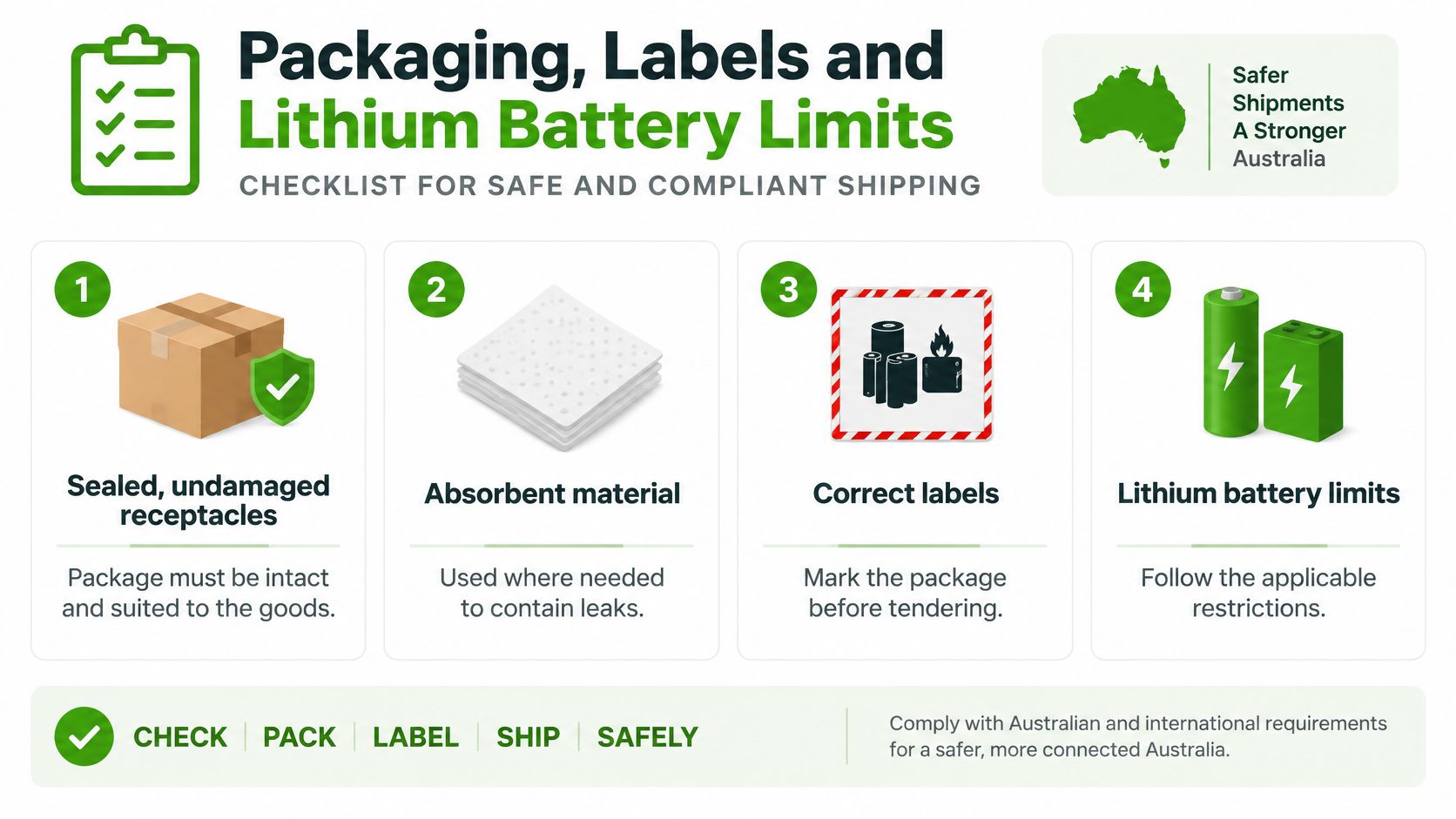
Start with sealed, undamaged receptacles suited to the substance. For a chemical liquid, check that the closure is secure and the receptacle material is compatible with the contents. Use absorbent material where required to contain leakage, and protect inner containers from movement inside the outer carton.
Check the battery arrangement, not just the carton
Say an online seller is preparing electronics with replacement lithium batteries. The seller needs to establish whether the batteries are installed, packed with equipment or being sent separately, then check whether that arrangement is permitted by the selected service.
Under the stated IATA provisions, Australia Post's dangerous goods guide permits no more than four cells or two batteries in a single package and says no labelling is required for that permitted quantity. That allowance operates within the relevant postal conditions. It isn't blanket approval for replacement batteries, every battery chemistry or every courier service.
Exceeding the allowance means you can't rely on that simplified treatment. Don't split or rearrange an order merely to avoid a label without checking whether the resulting packages satisfy the applicable conditions.
Match the marks to the contents
Use the SDS and applicable transport rules to identify the required hazard labels and UN marks. Our explanation of hazardous goods classification can help you understand the terminology, but the classification must suit the actual product.
A neat carton with the wrong hazard label is still non-compliant. Equally, don't add unrelated hazard labels as a precaution, because they can contradict the declaration.
Keep this packing-bench checklist beside the label printer:
- Confirm classification: Identify the product and its applicable transport requirements.
- Check battery eligibility: Verify the arrangement, quantity and service conditions before sealing.
- Protect and mark: Secure receptacles, add required absorbent material and apply the correct marks and labels.
- Compare with the declaration: Make sure the documented contents describe the parcel that will leave the bench.
How to Complete the Form Field by Field
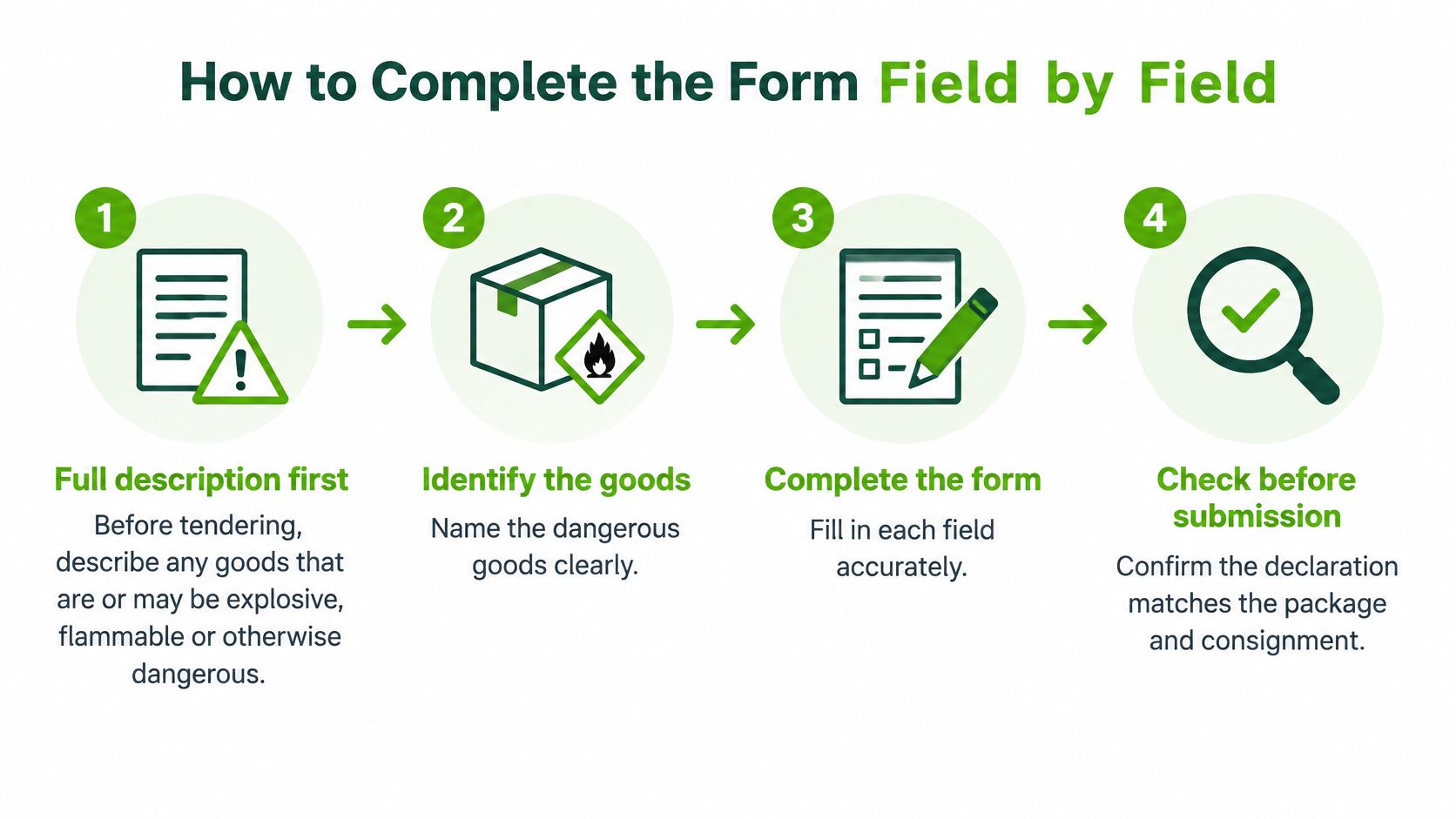
Before tendering goods for carriage, our customers must provide a full description of anything that is or may be explosive, flammable or otherwise dangerous. Don't reduce that description to a broad booking category such as household supplies.
Start with the current Safety Data Sheet, then verify the transport entries against the Australian Dangerous Goods Code. The NSW EPA transport documents guidance identifies the required road-document details and requires a legible document in English, carried in the vehicle cabin for authorised persons or emergency services.
Identify the substance before counting packages
The classification determines which packaging and labels you need. Resolve the UN number, proper shipping name, class and packing group before finalising the parcel, then enter quantities from the finished consignment.
Field-by-field entries for the declaration
| Field | What to enter | Where to check |
|---|---|---|
| Consignor name and telephone | Legal name of the sender and a daytime contact number | Business records |
| UN number | The UN identifier assigned to the substance or article | SDS section 14 |
| Proper shipping name | The official name from the Australian Dangerous Goods Code, not the product trade name | Australian Dangerous Goods Code |
| Class or division | Primary hazard class, for example Class 3 for flammable liquids | SDS section 14 |
| Subsidiary hazard | Any secondary hazard class, or nothing if the SDS lists none | SDS section 14 |
| Packing group | I, II or III where the substance is assigned one | SDS section 14 |
| Package type and count | Receptacle type and the number of packages in the consignment | Packed consignment |
| Aggregate quantity | Total litres or kilograms of dangerous goods in the consignment | Packing list and load count |
| Signature and date | Signed by the consignor before the goods are tendered | Completed declaration |
For a hypothetical paint consignment, entries might include your registered business name and daytime telephone, UN1263, PAINT, Class 3, no subsidiary hazard if none is assigned, and packing group III only if the product's SDS specifies it. Package and quantity entries might read metal tins, count two, containing ten litres in total. These are illustrative entries, not classification advice for an unidentified paint.
Check the document as a complete record
A consignment note identifies the shipment and its delivery details. Don't assume it also satisfies dangerous-goods documentation requirements unless it contains every required entry.
Use a controlled template rather than typing the same product description from memory. Keep the source SDS available to the person preparing the document, and don't carry an old packing group into a new product's record because the trade names look similar.
Before signing, match the UN number to the proper shipping name, the class to the package's hazard label, and the aggregate quantity to the actual contents.
Completing One Declaration
Consider a hypothetical domestic road parcel containing two metal tins of solvent-based paint, each holding five litres, protected in absorbent-lined cartons. Assume the selected carrier has confirmed that it accepts this particular product, packaging and service combination.
The sender prepares the declaration using the product's current SDS, rather than treating the tin's retail label as a transport description. The following example shows how the entries fit together.
An illustrative completed record
| Field | Example entry |
|---|---|
| Consignor | The sender's registered business name and daytime telephone |
| UN number | UN1263, if confirmed by the product's SDS |
| Proper shipping name | PAINT, verified against the Australian Dangerous Goods Code |
| Class | 3, flammable liquid, if confirmed for the product |
| Subsidiary hazard | The assigned code, or blank where none is listed |
| Packing group | The value assigned in the product's SDS |
| Package type and count | Metal tins, count 2, with the outer cartons also described as required |
| Aggregate quantity | 10 litres |
| Signature and date | Completed by the consignor before tendering |
Every classification value here is illustrative. Your own product's SDS determines the entries. Solvent-based paint isn't a sufficient description from which to guess a packing group or secondary hazard.
Package descriptions also need to reflect the actual packing arrangement. If the tins are inside separate cartons, don't leave the carrier trying to reconcile an entry that mentions only the inner receptacles with the outer packages presented for collection.
Keep the record aligned with the remaining load
Suppose a delivery removes one of those tins from the vehicle's load. The remaining record would show one tin and five litres, with the corresponding outer-package details adjusted where necessary.
That reconciliation belongs in the handover process, not in an end-of-day office update. A document describing what was originally loaded is no longer an accurate description of what remains in the vehicle.
Chain of Responsibility Duties for Senders
A signed declaration travels with the goods, while responsibility for describing them accurately stays with the sender. The consignor, packer, loader, carrier and driver each hold a different duty, and a driver collecting a parcel at the door doesn't certify the classification behind it. Under Aeros Couriers' conditions, goods remain at the customer's risk, so a careless description stays your problem after collection.
A seller packs a five-litre bottle of cleaning solvent and books it as an ordinary parcel. Collection doesn't correct that omission. Before tendering goods that are or may be explosive, flammable or otherwise dangerous, the customer must present a full description of them, and the seller still needs to establish the product's classification and disclose its dangerous characteristics first.
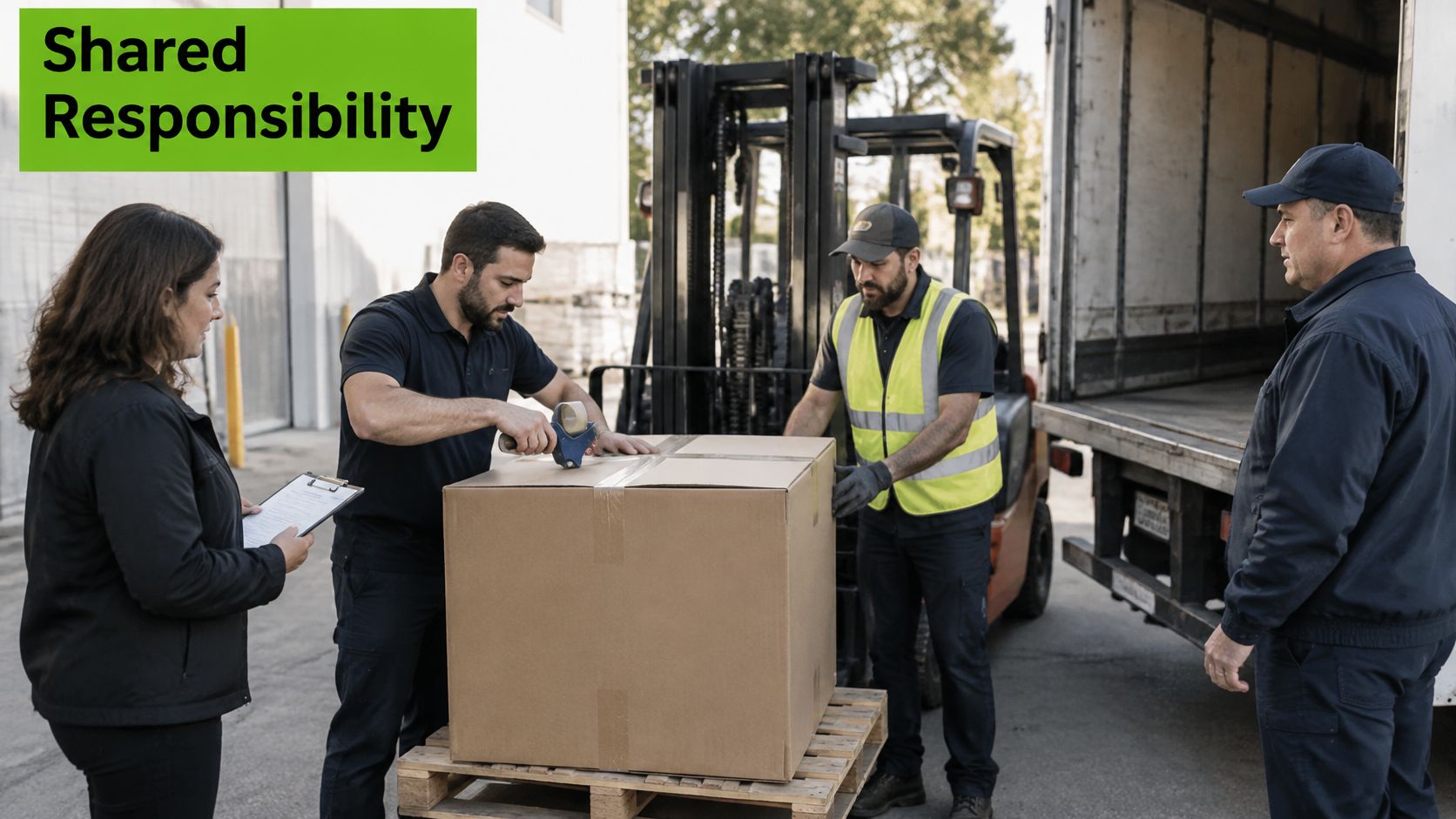
Make responsibilities visible at the packing bench
For air cargo, CASA's dangerous goods declaration guidance explains that the packer must be appropriately qualified and that declaration information supports the operator's loading and emergency-response decisions. What you write on the form shapes decisions made after the parcel leaves your hands.
Give each task a named owner, even if one person runs the whole business:
- Describe accurately: The person preparing the declaration checks the actual product, not a remembered description from an earlier order.
- Reconcile the package: The packer compares the contents, package marks, hazard labels and document before sealing the dispatch.
- Provide accessible records: The dispatch person ensures the carrier receives the required document, rather than leaving it in an email thread that the driver can't access.
Aeros Couriers may refuse non-compliant dangerous goods, an additional fee applies when dangerous goods don't meet requirements, and the carrier may destroy, dispose of or render harmless goods it believes may become dangerous without compensation. A consignment can also be stopped later in the transport chain, so passing collection is no compliance guarantee.
Keep parcel preparation separate from freight-unit advice
Preparing a compliant box or parcel is a different job from preparing palletized freight. If your goods ship on a pallet, follow guidance on wrapping a pallet for shipping for the freight unit, then apply the dangerous goods requirements that belong to each package inside it.
Ordinary shipping insurance won't settle the risk either. Aeros Couriers' insurance doesn't cover dangerous goods, and arranging appropriate cover remains the customer's responsibility.
If you wouldn't sign the declaration yourself, don't hand the goods over.
Resolve uncertainty while the parcel is still under your control. Getting the correct SDS or revising the packaging at your bench is far easier than correcting the record after the box enters a delivery network.
Errors to Catch Before You Book
A product trade name isn't a proper shipping name. Writing the familiar brand or product description in that field feels clearer to your customer, but it doesn't give the carrier the standardised transport description it needs.
Copy the proper shipping name from the Australian Dangerous Goods Code and verify it against the product's transport classification. Keep the retail description elsewhere in your records if it helps identify the order, without letting it replace the regulated entry.
Fix the cause, not just the rejected field
Declaration errors, consequences and fixes
| Error | What it causes | Fix |
|---|---|---|
| Trade name written instead of the proper shipping name | Refusal at acceptance or misclassified handling | Copy the proper shipping name from the Australian Dangerous Goods Code |
| Subsidiary hazard or packing group left off | Wrong loading, stowage and emergency response | Re-read SDS section 14 and fill every applicable hazard field |
| Original load quantity kept after partial unload | Inaccurate aggregate quantity and breach of NSW EPA guidance | Reconcile the declaration after each delivery or unload |
| Air-eligible parcel declared without dangerous goods check | Parcel refused for air carriage, redirected to road or treated as a false declaration | Check contents against the SDS before booking and sign the appropriate declaration |
A missing field isn't always a typing problem. It can mean the person preparing the form never established the classification, or that a saved template no longer matches the product in the box. Resolve that uncertainty before producing another declaration, because a corrected form built on a wrong classification is still wrong.
Check the label on the package at the same time. Clear delivery details help the courier route the box, but an address label doesn't replace hazard labels or dangerous goods paperwork.
Don't use a no-dangerous-goods statement as a shortcut
For air freight, CASA's packing and special transport approvals guidance sets a strict sequence: establish whether the goods are dangerous and permitted, then prepare compliant packaging, marks, labels and the Shipper's Declaration. The operator's acceptance check remains a separate stage, so a signed declaration does not by itself put the parcel on an aircraft.
An aviation security declaration isn't permission to send dangerous contents as ordinary cargo. Australia Post's domestic parcels guide says parcels without the completed declaration won't be carried by air and warns that making a false declaration is a criminal offence.
Route batteries, aerosols and chemicals to someone with the appropriate dangerous-goods knowledge before generating an ordinary parcel label. If the product information is incomplete, pause the booking instead of ticking a box to keep the order moving.
Under its conditions, Aeros Couriers may destroy, dispose of, abandon or render harmless dangerous goods, or goods it believes may become dangerous, without compensation to the customer. Accurate disclosure protects more than the delivery schedule.
Run the pre-booking check
- Establish eligibility. Use the current SDS and applicable service rules to determine whether the goods are dangerous, permitted or qualify for an exemption.
- Select the document. Match the actual transport mode and service to its declaration requirements, since road, sea and air each call for different paperwork.
- Verify classification. Check the proper shipping name, UN number, class, subsidiary hazard and packing group against the relevant records.
- Reconcile the parcel. Confirm that quantities, receptacles, package count and marks describe the finished box.
- Authorise dispatch. Sign and date the required declaration before tendering, then provide it through the service's required handover process.
Aeros Couriers handles domestic box and parcel shipments locally and interstate across Australia, and its Australian support can help with pickups, delivery questions and unexpected issues at save@aeroscouriers.com.au.
Pull the SDS for your next product, run these checks and confirm acceptance before booking. That is how you compare the cheapest suitable delivery options without choosing a service that can't carry the contents.
Aeros Couriers offers fast, low-cost box and parcel deliveries locally and Australia-wide, with Australian support for shipping questions. Once you've confirmed the contents, documentation and carrier acceptance, visit Aeros Couriers to compare suitable delivery options and book your parcel.
Courier quotes, tracking and support
Ready to send a parcel? Compare the available services for your postcodes, parcel dimensions and weight. For an existing delivery, use your consignment number to check tracking or ask our team for help.