


It's a familiar feeling: you're excitedly tracking a parcel, but the status hasn't changed for days. Your mind starts to race – is it lost? Did it even get sent? Before you panic, let's look at what's really going on behind the scenes.
When your Australia Post tracking seems stuck, it’s usually because the parcel is simply moving between scanning points. Think of it less like a live GPS tracker on a map and more like a series of digital handshakes between sorting facilities. If there's no "handshake," there's no update.
This is especially common for parcels on a long-haul journey. A package travelling by truck from Sydney to Perth might not get scanned for a day or two, even though it's steadily making its way across the country. The tracking will only spring back to life once it arrives at the next major hub for processing.
Another classic reason is a gap between the sender creating a shipping label and the parcel actually being lodged with Australia Post. The tracking number exists and is in the system, but the clock doesn't truly start until that first physical scan at a post office or facility.
So, Why is My Tracking Stuck?
High-volume periods are the biggest culprits for tracking blackouts. During the Christmas rush, for instance, Australia Post can handle a mind-boggling 102.8 million parcels. While that’s an impressive logistical feat, it puts a massive strain on the network. Sorting centres get overwhelmed, and it can take 48 hours or more for a parcel's first scan to appear after it's been lodged.
Let's break down the most common reasons for a pause in your tracking updates:
- The Lodgement Gap: This is the delay between a retailer marking your order as "shipped" and Australia Post performing the first scan. Your tracking number is live, but your parcel isn't officially in their hands yet.
- The Long Haul: If your package is travelling interstate or to a regional area, it can be on a truck or plane for a long time without hitting a scanning checkpoint. To understand this phase better, check out our guide on what 'in transit' really means.
- Network Overload: Think Black Friday, Click Frenzy, or Boxing Day sales. The sheer volume of parcels can create queues at sorting facilities. Your parcel is moving, just waiting its turn to be scanned.
The biggest misconception is that "no update" means "no movement." In reality, your parcel is almost always on the move—it’s just in a blind spot between the official checkpoints.
To give you a clearer picture, here’s a quick guide to what some of those common AusPost tracking statuses actually mean and why they might seem frozen.
Common AusPost Tracking Statuses And What They Mean
| Tracking Status | What It Really Means | Common Reason For No Update |
|---|---|---|
| Pending | A shipping label has been created by the sender, but Australia Post has not yet received or scanned the parcel. | The sender hasn't dropped off the parcel yet. This can last a few days depending on their processes. |
| In Transit | The parcel has been scanned at one facility and is on its way to the next one (often the destination state). | The parcel is physically on a truck or plane. No updates will occur until it reaches and is scanned at the next sorting centre. |
| Processing | The parcel is at a major sorting facility and is being sorted with thousands of other items for its next destination. | Delays here are common during peak periods. High volume means it's in a queue waiting for its turn to be sorted and scanned. |
| Onboard for delivery | The parcel is on the local delivery van or with a postie, heading to your address today. | This is the final step! You shouldn't see delays here, but if the driver runs out of time, it may be updated to "awaiting collection." |
Ultimately, a temporary silence on the tracking page is usually just a normal part of the delivery process. It almost always resolves itself once the parcel hits its next major scanning point.
What to Check Before You Contact Support
Before you spend time on hold with a support agent, there are a few quick checks you can do yourself. It’s easy to jump to conclusions, but more often than not, the reason your Australia Post tracking isn't updating is surprisingly simple. Running through these steps first can save you a world of frustration.
Double-Check the Basics
First things first, have another look at that tracking number. A simple typo is one of the most common culprits. I’ve seen it happen countless times – an ‘O’ mistaken for a ‘0’, or an ‘I’ for a ‘1’. Carefully re-type the number and see if that clears it up.
Next, it’s worth confirming with the sender that the parcel has actually been dropped off. Many online sellers create a shipping label and tracking number the moment you hit "buy." This generates an initial "Shipping information received" status, but it doesn't mean Australia Post has the item. All it means is the paperwork is done. The real journey only begins once it gets that first physical scan at a post office or depot. To get a better handle on the different shipping documents, our guide on what is a consignment note is a great resource.
Look for Official Service Updates
Sometimes, the problem isn't with your parcel but with the entire network. Australia Post is usually pretty good about posting service disruption notices on its website. A quick look might show you there are delays due to floods, road closures, or just a massive backlog in a certain area. This can instantly explain the radio silence on your tracking.
Here's another pro tip: download the official Australia Post mobile app. For whatever reason, I've noticed the app sometimes shows more current tracking details than the website. It seems to refresh more frequently, giving you a slight edge in getting the latest scan info.
Before you dig any deeper, get your details in order. You'll want the full tracking number, the sender's and recipient's details, and the original estimated delivery date. Having this handy will make any conversation with support much smoother.
This flow chart gives a great visual of a parcel's journey and where things can get held up.
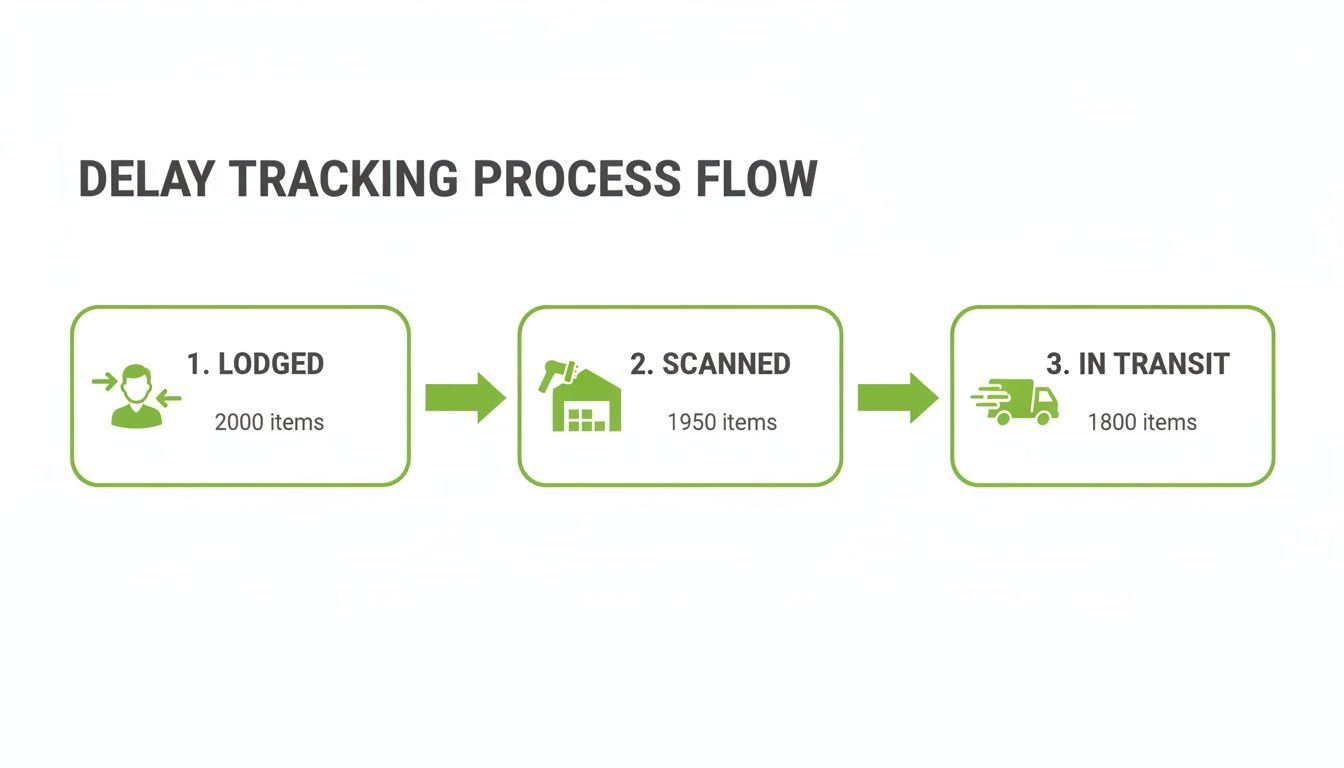
As you can see, the biggest information gap is often during that ‘In Transit’ stage. Your parcel could be on a truck travelling hundreds of kilometres between major sorting facilities without a single scan. By doing these quick checks, you can often figure out what’s going on without needing to pick up the phone.
How to Effectively Contact Australia Post
Alright, you've done the initial checks, waited a bit, and your parcel tracking is still stuck. It’s officially time to get in touch with Australia Post. Knowing exactly when and how to do this can be the difference between getting a fast answer and getting stuck in a support loop. My advice? Don't be too hasty, but definitely don't let it slide for too long.

The sweet spot for lodging an enquiry is once the estimated delivery window has passed by at least two business days. This buffer gives the system a chance to catch up on any minor delays or missed depot scans. If you contact them any earlier, you're almost guaranteed to get the standard "please wait a little longer" reply, which doesn't help anyone.
Who Should Make the Enquiry?
This is one of the most important parts, and it’s where many people go wrong. While it feels instinctive for the person waiting for the parcel (the receiver) to do the chasing, it’s almost always the sender who holds the power here.
Think about it: Australia Post's contract is with the person or business who paid for the postage. They are the actual customer in this transaction.
This means the sender is the one who needs to lodge the official enquiry. They have the lodgement receipts, payment details, and account info that the support team needs to kick off a proper investigation. If you're the receiver, your first port of call should be to contact the sender and ask them to get the ball rolling on your behalf.
Using the Online Enquiry Form
From my experience, the most efficient way to get your issue logged and tracked is by using the official Australia Post online enquiry form or lodging it through your MyPost account. This creates a digital paper trail, assigns you a case number, and routes your problem to the correct internal team.
To make this as painless as possible, get all your ducks in a row before you start filling out the form.
Have this information ready:
- The full tracking number (copy and paste it to avoid typos).
- Sender’s and receiver’s full names and addresses.
- A clear, simple description of the item and its packaging.
- The date the item was sent.
Having this on hand saves a ton of back-and-forth emails and lets the support agent get straight to work.
Pro Tip: Be specific, but keep it brief. Instead of just saying "my tracking is broken," write something like, "Tracking has been stuck on 'In Transit' since [Date], which is now three days past the estimated delivery date of [Date]."
When deciding the best way to raise the issue, it helps to know which channel suits your situation.
| Choosing The Right Contact Method |
| :— | :— | :— | :— |
| Scenario | Who Should Contact | Best Method | When To Act |
| Domestic parcel is a few days late | Receiver, then Sender | Contact Sender first | 2 business days after ETA |
| Item is marked 'Delivered' but not received | Receiver | Online Enquiry Form / Phone | Immediately |
| Business sending multiple parcels | Sender (Business) | Business Support / Online Form | 2-3 business days after ETA |
Ultimately, having the sender initiate contact through the online form is usually the most effective path for standard delays.
A Simple Template for Your Message
To get results, you need to give the support team clear, actionable information right from the start. Cut the emotion and stick to the facts. Here's a template you can adapt—either for yourself as the sender or to give to the sender to use.
-
Subject: Enquiry for Tracking Number: [Your Tracking Number]
-
Body:
- Hi, I'm lodging an enquiry for a parcel with a stalled tracking status.
- Tracking Number: [Enter Full Tracking Number]
- Sent Date: [Date]
- Sender: [Name], [Address]
- Receiver: [Name], [Address]
- Item Description: [e.g., Blue cotton shirt in a white satchel]
- Last Status: [e.g., 'In Transit' on DD/MM/YYYY]
- The estimated delivery date has now passed. Could you please investigate and provide an update on its location?
Using a clean, bulleted format like this makes it dead simple for the support agent to find what they need.
Of course, if you're a business that ships frequently, dealing with these issues can become a major time-sink. This is often when exploring specialised courier platforms makes sense. For instance, services built for businesses offer more direct support channels because they understand that your time is money. You can see what a difference it makes by looking at the Aeros Couriers contact options to understand how a dedicated provider handles customer care.
Advanced Scenarios and When to Escalate
Sometimes, your first enquiry gets a canned response, and your parcel is still nowhere to be seen. If you're past the initial troubleshooting steps, it’s time to push things up the ladder. The standard process is built for common delays, but it often breaks down with more complicated situations, especially if you're sending something valuable or time-sensitive across the country.
This is especially true when you factor in Australia’s unique shipping challenges. Think about it: a parcel going from a farm in regional Queensland to a remote community in Western Australia has a far more complex journey than a simple hop between Sydney and Melbourne. These long-haul routes can involve multiple handoffs to different contractors, creating tracking blackouts that last much longer than a day or two. Knowing this helps you spot when a delay is genuinely unusual and needs a firmer follow-up.
When a Parcel Is Declared Lost In Transit
After you've lodged that first enquiry, Australia Post kicks off an internal investigation. If they still can't find your parcel after a certain amount of time—usually about 10 business days past the estimated delivery date—they will officially declare it 'lost in transit'. This is the green light for starting a formal claim.
Once that happens, it's up to the sender to get the claim process started for compensation. They'll need to dig up proof of value (like an invoice or receipt) and the original postage receipt. It’s not a quick fix and requires a bit of patience, but it's the only way to recover the value of what's gone missing.
Key Tip: The responsibility to lodge a claim almost always falls on the sender, because they're the one who paid Australia Post. If you're the receiver, your job is to keep the sender in the loop and encourage them to see the claim through.
Navigating Specific Australian Shipping Challenges
The sheer size of Australia means our domestic shipping can be particularly tricky. Your parcel's journey can be thrown off course by local events that you'll never see on a standard tracking page.
- Regional Backlogs: A major flood or bushfire can sever key transport routes, causing parcels to pile up in state sorting facilities for days on end.
- Remote Area Handoffs: For deliveries to really remote spots, AusPost often hands the parcel over to a local third-party contractor for the final leg. When this happens, tracking updates can stop dead.
It’s not just the Christmas rush that causes network overloads. Unexpected events can cause massive domestic delays, with parcels sitting 'stuck in transit' for weeks. You can keep an eye on these kinds of major issues by checking the latest service updates from Australia Post.
Knowing what to do next is crucial. If your tracking has been silent for more than a week past the delivery estimate and your first enquiry went nowhere, it's time to escalate. This means calling them again, quoting your case number, and politely but firmly asking for a proper investigation into the parcel's last known whereabouts.
For businesses shipping valuable items, it’s essential to understand exactly what your postage costs cover. Taking the time to review Australia Post courier charges and the included protections is a proactive step that can save a lot of headaches later on.
Tips for Senders to Prevent Future Headaches
Let's be honest, the best way to fix a tracking problem is to avoid it altogether. If you’re sending parcels regularly, especially for a small business, a few preventative steps can save you—and your customers—a world of stress. It's all about setting your package up for success before it even leaves your sight.

Think about your parcel's journey. It’s handled by high-speed sorting machines that rely entirely on scanning barcodes. If that barcode is unreadable for any reason, your parcel gets sidelined for manual handling. That’s where the first, and most common, delays often happen.
Get Your Packaging and Labelling Right
A clear, scannable label is your parcel’s passport through the delivery network. It sounds simple, but getting this small detail right has a massive impact on whether your tracking updates smoothly.
Here are a few golden rules I always follow:
- Print it properly: A blurry or faded barcode is a guaranteed problem. Make sure your printer isn't running low on ink or toner, and always aim for a sharp, high-contrast print.
- Keep it flat and smooth: Wrinkles, creases, or even air bubbles under the label can distort the barcode just enough to make it unreadable. Stick it on the largest, flattest side of your box.
- Don't tape over the barcode: It’s tempting to secure the label with tape, but the glare can block the scanner. Tape the edges down, but leave the barcode itself exposed.
Nailing your labelling process is the cornerstone of reliable tracking. For businesses, mastering the essentials of shipping labels and printing can cut out a huge number of potential shipping headaches before they even start.
Manage Customer Expectations from the Get-Go
If you run an e-commerce store, how you communicate is just as crucial as how you pack. The moment a customer sees "tracking not found," their mind often jumps to the worst-case scenario. That's when the support tickets start rolling in.
Your communication can be the difference between a panicked customer and a patient one. Being upfront about how tracking actually works builds trust and seriously cuts down on those "Where is my order?" emails.
Don't just send a tracking number and call it a day. Give your customers some context. A quick note in your shipping confirmation email explaining that it can take 24-48 hours for tracking to go live makes a huge difference. You could also mention that long gaps between scans are normal for interstate travel.
This small bit of proactive communication shows you know what you’re doing. It reassures customers that a quiet tracking page isn’t a red flag, and it proves you’re on top of their order, even when the system is slow to update.
Your Top Tracking Questions Answered
When a parcel seems to vanish off the grid, it's natural to feel a bit anxious. You just want to know what's going on. Here are some of the most common questions we see, along with practical advice on what to do next.
My Tracking Hasn’t Updated in Over a Week. What Should I Do?
This is a big one. A day or two of silence can be normal, especially for parcels travelling interstate, but a full week without a single scan is a clear signal that something's not right, particularly if you're well past the estimated delivery date.
It's time to take action. Your first port of call should be the sender. As Australia Post's direct customer, they hold the power to get an official investigation started. Just send them your tracking number and order details and ask them to lodge a formal enquiry.
If you're the one who sent the parcel, you'll need to head to the Australia Post online enquiry form yourself. Be ready to provide all the key details – tracking number, sender and receiver addresses, and a description of what’s inside. Filling this out creates an official case file, which is the fastest way to get boots on the ground to find your package.
The Tracking Says ‘Delivered,’ But My Parcel Isn’t Here
It’s a uniquely frustrating feeling, but before you panic, run through a few common scenarios. More often than not, there's a simple explanation.
- It’s in a ‘Safe Place’: Your postie might have tucked it somewhere out of sight to keep it secure. Have a good look behind pot plants, under the doormat, around verandah furniture, or even in your meter box.
- A Neighbour Grabbed It: It's surprisingly common for parcels to be delivered one or two doors down by mistake. It’s always worth a quick, friendly knock on your neighbours' doors.
- Scanned Too Soon: Sometimes, a driver will scan a parcel as 'delivered' on their handheld device before they’ve actually dropped it off. It might still be in the van and could show up later in the day or even the next morning.
If a full 24 hours pass and it's still missing, it's time to lodge an enquiry. This is one situation where, as the receiver, you should act fast because the issue is tied directly to your delivery address.
Is Express Post Tracking More Reliable?
Generally, yes. Express Post parcels are treated with higher priority across the entire network. This means they get handled and scanned more often than standard mail, which usually results in more frequent and detailed tracking updates.
That said, Express Post isn't a magic bullet. It can still fall victim to the same problems that plague the standard service, like major network congestion during Christmas or unexpected transport delays. You’ll see more scans, but a temporary blackout isn't out of the question.
The real advantage is that the faster, prioritised journey makes any long silence in the tracking a much stronger red flag, so you know to investigate a potential problem sooner.
I’ve Lost My Tracking Number. What Are My Options?
Misplacing your tracking number can feel like you've hit a brick wall, but all is not lost. Your main goal is simply to find that number again.
Start by digging through your emails. Search your inbox (and don’t forget the spam or junk folders!) for the shipping confirmation email from the sender. The tracking number is almost always in there.
Can't find the email? Your only other move is to contact the sender directly. They keep detailed records of all their shipments and will be able to pull up the tracking number for you in no time. For security and privacy reasons, Australia Post support staff can't find a parcel for you with just a name or address.
Constantly chasing up tracking issues is a huge time-waster, especially when you're running a business. Aeros Couriers offers a refreshingly reliable and affordable alternative, with clear tracking and dedicated local support to help you sidestep these headaches entirely. Get an instant quote and see the difference.
