
You've sent a box interstate, emailed the customer their tracking details and returned to your orders. Then they ask why the parcel hasn't moved. You open the tracking page, see the same update as yesterday and wonder whether to wait, call someone or send a replacement.
Australia wide shipping tracking is most useful when it helps you make that decision. A quiet tracking page isn't proof of a lost parcel. This guide focuses on domestic box and parcel deliveries within Australia, not international shipping or pallets, with practical ways to keep deliveries moving without paying for speed you don't need.
What Each Tracking Status Means and What to Do
Say your Perth-to-Cairns box has shown In transit for three days and the recipient is asking questions. A stalled tracking page is a decision point: wait, act, or escalate. The headline label matters less than the last confirmed physical scan, where that scan happened, and whether the expected delivery window has closed.
That habit of checking is common. Australia Post's eCommerce Report 2025 reports that 45% of shoppers actively track parcels, and more than two-thirds go directly to the delivery provider for tracking information.
Tracking statuses, meanings and next actions
Carrier wording varies, but the meanings below give you a practical starting point.
| Status | What it means | What to do |
|---|---|---|
| Label created | Details exist but the carrier hasn't collected the parcel | Wait for the acceptance scan; confirm the parcel was handed over |
| Accepted by carrier | First physical scan; the carrier has possession | Check the lane window in the ETA section |
| In transit | Moving between facilities on a line-haul leg | Normal on regional routes; check the expected window |
| Arrived at facility | Parcel reached a processing or destination depot | Expect the next scan within the usual interval |
| Awaiting collection | Held for pickup at a depot or outlet | Arrange collection before the hold ends |
| Out for delivery | On a driver's run for the day | Keep the delivery contact reachable |
| Attempted delivery | Driver couldn't complete the drop | Check for a card or re-delivery option |
| Incorrect address | The address couldn't be matched | Contact support with the reference to correct it |
| Delivery delayed | Scans have slowed or stopped past the lane window | Escalate using the steps in this guide |
| Delivered | Proof of delivery has been recorded | Confirm receipt with the recipient |
| No scan after escalation window | No movement after the expected window and follow-up | Raise a formal enquiry with the reference |
Read the event, then choose the action
For the Perth-to-Cairns box, a departure scan followed by silence usually means the parcel is moving between facilities on a long line-haul leg that produces no customer-visible event. Regional handovers often work this way. The right move is to wait inside the window. An address exception calls for something different: the sender needs to supply corrected details, and refreshing the page changes nothing.
Silence inside the window is normal. Silence past it is a signal. A parcel shifts from wait-and-see to worth chasing when three things line up: the expected delivery window has closed, new scans still haven't appeared, and the carrier has had a chance to respond to an enquiry. At that point you raise a formal enquiry with the booking reference, rather than assume the worst.
If a delivered parcel can't be found, check the delivery evidence and the recipient's receiving arrangements. If it's awaiting collection, act on the holding instructions instead of waiting for another attempt.
A tracking status earns its place on the screen when it tells you what to do next.
Keep parcel enquiries and refund follow-ups on separate tracks. If a seller has already issued a refund and you want to check its progress, a separate guide explains how to track a pending refund. For the box itself, the question stays the same: which event should happen next, and who do you contact when it doesn't?
Metro, Regional and Rural ETAs Explained
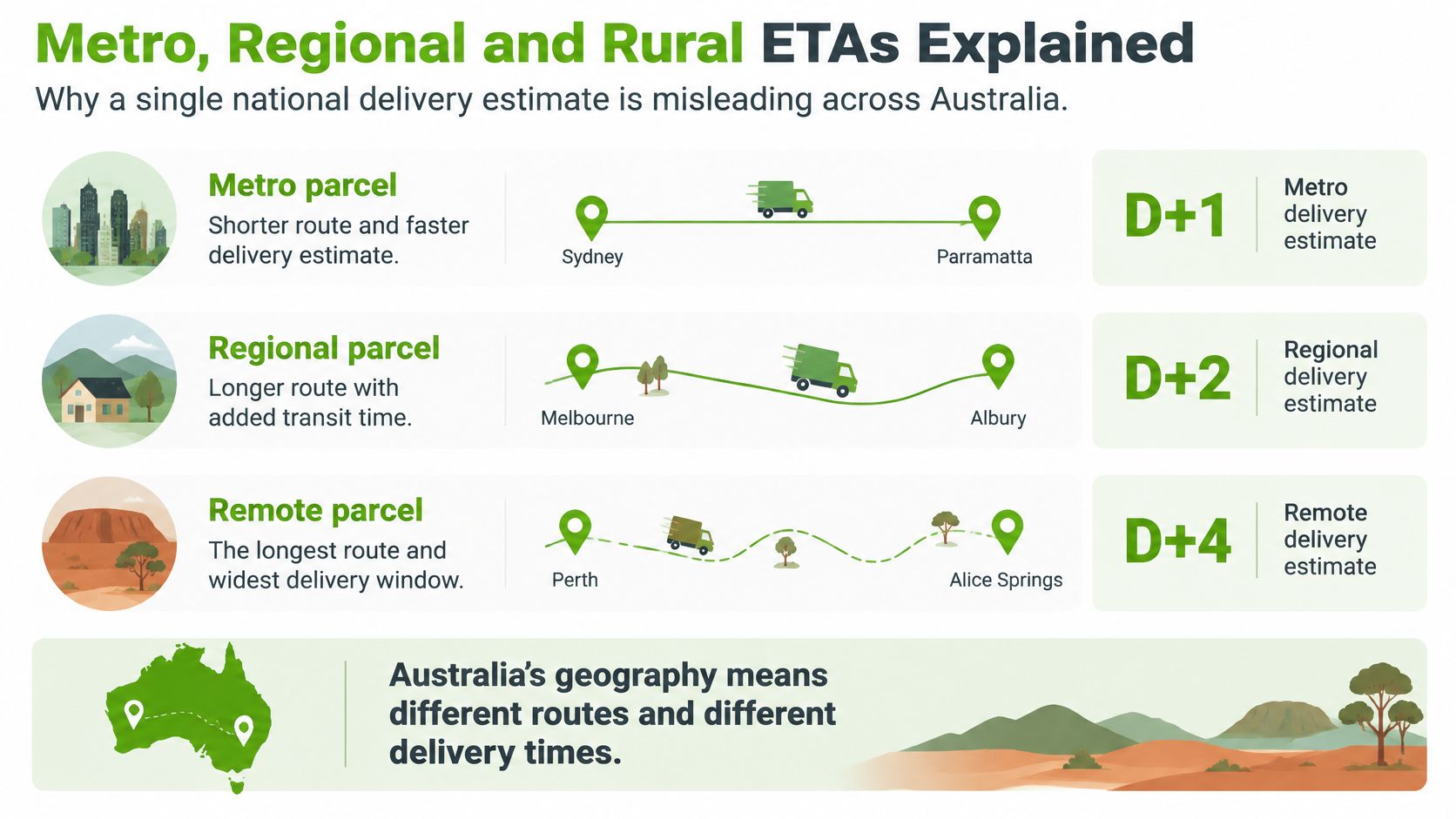
Say you lodge a metro parcel on Monday and its applicable standard is D+2. With ordinary delivery days and no intervening public holiday, Wednesday is the indicative arrival day. The D+ notation counts delivery days after lodgement, not elapsed hours or a guaranteed appointment.
The ACCC review of Australia Post's cost-allocation methodology records indicative standards of approximately D+2 for metro-to-metro, D+3 for metro-to-country and D+4 for country-to-country parcels, with some service categories extending to D+5 or D+6. These are reference standards, not a universal promise for every courier booking.
Indicative delivery standards by lane
| Lane | Indicative standard | Why it differs |
|---|---|---|
| Metro to metro | D+2 | Shortest route with the fewest transfers |
| Metro to country | D+3 | Adds a regional line-haul leg |
| Country to country | D+4 | Two regional legs and depot transfers |
| Some service categories | D+5 to D+6 | Longer remote routes and less frequent runs |
A lane is the origin-and-destination pairing. Your Perth-to-Cairns parcel needs an estimate for its actual postcodes and selected service, not an estimate borrowed from a short capital-city route.
Regional freight may pass through a main processing depot, travel on a longer line-haul service and transfer to a local delivery run. During that journey, the parcel can be progressing normally even though the customer sees no fresh scan.
The geographic differences are illustrated below. Use the lane standards above and your booking estimate for timing, rather than treating the graphic's simplified labels as service commitments.
Turn the estimate into a useful window
We run deliveries to metro, regional and rural zones across Australia. Use our quote tool to check whether the destination postcode is covered and review the timing presented for the booking. For service-specific planning, our Aramex delivery-time guide provides further context.
For a regional customer, communicate a delivery window rather than announcing an exact arrival day from a generic national estimate. Tell them which milestone you're watching for, such as arrival at the destination depot.
A parcel still within its booked window needs monitoring. A parcel beyond that window, with no expected milestone and no explanation, needs follow-up. That's a more useful distinction than whether the tracking page changed this morning.
Parcel Size, Weight and Cubic Limits Before You Book
Before sending that Perth-to-Cairns order, put the packed carton on the scales and measure its outside dimensions. Australia Post's domestic parcels guide sets standard domestic parcel limits of 22 kg physical weight, 105 cm maximum length and 0.25 cubic metres maximum volume. These are Australia Post limits, not universal limits for every carrier.
A box can pass the weight check and still fail the length or volume check. Measure the finished package, including any bulging sides, rather than relying on the carton's nominal size.
Check the space as well as the scales
Under Australia Post's size and weight guidelines, flat-rate packaging for parcels up to 5 kg is priced by packaging size; other packaging, and parcels above 5 kg up to 22 kg, use the greater of actual or cubic weight together with destination.
For a hypothetical carton measuring 60 cm × 40 cm × 40 cm, the calculated volume is 0.096 cubic metres. A light item in that box can therefore cost more to send than its scale weight suggests. Our cubic-weight formula guide explains the calculation.
- Fit the contents: Choose a close-fitting carton while retaining enough cushioning to protect the goods.
- Measure after packing: Tape, padding and protrusions affect the finished dimensions.
- Compare the complete price: Include packaging, service speed and delivery requirements.
Compare like-for-like options
Australia Post's Parcel Post page lists prepaid satchels, including packaging and domestic postage, at $10.55 extra-small, $12.05 small, $16.40 medium, $20.70 large and $24.95 extra-large.
For speed, Australia Post's domestic sending guide lists regular parcels at generally 2–6 business days and its fastest parcel option at generally 1–3 business days. Compare current quotes for the actual destination, then choose the cheapest option that meets the recipient's deadline, rather than assuming every express booking offers the same coverage.
Signature on Delivery and Safe Drop Choices
Match the completion option to the value and replaceability of the goods. A replaceable item sent from Melbourne to an Adelaide home may suit an authorised unattended delivery. A difficult-to-replace item sent on the same route may justify a signature and a staffed receiving address.
The trade-off isn't just convenience versus security. You're deciding what evidence you need at delivery and how likely someone is to be available when the driver arrives.
Delivery completion choices compared
| Delivery choice | Best for | Main risk |
|---|---|---|
| Standard drop without signature | Low-value, replaceable items | An unattended drop makes a loss harder to prove |
| Signature on delivery | High-value goods and items needing identity checks | An attempted delivery and delay if nobody is available to sign |
| Signature with staffed business address | Business deliveries with rostered staff | Requires a reachable recipient on the expected day |
A signature isn't automatically an identity check. If the goods require identity verification, confirm that the selected service includes that requirement rather than assuming a signature will cover it.
An unattended drop also needs suitable permission and a suitable location. An exposed doorstep isn't equivalent to a sheltered, accessible spot out of public view.
Avoid the costly mismatch
For the Melbourne-to-Adelaide parcel, ask whether the recipient will be home. If not, a permitted business address with reception staff may be more practical than requiring a signature at an empty house.
We offer signature on delivery as an optional booking choice, so make the decision before dispatch. Our signature-on-delivery guide explains the considerations behind that choice.
Before dispatch: Choose the delivery arrangement the recipient can realistically complete, not just the one that sounds safest.
Run these checks in order:
- Confirm the destination: Use the quote tool to check postcode coverage and the expected lane window.
- Set the completion option: Agree on signature or permitted safe drop with the recipient before booking.
- Save the reference: Keep the tracking number in the booking-confirmation folder or shared order sheet.
Those small decisions give you a clearer answer if the parcel later shows attempted delivery. You'll know whether to arrange access, contact the recipient or investigate an unexpected delivery outcome.
Finding Your Tracking Number and Following It
Say a café owner in Perth ships a replacement grinder part to a customer in Cairns. The moment the booking is confirmed, a tracking number is issued, and live tracking updates go automatically to the sender's email and the customer's email. That same number works on our website or dashboard, where it returns status updates in real time. Keep it alongside the booking reference, but treat them as different identifiers: the reference pulls up the order, the tracking number follows the freight.
Before reading anything into the Perth-to-Cairns results, confirm the number belongs to that order and the selected carrier. Our tracking-number guide shows how to identify the reference you need.
Start from a trusted channel
Open the saved booking confirmation and follow its link, or go directly to the courier's official website yourself. An unexpected delivery text that asks you to correct details or pay a fee deserves caution, especially when the parcel was booked through a different channel.
Check the handover evidence before telling a customer their order is moving. Label created proves electronic preparation; accepted by carrier proves physical possession. For a business dispatching from several sites, that distinction decides whether the next call goes to the packing team or to delivery support.
Keep the tracking page and the order details open together while you review the journey.
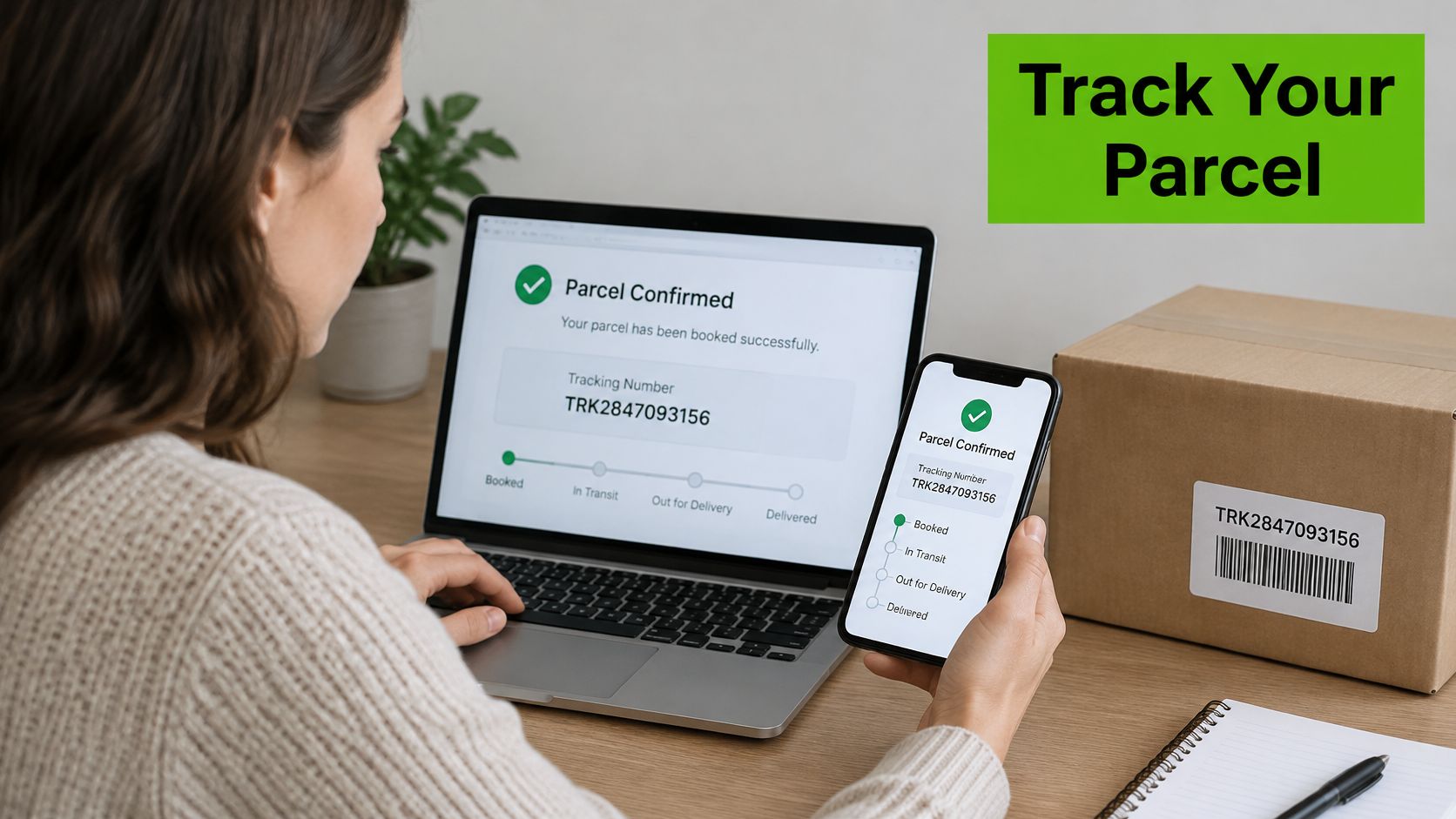
A practical dashboard routine
- Open the website from your saved booking confirmation. Start from the platform associated with the shipment.
- Enter the tracking number and read the latest status, including any exception note underneath it.
- Record the last scan's time and location. Use the status table to decide what action that event calls for.
- Compare progress with the booked lane window. For the Cairns delivery, look for the destination-depot milestone rather than expecting local delivery straight after an interstate departure.
- Share the tracking details with the recipient. They can follow the delivery themselves and be ready for the driver or a collection.
- If the page goes quiet, match the silence against the lane. A gap between scans during a regional handover is ordinary freight movement; a missed destination-depot milestone is the signal that the situation needs a closer look.
A quiet tracking page asks a question rather than announcing a loss. Missing acceptance, prolonged facility dwell, failed delivery, address corrections and signature completion all point to something waiting on a person, while a silent interstate leg often just means the freight is between depots.
Keep customer updates factual: the confirmed event, the current delivery window and the action you're taking. A scan at a processing facility is no promise of same-afternoon delivery.
How to Escalate a Parcel That Has Stopped Moving
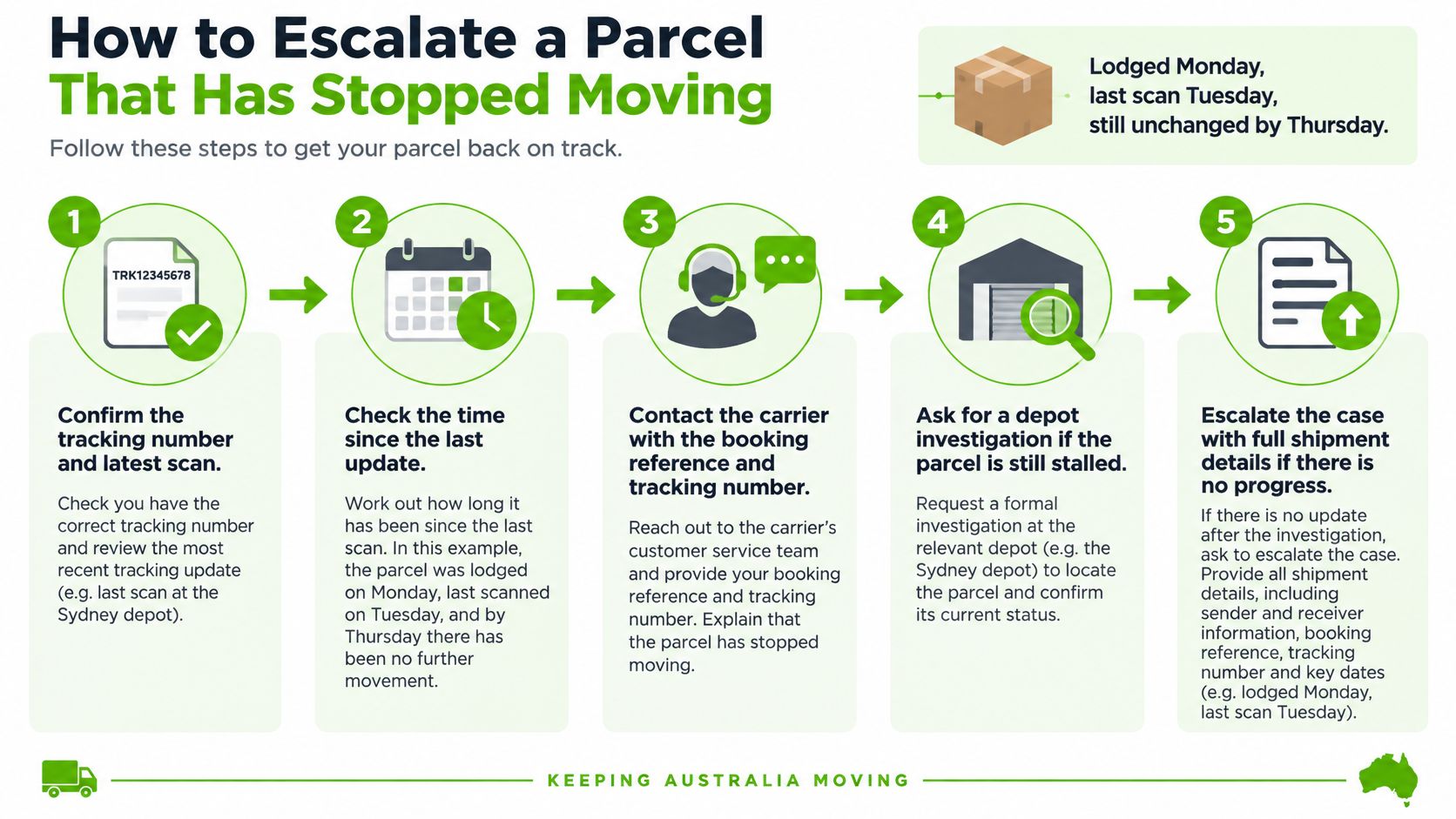
Say you lodge a parcel in Sydney on Monday for Alice Springs. It receives a Sydney-depot scan on Tuesday, but by Thursday nothing else appears. That's a reason to check the booking, not enough evidence to declare the parcel lost.
The important question is whether the booked delivery window has expired. A regional handover can leave a gap between visible events, while an address hold may require immediate attention from the sender.
Build an enquiry someone can act on
- Compare the last physical scan with the lane window. Check the booked estimate and any service notice before deciding that the parcel is overdue.
- Confirm the tracking number matches the booking reference and destination. This rules out following a different order.
- Read the exception notes. Incorrect-address and attempted-delivery messages identify a known obstacle that waiting won't fix.
- For an ordinary shipment without an urgent exception, allow one further business day beyond the booked lane window before escalating. Treat this as a practical follow-up rule, not a carrier guarantee or a reason to delay reporting damage, urgent goods or an address problem.
- Call our Australian support team on 1300 870 928. Include the booking reference or tracking number, collection and delivery suburbs, and a short description of the issue.
- Keep the full event history, booking confirmation and relevant delivery evidence for any subsequent claim.
For the Sydney-to-Alice-Springs example, a useful enquiry states that the latest visible event is Tuesday's Sydney-depot scan and asks whether a line-haul or destination-depot event can be confirmed. That gives support something specific to investigate.
The escalation process below shows how to move from checking the reference to requesting an investigation.
Keep the investigation separate from the outcome
Ask support what event they're checking for and when you should expect a response. If the shipment remains unlocated, request a formal enquiry and keep its case reference with the order.
Our guide to Australia Post tracking not updating offers further troubleshooting for that carrier. Avoid opening duplicate enquiries through different channels unless support directs you to do so, because one complete record is easier to follow.
An overdue parcel needs investigation. A confirmed lost parcel needs an outcome. They aren't the same stage.
Once the enquiry is open, let our support team coordinate the investigation while you keep the recipient informed. You don't need to promise a replacement immediately or refresh the screen all day. You need a documented next step, an owner and a follow-up point.
Aeros Couriers offers fast, low-cost box and parcel deliveries locally and interstate across Australia, with tracking to help you follow each shipment. Visit Aeros Couriers to compare quotes for your packed parcel, check postcode coverage and choose the cheapest available option that meets your delivery needs.
Courier quotes, tracking and support
Ready to send a parcel? Compare the available services for your postcodes, parcel dimensions and weight. For an existing delivery, use your consignment number to check tracking or ask our team for help.