

If you're shipping parcels around Australia, getting a handle on your shipping costs is crucial. It’s not just about what your parcel weighs on the scales; it's about understanding how couriers price their services, especially the difference between actual weight and volumetric weight. A big, bulky item might not weigh much, but it still takes up a lot of valuable space in a van. Nailing your cost estimate from the get-go is the key to avoiding nasty surprises on your invoice and keeping your budget in check.
Your Guide to Estimating Australian Shipping Costs

Trying to figure out domestic freight can feel like a bit of a minefield. One minute you think you have a handle on the costs, and the next, the final bill comes in higher than you expected. If that sounds familiar, you're definitely not alone. The secret is knowing that a shipping quote isn't just a rough guess—it's a precise calculation. Every courier, including us at Aeros Couriers, uses a set of specific, measurable factors to land on a final price.
This guide is here to pull back the curtain on that process for Australian businesses and individuals. We'll break down everything that goes into a shipping quote, helping you move from guesswork to genuine confidence. Forget about budget blowouts and confusing invoices; once you understand the core principles, you can take back control of your shipping expenses.
Why You Can't Afford to Guess Your Shipping Costs
For any business in Australia, an accurate shipping estimate isn't just a 'nice-to-have'—it's essential. If you run an e-commerce store, you’ll know that unexpectedly high shipping fees are the number one reason shoppers abandon their carts. For B2B suppliers, reliable quotes are vital for protecting your profit margins and being transparent with your clients.
Getting it right has some serious upsides:
- Smarter Budgeting: You can predict your overheads with real accuracy, which means better financial planning and no more cash flow headaches.
- Happier Customers: Clear, consistent shipping costs at checkout build trust and are a massive incentive for customers to come back.
- Smoother Operations: When you know your likely costs upfront, you can make better decisions on everything from your packaging to the courier service you choose.
The real aim here is to turn shipping from a reactive, unpredictable expense into a manageable part of your business. When you can confidently estimate shipping costs, you can build them directly and fairly into your pricing strategy.
It's Time to Move Beyond Guesswork
Thankfully, the days of scribbling numbers on a notepad and hoping for the best are long gone. Modern logistics tools have made getting a precise, real-time quote incredibly straightforward. With a tool like the Aeros Couriers online shipping fee calculator, you just need to pop in your shipment details to get an instant, accurate price.
Think of this guide as your complete playbook for domestic freight in Australia. We'll walk through all the essential bits of a quote, from calculating volumetric weight to understanding how regional deliveries affect the price. By the end, you'll not only know how to get a spot-on estimate but also how to find smart ways to save money. Let’s dive in.
The Building Blocks of Every Shipping Quote
To get a handle on shipping costs, you first need to think like a courier. Picture a delivery van: it has a limited amount of space and a maximum weight it can carry. Every parcel you send uses up a bit of both. This is why every quote comes down to two key figures: actual weight and volumetric weight.
Getting your head around how these two work together is the single most important thing you can do to master your shipping budget.
It’s a classic mistake to think the number on the scales is the only thing that matters. The reality is, a big, light box of styrofoam can cost more to ship than a small, heavy box of machine parts. Why? Because that bulky box eats up a massive amount of space in the van, space that could have been used for other parcels. This is exactly where volumetric weight comes into the picture.
Actual Weight vs Volumetric Weight
Let's quickly define these two crucial terms.
- Actual Weight: This one’s easy. It’s simply what your parcel weighs on a set of scales, measured in kilograms (kg).
- Volumetric Weight: This is a calculation that works out the density of your parcel. Think of it as a standardised way of measuring how much room your shipment takes up, not just how heavy it is.
Couriers calculate both the actual and volumetric weight for every single shipment. The final price is then based on whichever number is higher. This figure is known as the chargeable weight.
This "whichever is greater" rule is the bedrock of the entire logistics industry. If you send a one-kilogram pillow that fills a huge box, you're paying for the space it consumes. On the flip side, a small but dense engine part will be charged based on its actual, heavy weight.
Calculating Volumetric Weight The Right Way
Nailing the volumetric weight calculation is essential for getting an accurate quote. The formula itself is straightforward, but your measurements have to be spot-on. For domestic road freight in Australia, the standard cubic conversion factor is 250.
Here’s the formula:
(Length in metres x Width in metres x Height in metres) x 250 = Volumetric Weight in kg
Let's walk through a real-world example. Say you're sending a carton of promotional t-shirts.
- Measure your box: It's 50cm long, 40cm wide, and 30cm high.
- Convert to metres: That gives you 0.5m x 0.4m x 0.3m.
- Find the cubic volume: 0.5 x 0.4 x 0.3 = 0.06 cubic metres.
- Apply the magic number: 0.06 x 250 = 15 kg.
So, your parcel’s volumetric weight is 15 kg.
Now, you pop it on the scales, and its actual weight is only 10 kg. Because the volumetric weight (15 kg) is higher than the actual weight (10 kg), the courier will lock in 15 kg as the chargeable weight. If you'd punched only the 10 kg figure into a calculator, your estimate would have been wrong and your final invoice a nasty surprise.
To save yourself the headache, you can use an online tool to calculate shipping cost which runs these numbers for you instantly.
Volumetric Weight vs Actual Weight: A Practical Comparison
To make this crystal clear, let's look at how the chargeable weight is determined for a few different items. Remember, carriers will always charge based on the higher value between actual and volumetric weight.
| Item Example | Dimensions (cm) | Actual Weight (kg) | Volumetric Weight Calculation (kg) | Chargeable Weight (kg) |
|---|---|---|---|---|
| A Box of Pillows | 80 x 50 x 50 | 5 | (0.8 x 0.5 x 0.5) x 250 = 50 | 50 |
| A Small Engine Part | 30 x 20 x 20 | 25 | (0.3 x 0.2 x 0.2) x 250 = 3 | 25 |
| Promotional T-Shirts | 50 x 40 x 30 | 10 | (0.5 x 0.4 x 0.3) x 250 = 15 | 15 |
As you can see, the light but bulky pillows are charged at a much higher weight than what the scales say, while the heavy but compact engine part is charged based on its actual weight. Getting this right is key to avoiding invoice shock.
Beyond Weight: Surcharges You Need to Know
The chargeable weight is the foundation of your shipping cost, but other fees can still be added on top. These are called surcharges, and they cover services or handling that fall outside a standard, straightforward delivery.
While some goods require special handling and documentation for different transport modes, like the ADR transport documentation requirements used in Europe, the surcharges you'll see for standard Australian domestic freight are much more common.
Here in Australia, you're most likely to encounter surcharges like these:
- Residential Delivery: It often costs a bit more to deliver to a home address compared to a commercial one. This is due to things like access issues and drivers covering more ground between drops.
- Manual Handling Fee: If a parcel is an awkward shape, poorly packed, or too heavy for the automated sorting machines, it needs a human to move it. That extra labour comes with a fee.
- Remote Area Surcharge: Getting a parcel out to postcodes far from major cities and regional centres takes more time and fuel, so a surcharge applies.
- Futile Pickup Fee: If the driver shows up to collect a parcel and it isn't ready to go, you may be charged a fee to cover their wasted trip.
By understanding these core building blocks—actual weight, volumetric weight, and common surcharges—you can stop guessing and start estimating your shipping costs with real confidence. You'll be able to provide the right details from the get-go and keep those unexpected costs off your final invoice.
Getting an Instant and Accurate Quote
Alright, we've covered the theory behind chargeable weight and those pesky surcharges. Now, let's put it into practice. The quickest and most reliable way to figure out your shipping cost is to use a real-time quoting tool. It completely cuts out the guesswork and manual math, giving you a solid price based on live data from the carriers themselves.
Let’s walk through just how straightforward this is on the Aeros Couriers platform. You’ll see exactly how the details you punch in translate directly into a final, bookable price in less than a minute.
Starting Your Quote: From Postcode to Postcode
First things first, you need to tell the system where the journey starts and ends. Your quote begins with two simple but vital bits of information: the pickup location and the delivery destination.
All you have to do is enter the suburb or postcode for both. This initial step is crucial. It immediately tells the system the distance your freight needs to travel and flags whether it’s a local metro run, a trip between major cities, or a regional route that might come with higher costs and longer transit times.
Entering Your Parcel's Vital Statistics
This is where your accurate measurements pay off. To get the chargeable weight right, the quoting engine needs the precise details of your shipment to calculate both its actual and volumetric weight.
For every parcel in your consignment, you’ll need to input:
- Quantity: How many identical parcels are in the shipment?
- Dimensions: The length, width, and height in centimetres.
- Actual Weight: The weight in kilograms, straight from your scales.
Being precise here is non-negotiable. I’ve seen it time and again—providing inaccurate dimensions, even by just a few centimetres, can lead to your quote being re-calculated. That often results in an unexpected adjustment popping up on your final invoice. It's an avoidable headache.
This flowchart breaks down how carriers use the dimensions and weight you provide to figure out the final chargeable weight.
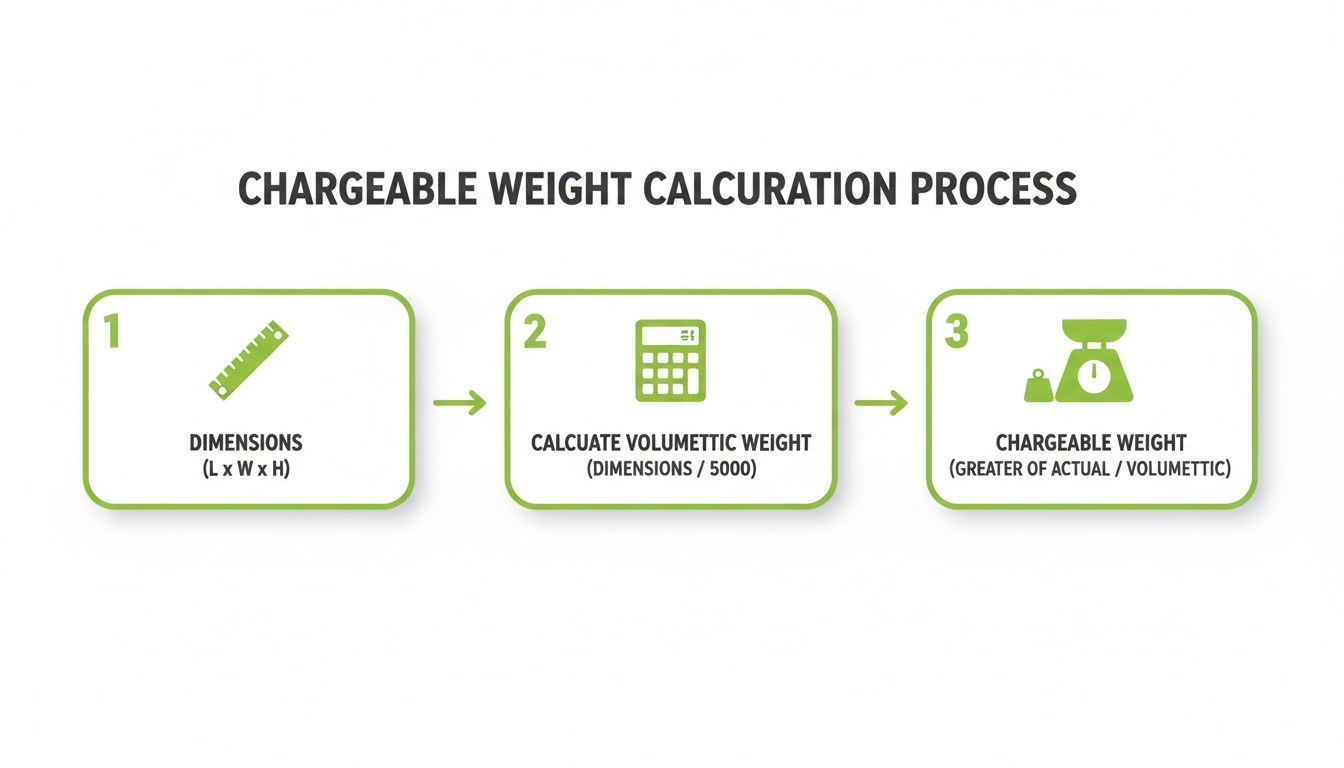
As you can see, the system takes your measurements, crunches the numbers for volumetric weight, compares it to the actual dead weight, and simply uses the bigger number to price your shipment.
Choosing Your Service Options
Once the core details are locked in, you’ll see a list of available courier services and their prices. This is where you can really tailor the delivery to your needs and budget.
You can instantly compare different carriers, check their estimated transit times (ETAs), and see how the costs stack up. For example, an express service for a Sydney-to-Melbourne run will naturally be priced higher than a standard road service, but you’ll get a much shorter ETA.
This is also where you can select any value-added services. A common one is Authority to Leave (ATL), which gives the driver permission to leave the parcel in a safe spot if nobody’s home. On the other hand, you can opt for a Signature on Delivery for extra security, which usually adds a small fee to the total.
A key thing to remember is that the price you see is dynamic. It reflects the carrier's real-time capacity and pricing for that specific route. This is exactly why online quoting is so much more accurate than relying on a static price list, which can go out of date surprisingly fast.
By following these simple steps, you get an all-inclusive price. The final figure already accounts for the chargeable weight, distance, the service you've chosen, fuel levies, and any optional extras. No hidden fees. The price you see is the price you pay, giving you the confidence to book right away.
Why not give it a go? You can use the instant Aeros Couriers shipping quote calculator yourself and see just how quickly you can get a fixed price for your next shipment.
Unpacking the Hidden Variables in Your Shipping Price
Once you've got your head around chargeable weight, you're halfway there. But the story doesn't end with just weight and dimensions. A few other crucial factors are working behind the scenes, and they can have a surprising impact on the final price you pay.
To build a truly reliable shipping budget, you need to look beyond the basics. Let's dig into the details of where your freight is going, how you've packed it, and what level of protection it has.
The Impact of Destination on Cost
Where your parcel is headed in Australia is one of the single biggest levers on your shipping costs. A delivery from Sydney to Melbourne is a completely different logistical puzzle than one from Sydney to regional WA, and the price reflects that.
Carriers think in terms of delivery zones, and the difference between them can be massive.
- Metro to Metro: This is your bread and butter. Sending a package between major capital cities like Sydney, Melbourne, or Brisbane is almost always the cheapest route. These are high-volume, well-serviced corridors, keeping operational costs low for everyone.
- Regional Deliveries: The moment your parcel heads out to a regional town, the price starts to tick up. These deliveries take more time, burn more fuel, and often get passed to a local delivery partner, which adds a step (and a cost) to the journey.
- Remote Locations: Delivering to remote postcodes is where you'll see the highest costs. These are spots far off the beaten track. A remote area surcharge is pretty much standard here to cover the significant extra expense of getting your package to its final destination.
Think of it this way: a driver can tick off dozens of deliveries in a single city block in an afternoon. In contrast, a single remote delivery could take that same driver half a day. The pricing is a direct reflection of that time and effort.
How Your Packaging Choices Affect the Price
Believe it or not, the box you choose does more than just protect your item—it has a real financial impact. If your freight isn't prepared correctly, you're not just risking damage; you could be hit with unexpected surcharges that inflate your bill.
Modern courier depots are highly automated, full of conveyor belts and scanners. Any package that can't sail smoothly through this system needs to be pulled aside and handled by a person, and that costs money.
A manual handling surcharge is often applied if your package is:
- Not packed in a standard, sturdy cardboard box.
- Wrapped in something like plastic film that can get snagged in the machinery.
- An awkward or irregular shape, like a cylinder, a tyre, or even a bucket.
For instance, shipping something in a tube instead of a long, rectangular box is a classic trigger for this fee. Why? Because it will literally roll off a conveyor belt and can't be read by automated scanners. Getting your packaging right isn't just about protection; it's about making your freight "machine-friendly" to keep those extra fees at bay. If you want to dive deeper into how dimensions become costs, our guide on how to calculate cubic weight has all the details.
Understanding Freight Insurance
Finally, let's talk about protecting the value of what you're sending. Even with the best care, things can go wrong. Understanding your freight insurance options helps you plan for the unexpected.
Most standard courier services in Australia, including ours at Aeros Couriers, come with a small amount of complimentary freight protection. This is a basic level of cover against loss or damage, typically up to a value of around $100 to $300 per consignment.
This is perfectly fine for lower-value goods. But what if you're shipping expensive electronics, artwork, or custom-made equipment? That's when additional freight insurance is a must. For a relatively small fee, you can insure your items for their full replacement value, giving you complete peace of mind. When you get a quote, always check the insurance options and ask yourself if the basic cover is enough. It’s a small investment that can save you from a major headache.
Smart Ways to Lower Your Shipping Costs
Getting an accurate quote is a great starting point for managing your freight budget. But the real wins come from actively shrinking that quoted price. Smart shipping isn't about just accepting the first number you see—it's about turning a necessary expense into a real competitive edge for your business.
With a few thoughtful tweaks to how you pack, combine shipments, and even pay for your freight, you can make a serious dent in your overall spend. Let's dig into some practical, real-world tactics you can start using right away to cut your shipping costs and boost your bottom line.
Trim Your Packaging to Reduce Volumetric Weight
As we covered earlier, volumetric weight is often the real driver behind your final shipping price. Every centimetre of empty space in your box is dead air you’re paying to send across the country. This is exactly why getting your packaging right is one of the most powerful cost-saving moves you can make.
Think about it this way: grabbing a standard large box for a small item might feel easy, but it inflates your parcel's dimensions. That pushes up the volumetric weight and, in turn, the chargeable weight. The fix is simple: match your packaging to your product as snugly as possible.
Here are a few ways to do it:
- Stock a variety of box sizes. Having a few options on hand means you can always pick the one that leaves the least amount of wasted space.
- Get custom-fit boxes for regular products. If you ship the same items over and over, ordering custom-sized packaging can translate into huge long-term savings.
- Use lighter void-fill. Swap out heavy packing materials for lightweight alternatives like air pillows or bubble wrap. You’ll keep the actual weight down without sacrificing protection.
By simply moving an item from a 50x40x30cm box (15kg volumetric weight) to a 40x30x25cm box (7.5kg volumetric weight), you can literally cut your chargeable weight in half for lighter goods. That’s a direct and immediate saving.
Consolidate Shipments to Get More Bang for Your Buck
Sending a bunch of small parcels to the same destination on the same day is often a massive waste of money. Each one of those shipments gets hit with its own base charge and handling fees. A much savvier approach is to consolidate those items into a single, larger shipment whenever you can.
Bundling several items into one box or onto one pallet immediately cuts down on the number of individual consignments you're paying for. This nearly always results in a lower total cost than shipping each piece separately, even if the combined shipment has a higher chargeable weight.
For instance, shipping three separate 5kg (chargeable weight) parcels from Sydney to Melbourne means you're paying three individual base rates. But sending one consolidated 15kg parcel will almost certainly be cheaper because you only pay that base rate once. This is a game-changer for businesses sending multiple orders to the same client or retail store.
Make the Most of Loyalty and Rewards Programs
If you’re shipping regularly, you should be getting something back for it. Many freight platforms, Aeros Couriers included, understand the value of repeat business and offer loyalty programs that give you real, tangible returns on your shipping spend.
These programs typically award points for every dollar you spend on freight. Before you know it, those points add up and can be redeemed for a huge range of goods and services, effectively giving you a rebate on your shipping.
At Aeros Couriers, our rewards program lets you redeem points for over 10,000 different items, from essential office supplies to branded merchandise. It turns a standard business cost into an opportunity to get valuable assets for your company, offsetting your expenses in a very real way. Sticking with a single platform that rewards your loyalty ensures you're squeezing maximum value from every single parcel you send.
For more ideas on shipping efficiently, our guide to affordable parcel delivery offers further insights.
Look Into Alternative Loading and Packaging Methods
Beyond the box itself, how you prepare larger shipments can unlock even more savings. For businesses sending freight on pallets, the traditional wooden pallet isn’t your only choice. Exploring alternatives like cost-saving slip sheeting methods can lead to significant savings by optimising space and cutting down on material use.
These clever innovations can reduce the tare weight of your shipment and allow more of your product to fit into a truck or container, ultimately lowering your shipping cost per unit.
Common Questions About Shipping Cost Estimates
It’s completely normal to have a few questions when you’re figuring out shipping costs. Even with careful planning, things pop up. Getting straight answers not only helps you stick to your budget but also helps you sidestep some common frustrations. Let's tackle a few of the queries we hear all the time from Aussie businesses.
Why Was My Final Charge Higher Than My Initial Estimate?
This is the big one. We get asked this more than any other question, and nine times out of ten, the answer lies in a tiny difference between the details you entered and what the courier’s automated scanners measured.
The most frequent culprit is a slight mismatch in the parcel's weight or dimensions. Even a few centimetres or half a kilo can be enough to bump the chargeable weight into a new price bracket.
The other common reason is an unexpected surcharge that wasn’t factored into the original quote. This could be something like:
- A residential delivery fee if the address wasn't specified as a home.
- A remote area levy for a postcode that falls outside the main delivery networks.
- A manual handling fee for awkward freight, like a tube or an oddly shaped package that can't go on the conveyor belt.
The best way to avoid a surprise invoice is to be meticulous from the start. Grab a tape measure and scales and double-check everything before you book. When it comes to freight, accuracy is king.
How Do I Correctly Calculate Volumetric Weight?
Getting the volumetric weight right is crucial for an accurate quote, and thankfully, the formula for road freight in Australia is straightforward. It’s just a simple sum that converts your parcel’s size into its "weight equivalent."
Here's that formula again:
(Length in m x Width in m x Height in m) x 250 = Volumetric Weight in kg
Let’s walk through a quick example. Say you're sending a box that's 60cm long, 40cm wide, and 20cm high.
- First, you’ll need to convert those dimensions into metres: 0.6m x 0.4m x 0.2m.
- Next, multiply them together to get the cubic volume: 0.6 x 0.4 x 0.2 = 0.048 cubic metres.
- Finally, multiply that by the cubic conversion factor: 0.048 x 250 = 12 kg.
So, your parcel's volumetric weight is 12 kg. If the box actually weighs less than that on the scales, the courier will base the shipping price on the 12 kg volumetric weight.
What Is the Cheapest Way to Send a Parcel in Australia?
For most small-to-medium parcels zipping between major Aussie cities, a standard road freight service is almost always your most budget-friendly bet. Express services are all about speed, and you pay a premium for that priority.
But honestly, the "cheapest" way really comes down to the specifics of your shipment. The trick is to compare real-time quotes from different carriers. A multi-carrier platform like ours does the legwork for you, pulling up live prices for your exact parcel and destination. It means you’re not just choosing a service that’s cheap in general, but the one that’s the absolute cheapest for that particular job.
Want to trim costs even more?
- Pack smart: Use the smallest box you can without compromising safety. Less empty space means a lower volumetric weight.
- Ship to a business: If you have the option, sending to a commercial address can help you dodge residential delivery fees.
- Bundle your items: Sending one larger parcel is nearly always more cost-effective than shipping several small ones to the same place.
With these answers in your back pocket, you can tackle your next shipment feeling much more confident that you're getting an accurate, fair price every single time.
Ready to stop guessing and start shipping with confidence? Aeros Couriers provides instant, all-inclusive quotes from Australia’s top carriers, helping you find the best rate in seconds. Get your free quote today.
Courier quotes, tracking and support
Ready to send a parcel? Compare the available services for your postcodes, parcel dimensions and weight. For an existing delivery, use your consignment number to check tracking or ask our team for help.