
Good ecommerce shipping in Australia comes down to four decisions: which carriers you use, what you charge customers, how you promise delivery times, and who you call when a parcel goes missing. Get those right and shipping stops eating your margin. Get them wrong and you pay twice, once in freight and once in refunds and lost customers.
This guide is for small and medium online sellers, from a Shopify store shipping its first fifty orders a week to an established business tired of surcharges. It covers what shipping really costs, the main options by type, how to connect a courier to your store, and what Australian law expects of you.
TL;DR
- Shipping is the cost shoppers notice most: 81% of Australians see it as a barrier to buying, so price it deliberately.
- Don’t depend on one carrier. Splitting volume across several options protects you from price hikes, capacity limits and delays.
- Under the Australian Consumer Law, you are responsible for delivery, even when a courier loses or damages the parcel.
- Compare all-inclusive rates, not headline rates. Fuel surcharges, handling fees and insurance add-ons change the real cost per parcel.
- Offer tiered delivery (standard, express, same-day) and let customers choose the speed they will pay for.
Table of Contents
- What ecommerce shipping costs Australian sellers
- Your shipping options by type
- Why one carrier is a risk
- Shipping from Shopify and other stores
- Your legal duties as a seller
- Our view: what we see sellers get wrong
- Book Australia-wide delivery with Aeros
- A simple setup plan for your first month
- Keeping returns and costs under control
- FAQ
- Sources
What ecommerce shipping costs Australian sellers
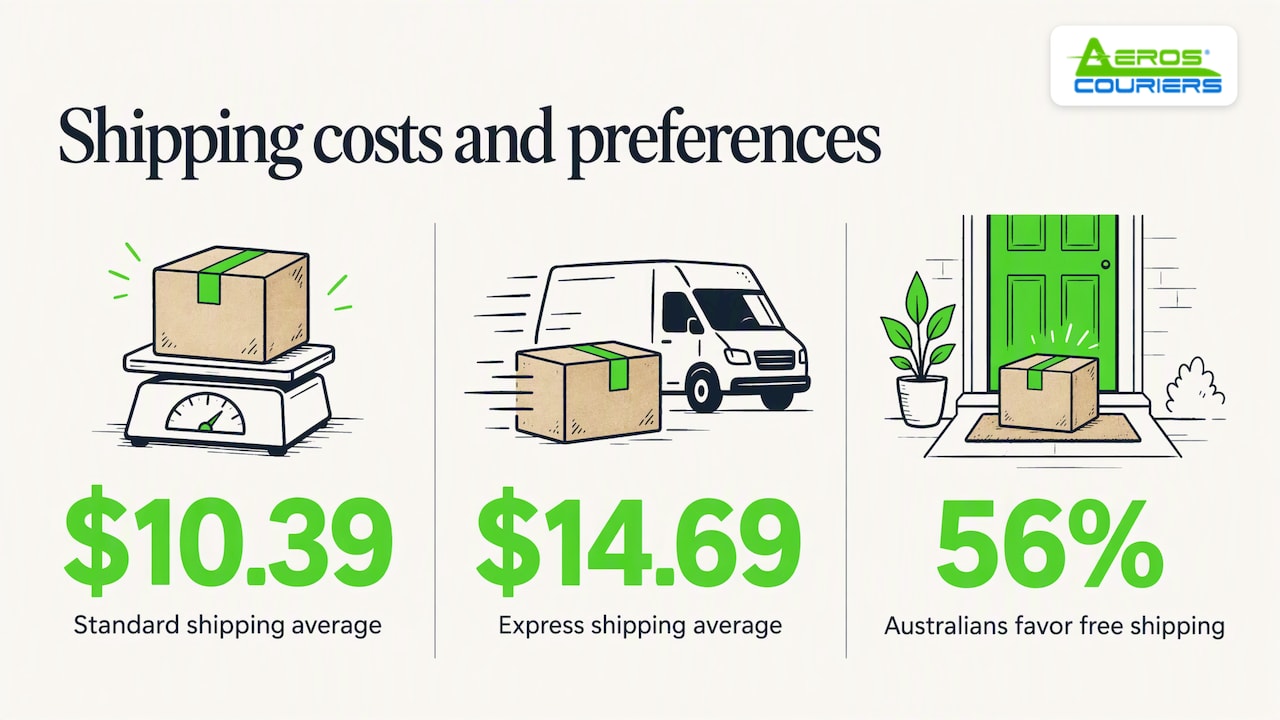
Shipping is now the line item most retailers complain about. Ragtrader’s 2025 shipping outlook reports retailers ranking shipping as their biggest headache, driven by fuel, labour shortages and carrier price rises. Customers feel it too. According to Fully Loaded, standard shipping averaged $10.39 per shipment and express $14.69 in 2025, and 56% of Australians ranked free shipping as their top delivery preference.
That creates a squeeze. Shoppers want free and fast. Your carrier wants more per parcel. The gap comes out of your margin unless you manage it.
Where the real cost hides
The quoted price per parcel is rarely the price you pay. When you compare options, add up:
- Base rate for the weight and zone (metro, regional, remote).
- Fuel surcharge, often a percentage added on top.
- Handling or residential delivery fees for some parcel types.
- Insurance or transit cover, sometimes optional and extra.
- Redelivery and failed-delivery fees when no one is home.
- Packaging, since oversized or poorly packed parcels can be charged by cubic size rather than weight.
To see how these combine on a real order, work through a single example before you sign up for anything. Take a 2kg parcel from Melbourne to Perth and price it at three carriers, with every surcharge included. The cheapest headline figure is often not the cheapest total. Our own breakdown in ecommerce shipping costs in Australia goes deeper on cutting freight expenses line by line.
Your shipping options by type
Australian sellers generally choose between four kinds of providers. None is right for everyone, so match the option to your volume, parcel size and customer promise.
| Option | Best for | Watch out for |
|---|---|---|
| National postal carrier | Lightweight parcels, regional and rural reach | Account requirements, slower standard service on long routes |
| Direct courier account | High, steady volume with negotiated rates | Minimum volumes, contracts, one carrier dependency |
| Courier comparison and booking platform | Small and mid-volume sellers who want several carriers and no contract | Check that quoted prices include surcharges and insurance |
| Fulfilment or 3PL provider | Sellers who want to outsource storage, packing and dispatch | Storage fees, setup costs, less control over packing |
A comparison platform suits many small sellers because you get bulk-style rates without the volume commitment. You choose per shipment, so a heavy parcel to a regional town can go with a different carrier than a light satchel across the city.
When a postal account makes sense
The national postal network reaches addresses couriers sometimes treat as remote, and its flat-rate satchels can keep costs predictable. There is a catch if you run Shopify. Shopify’s help documentation says a MyPost Business account is required to buy that carrier’s labels in the admin, and that larger eParcel accounts aren’t currently supported there. Check this before you plan your setup around it.
When a fulfilment partner makes sense
If you spend more than a few hours a day packing, or your stock fills your spare room, outsourcing starts to pay for itself. The trade-off is cost and control. Run the numbers per order, including storage, pick-and-pack and freight, before moving stock out of your own hands.
Why one carrier is a risk
Relying on a single carrier means one price rise, one depot problem or one fuel surge hits every order at once. Ragtrader notes that successful Australian sellers are diversifying their logistics networks to manage fuel price swings, capacity limits and unexpected delays, often using dashboards that sync several options.
A practical way to do this without extra admin:
- Pick a primary option for your most common parcel (say, a 1kg satchel).
- Keep a second option live for heavy or bulky parcels.
- Keep an express or same-day option ready for urgent orders and for peak weeks.
- Review which option wins on cost and on delivery success every quarter.
Shipping from Shopify and other stores
Most searches here come from people running Shopify, WooCommerce or similar. The logic is the same on any platform.
Set rates that match your real costs
In your store’s shipping settings you can choose between flat-rate, weight-based, calculated-at-checkout and free-shipping rules. For most small sellers:
- Flat rate by zone is simple and customers understand it.
- Free shipping above a threshold lifts basket size. Set the threshold above your average order so the extra items cover the freight.
- Calculated rates are fairest on heavy, variable parcels, but they can scare off shoppers if the number looks high at the last step.
If you cannot absorb freight, show it early on the product page or cart. Surprise costs at the final checkout step are what turn browsers into abandoned carts.
Offer a choice of speed
The era of free and fast for everyone is fading. Industry reporting says retailers are shifting to tiered delivery options, where customers who want speed pay for it and budget-minded shoppers accept longer standard times. A sensible checkout offers:
- Standard, priced low or free above a threshold.
- Express, for buyers who need it in a few days.
- Same-day in metro areas, where available and where your order cut-off allows.
Print labels and track from one place
Whatever you use, you want printable labels, automatic tracking numbers sent to the customer, and one screen where you can see every parcel. Every manual copy-and-paste step is a place for a wrong address to creep in.
Your legal duties as a seller
This is the part many small sellers get wrong. Shipping is not just logistics. It is a consumer law obligation.
You are responsible, not the courier
Western Australia’s Consumer Protection Commissioner has pointed out that retailers often think they can pass delivery responsibility to the carrier. Under the Australian Consumer Law, the retailer manages the end-to-end delivery experience, including refunds for lost or damaged goods. If a courier loses a parcel, you refund or replace first, then pursue the carrier.
That is why insurance and responsive support matter more than a few cents saved per parcel. A cheap parcel that vanishes without recourse costs you the item, the freight and a customer.
Be honest about delivery times
The ACCC’s case against Mosaic Brands shows the stakes. The Federal Court ordered $25.05 million in penalties in 2025 for breaches that included taking payment but failing to deliver within a reasonable time. The lesson for a small shop is simple: do not take an order you cannot realistically fulfil by the date you promise, and update your delivery estimates when stock or carrier capacity changes.
Put your policies in writing
Business.gov.au explains that shipping and returns policies in your terms and conditions are legally binding and should line up with the Australian Consumer Law, including remedies for delayed or faulty goods. Your policy should state:
- Dispatch times (business days, cut-off hour).
- Delivery estimates by region.
- What happens if an item is lost, damaged or late.
- How returns work and who pays the return freight, without limiting the remedies the law gives consumers.
If you are unsure whether your terms comply, speak to a solicitor or contact your state or territory consumer protection agency.
GST on your sales
If you are registered for GST, freight you charge on taxable sales is generally part of the taxable price, so ask your accountant how it applies to your invoices. The Australian Taxation Office sets the registration threshold at A$75,000 of GST turnover from sales connected with Australia in a 12-month period. That page is written for non-resident businesses, so check with the ATO or a registered tax agent for your own situation. It also notes that on marketplaces and similar platforms the platform operator is often the one responsible for collecting and paying the GST.
Our view: what we see sellers get wrong
We built Aeros Couriers around a frustration we hear from small sellers all the time: the price on the quote is not the price on the invoice. Here is how we think about ecommerce shipping.
Price the whole parcel, not the headline. Fuel surcharges and handling fees are how a cheap-looking rate becomes an expensive one. We publish flat-rate, all-inclusive pricing with no hidden fees, so what you see at booking is what you pay.
Compare before every booking. No single carrier is cheapest for every parcel. Instant rate comparison lets you choose the best carrier for each shipment, with bulk discount rates through major carriers that a small seller couldn’t negotiate alone.
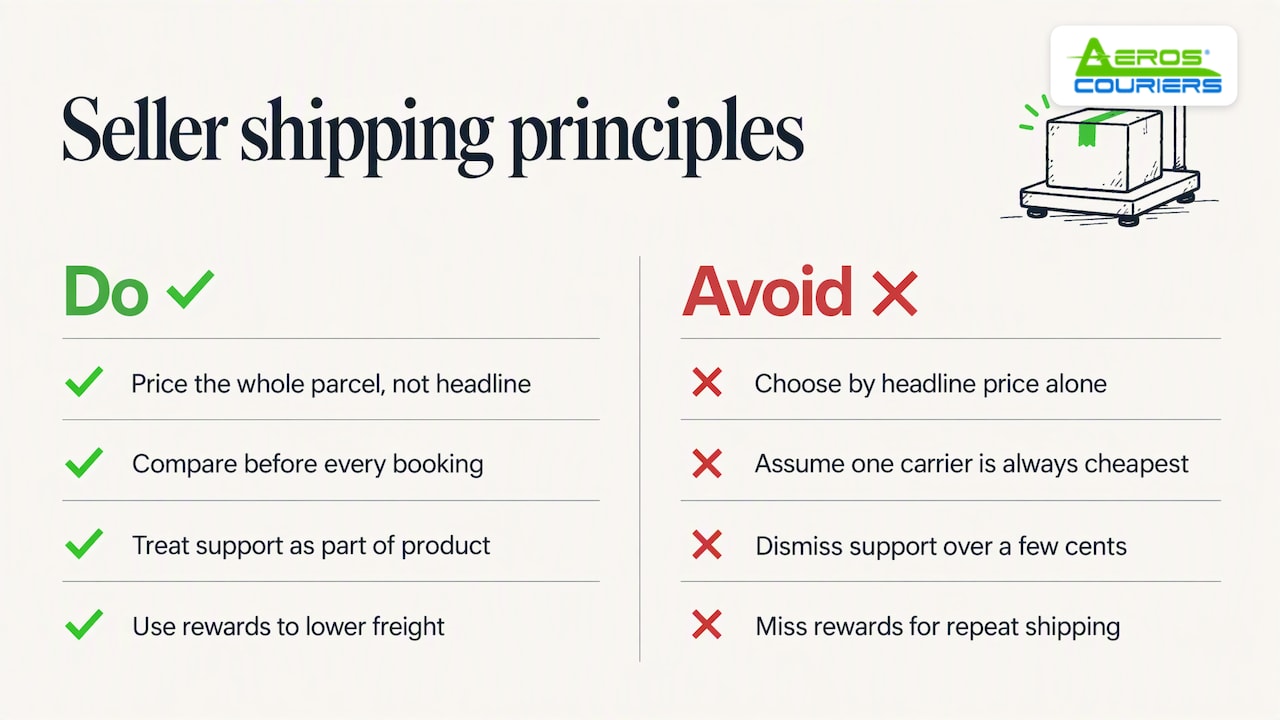
Treat support as part of the product. When a parcel is late, the retailer answers to the customer. Reaching a real person in Australia quickly, and being able to watch a parcel actively, is worth more than a few cents.
Use rewards to lower freight. Our rewards program lets repeat shippers redeem points for discounted rates or merchandise, so steady volume is rewarded without a contract or subscription.
— Aeros
Book Australia-wide delivery with Aeros
If you are ready to ship, we handle parcels up to 25kg Australia-wide, with door-to-door pickup, printable labels, shipment tracking and insurance. You can compare rates and book in one place, with express, same-day and air courier options when a parcel can’t wait. There is no subscription: you pay per shipment.
Start with our parcel delivery service for everyday orders, or compare and book freight for bigger consignments. Need it faster? See our express courier service.
A simple setup plan for your first month
If you are starting from scratch or rebuilding, this order of work avoids most mistakes.
- Weigh and measure your top ten products in their packaging. Record weight and dimensions in your store so calculated rates are accurate.
- Get all-inclusive quotes for three typical orders: a light local parcel, a mid-weight interstate parcel and a heavy regional one.
- Decide your customer pricing: flat rate, threshold-based free shipping, or calculated at checkout. Work out your margin on each.
- Write your shipping and returns policy to match the Australian Consumer Law, and publish it where customers can find it before they pay.
- Set delivery estimates you can keep, with a buffer for regional and remote addresses and for peak periods.
- Automate tracking emails so customers don’t have to ask where their order is.
- Review monthly: late deliveries, claims, cost per parcel and abandoned carts at the shipping step.
If you want more on specific parts of this, our guides on last mile delivery for Australian SMBs and choosing a courier company go further.
Keeping returns and costs under control
Fast checkout and impulse buying lift sales, but also returns. Inside Retail reports that this instant-gratification culture pushes up return rates, and that stronger businesses use predictive analytics and clearer product descriptions to manage them in advance. For a small store, that translates into practical habits:
- Put exact dimensions, materials and sizing guides on product pages.
- Use real photos and, for clothing, fit notes taken from customer feedback.
- Track your top return reasons and fix the listing, not just the refund.
- Pack to protect. A cheaper box costs more if it leads to a damaged-goods claim.
Shipping cost matters for loyalty as well. A Grant Thornton and Power Retail report says low delivery costs influence loyalty for 33% of shoppers and on-time delivery for 30%. Both are in your hands.
FAQ
What is the best ecommerce shipping option in Australia?
There is no single best option. The right one depends on your parcel weight, volume and where your customers live. Most small sellers do well with a comparison platform that gives access to several carriers, plus a second option for heavy or urgent orders.
How do I ship from my Shopify store in Australia?
Connect a carrier account or a booking platform to your store, set your shipping rates in the admin, and print labels from there or from the booking platform. Check which accounts your plan supports first: Shopify says its Australia Post integration needs a MyPost Business account. Then test with a few real orders before you go live.
Who is responsible if a courier loses my customer’s parcel?
You are. Under the Australian Consumer Law, the retailer is responsible for delivery, including refunds for lost or damaged goods. Having insurance and a courier you can reach quickly makes it far easier to resolve and recover the cost.
Should I offer free shipping?
Only if the numbers work. Many shoppers want it, but retailers are pulling back on free shipping as costs rise. A free-shipping threshold slightly above your average order value, or built into product prices, is a common middle path.
Sources
- Retail shipping perks on the decline as costs surge, Fully Loaded
- Fighting fulfilment costs: The 2025 shipping outlook, Ragtrader
- Shipping with Australia Post, Shopify Help Center
- Click and wait: who’s responsible for delivery issues, Government of Western Australia
- Owner of Noni B, Rivers, Katies brands ordered to pay penalties of $25m, ACCC
- Shipping, business.gov.au
- How Australian GST works, Australian Taxation Office
- What’s in store for retailers, Inside Retail Australia
- Value, Speed, and Reliability, Grant Thornton and Power Retail
Recommended
- Ecommerce Shipping Costs in Australia: Cut Freight Expenses
- A Guide to Domestic Courier Services in Australia
- Send Big Parcels Cheap Australia-Wide: Your 2026 Guide
Courier quotes, tracking and support
Ready to send a parcel? Compare the available services for your postcodes, parcel dimensions and weight. For an existing delivery, use your consignment number to check tracking or ask our team for help.