

Figuring out what Australia Post will charge to send a parcel can feel like trying to solve a puzzle. But once you know the pieces, it all clicks into place. It really just comes down to four things: how much your parcel weighs, how big it is, how far it’s going within Australia, and how fast you want it to get there.
Let's break down how these elements come together to create your final shipping price.
How Australia Post Courier Charges Actually Work
Getting a straight answer on shipping costs can be frustrating, but the calculation itself is pretty logical. The final price is a mix of your parcel's actual weight, its size (which gets turned into something called cubic weight), the destination it’s heading to, and the delivery speed you choose.
Think of it like booking a flight for your package. The 'ticket price' changes based on a few key variables. For instance, a small but very heavy item might actually cost less to ship than a large but lightweight one. Why? Because space on a delivery truck or plane is a premium commodity, just as much as the fuel needed to carry heavy loads.
Getting your head around this is the key to managing your shipping budget. It's the interplay between these factors that explains why two parcels that seem similar can end up with wildly different shipping costs.
The Core Calculation Factors
Before you can estimate your costs, you need to know what goes into the calculation. Here are the main building blocks of any shipping quote:
- Physical and Cubic Weight: Couriers look at two things: the actual weight on the scales and the parcel's size, calculated as its cubic weight. They will charge you for whichever is greater.
- Destination Zone: Australia is carved up into different shipping zones. The further your parcel travels from where you sent it, the higher the zone number and, you guessed it, the higher the price.
- Service Speed: This one's straightforward. If you need it there tomorrow with Express Post, it’s going to cost more than the standard Parcel Post service.
Understanding these variables is the first step toward mastering your shipping spend. By recognising how weight, size, distance, and speed influence the price, you can make more informed decisions and avoid unexpected fees on your invoice.
We’ll dig into each of these pillars in more detail, but you can also use online tools to help you calculate shipping charges before you send. Laying this groundwork now will also make it easier to understand other potential costs, like surcharges, which we'll cover later in this guide.
How Australia Post Really Calculates Your Shipping Costs
Ever wondered what goes into the price you’re quoted at the post office? It’s not just one thing. Australia Post’s courier charges are a blend of four key factors. Getting a handle on these lets you see exactly where your money is going, predict your costs far more accurately, and even spot some clever ways to save.
Think of it as a simple, three-step recipe: start with the parcel's size and weight, factor in the distance it needs to travel, and finally, add the speed you need it to get there.
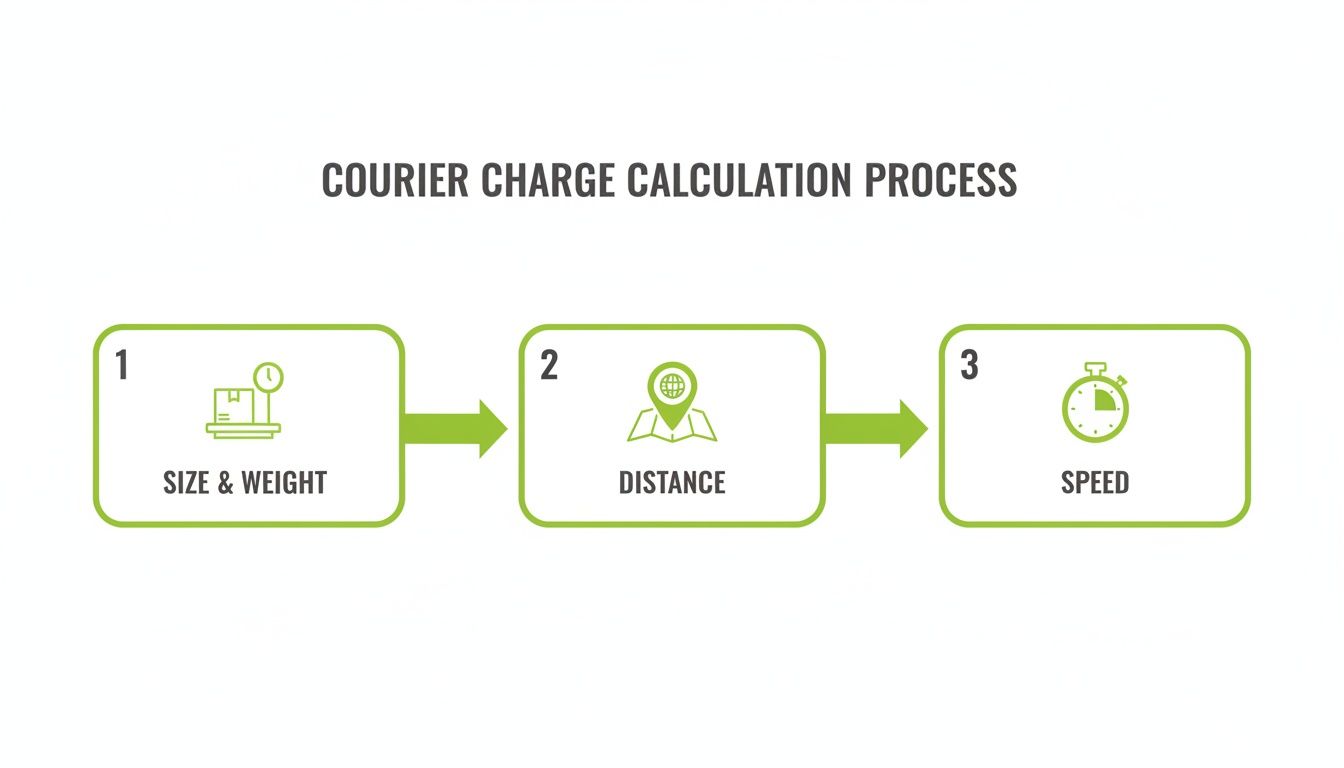
Let's break down each of these ingredients to see how they affect the final price.
Factor 1: Actual Weight
This one's the most obvious: how much your parcel weighs on the scales. But it’s not a simple sliding scale. Australia Post uses a tiered system, and crossing from one tier to the next can hit your wallet hard.
A parcel that weighs 499 grams is one price, but tip the scales to 501 grams and you could be looking at a completely different, much higher cost. The jump can be significant – for a standard parcel, moving up just one weight tier from under 500g can increase the price by over 75%. It pays to know exactly where those thresholds are.
Factor 2: Size and Cubic Weight
Here’s where a lot of people get caught out. It's not just about how heavy your item is, but also how much room it takes up in the van. This concept is called cubic weight.
Picture this: you're sending a big box of fluffy pillows and a small, heavy paperweight. The pillows weigh almost nothing, but they hog a ton of space. The paperweight is heavy but compact. Since space on a truck is just as valuable as its weight capacity, couriers will charge you for whichever is greater – the actual weight or the cubic weight. If you're shipping large but light items, this is the number you need to watch.
Want to figure this out for your own parcels? We have a handy guide to help you calculate cubic weight.
Factor 3: Destination Zones
Naturally, how far your parcel has to travel matters. To standardise this, Australia Post has carved the country up into destination zones. The final price is based on the number of zones your package crosses to get from A to B.
Sending a parcel from a Sydney warehouse to a Melbourne suburb will always be cheaper than sending that same parcel from Sydney to a remote community in the Kimberley. It’s a simple system that reflects the real-world logistics and fuel needed to get your package there.
Factor 4: Service Speed
The last piece of the puzzle is how fast you need it to arrive. You’re essentially choosing between cost and time.
- Parcel Post: This is your standard, no-frills option. It's the most budget-friendly choice for deliveries that aren't time-sensitive.
- Express Post: Need it there tomorrow? This is the premium service, promising next-business-day delivery within their network.
Opting for Express Post will cost more, but for urgent shipments, the speed and enhanced tracking are often worth the investment.
By understanding these four factors—weight, size, distance, and speed—you're no longer guessing. You're in control, ready to make smart, cost-effective shipping decisions every single time.
Decoding the Hidden Costs and Surcharges
The first price you see for a shipment? Think of that as the starting line, not the finish. Your final invoice can sometimes look quite different, and the reason usually comes down to surcharges that pop up in specific situations. For a lot of businesses, these little extras are a major source of budget headaches.
Getting a handle on these potential add-ons is the secret to accurate financial planning. When you know what triggers these fees, you can see them coming, budget for them, and stop the nasty surprises when your courier bills arrive. It’s a bit like knowing all the possible tolls on a road trip before you even pull out of the driveway.
Common Surcharges to Watch For
While the full list of potential fees can feel a bit overwhelming, most businesses only ever run into a handful of the common ones. If you can get your head around these, you’ll be prepared for most situations.
These charges aren't just plucked out of thin air. They’re there to compensate the courier for the extra effort, special handling, or transport costs that come with certain types of deliveries. For example, a heavy box that needs two people to lift it safely is always going to cost more to handle than a standard little parcel.
Here are the usual suspects that can inflate your Australia Post courier charges:
- Remote Area Surcharge: This one kicks in when you’re sending something way out of the major city networks or regional hubs. It simply covers the extra fuel and time it takes to get to those less-travelled postcodes.
- Oversize or Overweight Item Fee: If your parcel is bigger or heavier than the standard limits, expect to see this fee. It’s for anything too bulky for the automated sorting machines that has to be moved around by hand.
- Signature on Delivery: While many parcels can be left in a safe spot, getting a signature as proof of delivery is an optional extra. It gives you peace of mind for valuable items but does come with a small additional cost.
Once you understand what triggers these fees, you can often find ways to sidestep them. For a closer look at managing these expenses, check out our guide on keeping a lid on parcel postage costs.
How These Fees Impact Your Bottom Line
A few dollars here and there might not sound like much, but these surcharges can snowball, especially if you’re shipping a lot of items. That $10 manual handling fee on 50 parcels a month? That’s an extra $6,000 a year in costs you might not have planned for.
The key takeaway is that the 'base rate' is only one part of the equation. A truly accurate shipping budget must account for the specific nature of the items you send and the destinations they are going to.
Being proactive is your best defence. Always double-check your parcel dimensions, know which postcodes are considered 'remote', and think carefully about whether you really need services like a signature on delivery for every single shipment. This kind of foresight turns hidden costs into predictable expenses and puts you back in control of your shipping budget.
Putting It All Together with Real-World Examples
All that theory is great, but let's be honest—seeing how the numbers stack up in real life is what really matters. Getting a handle on how weight, size, and destination all play together is the key to managing your Australia Post courier charges.
So, let's walk through a few everyday scenarios that Aussie businesses run into. These examples will make it crystal clear how all those factors mix together to give you a final shipping price.
Example 1: Small Satchel, Sydney to Melbourne
Picture this: you run an online clothing store in Sydney and need to send a t-shirt to a customer in Melbourne. The shirt weighs about 400g and slips easily into a small satchel, keeping it well under the 500g limit.
This is a classic metro-to-metro delivery. It's a busy route, so the destination zone cost is low. Here, the actual weight is what really drives the price. You could go with standard Parcel Post for the cheapest option or pay a bit more for Express Post to get it there the next business day.
Example 2: 4kg Parcel, Brisbane to Perth
Now for something a bit heftier and going a lot further. Imagine you're sending a 4kg box of machine parts from Brisbane all the way over to Perth. This package is crossing the entire country, jumping through multiple delivery zones, which makes distance a huge part of the final cost.
The parcel’s weight puts it in a higher price bracket right away. The final charge is going to be a blend of that weight tier and the high zone cost for a cross-country trip. It's a perfect example of how both weight and distance can really ramp up the price.
These situations reveal a simple truth: the heavier the item and the further it has to go, the more you're going to pay. Once you get this, you can start predicting your shipping costs before you even tape up the box.
Example 3: Large Box to Regional NSW
Last one. You're shipping a big, bulky box of cushions from Melbourne to a regional town like Armidale in NSW. The box itself is pretty light, maybe 15kg, but it's large. This is where things get tricky.
Because of its size, Australia Post will almost certainly calculate its cubic weight, which will be much higher than its actual 15kg weight. You’re being charged for the space it takes up in the truck, not just how heavy it is. On top of that, delivering to a regional postcode often means a higher zone fee and maybe even a remote area surcharge.
For a shipment like this, guessing just won't cut it. Your best bet is to use an online tool to get a precise quote. You can use a detailed shipping fee calculator to compare services and see a full breakdown of the costs before you send.
Smart Strategies to Lower Your Shipping Costs
Knowing how Australia Post works out its courier charges is one thing, but actually doing something to bring those costs down is where you’ll see the real difference. A few clever tweaks to how you pack and send your items can have a massive impact on your bottom line, all without compromising on service.
The easiest win is almost always your packaging. So many businesses accidentally pay for air by using boxes that are way too big for the product inside. By finding packaging that fits your items snugly, you’ll cut down on dimensional weight and can often slide into a cheaper pricing tier. That's a direct saving on every parcel you send.
Optimise Your Packaging and Processes
Bundling shipments is another brilliant move. If a customer makes a few separate orders, it's nearly always cheaper to pop them all into one bigger box instead of sending out several smaller ones.
On top of that, here are a few more practical things you can do:
- Use Flat-Rate Satchels: If your items fit, Australia Post's prepaid satchels are fantastic. You pay one fixed price, no matter where it's going within Australia, which is a lifesaver for heavy items travelling a long way.
- Buy Postage in Bulk: If you're shipping regularly, look into prepaid options or a business account. Paying upfront often gives you access to better rates than you'd get just walking into the post office.
- Weigh and Measure Accurately: Don't guess! A good set of digital scales and a tape measure are essential tools. Getting the dimensions wrong can mean you either overpay from the get-go or get a surprise bill later for underpaying.
Know Your Service Levels
Choosing the right delivery speed is key. Express Post is great for getting things there quickly, but you pay a premium for that speed. For instance, sending a parcel up to 5kg might cost $23.30 with Express Post, but the standard Parcel Post rate for a similar weight can climb to over $45 depending on the destination zone. It’s worth asking if every single order truly needs to be there tomorrow. You can dig deeper into the official Australia Post rates determination to see the details.
A simple audit of your shipping habits can reveal significant savings. Ask yourself: "Are we using the right-sized box?" and "Does this shipment really need to be express?" The answers can directly lower your overheads.
At the end of the day, it's these small, consistent changes that really add up. For a more detailed breakdown of shipping expenses, our complete guide to understanding courier costs provides even more insights. By taking a proactive approach, you can turn shipping from just another cost into a real competitive advantage.
A Smarter Way to Manage Your Domestic Shipping
For most Australian businesses, heading down to the local post office for every shipment just isn't practical. It’s often not the cheapest or most efficient way to get things done, either. If you've ever found yourself wrestling with confusing price lists, unexpected surcharges, and the yearly rate increases, you know there has to be a better way.
And there is. This is where courier aggregator platforms like Aeros Couriers come into the picture, and they can make a massive difference to your workflow and your bottom line.

The idea behind them is pretty straightforward but incredibly effective. Instead of trying to negotiate shipping rates as a single small business, platforms like Aeros bring together the shipping volume of thousands of businesses just like yours. This collective buying power allows them to lock in wholesale rates from the big carriers—savings they pass directly on to you, from the very first parcel you send.
Unlocking Better Rates and Simpler Processes
Moving to a platform designed for business shipping brings some immediate, real-world benefits. The whole point is to cut out the usual headaches that come with posting parcels, giving you a clear, predictable system that saves you both time and money.
This has become more important than ever as direct carrier costs keep climbing. Australia Post, for example, has been steadily increasing its parcel prices to cover its own operational costs. As of 1 July, we saw flat-rate Express Post parcels jump across the board. These constant hikes are a big reason why smart Aussie businesses are now looking to platforms like Aeros Couriers for cheaper alternatives, often saving up to 30% on their nationwide shipping. You can see the full breakdown of these increases over on the Australia Post website.
Here’s what you can generally expect from making the switch:
- Instant Online Quotes: No more guesswork. Get a clear price in seconds without needing an account.
- No Hidden Fees: Forget about surprise account-keeping fees or credit card surcharges.
- Included Freight Insurance: A bit of extra peace of mind comes standard with built-in protection.
- User-Friendly Dashboard: A single place to manage all your bookings, print labels, and track shipments.
By using a dedicated shipping platform, you're doing more than just sending a package. You're bringing on a strategic tool that tightens up your logistics, lowers your overheads, and gives you back time to focus on actually growing your business.
More Than Just Shipping: A Rewards Program for Growth
The right shipping partner should do more than just offer lower Australia Post courier charges; it should add genuine value to your business. One of the standout benefits you'll find with platforms like Aeros Couriers is an integrated rewards program.
Every dollar you spend on shipping earns you points, which you can then redeem for over 10,000 different branded merchandise items. Suddenly, a necessary business expense is transformed into an investment. You could use your points to order branded pens for a trade show, new staff uniforms, or other marketing materials—essentially getting a return on money you were already spending.
This shifts your courier from being just another supplier to a real partner invested in helping your business grow and get noticed.
Still Have Questions About Australian Courier Charges?
Let's face it, getting your head around shipping costs can feel a bit like learning a new language. To help clear things up, here are some straightforward answers to the questions we hear most often from businesses trying to navigate courier charges in Australia.
How Is Cubic Weight Calculated and Why Does It Matter?
Ever wonder why a big, light box of pillows costs a fortune to send? The answer is cubic weight.
Cubic weight isn't about how heavy your parcel is on the scales; it's a measurement of its size and how much space it takes up in a van or plane. Couriers will always charge you for whichever is greater: the actual physical weight or this calculated cubic weight.
To work it out yourself, simply multiply the length x width x height (in metres) of your parcel by 250. This figure becomes the "cubic weight" in kilograms. If that number is higher than the actual weight, that's what you'll be billed on.
Can I Get a Business Discount on Australia Post Charges?
Yes, you certainly can. Australia Post has business-specific accounts like MyPost Business, which can give you discounts once you start sending a decent number of parcels. The more you ship, the more you save.
But for many small or medium-sized businesses, there's often a better way. A courier aggregator can give you access to heavily discounted rates from the get-go. Because they pool the shipping volume of thousands of businesses, they get wholesale pricing that you wouldn't be able to access on your own, without any pressure to meet high shipping targets.
Are There Items That Have Special Shipping Charges?
Absolutely. Certain items are classified as dangerous goods, and they come with a whole different set of rules and costs. Think things like lithium batteries, aerosols, flammable liquids, or even everyday items like perfume and nail polish.
These goods need special handling to be transported safely and legally within Australia. This often means they'll attract extra fees, can't fly on planes, or might be restricted from some courier services entirely. It's crucial you declare these items properly when booking to stay on the right side of the law and avoid any nasty surprises.
Ready to stop overpaying and start saving on every parcel? Aeros Couriers gives you instant access to wholesale shipping rates with no account fees or minimum volumes. Get a free quote online in seconds and see how much you could save on your domestic shipping.
