
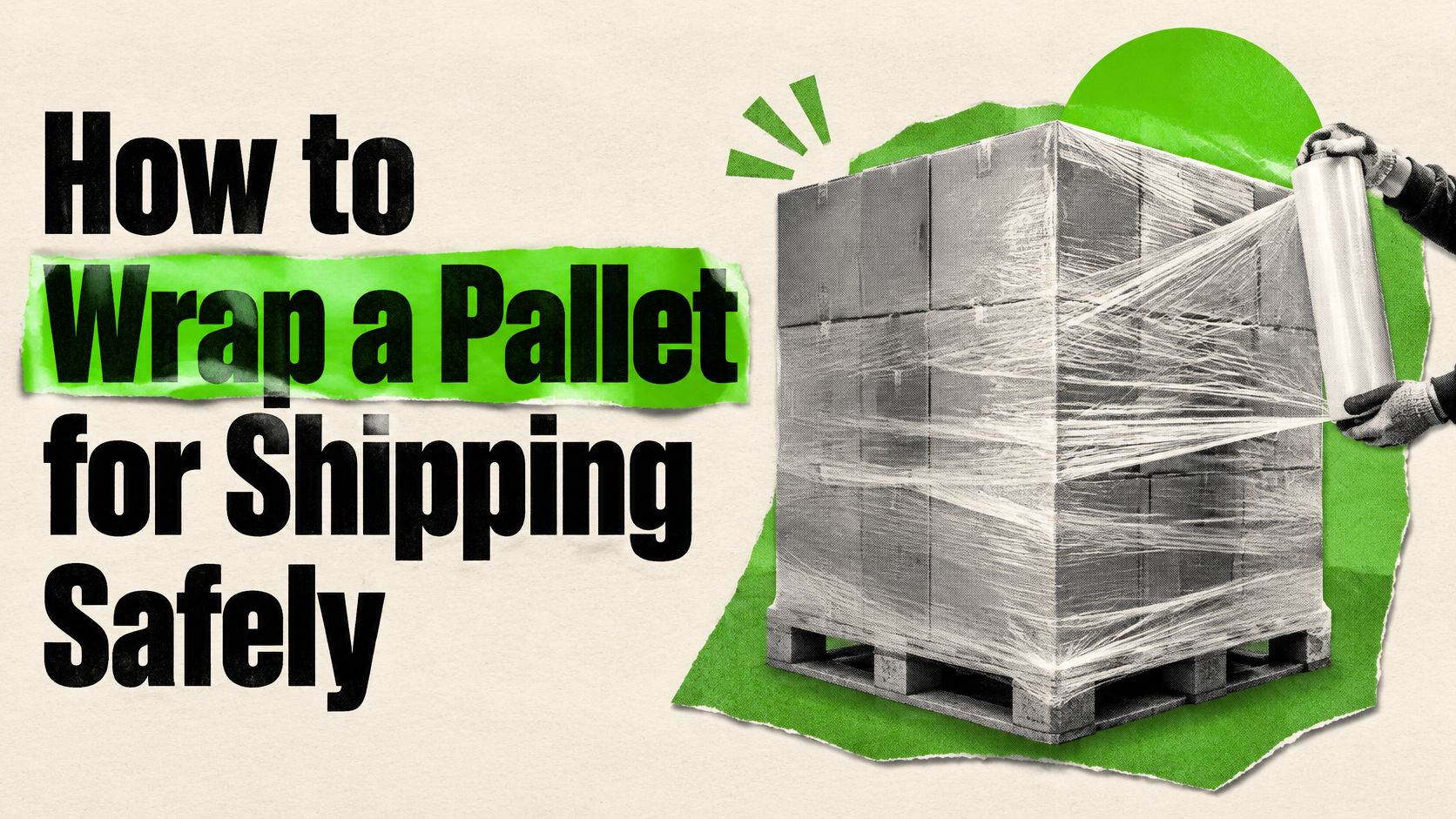
You've got a stack of cartons at the dock door, a roll of stretch film in one hand and a pickup coming sooner than you'd like. The load looks fine standing still. It rarely fails standing still. It fails when a forklift tilts it, when a truck brakes, or when one loose corner lets the whole face slide. Learning how to wrap a pallet for shipping starts before you tear the film. You need to know whether these cartons should be a pallet at all, how square the stack is, and what the film can and can't hold once the vehicle moves. Get those calls right and you've got a fair chance of seeing the freight arrive intact.
Decide Parcel or Pallet Before You Wrap
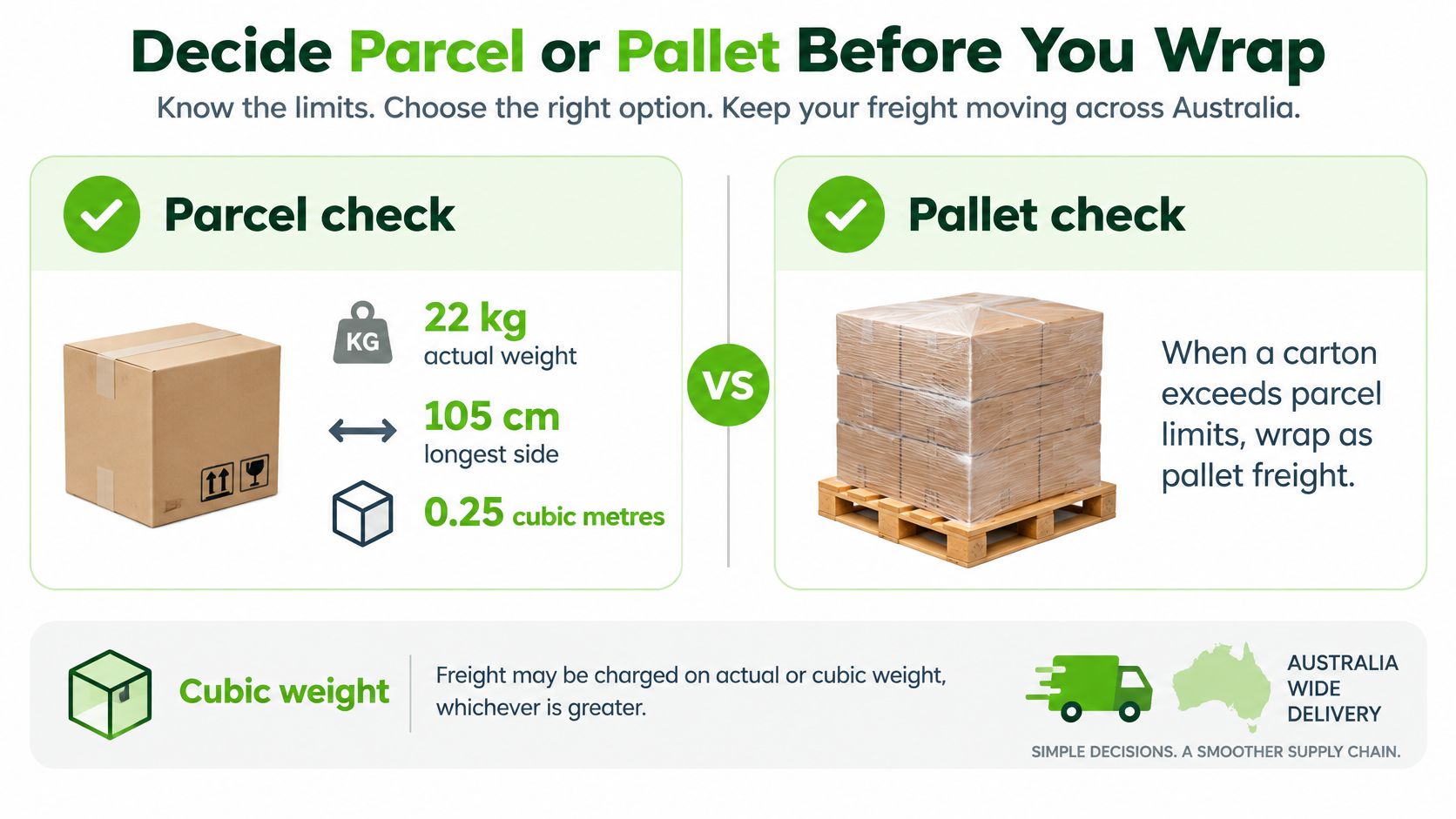
A pallet is not automatically the safer or cheaper choice. First check whether each carton can travel as a parcel. Palletising goods that fit parcel limits adds handling, film and a pallet booking without necessarily protecting them better.
For domestic parcels, Australia Post's size and weight guidelines set maximums of 22 kg physical weight, 105 cm length and 0.25 cubic metres volume. Exceed any one and the carton may need a different service. If it meets all three, compare the parcel option before building a pallet.
Run the Three Checks in Order
- Weigh and measure every carton: Use scales, then measure length, width and height at the widest points. Include tape bulges, corner protectors and any loose outer packaging.
- Check for excess space: Cubic weight is volume in cubic metres multiplied by 250. The chargeable weight is whichever is greater: scale weight or cubic weight. For example, a 0.10 cubic metre carton has a cubic weight of 25 kg, even if its scale weight is lower. A smaller carton can reduce the space being charged for.
- Measure the packed carton: Tape, labels and protective wrap can push a carton over a limit. If it is close, check its dimensions again after packing.
Eligible prepaid satchels use a flat rate based on pack size for parcels up to 5 kg. A small, dense item that fits properly may cost less in a satchel than in a roomy carton. Other cartons are assessed on actual or cubic weight and destination, so unused space can affect the charge.
Stay a Parcel or Move to a Pallet
| Check | Parcel stays eligible | Shift off the parcel path |
|---|---|---|
| Weight | Up to 22 kg actual | Over 22 kg |
| Longest side | Up to 105 cm | Longer than 105 cm |
| Volume | Up to 0.25 cubic metres | Over 0.25 cubic metres |
| Bulky but light | Pay greater of scale or cubic weight (m3 x 250) | Cubic weight exceeds scale weight |
| Prepaid satchel | Eligible pack, flat rate, up to 5 kg | Non-eligible carton billed on actual or cubic weight and destination |
If every carton fits the parcel limits, compare services for sending big parcels cheaply before choosing freight handling. Aeros Couriers supports cartons, satchels and palletised freight, so the right booking depends on the shipment, not a blanket rule.
If it fits as a parcel, wrapping it onto a pallet does not make it safer. It adds handling and can make pricing less straightforward.
If a carton exceeds a parcel limit, consider whether splitting the order into separate compliant cartons is practical. Two compact cartons may be easier to handle than one tall, partly filled pallet. For bulk stock being relocated rather than sent as customer orders, planning pallet removals in Melbourne can help you compare a removal-style move with parcel freight. Choose the smallest suitable shipping format, and use stretch film only when the goods need to be unitised on a pallet.
Stack Square and Close the Gaps First
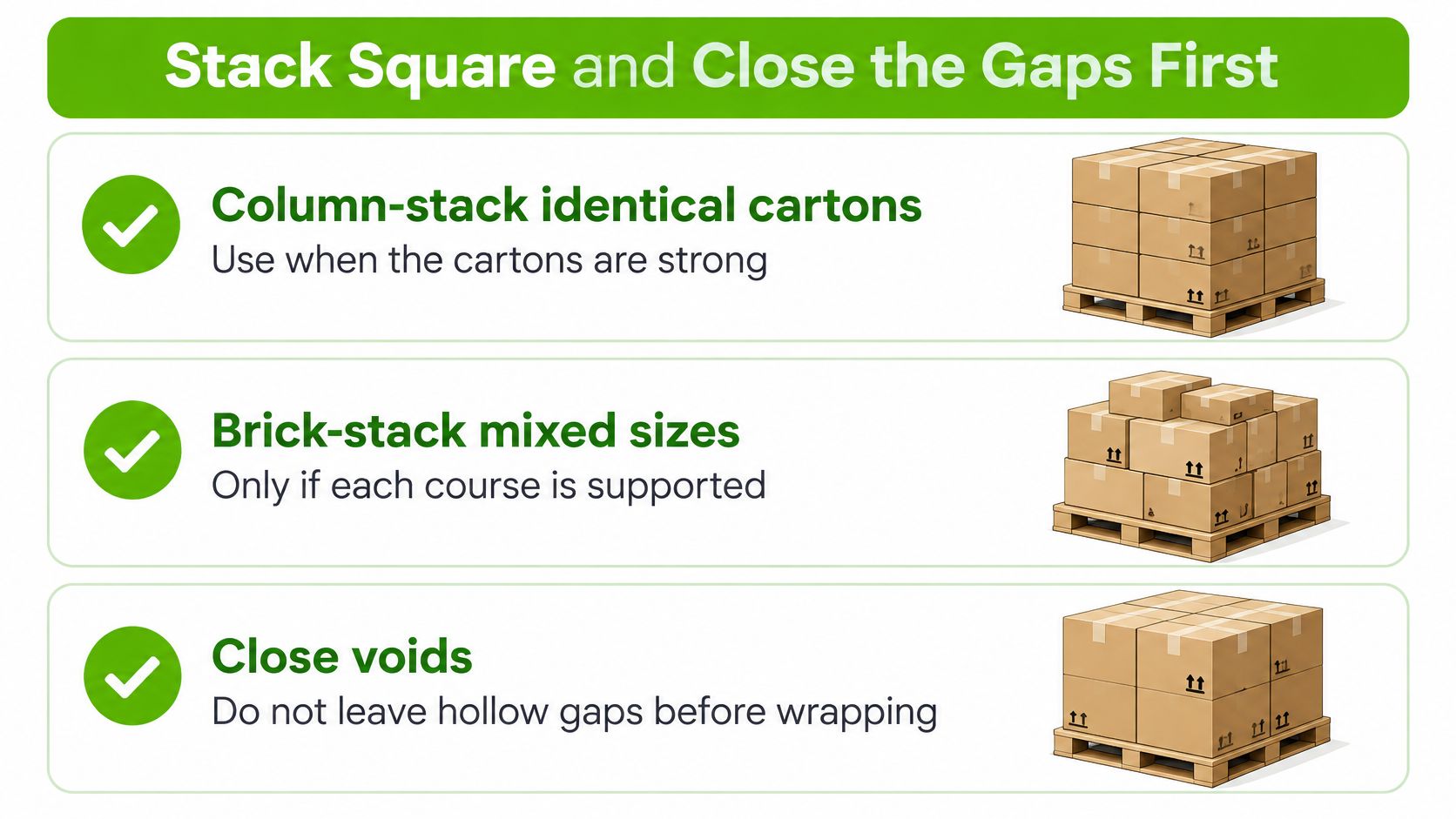
Film can't invent friction that a hollow stack never had. If cartons can rock before you wrap, they'll keep moving under the film. The wrap just hides the movement until braking or cornering gives it somewhere to go. Build a dense cube first.
Column stack identical cartons when they're strong. Corners sit over corners, walls carry the load straight down, and the face stays flat for film. Brick stack mixed sizes only if each course is supported and tied, with no carton bridging a void. If a smaller box drops into a gap, the layer above will sag and the film will pull it further out of shape.
Build From the Deck Up
- Heavy low, light on top: Put dense goods at the bottom and fragile goods where they won't be crushed. A low centre of gravity resists tipping.
- Zero overhang: Keep every carton inside the pallet footprint. A box hanging past the deck loses support at its corners and catches on racking, forklift tines and other freight.
- No chimney voids: Fill internal gaps with dunnage that won't crush flat. A hollow centre lets cartons fall inward.
- Labels facing out: Show goods type, weight and hazards so the next handler doesn't have to cut film to learn what's inside.
Gap size isn't a matter of opinion. The NHVR blocking guide says gaps between the load and a blocking structure should not exceed 200 mm, while total sideways gaps should be less than 100 mm. Think of 200 mm as roughly an adult handspan and 100 mm as about a carton edge. Leave more than that and the load gets a run up before it hits the block. Momentum builds fast, even at dock speeds.
The same logic applies inside your stack. A carton with room to slide will slide. Pack each course tight enough that you can't pull a middle box out by hand. If you can, repack it. Fragile contents need internal packing first, and the guidance on packing fragile items is worth sorting before those cartons ever reach a pallet.
Check the pallet itself while you're at it. It should be undamaged, used within its load rating and labelled with goods type, weight and any dangerous or perishable hazard. Split boards, missing blocks and proud nails aren't cosmetic faults. They change how the load sits and where film tears.
If the stack only looks stable because someone's holding it, restack it. Don't wrap a lean and hope tension pulls it true. Film under tension pulls a leaning stack further over, it doesn't straighten it.
How to Wrap the Pallet From the Base Up
A load can look secure on the dock, then loosen as cartons settle. Stretch film helps hold the cartons together and lock them to the pallet for handling. That is unitising, not vehicle restraint.
The Seven Step Hand Wrap
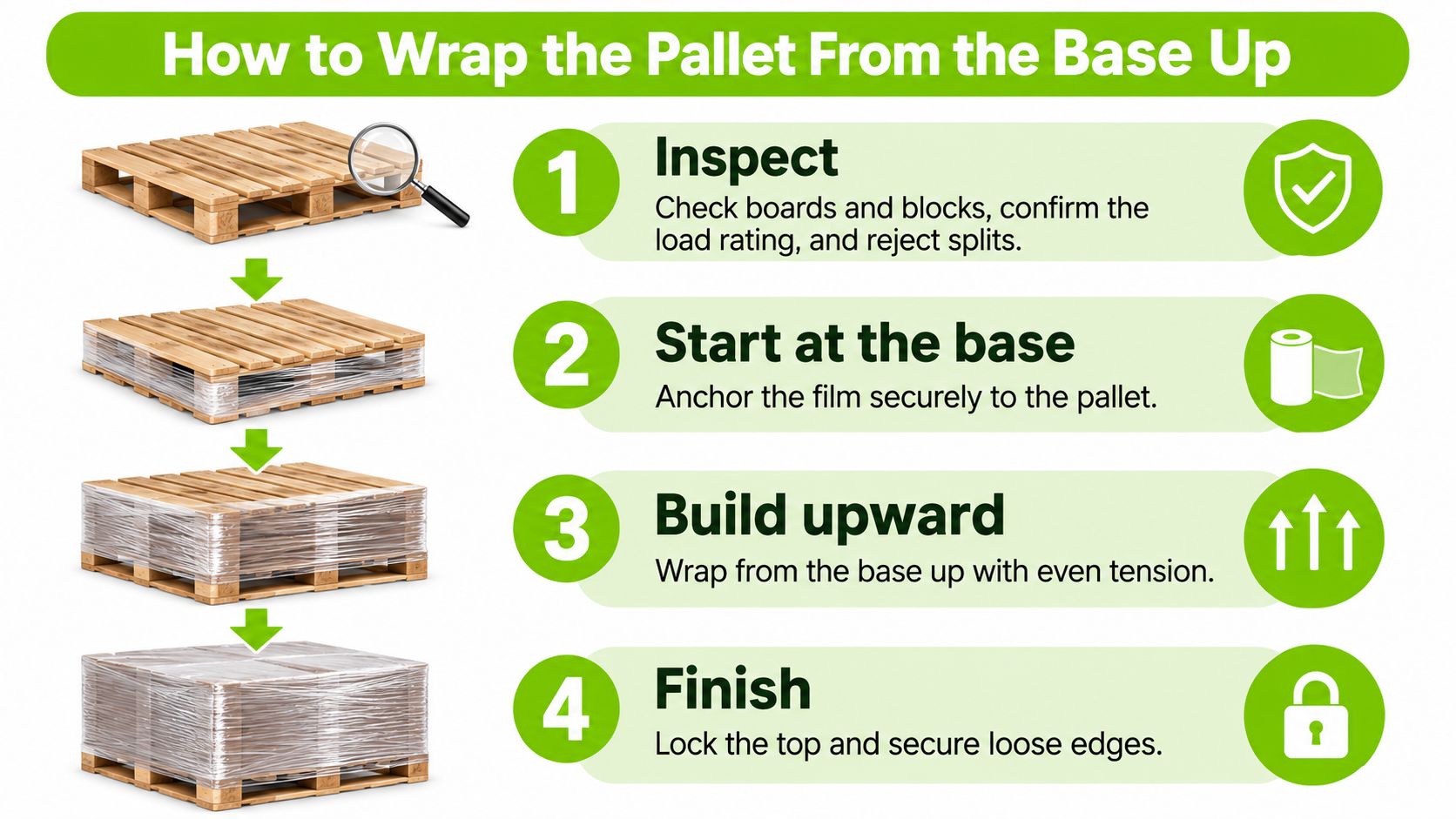
- Inspect the pallet: Check the boards and blocks, confirm the load rating, and reject splits, proud nails and wet timber. Wet timber can be heavier, weaker and slippery under cartons.
- Confirm the stack: Keep faces square, heavy goods low, labels outward, and cartons within the pallet edges. Push each face. Nothing should rock.
- Anchor to the timber: Tie or tuck the film so it grips both the load and the pallet. Wrap through the base so the film locks the cartons to the pallet deck, not just to the top layers. Keep the tension even as you go.
- Build the base: Walk the roll around the pallet under steady tension, overlapping each pass by about 50%. Make two or three turns at the base before climbing. The film should catch the pallet and the lowest cartons, so the load cannot slide as one block.
- Spiral up and cap the top: Keep the overlap consistent as you rise. Cross the top corners so the film folds over the upper edges, then spiral back down. The return pass helps keep the cap attached to the sides.
- Finish the tail tight: Tear the film and tuck the end under a previous layer, or press it flat under tension. A loose tail can catch on a forklift tine or conveyor edge and start unwrapping the load.
- Shake test the result: Push and pull at different heights. If a carton slides, leans or lifts independently, unwrap to that layer and fix the stack or film tension. Adding random turns over a fault leaves the cause in place.
Tension Without Crushing
Stretch film should extend as you apply it and keep pulling in afterwards. Slack film may look tidy, then loosen as cartons settle. Too much tension can crush retail cartons, bow their walls or snap the film at a corner.
There is no single turn count for every load. The amount depends on the load's weight and the friction between product layers. Glossy cartons can slide more readily against one another than rough cardboard, so the stack pattern and base lock matter. Heavy loads and sharp edges can also tear the film. Fit corner boards before wrapping to protect edges and spread the tension.
Corner boards give the film a broader surface to press against. They also protect carton edges and provide a surface for straps. Fit them where hard corners meet the film, especially on tall loads. A top sheet of cardboard or film spreads pressure and keeps dust off the upper cartons.
Practical rule: If you can lift a top carton after wrapping, the cap is not holding it. If the film spins around the cartons, the base is not anchored.
Hand wrapping suits low volumes and odd-shaped loads because you can feel changes in tension. Hold the roll with both hands, walk backwards where the dock allows, and keep each pass at a steady height. For a stronger grip around the pallet blocks, twist the film into a rope for one base turn. The narrow strand can bite around the blocks where a flat web may ride up.
Stop once the shake test passes on a light, square load. Heavier, taller or sharp-edged freight may need a separate vehicle-restraint system. Stretch film keeps the load together; it does not restrain the pallet in transit.
Forces a Wrapped Pallet Must Still Resist
A tight wrap can fool you. It looks finished because the cartons don't move when you push them in the warehouse. A truck doesn't push gently. Braking, cornering, acceleration and road bumps apply force to the whole mass at once, and Australian load restraint rules put numbers on that force.
The NTC Load Restraint Guide.pdf) specifies minimum restraint forces of 80% of the load's weight forward, 50% sideways, 50% rearwards and 20% upwards when the load is not fully contained. Read those percentages as kilograms of force your system has to resist, not as paperwork.
Minimum Load Restraint Forces
| Direction | Minimum share of weight | Force on a 500 kg pallet | What usually supplies it |
|---|---|---|---|
| Forward | 80% | 400 kg | Blocking plus rated tie downs, blocking at 0.3 g can count 30%, leaving 50% |
| Sideways | 50% | 250 kg | Containment, friction and tie downs |
| Rearwards | 50% | 250 kg | Containment and tie downs |
| Upwards, load not fully contained | 20% | 100 kg | Tie downs, not film |
Say your wrapped pallet weighs 500 kg. Under hard braking, the restraint system must withstand a forward force equivalent to 400 kg. A sideways force of 250 kg arrives in a corner. Film that's doing a good unitising job isn't a rated strap, a headboard or a containment wall, and it shouldn't be treated as a substitute for approved restraint equipment.
Blocking changes the maths, but it doesn't remove it. Forward blocking that can withstand 0.3 g may contribute part of the forward requirement, leaving the rest of the system to supply the balance. Without qualifying blocking, the restraint system owes the full forward share. That distinction matters when a driver or loader asks what your tidy wrap is rated to hold. The honest answer is that it holds cartons together. The vehicle system holds the pallet.
What Film Is Allowed to Do
Stretch wrap helps during forklift handling and transfers. It stops individual cartons walking off the stack when the pallet tilts slightly or bumps a dock plate. It also unitises the load when tie down restraint is used, so straps act on one block instead of squeezing single cartons loose. Every bag and pallet still has to be restrained in the vehicle.
Your part as sender is practical. Wrap from the base, overlap evenly, lock the top, then ask whether corner boards, strapping or carrier applied restraint are required for this mass, shape, centre of gravity, vehicle and route. Note the weight and hazards clearly so the loader can make that call. If the goods are valuable, check your position on insurance for courier deliveries before pickup, because good wrapping reduces damage risk but doesn't remove it.
Chain of Responsibility means the packer shares the restraint question with the loader and operator. You can't hand over a heavy pallet in film alone and assume the driver will sort it out. Say what it weighs, flag a high centre of gravity, and don't hide sharp edges under extra plastic.
When Stretch Film Stops Being Enough
More layers aren't automatically safer. That's the myth that causes trouble on docks. A packer sees a tall load wobble, adds six more turns, and calls it restrained. The wobble is still there. It's just hidden under plastic that'll stretch or tear when the vehicle brakes.
The NHVR stretch and shrink wrapping guide says stretch or shrink wrap alone is unsuitable for heavier loads or freight with edges and corners that can tear or penetrate the film. Wrapping is one component of a broader system that may also need blocking, friction matting, edge protection, straps or other rated equipment.
Keep two jobs separate in your head. Unitising keeps cartons or products together on the pallet. Vehicle restraint prevents the palletised load from moving or falling during transport. Film does the first job. It doesn't automatically do the second.

Load Type and Restraint Build
| Load type | Film role | Extra restraint required |
|---|---|---|
| Light, stable cartons inside the pallet footprint | Unitise with tensioned film | Corner boards where a corner meets the film |
| Tall freight or high centre of gravity | Unitise with film | Strapping and blocking against tipping under braking |
| Heavy loads or sharp, projecting edges | Unitise only | Rated straps, edge protection, blocking or containment, never film alone |
Light, stable cartons are the easy build. Square stack, tensioned film from the base, corner boards where needed, then normal vehicle restraint by the carrier. Tall freight is different because height turns braking force into a tipping moment. The top wants to keep travelling while the base stops. Strapping over the top and down through the pallet, plus blocking in the vehicle, gives that force somewhere rated to go.
Heavy or sharp freight should never rely on film. Metal parts, flat pack furniture corners, tiles and machinery edges cut webs of film from the inside. Edge protection goes on first, then film to unitise, then rated straps. Any sender moving household style items can also learn from furniture protection advice for Sydney renters, where padding corners before wrapping is treated as basic practice rather than an extra.
Use a simple dock rule. If a forklift will pick the load, if the top layer can slide, or if a corner can cut film, plan the extra restraint before the last pass of wrap. It's much harder to fit corner boards and straps neatly after you've sealed everything in plastic. Confirm the pallet is undamaged and inside its rating before any of these builds.
For freight that stays in the parcel world, you can avoid most of this decision tree. Cartons booked through a domestic freight express service travel as individual units, so your job is carton strength, internal cushioning and a tight outer seal. Save pallet restraint decisions for loads that can't travel that way.
Wrap Faults That Fail on the Dock
Most failures announce themselves before pickup. You can see a loose tail, a leaning face or a cut corner. The skill is matching the fault you can see to one fix, instead of wrapping the whole load again in the same wrong way.
Start with loose tails. Film that spins on the cartons means tension was never held and the base was never anchored. Tape on a floppy end won't cure it. Re wrap from a base tie with overlap. It's annoying for five minutes and cheaper than a collapsed pallet in someone else's warehouse.
Visible Fault and the Single Fix
| Visible fault | Single fix |
|---|---|
| Loose tails or film spinning on cartons | Re wrap from a base tie with overlap |
| Top carton layer lifting off | Cap the top and spiral back down |
| Crushed retail carton | Drop to the minimum tension that passes the shake test and add corner boards |
| Cuts at corners | Fit corner boards before the passes that would slice |
| Pallet rocking or freight past the deck | Unfilm and restack |
| Film is the only hold on a heavy or sharp load | Add rated straps or blocking and keep film as the unitiser |
A top layer lifting off means you spiralled up and stopped. The upper cartons were circled, not capped. Cross the top corners and come back down so the film ties the cap to the body of the load. You'll feel the difference straight away in the shake test.
Crushed cartons point the other way. Too much tension or too many turns on a soft pack squeezes the product you're trying to protect. Ease off to the minimum tension that still passes the shake test and use corner boards to spread the force. Boards stiffen the edge so film doesn't have to be wound on like rope.
A rocking pallet is a stacking fault, not a wrapping fault. Unfilm it and restack it.
Cuts at corners mean edge protection was skipped. Fit boards before the passes that would slice, not after the web has torn. Once film is cut, tension falls across that whole face and the tear travels.
Freight hanging past the deck needs the same blunt response. Unfilm and restack. Banding a lean or wrapping an overhang locks in a weak shape and invites damage at the unsupported corners. Correct footprint first, film second, every time.
There's a waste angle here too. Extra turns used as a substitute for stacking, boards or straps create avoidable soft plastic without adding rated restraint. Use a film grade that holds at the lowest validated tension, note roughly how much you use per pallet, and keep contaminated film out of any soft plastics stream. Collection varies by area, so don't wrap rubbish into the load and call it recycling.
Finish with labels on the outside of the film where handlers can read them. The checklist for putting a label on a package applies just as much to a wrapped pallet face. Clear weight, destination and hazard information helps the next person restrain and handle the load properly. Then do one last shake test, check the tail is tucked, and let it go with confidence.
If your cartons pass the parcel checks, skip the pallet and send them as fast, low price boxes or satchels with local and Australia wide delivery through Aeros Couriers. Get an instant quote, book in minutes and print your labels, so your freight moves as compliant parcels without film, forklifts or pallet fuss.
Courier quotes, tracking and support
Ready to send a parcel? Compare the available services for your postcodes, parcel dimensions and weight. For an existing delivery, use your consignment number to check tracking or ask our team for help.