
You're staring at a bench of taped cartons in Darwin, a customer in Alice Springs is asking when they'll arrive, and the weather radar is not helping your mood. Do you post them today, book a road courier, consolidate them for later, or hold off until conditions settle? That choice is the whole Darwin to Alice Springs problem in miniature. It looks like one straight line on a map, but for a sender it's a long, thin supply chain with very few detours, sparse depots, and no room for sloppy packing or optimistic promises. Get the basics right and it's a profitable regional lane. Get them wrong and you pay twice, once in freight charges and again in refunds, redeliveries and angry phone calls.
Why the Darwin to Alice Springs Route Matters
She runs a small online store out of a Darwin industrial unit, nothing fancy. Tuesday's orders are mixed cartons, clothing in satchels, a couple of boxed parts for a workshop near Alice Springs, and one fragile item she is nervous about. She can post the lot and hope, she can book a road courier for better tracking, or she can sit on the Alice Springs orders until the wet season risk eases. Most small operators I talk to have stood exactly there, tape gun in hand, doing that mental maths.
My advice is simple. Don't treat this lane like a Sydney to Melbourne overnight run. Treat it as a strategic inland spine that happens to carry your parcels. The corridor grew from John McDouall Stuart's exploration route, then the Overland Telegraph, then the Stuart Highway that still bears his name, a history traced in the Alice Springs public art and history record. Rail arrived at the settlement then called Stuart by 1929, but a complete Adelaide to Alice Springs to Darwin rail link wasn't achieved until February 2004. That long gap tells you everything about the terrain and the economics. Distance won for a very long time.
Two Very Different Markets at Each End
Darwin and Alice Springs are not two versions of the same market. Australian Bureau of Statistics data for 2024-25 recorded 90,035 residents in the Darwin local government area and 30,875 residents in Alice Springs, a combined 120,910, in the ABS regional population dataset for 2024-25. Darwin grew by 1,282 people, or 1.4%, Alice Springs by 388 people, or 1.3%, in that year. Density is the sharper contrast. Darwin sits at 809.2 persons per square kilometre over 111.3 square kilometres, while Alice Springs sits at 94.2 persons per square kilometre over 327.7 square kilometres.
For a sender, that gap changes everything. Darwin gives you concentrated pickup demand, more carrier choice, and shorter local legs. Alice Springs gives you a vital inland service hub serving a wide, thin catchment where one missed linehaul connection can add days, not hours. Both centres also recorded negative net internal migration offset by positive net overseas migration and positive natural increase in the same dataset. In plain terms, the customer base turns over. Address details go stale faster than you think, so confirm delivery details on every order, not just the first.
Why Parcel Only Changes the Logic
General freight talk on this corridor is dominated by fuel, mining and livestock. Your cartons are not that freight, and that's an advantage if you use it. Parcel only, local shipping in Australia means you can move through established parcel networks, use residential and commercial pickups, and deliver to homes, workplaces and collection points without booking pallet space you don't need.
- Households send personal effects, gifts and online sale items that need tracking more than they need a forklift.
- E-commerce sellers send repeat cartons where a few dollars per parcel decides whether the Alice Springs market is worth serving at all.
- Workshops and offices send parts, documents and equipment where a late arrival stops someone else's job.
If your goods fit safely in a carton or satchel, don't pay pallet thinking to solve a parcel problem. Right size the consignment first, then choose the carrier.
That's the opportunity here. Reliable, low cost box and parcel movement turns Alice Springs from a too hard destination into a normal part of your Australia wide offer. The constraint is real, sparse services, long distances, seasonal disruption, but it's manageable when you plan for the corridor you've got, not the one a travel itinerary describes.
Road, Rail, and Air Compared
Start with road, because road runs this corridor. The Stuart Highway is the Northern Territory's principal north to south freight artery, part of the National Land Transport Network, with the complete Port Augusta to Darwin route at approximately 2,781 km, according to the national freight supply chain submission on the Stuart Highway corridor. Fuel accounts for 32% of the route's freight task, mining and livestock each account for 20%, and about 40% of movements originate at a property or port. Your parcels share that road with road trains serving mines, stations and remote communities. Expect professional linehaul, but don't expect metro frequency.
Road wins for most Darwin to Alice Springs parcels for three practical reasons. It offers door to door movement without terminal transfers at both ends, it handles mixed carton sizes well, and it connects naturally to the towns and delivery points along the highway. When you're weighing up interstate transport options for Australian parcel freight, road is the default for anything that's boxed, moderately urgent, and needs a residential or business delivery at the other end. The trade off is exposure. Weather, crashes, roadworks and fatigue management all sit on the same sealed ribbon your carton travels on.
Rail Is Real, but Selective
Rail is not a myth on this lane, it's just built for a different job. The 1,420 km Alice Springs to Darwin standard gauge railway uses a 23 tonne axle load design, permits double stacked containers, has a maximum operating speed of 115 km/h, supports trains up to 1,800 m long, and has a reported transit time of about 52 hours, as set out in the federal rail strategic options paper on the Alice Springs to Darwin line. It's a single track system with passing loops, so meets, terminal handling and maintenance windows shape the actual schedule.
That profile suits consolidated, non urgent freight that can fill container space and absorb terminal transfers. It suits a single urgent carton poorly. Minimum charges, depot handling and last mile delivery at the Alice Springs end can erase any linehaul saving fast. If you're a parcel sender, think of rail as background infrastructure that supports the broader freight system, and as a fallback for larger consolidated movements, not as your everyday booking.
For context, the famous passenger journey on this alignment covers 2,979 kilometres in approximately 54 hours end to end. That's a useful reality check. Even a flagship train takes days across this continent, so anyone promising casual overnight outcomes for standard road or rail parcels into Central Australia is selling you a story.
Air for Genuine Urgency Only
Air freight has a place, and it's narrow. Use it when the item is light, valuable, and time critical, a critical part, urgent documents, medical or technical items where downtime costs more than the freight bill. Cargo space is limited, pricing reflects that, and size and dangerous goods restrictions bite harder than they do on road. Senders who default to air for ordinary cartons burn margin for speed their customers often didn't ask for and won't pay for.
My recommendation is blunt. Quote road first, every time. Consider rail based consolidation only when volume and timing fit. Reserve air for the small share of jobs where a day saved is worth real money. That discipline alone will put you ahead of other senders on this lane.
Transport modes for Darwin to Alice Springs
| Mode | Best fit | Typical transit | Cost shape | Key limitation |
|---|---|---|---|---|
| Road | Boxes and satchels, door to door parcel delivery | Multi day, varies with conditions and connections | Distance and size based, best value for most parcels | Exposed to weather, closures and highway incidents |
| Rail | Consolidated, non urgent containerised freight | About 52 hours linehaul, plus terminal and last mile time | Efficient at volume, minimum charges hurt small jobs | Single track with passing loops, terminal transfers required |
| Air | Light, urgent, high value items | Fastest available, subject to flight and handling schedules | Highest per kilo, priced for urgency | Limited space, tighter size and goods restrictions |
One more structural point matters. Approximately two thirds of the Territory's interstate land freight moves by road, and the north to south corridor carries about 70% of the NT's interstate land freight, per the parliamentary submission on Northern Territory interstate freight movements. That's why road capacity, road condition and road safety dominate your delivery outcomes. You're not booking in a vacuum. You're booking space in the Territory's main freight artery, and planning like it will save you money and grief.
Transit Times and What Really Drives Cost
Distance sets the floor for this lane, but distance alone doesn't explain your quote. Weight, dimensions, destination, service level and how you've described the parcel do most of the damage or most of the saving. Senders who understand those levers pay less. Senders who guess dimensions and pick the first price they see usually don't.
Start with a public benchmark so your expectations are anchored. Australia Post guidance puts standard Parcel Post at 2 to 4 business days for same state deliveries and 3 to 6 business days interstate, with Express Post at 1 to 2 business days same state and 1 to 3 business days interstate, in its domestic parcel delivery guidance for merchants. The same guidance warns that origin, destination, network congestion and rural delivery all affect speed, and some rural areas take longer. Darwin to Alice Springs is exactly the kind of long regional movement that warning was written for. Don't quote your customer a metro style promise and hope the Territory cooperates.
How Parcel Pricing Actually Works
Domestic parcel pricing is mechanical. It's tied to weight, size and destination zone, not to a single flat national fee. Australia Post's charges guide shows parcels above 5 kg and up to 22 kg carry a basic charge of $24.45 including 5 kg, plus a distance charge calculated per kilogram and rounded up to the nearest kilogram, as detailed in the Australia Post charges guide for parcel pricing. You identify the lodgement and destination zones, calculate the distance charge, and add it to the base.
Read that again if you ship heavy cartons, because two lessons fall straight out of it. First, rounding punishes sloppy weighing. A parcel just over a kilo boundary costs like the next kilo. Second, distance charges make long regional lanes like this one especially sensitive to chargeable weight. A bulky, half empty box can cost more than a slightly heavier, right sized one, because carriers price the space your carton occupies in a truck that has a very long way to travel.
That's why I push senders to estimate shipping cost from exact weight and dimensions before they tape the final box shut, not after. If the quote surprises you, you've still got options at that point. Repack tighter, split or consolidate, or change service level. After pickup, your only option is paying.
Levers You Control
- Right size every carton: Trim dead air. Oversized packaging is a self imposed surcharge on a distance priced lane.
- Consolidate where it helps: One well packed carton often beats three loose ones, provided it stays safely liftable and within carrier limits.
- Weigh and measure: Under declared parcels get reweighed, rebilled and sometimes delayed. Accurate data also helps carriers plan vehicle space properly.
- Question signature upgrades: On rural and residential drops where nobody's home during work hours, a signature requirement can mean a failed delivery and a long trip to a collection point. Use it for high value goods, skip it where safe drop works.
- Compare across carriers: Aggregated carrier selection and wholesale bulk purchasing can lower headline rates because different carriers price regional lanes, weights and dimensions differently. The cheapest carrier for a light satchel is rarely the cheapest for a dense 18 kg carton.
Practical rule: Never book on dead weight alone. Measure all three dimensions, weigh the finished parcel, then quote. That two minute habit prevents most billing arguments I see.
Scale sits behind all of this. A national parcel network has to serve metropolitan and remote addresses through the same system, which is why regional routes are priced and timed differently from capital city lanes. Service standards vary by weight, size, origin and destination, and a practical quote should show you that difference upfront rather than burying it in fine print. If a quote for Alice Springs looks identical in logic to a quote across suburban Darwin, ask harder questions.
Time and cost trade against each other, and pretending otherwise helps nobody. Paying express rates for stock that will sit in your customer's storeroom for a week is waste. Saving a few dollars on a part that keeps a workshop idle is false economy. Match the service to the consequence of late arrival, state a realistic delivery window to your customer, and build your margin on honest quoting. That's how experienced NT senders stay profitable on this lane.
Packing and Dangerous Goods Essentials
Pack every carton as if it'll be tossed from a road train onto the Stuart Highway shoulder and loaded again at a depot in Alice Springs. I'm exaggerating only slightly. Your parcel will be lifted, stacked, vibrated for hours, transferred between vehicles, and handled by people working to a schedule in serious heat. Packaging that survives a suburban courier run can fail halfway to Tennant Creek.
Start with the outer carton. Use a sturdy double wall carton for anything heavy, fragile or valuable, and don't reuse a box that's already soft at the corners. Fill voids so contents can't shift, because movement inside the box is what turns vibration into breakage. Wrap fragile items individually, separate them from each other and from the carton walls, and put the heaviest items at the bottom. Seal with heavy duty tape across all seams, not a single strip down the middle and a prayer.
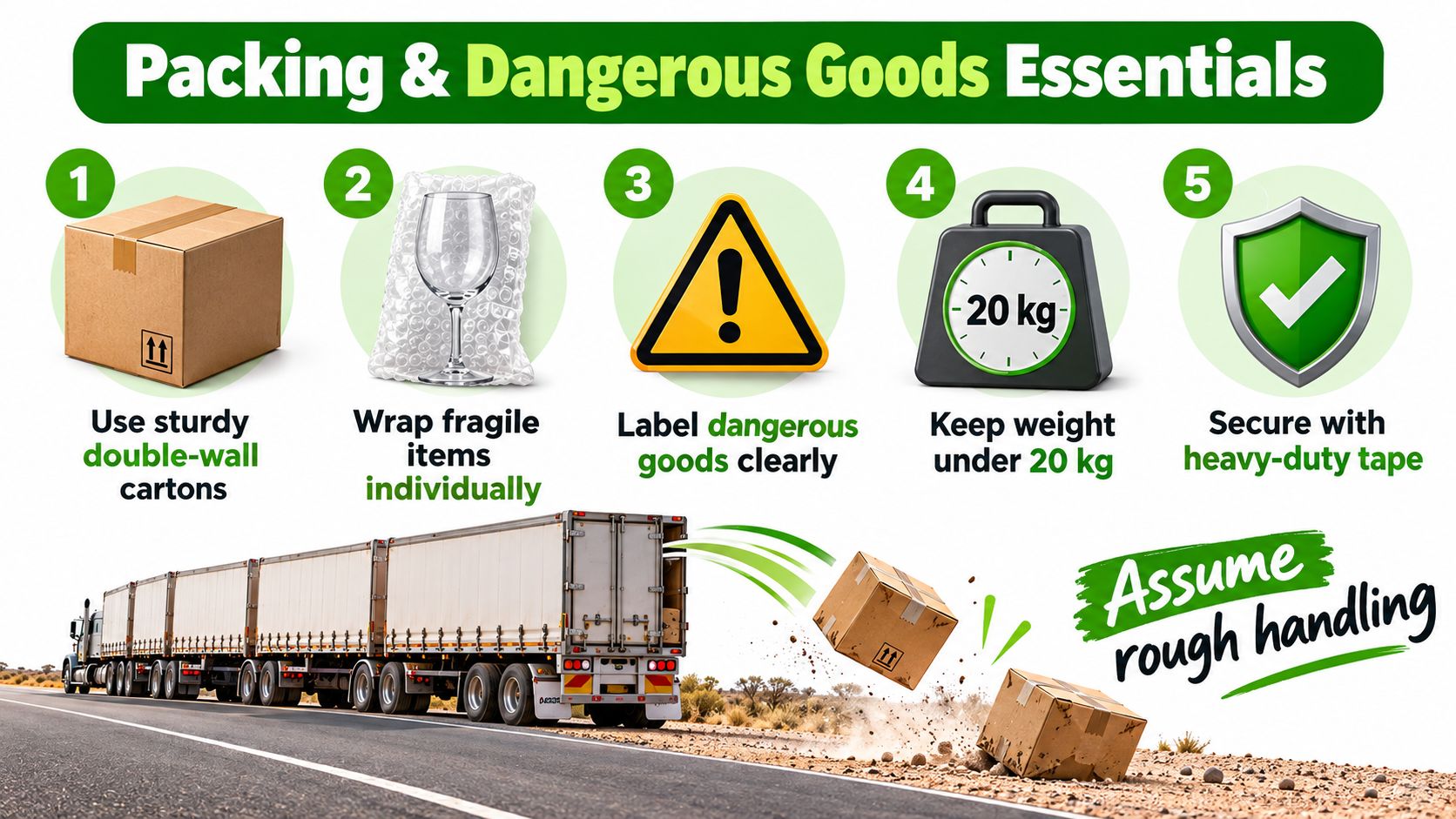
Satchels have their place for soft, light, non fragile goods like clothing. They don't belong around anything with corners, edges or crush risk. If it can be bent, dented or snapped, it goes in a box. Keep individual parcels at a weight one person can lift safely, and remember that a courier friendly box is a box a driver can pick up at a residential address without a forklift, a trolley chase or a bad back. If your team ships daily, it's worth reviewing your bench setup and order picking and packing equipment so scales, tape, void fill and labels sit within reach and every packer follows the same standard.
Labels That Survive Regional Depots
Put the label on the largest flat surface, fully adhered, with no tape over the barcode. Remove or cover every old label, because regional depots move fast and a stray barcode from the last journey can send your carton somewhere creative. Put a copy of the delivery details inside the box as well. If the outer label is damaged, that inner slip is often the difference between a delayed parcel and a lost one. Confirm the receiver's phone number is on the booking. In Alice Springs and smaller stops along the way, a quick call from a driver who can't find an address saves a failed delivery.
Check pickup access before you book, too. Tell the carrier if there's a gate, a steep driveway, a loading dock or limited hours. Accurate dimensions, realistic weights and a safe handover point aren't admin details. They're part of getting the job collected first time.
Dangerous Goods Are a Hard Boundary
Do not guess with dangerous goods. Aerosols, lithium batteries, perfumes, solvents, paints and similar everyday items can carry specific restrictions, quantity limits or outright exclusions depending on mode and carrier. Road rules differ from air rules, and an item that's fine in one network may be prohibited in another. Before you book anything that sprays, burns, corrodes or powers a device, check it against the nine classes of dangerous goods guidance and declare it.
Chain of Responsibility puts accountability on you as the sender, not just on the driver who collects the box. If you misdeclare contents, overload a carton or hand over a leaking package, that failure starts with you. Carriers can refuse, return or dispose of non compliant freight, and you'll wear the cost and the customer fallout.
- Declare it: If you're unsure whether an item is restricted, ask before booking and state exactly what's in the box.
- Repack it: Use compliant packaging, separation and labelling where the item is permitted at all.
- Leave it out: If it can't travel legally and safely in a parcel network, don't sneak it in and hope nobody checks.
That's the standard. Apply it the same way on every job, train anyone who packs for you to apply it too, and your damage claims, refusals and arguments will drop sharply. Good packing isn't overhead on this corridor. It's the cheapest insurance you'll ever buy, and it costs a few minutes and a decent roll of tape.
Booking the Job Through Aeros Couriers
A carton booked at "about 10 kilos" gets reweighed at the depot at 14. The invoice lands higher than the quote, the margin on the job evaporates, and the sender blames the carrier for a gap they created themselves. Booking this lane well comes down to accurate data going in before the driver arrives.
Aeros Couriers is an Australian owned courier and freight platform built over 15+ years of research and development. It gives customers instant quotes, booking in minutes, label printing and job tracking from a single dashboard, with freight insurance included. For a Darwin to Alice Springs parcel job, that quote-to-book flow is the practical core of the whole task.
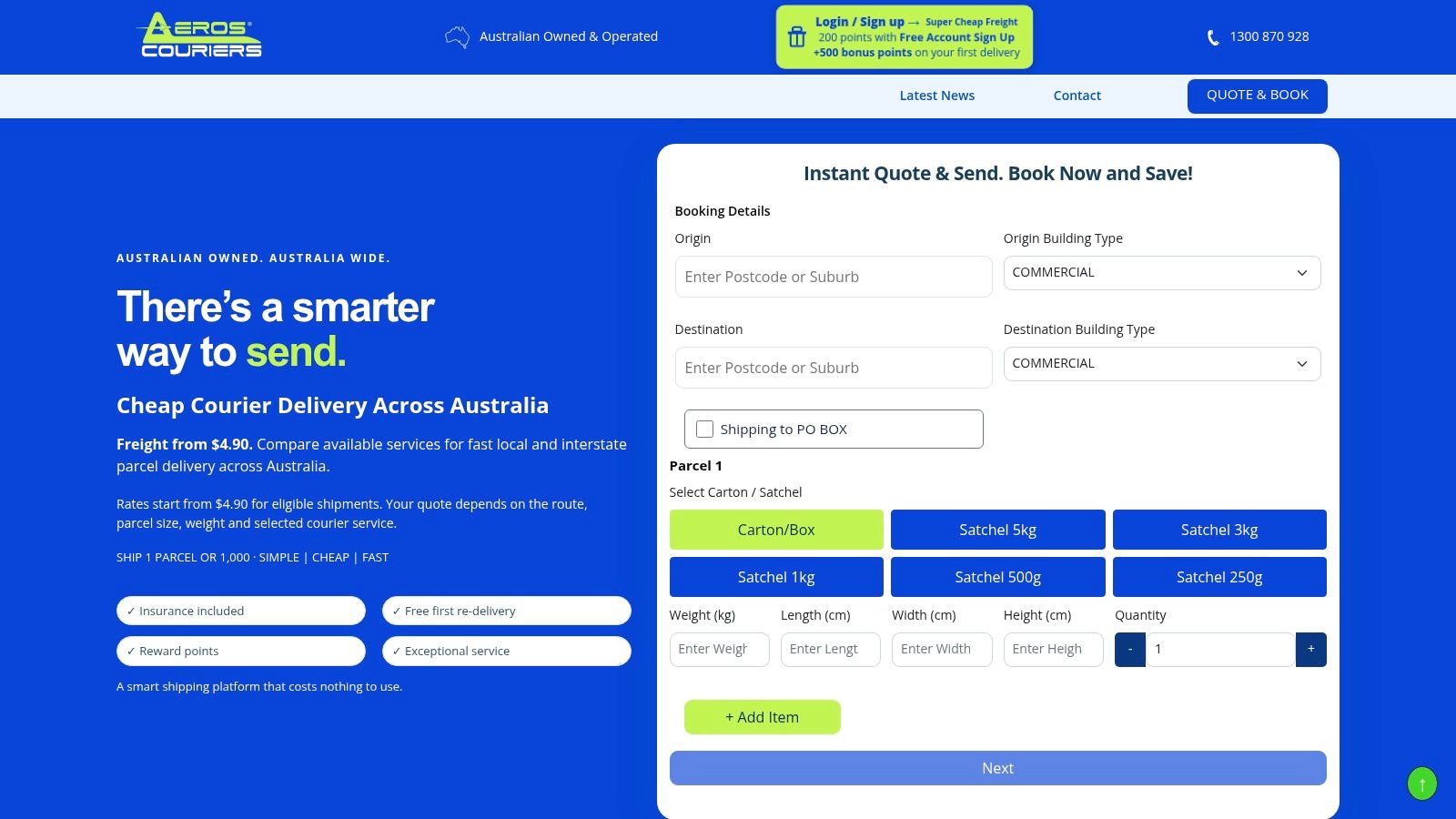
Start with the details you've already prepared if you've packed properly. Enter the pickup and delivery postcodes, then the parcel's weight and dimensions as measured on your scales and tape. The platform presents flexible carrier options so you can compare price and service fit for that specific consignment instead of defaulting to one carrier's regional pricing. On this lane, carriers price distance, bulk and remote delivery very differently, and the spread between quotes can be wide. The thinking behind comparing courier options before you commit is worth two minutes of your time if you usually book the first price you see.
From Quote to Label in One Sitting
Run the whole booking in one pass. Get the instant quote first: origin, destination, weight and dimensions, then review the carrier options and the delivery expectations shown for a regional destination. Confirm the parcel details next. Weight, dimensions, contents description and any restricted items all get a second check now, before pickup, because corrections after collection cost time and money. Then book and pay online, print the label, and attach it to a flat surface with the barcode clear and old labels stripped. Have the parcel ready at the agreed point, accessible, with someone available or clear handover instructions left.
Optional signature on delivery is there when you need proof for high value goods. Use it deliberately, as covered earlier, because on regional and residential deliveries it can mean a missed handover if nobody's home. Freight insurance being included takes one decision off your plate, and it should never make you careless about packing. Insurance responds after something goes wrong. Good packing stops it going wrong.
After the Driver Leaves
Track the job from the dashboard and skip the phone calls. You'll see movement updates as the parcel passes through the network, which lets you answer your customer's where-is-it question with facts instead of hope. Share the tracking with the receiver in Alice Springs proactively. Regional customers are generally patient about distance. Silence is what wears them down.
There's an upside senders rarely factor into their lane costs. Every booking earns reward points redeemable through partner Simply Merchandise on over 10,000 branded items. For a small business shipping weekly, those points can offset real spending on uniforms, promotional gear and office items you'd otherwise buy with cash. On its own it won't justify choosing a freight platform. It's still a genuine return on spend you're already making.
The national backdrop explains why this online model works on regional lanes. Australia wide parcel delivery at scale means coordinating thousands of delivery points and rounds across metro and remote destinations, and a platform that aggregates carrier capacity lets a small Darwin sender tap that scale without negotiating contracts alone. A Productivity Commission submission on Australia Post recorded approximately 4,400 post offices, 10.5 million delivery addresses, 7,600 postal rounds from 265 delivery centres, and 12,500 posties supported by parcel contractors, in its submission on the national postal and parcel network. You don't need to replicate that network. You need clean access to capacity like it, priced transparently, booked in minutes and tracked properly.
Do the preparation carefully and book with accurate data. There's nothing mysterious about sending Darwin to Alice Springs. It's a workflow, and run the same way every time it becomes one of the easier regional lanes on your list despite the kilometres involved.
Seasonal Risk and Safety on the Corridor
The Stuart Highway is sealed. That fact misleads a lot of senders into thinking delivery timing on this lane is predictable all year. It isn't. The wider Northern Territory network around that sealed spine is highly exposed to wet season closures, load limits and detours, and your parcel's first and last kilometres often depend on roads far less forgiving than the highway itself.
Infrastructure Australia reports that 75% of the NT road network is unsealed and that freight costs on unsealed roads can be 65% higher than on sealed roads, in its regional infrastructure analysis for the Northern Territory. Seasonal access restrictions, load limits and heavy dependence on road transport define the NT freight task. For a sender, that means wet season dispatch is a risk decision, not just a calendar entry. Ship early where you can, add buffer where you can't, and tell your customer before they ask.
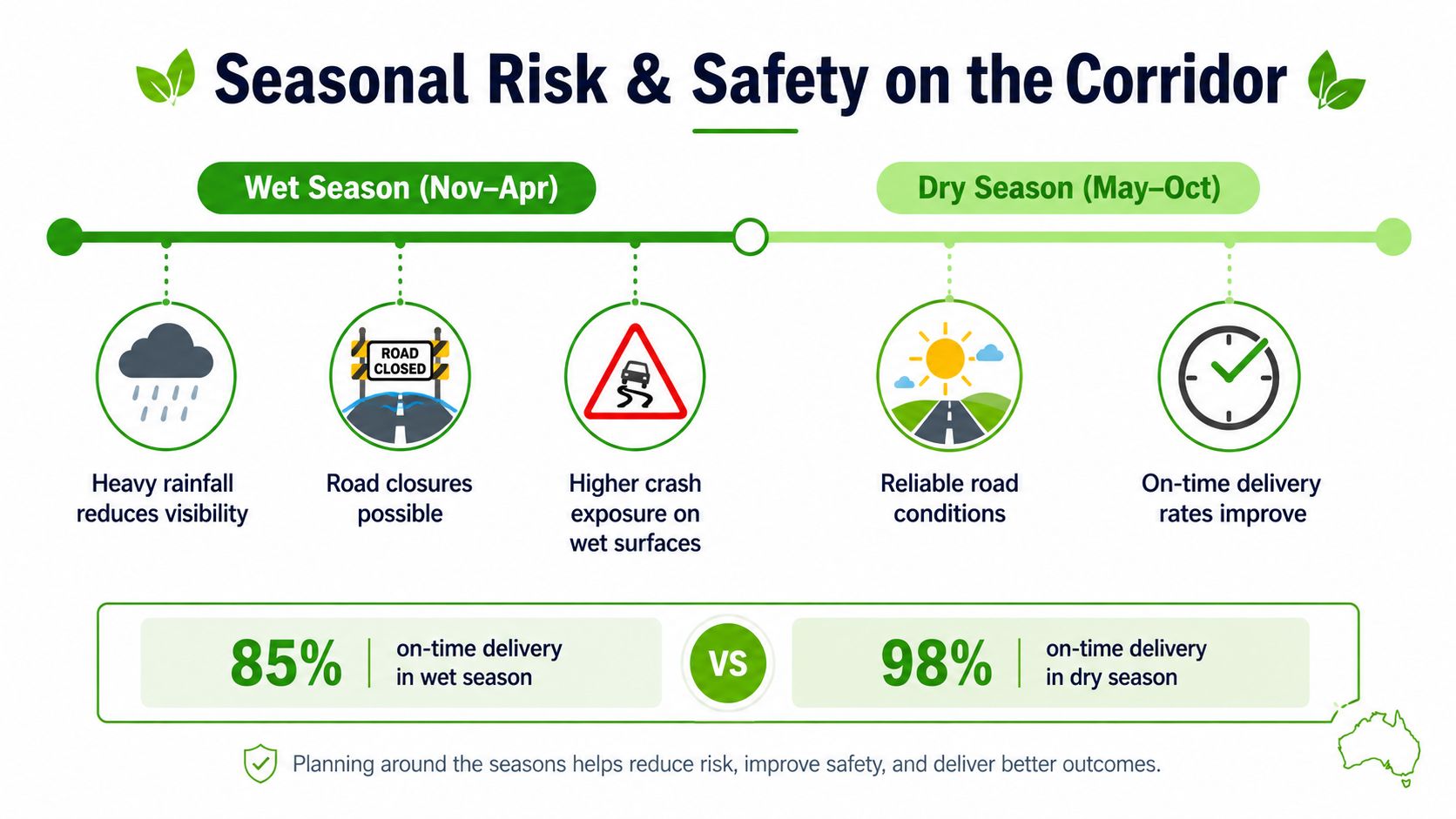
Flood disruption on the highway itself is not hypothetical either. In October 2026, a reported 600 kilometre section of the Stuart Highway was closed, temporarily reopening to move as many as 50 road trains carrying supplies to Darwin, with further delays remaining possible. Future dated reporting like that should be read as reported scenario planning, not as a guarantee about any given week, but the operational lesson is timeless. When the corridor closes, there is no handy parallel freeway. Freight waits, queues, then moves in a surge that strains depots at both ends. Your parcel is in that surge with everyone else's.
Crash Exposure Is a Sender Issue Too
Safety data on this corridor deserves your attention, not to frighten you, but to discipline the promises you make. Data from the Northern Territory Department of Logistics and Infrastructure, reported through the 2026 AANT Risky Roads analysis, recorded 964 crashes involving 1,762 people and 52 deaths on the Stuart Highway during 2021 to 2025, across 54 separate intersection locations between Darwin and Alice Springs, according to reporting of the AANT Risky Roads crash data. The same reporting put the NT road fatality rate at 12.0 deaths per 100,000 people for the year ending June 2026, described there as the highest Australian jurisdictional rate in that period. Treat forward dated figures as reported data requiring care, but don't dismiss the pattern. Risk is spread along the whole route, not concentrated at one notorious bend.
That means for you under Chain of Responsibility. Don't book unrealistic delivery promises that pressure scheduling and driver rest. Allow proper transit windows, especially in the wet. Load and pack so cartons stay stable and secure in the vehicle. Specify safe pickup points with clear access, not a roadside handover on a high speed stretch. Confirm residential collection arrangements that don't put a driver reversing blindly out of a difficult driveway at dusk.
Your delivery promise is a safety input. Promise a realistic window and you've removed pressure from every person who handles that parcel after you.
A Practical Seasonal Dispatch Routine
- Check official road conditions before dispatch: Make it part of the booking routine in the wet season, not an afterthought when a customer complains.
- Ship time sensitive stock early: If an Alice Springs customer needs goods for a fixed date, dispatch with buffer days in hand while conditions are good.
- Waterproof the vulnerable: Use inner plastic lining for paper goods, electronics and anything humidity or a wet loading dock could ruin.
- Communicate before delays land: A short message explaining Territory conditions and a revised window preserves trust. Silence destroys it.
- Consider staged or consolidated freight: For non urgent stock, building buffer inventory ahead of peak wet season risk can beat a string of anxious express bookings.
Dry season conditions are generally more reliable and transit expectations easier to meet, but heat, wildlife, fatigue and long distances don't take the season off. Analysis of NT pedestrian crashes has found many incidents occurred in light traffic, clear weather and on well paved roads, with higher speed areas and poor visibility increasing severity. Good conditions are not the same as no risk. Keep your dispatch discipline year round, tighten it in the wet, and your customers will experience consistency even when the corridor itself is having a bad week.
Smart Ways to Cut Cost and Avoid Delays
Everything on this lane rewards senders who simplify. Aeros Couriers' model here is cartons and satchels, local shipping in Australia, and no pallets, and I'll be direct about why I like that constraint for most small and medium senders. It forces right sized consignments that move cleanly through parcel networks, instead of over packed freight paying pallet logic for what should have been two tidy boxes. Focus is a cost saving.
Run this checklist before every Darwin to Alice Springs booking and you'll cut both price and delay risk.
- Right size the carton: Smallest safe box, voids filled, no dead air travelling thousands of kilometres at your expense.
- Consolidate repeat orders: Where a customer orders often, agree a dispatch rhythm that batches items sensibly without blowing out their wait.
- Use collection points where offered: If your receiver works near a depot or collection point in Alice Springs, that can beat a failed residential delivery and a second attempt.
- Skip signature where safe drop works: Keep signature for high value or sensitive goods. Drop it where it only creates missed deliveries.
- Book with accurate data: Correct weight, dimensions, address and phone number. Most avoidable delays I see start as data errors, not truck problems.
- Use your reward points: Points earned on recurring bookings can offset business costs through branded merchandise you'd otherwise pay cash for.
For operators sending from more than one site, multi site and residential pickups keep the system usable without centralising everything through one warehouse. A Darwin office, a home based seller and a workshop can all feed the same lane with the same booking discipline. Consistency across sites matters more than sophistication at one site. One packing standard, one labelling standard, one quoting habit. If you want the deeper playbook, work through the practical guide on how to reduce freight costs across your bookings and apply it lane by lane.
A word on air comparisons, because senders sometimes chase air pricing to rescue a late dispatch and make things worse. Understanding how air cargo routing and customs shapes capacity and compliance in that mode is useful background, but for a domestic parcel lane like this one, road based parcel networks remain the value option for the overwhelming majority of boxes. Don't let an avoidable packing or booking delay push you into an expensive mode that better planning would have made unnecessary.
Stop overpaying on dimensions. Stop over promising on timing. Stop putting parcel freight on pallet pathways. Those three habits account for most of the waste I see from otherwise good operators sending into Central Australia. Fix them and Australia wide delivery from Darwin becomes affordable, predictable enough to build customer promises on, and simple enough to hand to a new staff member without a week of training.
You've got a market at the Alice Springs end that values reliable supply precisely because distance makes it scarce. Serve it well, at a fair freight cost, with honest delivery windows, and you'll win repeat business that metro focused competitors never bother chasing. That's worth the small discipline this lane asks of you.
Ready to send your next carton Darwin to Alice Springs without the guesswork on price, timing or packing standards? Get an instant quote, compare carrier options, book in minutes and track your parcel from one dashboard with Aeros Couriers. Measure your box, enter the postcodes, and put a realistic, low cost Australia wide parcel service to work on this lane today.
Courier quotes, tracking and support
Ready to send a parcel? Compare the available services for your postcodes, parcel dimensions and weight. For an existing delivery, use your consignment number to check tracking or ask our team for help.