









The nine classes of dangerous goods are the nationally accepted categories for all things hazardous, from explosives right through to corrosive substances. If your business needs to ship anything that falls under this banner, getting your head around these classes is the critical first step to doing it safely and legally here in Australia.
Shipping Dangerous Goods Without the Headaches
Trying to navigate the regulations for shipping dangerous goods across Australia can honestly feel like you’re learning another language. Think of this guide as your personal translator, built to make sense of the rules, especially for small and medium businesses. Realising why this is so important isn't just a good idea—it's absolutely essential for safety and legal compliance.
Consider the Australian Dangerous Goods (ADG) Code the official rulebook for anything hazardous moving on our roads. It’s not just a set of guidelines; it's the very framework that keeps our entire domestic freight network safe.
Why These Rules Are So Important
At its heart, the ADG Code exists to stop accidents before they happen. By creating a standard way to identify, package, and handle hazardous materials, the code protects everyone from transport workers to the general public, not to mention our environment. It’s what ensures a carton of cleaning chemicals leaving Perth is handled with the same level of care as a drum of industrial solvents arriving in Sydney.
Getting these regulations right helps your business:
- Ensure Safety: When you correctly classify and label your goods, you prevent nasty chemical reactions or spills while they're on the move.
- Maintain Compliance: Sticking to the rules is your best defence against hefty fines and legal trouble under Australia's strict Chain of Responsibility laws.
- Build Trust: Proper compliance signals to your customers and logistics partners that you’re a professional and responsible operator.
The main idea is straightforward: everyone involved in the supply chain needs to know exactly what they're dealing with and how to handle it safely. This shared understanding, organised by the nine classes, is what keeps Australian commerce moving incident-free.
Our aim here is to cut through the jargon and provide real clarity. Now, let's get you ready for a simple walkthrough of each class so you can manage your domestic freight express shipments with confidence and steer clear of expensive errors.
Why the ADG Code Matters for Your Business
Before we jump into the nitty-gritty of the nine classes of dangerous goods, it's crucial to understand why this whole system exists in the first place. The Australian Dangerous Goods (ADG) Code isn't just a list of suggestions; it's the legal backbone for keeping freight safe on roads and rails right across the country.
Think of it as the universal rulebook for hazardous materials in Australia. It ensures that a small business sending a package of flammable liquids from Melbourne follows the exact same safety procedures as a major company moving industrial chemicals through regional Queensland. The code creates a shared language for classifying, labelling, and packaging, so everyone from the sender to the driver is on the same page.
The Power of Chain of Responsibility
This isn't just about following best practices—it's about legal accountability. The ADG Code is enforced through Australia's Chain of Responsibility (CoR) laws, a concept that is absolutely vital for any business to grasp.
CoR means that legal liability for any safety breach doesn't just stop with the driver. It extends to every single person in the supply chain. If something goes wrong because of poorly declared or packaged dangerous goods, the responsibility could fall on:
- The business that sent the package (the consignor)
- The company that packed the goods
- The warehouse team that loaded the truck
- The courier company that transported the freight
Under the CoR framework, pleading ignorance won't get you off the hook. Every party has a proactive duty to ensure safety. For your business, this means you are legally obligated to know precisely what you are shipping and prepare it correctly according to the ADG Code.
A Safety Framework for a Massive Industry
The sheer scale of freight moving around Australia makes this framework essential. In 2024–25, our domestic freight task is expected to hit a record 786 billion tonne-kilometres. That’s a staggering amount of goods.
Road freight makes up over 32% of that massive volume, turning our highways into critical arteries for commerce. This booming industry, valued at $73.0 billion in 2025, depends on everyone strictly following the ADG Code to manage the risks of moving everything from common household products to volatile industrial materials.
Getting it right starts with one thing: correctly identifying where your products fit within the nine classes of dangerous goods. This is the first, most important step toward shipping safely and compliantly. It protects transport workers, the public, and our environment from potential harm.
Understanding these regulations is non-negotiable. Our detailed articles on the ADG Code can help you get up to speed. After all, failing to comply can lead to severe penalties and bring your business operations to a grinding halt.
Breaking Down the Nine Classes of Dangerous Goods
Getting your head around the nine classes of dangerous goods is the first step towards safe, compliant shipping here in Australia. It’s best not to think of this system as a mountain of rules to memorise. Instead, see it as a shared language that instantly communicates the specific hazard a product poses.
Each class tells a story about what’s inside the package, giving everyone—from your warehouse team to the courier at the wheel—the crucial information they need to handle it safely.
Let’s walk through each of the nine classes, using real-world examples you might come across in your own day-to-day business.
This diagram shows how the ADG Code acts as the connecting tissue between the sender, the courier, and the receiver, creating a framework of shared responsibility.
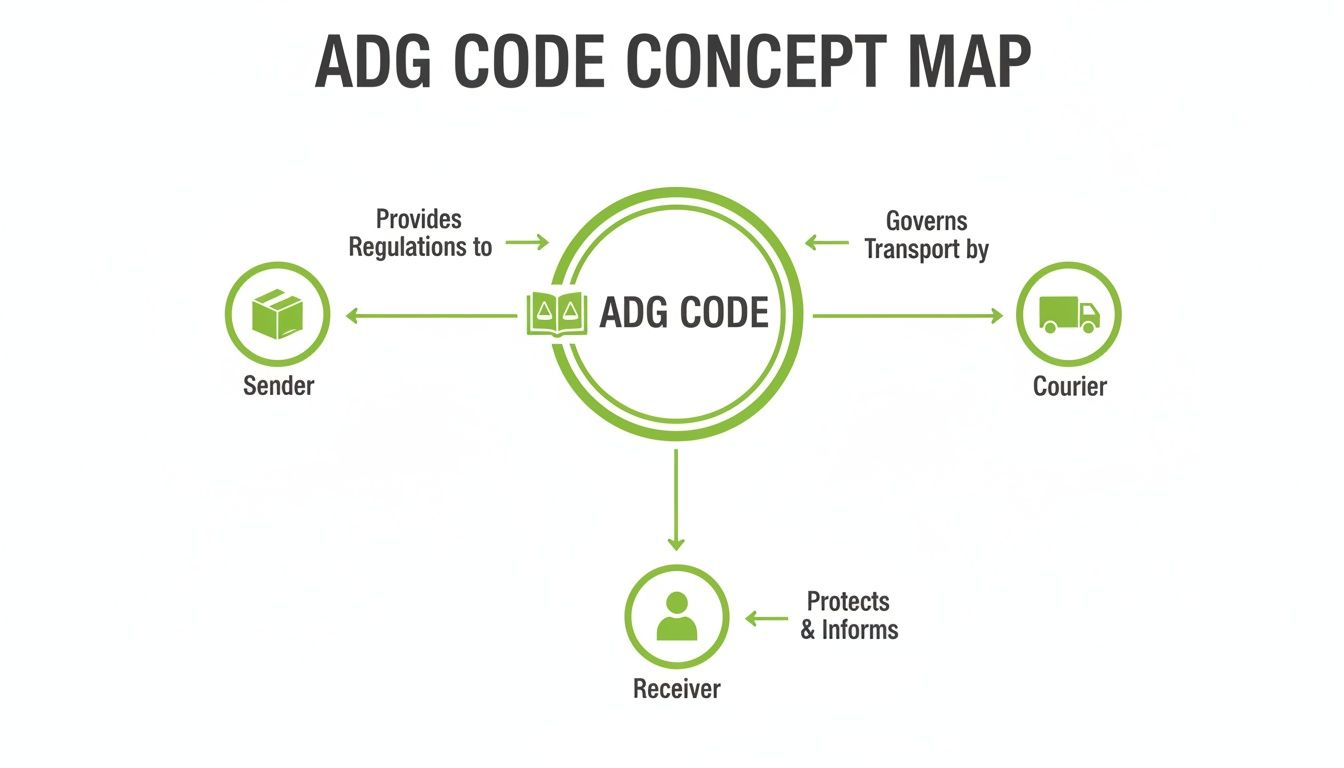
At the end of the day, the Code is all about upholding safety standards at every point in the journey, protecting people and property across Australia.
To give you a quick overview, here’s a summary of what we're about to cover.
Quick Reference Guide to the Nine Classes of Dangerous Goods
| Class Number | Class Name | Primary Hazard | Common Examples for Shipping |
|---|---|---|---|
| Class 1 | Explosives | Explosion | Ammunition, flares, fireworks |
| Class 2 | Gases | Pressure, flammability, toxicity | Aerosol cans, LPG, fire extinguishers |
| Class 3 | Flammable Liquids | Ignition of vapours | Paints, petrol, perfumes, sanitiser |
| Class 4 | Flammable Solids | Spontaneous combustion, ignition from friction or water | Matches, sulphur, sodium |
| Class 5 | Oxidising Substances | Intensifying fire | Pool chlorine, fertilisers, hydrogen peroxide |
| Class 6 | Toxic & Infectious Substances | Poisoning, disease | Pesticides, medical waste, lab samples |
| Class 7 | Radioactive Material | Radiation | Medical isotopes, industrial gauges |
| Class 8 | Corrosive Substances | Chemical burns, material destruction | Car batteries, strong acids, drain cleaners |
| Class 9 | Miscellaneous | Various hazards (e.g., thermal runaway) | Lithium-ion batteries, dry ice |
This table is a great starting point, but the real devil is in the detail. Let’s dive deeper into what makes each class unique.
Class 1: Explosives
This is the big one. Explosives are materials designed to go off with a bang, creating a sudden and violent release of pressure, gas, and heat. The name says it all—the primary danger is a powerful explosion.
Think of it like a firework. It's stable and contained until something—a spark, a hard knock, or even friction—triggers a massive, destructive energy release.
While most businesses aren't shipping dynamite, this class covers more than just military-grade items.
Common Australian Examples:
- Ammunition for sporting rifles
- Marine and vehicle safety flares
- Commercial fireworks for public events
- Blasting agents for mining and construction sites
Class 2: Gases
Class 2 covers gases that are compressed, liquefied, or dissolved under immense pressure. The danger here is threefold: the pressure itself, the gas’s flammability, or its toxicity.
Picture a powerful spring coiled tightly inside a can. If that can is punctured, all that stored energy is released in an instant. The gas can expand explosively, ignite, or even push all the oxygen out of a room.
Because the risks are so varied, Class 2 is split into three divisions: Flammable, Non-Flammable/Non-Toxic, and Toxic. This makes it one of the most diverse of the nine classes.
Divisions of Class 2 Gases:
- Division 2.1 Flammable Gases: These will ignite with just a spark. LPG cylinders for the barbie, propane, and butane are classic examples. Many aerosol cans, like spray paint or deodorant, also fall in here because of their flammable propellants.
- Division 2.2 Non-Flammable, Non-Toxic Gases: The main risk here is the high pressure and the potential for asphyxiation if they leak in a confined space. Think of carbon dioxide in fire extinguishers, nitrogen, or compressed air for scuba tanks.
- Division 2.3 Toxic Gases: Breathing these in can cause serious harm or even be fatal. This division includes things like chlorine, ammonia, and other specialised industrial gases.
Class 3: Flammable Liquids
These are liquids that give off a vapour which can easily catch fire. It's a common misconception that the liquid itself burns; in reality, it's the invisible vapour that ignites when it meets a spark, flame, or even just a hot surface.
Imagine the smell of petrol fumes at a service station on a scorching summer day. That smell is the flammable vapour hanging in the air, just waiting for an ignition source. This is a very common class for Australian businesses.
Common Australian Examples:
- Paints, varnishes, and lacquers
- Adhesives and industrial cleaning solvents
- Ethanol, rubbing alcohol, and hand sanitisers
- Petrol, diesel, and kerosene
- Alcohol-based perfumes and aftershaves
Class 4: Flammable Solids
Class 4 is a bit of a mixed bag. It covers three different types of solids that become flammable under very specific conditions.
Divisions of Class 4 Flammable Solids:
- Division 4.1 Flammable Solids: These are solids that ignite easily from simple friction or an external heat source. The best analogy is a matchstick—a quick strike is all it takes. This category includes matches, sulphur, and some metal powders.
- Division 4.2 Spontaneously Combustible: These materials can catch fire all by themselves, just from contact with the air. Think of a pile of oily rags in a corner that suddenly smoulders and bursts into flame. Activated carbon and sodium sulphide are common examples.
- Division 4.3 Dangerous When Wet: As the name suggests, these materials have a dangerous reaction with water, producing a flammable gas. The heat from the reaction itself is often enough to ignite the gas. Sodium, potassium, and calcium carbide are prime examples.
Class 5: Oxidising Substances & Organic Peroxides
These substances are the ultimate fire-starters. They might not be flammable on their own, but they produce oxygen, which can cause other materials to combust or can make an existing fire burn much more fiercely.
Think of them as a turbocharger for a fire. Oxidising agents are the chemical accelerants that can turn a tiny spark into an uncontrollable blaze.
Divisions of Class 5:
- Division 5.1 Oxidising Substances: These release oxygen and can dramatically intensify a fire. Common examples include ammonium nitrate (found in fertilisers), hydrogen peroxide, and pool chlorine.
- Division 5.2 Organic Peroxides: These are chemically unstable and can decompose explosively. They are very sensitive to heat, friction, and impact, and are often used in the manufacturing of plastics and rubber.
Class 6: Toxic & Infectious Substances
This class is all about things that can cause serious illness, injury, or death if they get into your body—whether swallowed, inhaled, or absorbed through the skin.
Divisions of Class 6:
- Division 6.1 Toxic Substances: In simple terms, these are poisons. The danger is direct chemical poisoning. This includes pesticides, arsenic, cyanide, and heavy-duty industrial cleaning chemicals.
- Division 6.2 Infectious Substances: These contain pathogens—microorganisms like bacteria, viruses, and fungi that cause disease in humans or animals. This covers items like medical waste, blood samples for pathology labs, and biological cultures.
Class 7: Radioactive Material
Class 7 covers any material that emits ionising radiation above a certain level. The danger, of course, comes from exposure to this invisible radiation. While it's a less common class for most businesses, it is absolutely critical for sectors like medicine, scientific research, and energy. Proper shielding and meticulous handling are non-negotiable.
Class 8: Corrosive Substances
Corrosive substances are materials that can literally eat through other materials. They can cause severe chemical burns to skin or, if they leak, can damage or even destroy other cargo and the vehicle itself.
Picture a powerful acid that can dissolve metal or a strong alkali that can cause instant, severe burns. The danger is a destructive chemical reaction. To get a complete picture, you can learn more about the specifics of handling Class 8 Corrosive Substances in our detailed guide.
Common Australian Examples:
- Strong acids like sulphuric acid and hydrochloric acid
- Strong bases like sodium hydroxide (caustic soda or drain cleaner)
- Lead-acid car and truck batteries
- Many industrial-grade cleaning fluids
Class 9: Miscellaneous Dangerous Goods
Finally, we have the catch-all category. Class 9 is for any substance or article that presents a danger during transport but doesn’t neatly fit into any of the other eight classes. It's a surprisingly diverse group with a wide array of potential hazards.
By far the most common item in this class for Australian businesses today is lithium-ion batteries. Found in everything from phones and laptops to power tools and e-scooters, their main hazard is "thermal runaway"—a chain reaction where they can overheat, violently catch fire, and sometimes explode.
Common Australian Examples:
- Lithium-ion batteries (shipped alone or inside devices)
- Dry ice (solid carbon dioxide), which poses a suffocation risk
- Environmentally hazardous substances that can harm marine life
- Genetically modified organisms
Your Checklist for Safe and Compliant Shipping
Knowing the nine classes of dangerous goods is one thing, but putting that knowledge into practice is what keeps people safe and your business compliant. Think of this checklist as your roadmap for preparing shipments within Australia, designed to take the guesswork out of the process.
Following these steps every single time you ship hazardous materials is your best defence against fines, frustrating delays, and serious safety incidents. It breaks down the complex ADG Code into a clear, repeatable workflow.
Step 1: Confirm Your Product’s Status with an SDS
First things first: you absolutely must confirm whether your product is classified as a dangerous good. The official source for this information is its Safety Data Sheet (SDS), which you might still see referred to by its older name, the Material Safety Data Sheet (MSDS).
The SDS is your ultimate guide. Head straight to "Section 14: Transport Information". This section will clearly state the product's UN Number, proper shipping name, class, and packing group. For a real-world example, you can see how this works in guides like the Material Safety Data Sheets (MSDS) for Natural Gas.
Step 2: Select the Correct Packaging
Once you know what you’re shipping, you need to pack it properly. This isn't a time for guesswork or using any old box. The ADG Code mandates the use of UN-approved packaging for the vast majority of dangerous goods.
This special packaging has been through the wringer, undergoing intense testing to ensure it can handle drops, pressure changes, and the weight of being stacked. Using unapproved packaging is a huge risk to your shipment, the courier, and the public.
The UN marking on a package isn’t just a sticker; it’s a certification that it meets strict national safety standards. It’s a non-negotiable part of shipping dangerous goods in Australia.
Step 3: Apply Labels and Placards Correctly
Clear, instant communication is the name of the game. Every package needs to have the correct class diamond label on it. This simple visual cue immediately tells anyone handling the package what kind of hazard is inside—whether it's flammable, toxic, or corrosive.
- Labels: These are the smaller diamond-shaped stickers you’ll apply directly to individual parcels, boxes, or drums.
- Placards: These are the larger versions of the same labels. You'll see them on the outside of large shipping containers and the vehicles transporting the goods.
Make sure your labels are stuck on securely, facing the right way up, and aren't covered by tape or other markings. Getting this right is crucial for safe handling from start to finish.
Step 4: Complete All Shipping Documents
Paperwork is the final piece of the puzzle, tying everything together. Your shipping documents are a legal declaration of what you're sending, so they have to be 100% accurate. You'll need to list the UN number, proper shipping name, class, and the exact quantity of the dangerous goods.
This information is usually required on the consignment note. If you're unsure about this document, our article on what a consignment note is explains its role in detail. Inaccurate paperwork is one of the most frequent reasons for shipments being rejected, and it's also one of the easiest mistakes to avoid.
Common Shipping Blunders and How to Sidestep Them
Even with the best intentions, it’s easy to make a mistake when you’re dealing with the nine classes of dangerous goods. Unfortunately, even small errors can snowball into huge problems – we’re talking returned shipments, frustrating delays, hefty fines, and, worst of all, serious safety incidents right here in Australia.
The best way to build a smarter shipping process is to understand where others go wrong. Many businesses get tripped up by what seem like tiny details, but when it comes to the Australian Dangerous Goods (ADG) Code, every single detail counts. Let's walk through the most common mistakes so you can protect your business, your customers, and your transport partners.
Undeclared or Misdeclared Goods
Probably the single most dangerous mistake is sending hazardous materials without declaring them at all. This isn't always malicious; sometimes it's just an oversight, like tucking a can of aerosol spray inside a bigger box of ordinary items. Just as risky is misdeclaring an item—for example, calling a corrosive liquid a simple "cleaning solution" to avoid the paperwork. This puts everyone down the line in serious danger.
Think about the real-world consequences here. An undeclared flammable liquid could end up loaded right next to an oxidising agent, creating the perfect recipe for a fire on the back of a truck. Total honesty isn't just a rule; it's a non-negotiable safety requirement.
Getting Packaging and Labelling Wrong
Another classic error is simply using the wrong box. Grabbing any old cardboard box from the supply closet for a chemical shipment is a major breach of the ADG Code. Most hazardous materials require specific UN-approved packaging that’s been tested and certified to contain spills and withstand the rigours of transit. A flimsy, everyday box just won't cut it.
Labelling mistakes are just as common and just as serious. Some of the typical blunders we see include:
- Wrong class diamond: Slapping a flammable gas label on a box of corrosive batteries is a recipe for disaster.
- Bad placement: Covering labels with sticky tape or putting them on the bottom of the package where no one can see them.
- Missing details: Forgetting to add the crucial UN number or the proper shipping name on the label.
Incomplete or Incorrect Paperwork
Finally, flawed documentation is a surefire way to get your shipment stopped dead in its tracks. A consignment note with missing information or incorrect details is an immediate red flag for any freight operator. A simple typo in the UN number or a vague description of the goods can lead to an outright rejection, holding up your entire delivery.
If you want to dive deeper into your obligations, you can find a wealth of information over on our freight compliance page. The good news is that every one of these mistakes is entirely preventable with a careful, methodical approach to every single dangerous goods shipment you prepare.
Your Dangerous Goods Questions, Answered
Working out the rules for shipping the nine classes of dangerous goods can feel a bit like navigating a minefield. To help you ship safely and stay compliant, we’ve put together clear, no-nonsense answers to the questions we hear most often from Australian businesses.
How Do I Know if My Product Is a Dangerous Good?
The single source of truth for this is the product's Safety Data Sheet (SDS). Don't guess and don't assume. The manufacturer is legally required to provide this document, and it contains everything you need to know.
Flick straight to Section 14: Transport Information. If the item is regulated for transport, this section will tell you its UN number, class, and proper shipping name. If you don’t have an SDS for a product, you must get one from your supplier before you even think about shipping it.
What’s the Difference Between a Placard and a Label?
This is a classic point of confusion, but the answer is pretty simple: it all comes down to size and placement. Both use the same diamond-shaped symbols to show the hazard, but that's where the similarities end.
- Labels are the smaller stickers that go directly onto your packages, boxes, or drums.
- Placards are the big ones. You'll see these on the outside of trucks and shipping containers to give a clear, at-a-glance warning about the hazardous cargo inside.
Can I Send Dangerous Goods Through Australia Post?
The short answer is almost certainly no. Australia Post prohibits almost all dangerous goods from their network, especially anything travelling by air.
While there are a handful of highly specific exceptions for road transport, the rules are so tight that it’s not a practical option for businesses. The safest and only compliant approach is to use a specialised courier service that's properly equipped and certified to handle hazardous materials under the ADG Code.
Trying to sneak prohibited items through the post isn't just risky; it's a serious offence. Always partner with a dedicated freight service that understands and follows dangerous goods transport regulations to the letter.
What Are the Penalties for Getting it Wrong?
Breaching the ADG Code in Australia is taken very seriously, and the penalties can be severe. The rules fall under the Chain of Responsibility (CoR) laws, which is a crucial concept to understand.
This means liability doesn't just stop with the driver. Fines can be issued to everyone involved in the supply chain, including your business as the sender. These penalties can range from a few thousand dollars to hundreds of thousands, depending on how serious the breach is.
Navigating the world of freight doesn't have to be a headache. At Aeros Couriers, we provide the clear guidance and reliable shipping solutions your business needs to stay compliant. Get an instant quote and see how easy managing your local and nationwide deliveries can be at https://www.aeroscouriers.com.au.
