Standard Parcel Post can cost as little as $10.20 for domestic delivery when you optimise the packaging, but many sellers overpay because they accept a higher dimensional-weight band. The cheapest parcel is usually the smallest safe parcel, not the lightest parcel by itself.
Australian ecommerce shipping costs are controlled at the packing bench long before a carrier collects the order. A carton that is only slightly too large can be rated on the space it occupies, pushing a profitable order into a more expensive bracket. That makes packaging dimensions, service selection and checkout transparency commercial decisions, not minor logistics details.
Why Shipping Costs Control Your Conversion Rate
Shipping costs control conversion because they change the final price at the moment a customer decides whether to pay. Australia Post reports that 56% of Australian shoppers ranked free shipping as their top delivery priority in 2024, while nearly 8 in 10 said delivery affects online-shopping satisfaction. Australia Post's 2025 ecommerce report puts the commercial issue plainly: freight presentation belongs in conversion planning, alongside product price and checkout design.
A customer can accept the product price, add an item and commit mentally to the purchase, then see a delivery charge that changes the total. That late surprise feels like a penalty for continuing. Show the delivery cost, service level and expected timing before payment. Hiding freight until the final step makes the customer absorb uncertainty when trust matters most.

Turn freight into an order-value lever
Treat free shipping as a placement decision: decide whether the freight cost sits in your margin or in the order total, and price the threshold accordingly. For small parcels, that decision must account for the packed carton's dimensional band, because a few centimetres can raise the carrier charge without adding product value.
A threshold model usually gives you more control than universal free delivery. Australia Post reports that 93% of businesses offering free shipping above a spending threshold use standard-speed delivery, indicating that the model generally uses a slower, lower-cost service instead of absorbing express freight. Set the threshold from contribution margin and expected freight, then show customers how close they are to qualifying in the cart.
For example, an A$80 average order value, a 40% gross-margin rate and A$10 standard freight plus packaging produce A$32 before fulfilment. Freight consumes 31.25% of gross margin in that example, based on the calculation in the Australia Post report. A higher threshold can protect margin while giving shoppers a clear reason to add another product. Test the threshold against actual parcel dimensions, not order value alone.
Practical rule: Display the delivery charge, service level and expected timing before payment. Make the freight outcome visible before the customer makes the buying decision.
Clear delivery information also supports customers buying from Australia. 71% of international shoppers consider clear delivery-charge information before purchase very important, according to Australia Post's research. The same checkout discipline applies to every domestic postcode. Pair transparent delivery choices with responsive e-commerce chat and email support, so customers can resolve delivery questions before abandoning the cart.
Retention depends on the promise being kept. A clearly explained fee, reliable tracking and a simple post-purchase response process strengthen the customer relationship. Retailers can also review customer loyalty reward programs alongside their freight strategy, especially when rewards help offset the perceived cost of delivery.
Breaking Down Domestic Parcel Pricing Structures
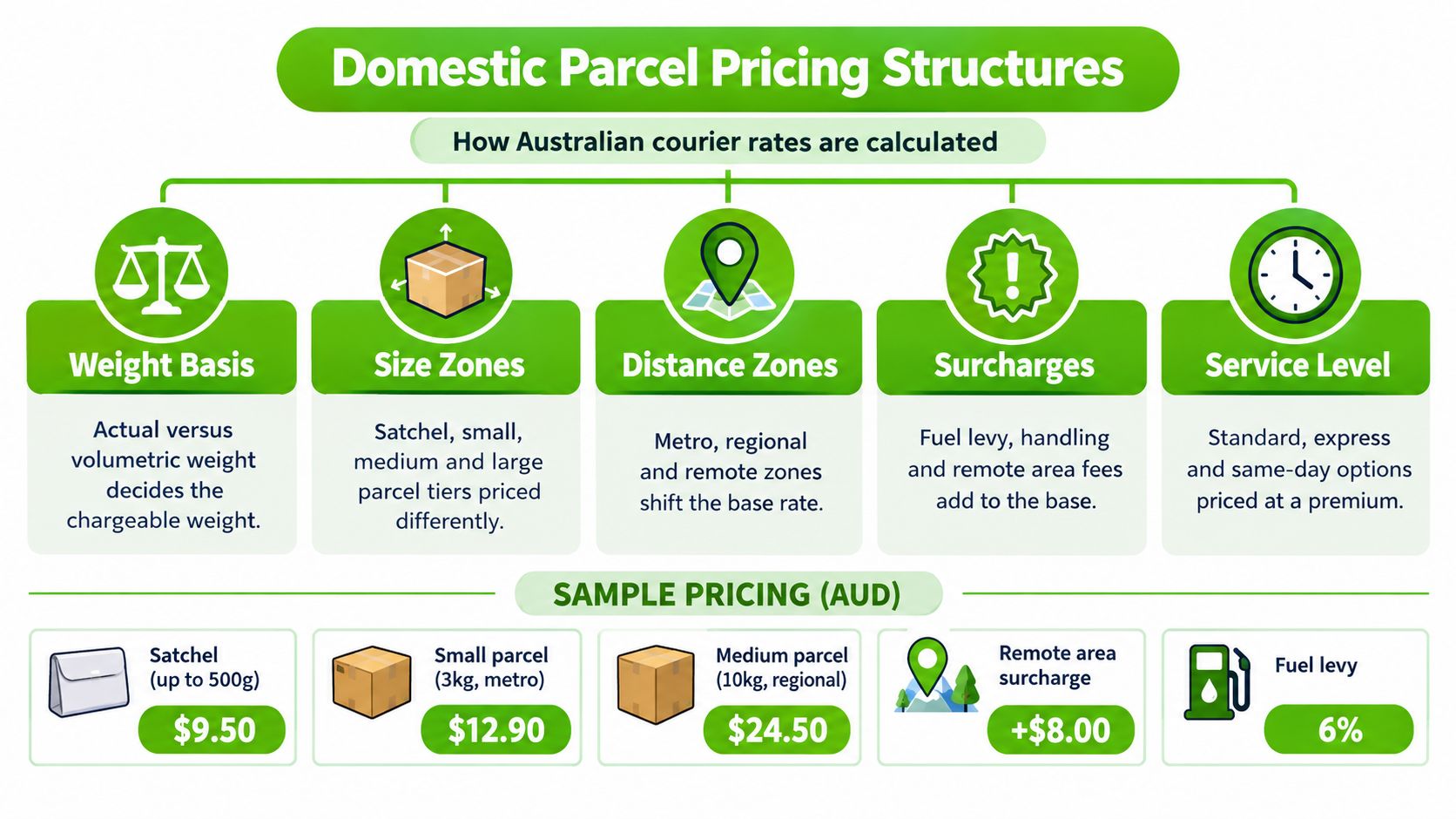
Small parcels are priced by the space they occupy, not only by what they weigh. Control size, weight, destination and service level separately. Treating them as one generic shipping rate hides the charges that erode margin.
Australia Post's domestic Parcel Post service lists size-based flat rates for eligible branded packaging up to 5 kg. Postage-only rates are $10.20 for extra-small, $11.70 for small, $16.00 for medium, $20.25 for large and $24.45 for extra-large packaging. These domestic rates exclude packaging costs when the customer supplies the packaging. Australia Post's Parcel Post pricing shows why a product packed into the smallest suitable satchel or box is easier to price than the same product placed in a larger carton.
Actual weight is only one input
Carriers can charge on actual weight or cubic, also called dimensional, weight. The higher chargeable result determines the price. Australia Post's Express Post formula multiplies volume in cubic metres by 250. A light carton with excess space can therefore cost more than a heavier, compact parcel because it takes up more vehicle and depot capacity. Australia Post's Express Post guide explains this domestic rule for parcels outside the eligible size-based Express Post range.
The guide also covers eligible Express Post packaging from extra-small through extra-large, with a maximum packaging weight of 5 kg. Packaging design directly affects the billable result. Remove void space, shorten unnecessary dimensions and choose packaging that fits the carrier's flat-rate structure. The item can stay unchanged while its shipping cost falls.
Domestic Parcel Post accepts parcels up to 22 kg, with a maximum length of 105 cm and maximum volume of 0.25 cubic metres, according to Australia Post. These limits fit ordinary ecommerce parcels and cartons, not pallet freight. For parcel delivery Australia wide, ask one practical question: which safe package occupies the least billable space?
| Pricing input | What it changes |
|---|---|
| Actual weight | The physical mass of the parcel |
| Cubic weight | The space an oversized parcel occupies |
| Package size | The applicable flat-rate or parcel tier |
| Postcode | The delivery geography and available service |
| Service level | The price of standard versus express delivery |
Measure the packed parcel before publishing a checkout rate. Product dimensions alone are unreliable because the finished carton may be larger after protection and void fill are added. A weight-only calculator can underquote a shipment that the carrier later measures by volume. Use Aeros Couriers' shipping estimate calculator to compare the packed details with available services, then confirm the result against the carrier's pricing rules.
Comparing Standard and Express Service Tiers
Standard delivery should be the default for orders that don't need premium speed. Express should be an upgrade the customer chooses, not a hidden cost every buyer funds.
Grant Thornton's Australian retail research found that 40% of consumers prefer an express-shipping price between A$5 and A$10, while 27% accept A$1 to A$5 and 23% accept A$10 to A$15. Grant Thornton's Australian retail research supports a two-tier checkout: show economical standard delivery first, then offer express as a clearly priced surcharge.
The operational difference isn't just the label. Express fulfilment often requires carrier priority, tighter cut-off compliance and more disciplined handling, with additional constraints in some metro networks. If you apply express to every order, you pay for urgency that many customers never requested. Standard delivery preserves margin when the product isn't time-sensitive, while express gives urgent buyers a way to pay for speed.
Use a clear service decision
| Checkout choice | Recommended role | Commercial effect |
|---|---|---|
| Standard delivery | Default option | Keeps the base price controlled |
| Express upgrade | Optional surcharge | Lets urgent customers fund urgency |
| Regional qualifier | Visible ETA context | Prevents metro expectations being applied nationwide |
Delivery reliability must sit beside the price. Australia Post finds that nearly 8 in 10 shoppers say the delivery experience affects satisfaction, so a cheap service that misses the promise can become expensive through support work, refunds and lost repeat business. Show metro and regional ETA qualifiers rather than presenting a national rate as if every postcode behaves identically.
This is also a fulfilment architecture decision. Businesses comparing direct fulfilment with marketplace logistics can use an FBM versus FBA decision framework to assess who controls packaging, service selection and the customer promise. For an independent Australian retailer, keeping those decisions visible at checkout is often more valuable than automatically choosing the fastest service.
Validate the carton before the rate is displayed. An inaccurate package size can move an order into a higher freight band and erase the margin gained from an apparently cheap advertised rate. The right default is the lowest-cost service that meets the stated delivery expectation, not the fastest service available.
Reducing Dimensional Weight Penalties
Dimensional pricing can erase margin before the parcel leaves your warehouse. A packer grabs the nearest carton, adds excess void fill and prints the label without checking the sealed parcel's final size. Repeat that shortcut across high-volume SKUs and empty air becomes a permanent freight cost.
Start with a packaging audit for each common product configuration. Record packed length, width, height and actual weight for single items, bundles and promotional kits. Measure after sealing. Flaps, protective corners and bulging void fill can change the dimensions used for rating.
Tighten the packaging line
Use this sequence at the packing bench:
- Map each product to a preferred package. Assign a satchel, extra-small carton or small carton instead of leaving packers to choose from an unstructured pile.
- Remove empty volume first. Shorten the carton's length, width or height wherever the product remains protected. A few centimetres can move a parcel across a size or cubic-weight boundary.
- Keep protection targeted. Use enough paper or suitable void fill to stop movement. Do not fill a large box just because it is available.
- Weigh and measure the sealed parcel. Store the result in the same format used by your rate calculator.
- Reprice the checkout rule. Update the shipping quote only after the packed dimensions have been validated.
Apply the Express Post cubic-weight rule from the pricing section as a hard packaging design constraint. For example, a 40 x 40 x 40 cm carton has a cubic weight of 6.4 kg, so a 3 kg product is rated at 6.4 kg. The parcel becomes expensive because of its height, width and depth, not because the product is heavy.
Packing principle: Optimise the parcel, not just the product. The carrier charges for the package you hand over.
Test a small batch before replacing every carton. Confirm that the tighter package protects its contents, survives normal handling and fits the selected service structure. Document the approved dimensions, package type and packing method so new staff do not recreate the original problem.
For a second check, compare the result with Aeros Couriers' parcel charge guidance. Use the comparison to check how package dimensions affect the quoted band, then keep the package that delivers reliable protection at the lowest repeatable cost. A compact carton only improves margins when it remains practical on the packing line and safe in transit.
Worked Examples of Cost Savings
A small Australian retailer selling compact home accessories had a familiar problem. The product was light, but the warehouse used a generic carton with enough room for several unrelated SKUs. The label cost reflected the finished parcel, so the business paid for empty space even when the item itself weighed very little.
The first change was straightforward. The team measured the product after protective wrapping, selected a tighter mailer for suitable orders and reserved the larger carton for fragile combinations that genuinely needed it. They didn't remove protection. They removed unnecessary volume.
Example one with Parcel Post
The retailer compared the available Australia Post domestic Parcel Post packaging rates:
| Package choice | Postage-only rate |
|---|---|
| Extra-small | $10.20 |
| Small | $11.70 |
| Medium | $16.00 |
| Large | $20.25 |
| Extra-large | $24.45 |
These rates are for eligible branded packaging up to 5 kg, and the amounts exclude packaging costs where the customer supplies the packaging. The useful lesson isn't that every product should go into extra-small packaging. It's that a product should never be placed in a larger band without a packing reason.
Moving from a medium package to an extra-small package changes postage by $5.80 before considering the packaging material itself. Moving from large to extra-small changes it by $10.05. Those are not invented savings projections. They're the direct differences between the listed Australia Post rates, and the actual result depends on whether the product can be safely packed in the smaller format.
Example two with an express order
For urgent orders, the retailer measured the finished carton before purchasing the label. A dense, compact parcel could use an eligible size-based Express Post package up to 5 kg, while an oversized lightweight carton could be rated by cubic weight. The team therefore created a separate express packing rule rather than just upgrading the existing standard carton.
The business then compared standard and express choices at checkout. Customers who needed speed paid the express surcharge, while customers buying routine products saw standard delivery as the default. This removed the habit of paying premium service costs for every order.
The retailer used Aeros Couriers' shipping price calculator to compare the packed dimensions, weight and postcodes before selecting a service. That process matters more than choosing a carrier based on habit. A rate comparison is only useful when it receives accurate parcel data.
Example three with margin protection
Consider the verified margin example from Australia Post. An A$80 order at a 40% gross margin contributes A$32 before fulfilment. If standard freight and packaging cost A$10, those costs consume 31.25% of gross margin. The retailer can respond by setting a free-shipping threshold above the average order value, using standard delivery for qualifying orders and retaining express as a paid option.
The important change is behavioural. Packaging reduces the cost of the parcel itself, while the threshold changes the customer's basket decision. Used together, they protect contribution without pretending that freight is free.
Building a Sustainable Shipping Audit Routine
A shipping audit only protects margin when it survives day-to-day warehouse changes. New cartons, product bundles and outdated checkout dimensions can increase small parcel costs, especially when carriers apply dimensional pricing. Build a repeatable process that connects the sealed parcel, the customer promise and the carrier invoice.
Start with frequently shipped orders. Create a live register for each SKU or bundle, including package type, sealed dimensions, actual weight, destination band and service level. Update it when a product changes, a carton is introduced or a carrier changes its pricing structure. A few centimetres can move a lightweight parcel into a higher chargeable-weight band.
The recurring audit checklist
Run the following checks on a fixed schedule:
- Review the package register. Remove cartons that no longer fit the products they serve, and record the smallest practical carton for each common order.
- Test chargeable weight. Compare actual weight with cubic weight for lightweight, bulky items. Record which dimension creates the penalty.
- Check the checkout promise. Confirm that the displayed service, price and ETA match the packed parcel and destination.
- Separate standard and express orders. Identify whether express reflects customer demand or late warehouse processing.
- Inspect regional outcomes. Compare metro and regional performance instead of relying on a national average.
- Check packaging quality. Confirm that tighter packing does not increase damage, reships or avoidable returns.
- Compare carrier options. Use current rates and measured service performance rather than staff preference or old habits.
Delivery choice affects conversion as well as freight cost. Australian shoppers can react negatively to high delivery charges, seek faster service and abandon baskets when their preferred options are unavailable. Audit the price and availability of delivery choices together. Removing useful options can reduce completed orders, while offering every service without carton and carrier controls can erode margin.
Make the process visible
Assign ownership clearly. The warehouse team should maintain packed dimensions, ecommerce should manage checkout presentation, and finance should reconcile billed charges with quoted charges. When these controls have no owner, dimensional errors remain in carrier rules and product data.
For businesses with many SKUs, streamlining logistics with AI can organise repetitive decisions, provided the dimensions and service rules are accurate. Automation cannot correct bad carton data. It repeats the error faster.
Use escalation rules that trigger action. If a parcel repeatedly enters a higher cubic band, redesign the packaging. If customers repeatedly select express, review the delivery promise and dispatch cut-off. If regional orders generate unexpected charges, add postcode or service qualifiers instead of concealing the cost in a nationwide flat rate.
A focused freight-cost reduction process should end with an action, an owner and a review date. That routine turns small packaging adjustments into lasting margin protection.
Aeros Couriers helps Australian businesses compare local and Australia-wide parcel services using shipment dimensions, weight and pickup and delivery postcodes, then quote, book, print labels and track in one online workflow. Review common cartons and run the packed details through Aeros Couriers before the next rate review. This exposes dimensional surprises while preserving practical delivery choices.
Courier quotes, tracking and support
Ready to send a parcel? Compare the available services for your postcodes, parcel dimensions and weight. For an existing delivery, use your consignment number to check tracking or ask our team for help.