








Think of a consignment note as your parcel's birth certificate. It’s the official record of your shipment, containing every vital detail needed to guide it safely from you to its destination anywhere in Australia. It’s far more than just a delivery slip; it's a critical contract between you (the sender) and your courier.
What Exactly Is a Consignment Note in Australia?

Can you imagine sending a valuable package based on nothing more than a verbal agreement? If anything went wrong, you’d have no way to prove what you sent, who sent it, or where it was even supposed to go. This is the problem a consignment note solves. It acts as the formal, legally recognised "handshake" between you and your transport provider.
This single document isn't just a label; it’s a multi-purpose tool that brings much-needed clarity and security to local shipping. From the moment you send a parcel with a courier, the consignment note gets to work.
The Three Core Roles of a Consignment Note
In Australian logistics, using a consignment note—often called a transport consignment note—isn't just good practice. It's a foundational piece of a secure supply chain. This document is often guided by regulations under state-based laws, such as the New South Wales Road Transport Act 2013, which helps ensure compliance for all freight movements.
Put simply, it has three critical jobs.
Let's break down the essential functions of a consignment note. The following table shows how this one document plays three very different, but equally important, roles.
Key Functions of a Consignment Note at a Glance
| Function | Description | Why It Matters in Australia |
|---|---|---|
| Receipt of Goods | When the driver scans or signs the note at pickup, it's official proof the carrier has collected your goods and taken responsibility. | This is your first line of defence. It confirms the handover and starts the clock on the carrier's accountability. |
| Contract of Carriage | The note lays out the terms of the agreement, detailing the service, destination, and any special instructions you've provided. | It ensures both you and the courier are on the same page, preventing disputes about the scope of the delivery service. |
| Key Document of Evidence | This is the go-to document for tracking, sorting, and, most importantly, getting a signature for proof of delivery (POD). | It creates a paper trail for the entire journey, which is invaluable for resolving issues, managing insurance claims, and confirming delivery. |
As you can see, this simple document is the backbone of accountability in shipping. It protects you, the carrier, and the receiver by ensuring everyone has a clear, agreed-upon record of the entire process.
Think of it like this: A consignment note is your shipment's passport. Without it, your goods can't legally or efficiently cross depot 'borders' or clear the final 'customs' check at the recipient's door.
The Must-Have Details for Every Consignment Note
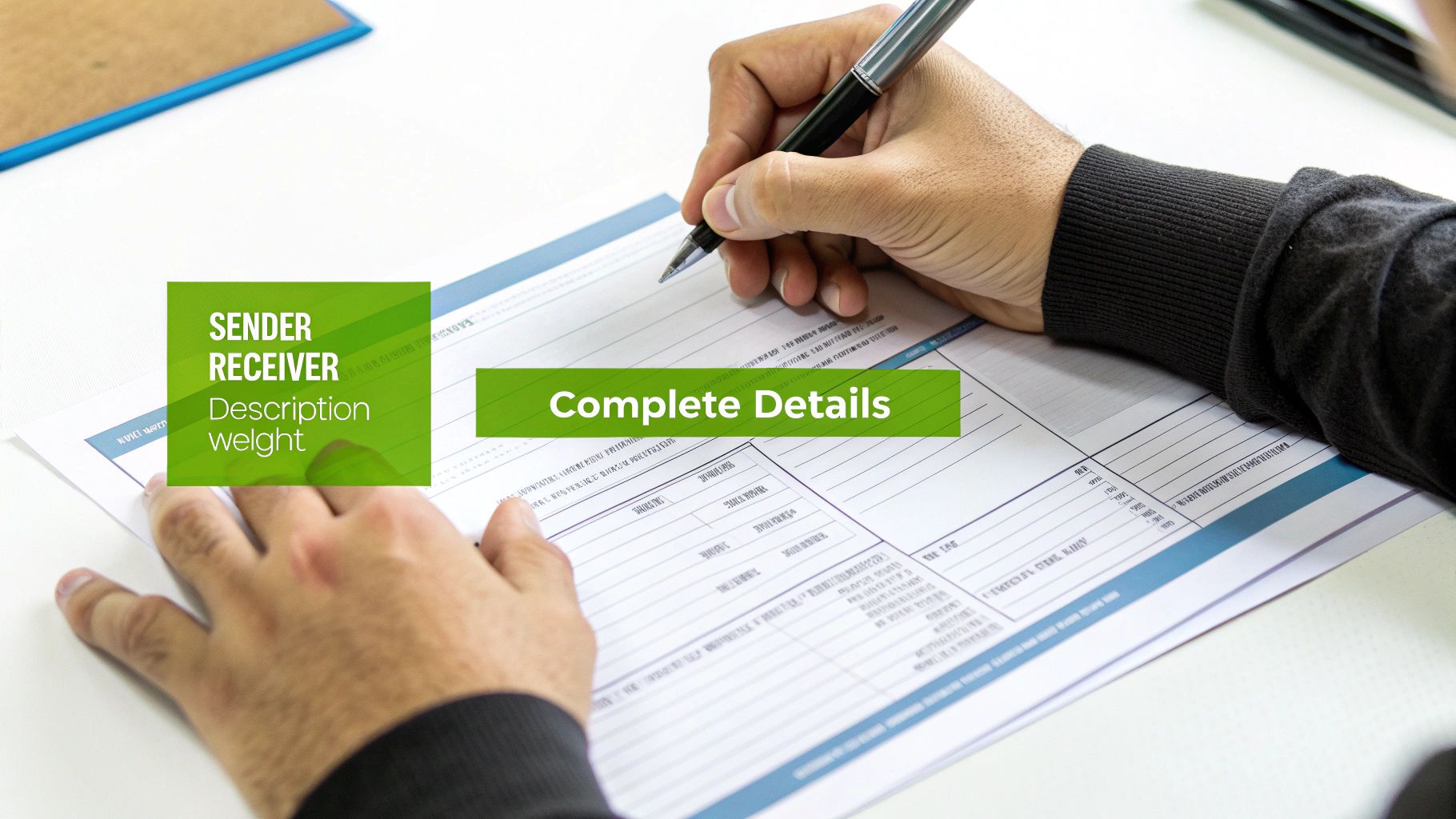
Think of a consignment note as the GPS coordinates for your shipment. If the information is vague or incomplete, you're essentially sending your driver out with a blurry map. It’s a recipe for wrong turns, delays, and a whole lot of frustration.
Getting the details right from the very beginning is your best defence against logistical nightmares. Every single field on that note has a job to do, building a complete picture for everyone who handles your goods. It’s not just about addresses; it’s about clarity, safety, and a smooth operation.
Sender and Receiver Information
This is the absolute bedrock of the consignment note, establishing the "from" and "to" of the journey. It's surprisingly easy to get wrong, and going beyond a simple name and suburb is critical to avoid any mix-ups.
For both the sender and the receiver, you’ll need to list:
- Full Name or Business Name: This ensures the package gets to the right person or department once it arrives.
- Complete Street Address: Don’t skimp here. Include the street number, street name, suburb, state, and postcode. A missing unit number or a wrong postcode is a classic reason for a delivery to fail.
- Contact Phone Number: A driver needs this. If they hit a locked gate or can't find the front door, a quick phone call can solve the problem instantly.
An incomplete address can send your freight straight back to the depot, adding days to the delivery time and potentially racking up extra fees. A quick double-check here saves so much trouble down the line.
Description of Goods
This part needs more than a one-word answer. Simply writing "goods" or "parts" is next to useless and can create real problems with handling and compliance. You have to be specific.
For instance, instead of writing "Boxes," a much better description is "10 x cartons of printed marketing brochures." Now, the carrier immediately understands the nature of the goods, the quantity, and how it’s all packaged.
Think of the description as your instruction manual for the carrier. It tells them if the items are heavy, fragile, or need to be kept a certain way up, which directly influences how they're loaded and transported.
Weight, Dimensions, and Special Instructions
In logistics, precise measurements are non-negotiable. The weight and dimensions (length, width, and height) of every item dictate how much space the freight takes up, and they are absolutely critical for accurate billing. Getting these figures wrong often leads to surprise billing adjustments and delays.
If you're ever unsure, it’s a good idea to refresh your memory on how to calculate shipping costs to ensure you’re providing the right details every time.
Finally, never forget the special handling instructions. This is all about protecting your goods and ensuring everyone's safety.
Common instructions you’ll see are:
- Fragile: For anything that can be easily broken.
- This Way Up: For goods that must stay in a specific orientation.
- Heavy: A simple but vital warning to handlers to prevent injury.
These simple notes communicate crucial information at a glance, protecting your shipment from the moment it leaves your warehouse until it’s safely in the receiver's hands.
Why a Consignment Note is Your Legal Safety Net in Logistics
Think of a consignment note as more than just a delivery slip. In Australian logistics, it’s your legal safety net, a tangible record that shields you from liability, helps sort out disputes, and protects your assets. Skipping over its importance is a gamble that can leave your business wide open to risk.
A properly filled-out consignment note is a powerful tool that works for you in three key ways. It pins down accountability, serves as proof of delivery, and is the backbone of any insurance claim. Let's break down why you need this paper trail when things go sideways.
Meeting Your Chain of Responsibility Obligations
In Australia, the Chain of Responsibility (CoR) laws are no joke. These regulations mean that everyone involved in the supply chain—from the sender to the driver—is legally accountable for on-road safety. A precise consignment note is your first line of defence, proving you’ve done your part.
When you accurately declare the weight, dimensions, and nature of your goods, you’re giving the carrier the exact information they need to load and transport your shipment safely. This isn’t just about ticking boxes to avoid hefty fines; it’s about contributing to a safer road network for everyone.
An incomplete or inaccurate consignment note isn’t just a delivery headache. Under CoR laws, it can be seen as a failure to meet your legal safety duties, putting your business in a very tight spot.
Acting as Your Official Proof of Delivery
"We never got the package." It's a common and frustrating claim that can be costly to resolve. The consignment note cuts right through this problem by becoming the official Proof of Delivery (POD). The second the recipient signs that document, it confirms the delivery contract is complete.
That signature is your concrete evidence. If a client claims a shipment never showed up, the signed note shuts down the argument, protecting you from the financial hit of resending goods or issuing a refund for a delivery that was actually made.
Your Essential Evidence for Insurance Claims
If your goods get damaged on their journey, the consignment note is the most critical piece of evidence for your insurance claim. It clearly states what was in the shipment and its condition when it was picked up, setting the baseline for any claim. Without it, you'll have a tough time proving the shipment's contents and value. For a deeper dive into what’s covered, it’s always a good idea to check the specifics of your courier's included freight insurance.
The scale of freight movement in Australia is massive. In NSW alone, for example, trucks move over 1.5 billion tonnes-kilometres of goods each year, and nearly all of it travels with a compliant consignment note. These documents form an essential audit trail, especially as the volume of goods moving throughout the country continues to climb.
Keeping these records in good order is just smart business. Knowing how to detail a consignment note properly is also a big part of sticking to Australia's record-keeping requirements, making sure your business activities are transparent and ready for any audit.
Consignment Note vs. Other Shipping Paperwork
Navigating the world of logistics can feel like swimming in an alphabet soup of paperwork. When every parcel comes with some kind of slip attached, it's easy to assume they all do the same job. But that’s a risky assumption. In Australian shipping, each document has a distinct and crucial role, and mixing them up can lead to serious headaches down the track.
The consignment note is the absolute cornerstone of domestic transport here in Australia. It's often mistaken for other documents like a Bill of Lading or even a simple invoice, but it's a unique beast. Getting the difference is key to making sure your shipments are handled correctly, legally, and without unnecessary delays.
Distinguishing Domestic from International Documents
The most common point of confusion is the mix-up between a consignment note and a Bill of Lading. They’re both contracts for carriage, so they seem similar on the surface, but their legal power and where they're used are worlds apart.
-
A Bill of Lading is a document of title, used almost exclusively for international sea freight. This is a huge deal. It means whoever physically holds the original Bill of Lading legally owns the goods described on it. It’s a negotiable document that can even be bought and sold while the cargo is still on the water.
-
A consignment note, on the other hand, is non-negotiable. Think of it as a detailed receipt and a transport agreement rolled into one. It proves a carrier has taken your goods, but it absolutely does not transfer ownership of them.
In short, if your goods aren't crossing international waters on a ship, you won’t be dealing with a Bill of Lading. For any truck, van, or local air freight moving within Australia, the consignment note is what you need.
Comparing Key Australian Shipping Documents
It's not just the Bill of Lading you need to worry about. A consignment note also gets confused with other common business paperwork that often travels with a shipment, like invoices or packing slips. These documents have completely different jobs to do.
To clear things up, here’s a simple table breaking down what each document is for.
Comparison of Australian Shipping Documents
This table gives you a clear, at-a-glance comparison of the main documents you'll encounter.
| Document | Primary Use | Scope | Is it a Document of Title? |
|---|---|---|---|
| Consignment Note | Serves as a contract for carriage, receipt of goods, and a tracking document. | Primarily for domestic road, rail, and air freight within Australia. | No, it is not a negotiable document and does not confer ownership. |
| Bill of Lading | Acts as a contract, receipt, and document of title for goods being shipped. | Almost exclusively for international sea freight. | Yes, the holder of the original document legally owns the cargo. |
| Invoice | A financial document requesting payment for the goods sold. | Used for all commercial transactions, both domestic and international. | No, it is purely a financial record of a sale. |
| Packing Slip | An inventory document detailing the physical contents of a shipment. | Used for all shipments to help the receiver verify the contents. | No, it is for inventory and stock-checking purposes only. |
By getting these distinctions straight, you ensure you’re always using the right tool for the job. A consignment note handles the journey, an invoice handles the payment, and a packing slip handles the inventory check—each playing its own vital part in a smooth delivery.
How to Fill Out a Consignment Note Without Mistakes
Filling out a consignment note might seem like just another piece of paperwork, but getting it right the first time is one of the simplest ways to guarantee a smooth, delay-free delivery. Think of it as giving your courier a crystal-clear map for your shipment.
This guide will walk you through the process, pointing out the common traps so you can sidestep them completely.
A Step-by-Step Guide to Accuracy
Whether you're using a paper form or a digital system, nailing the details is what matters. Precision is everything. Let's break it down.
- Enter Sender and Receiver Details: Start with the who and the where. You’ll need the full business or individual name, the complete street address (don't forget unit numbers and postcodes), and a contact phone number for both you and the recipient. A single wrong digit in a postcode is a classic mistake that can send a parcel on a frustrating detour.
- Describe Your Goods Clearly: Vague descriptions like "parts" or "stock" just don't cut it. You need to be specific. For example, "5 cartons of automotive air filters" or "1 pallet of A4 copy paper." This clarity is crucial for proper handling and quick identification.
- Provide Accurate Dimensions and Weight: Grab a tape measure and a scale—guessing won't work here. This information is the backbone of logistics planning and accurate billing. If you estimate, you could be hit with unexpected extra charges later on.
- Note Special Handling Instructions: This is your chance to speak up for your shipment. Clearly state if the goods are "Fragile," "Heavy," or need to be kept "This Way Up." These aren't just suggestions; they're vital instructions that protect your items and the people handling them.
This flowchart helps picture where the consignment note fits within the wider world of shipping documents, depending on how your goods are travelling.
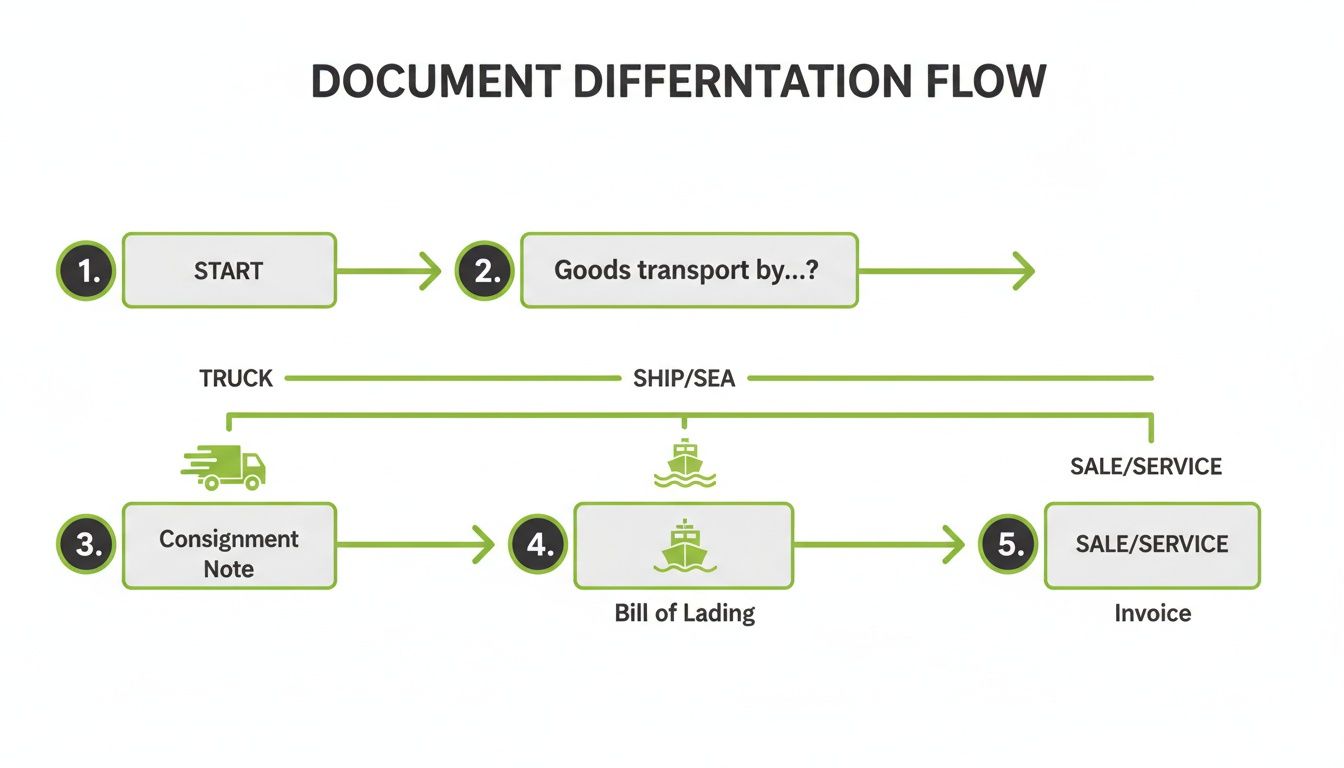
As you can see, for road freight here in Australia, the consignment note is the key document, distinct from something like a bill of lading used for sea freight.
Embracing Digital Consignment Notes
While you’ll still see paper forms, the industry has largely shifted to digital consignment notes, often called e-notes. These are usually generated automatically when you book a courier online, pulling information straight from your booking. This instantly slashes the risk of human error from bad handwriting.
The single biggest advantage of digital consignment notes is the reduction in manual errors. When information is entered once and used to automatically create the note, label, and tracking data, the entire process becomes faster and far more reliable.
Digital notes also talk directly to tracking systems, giving you instant updates as your parcel makes its way to the destination. It streamlines the creation of all the necessary documents, too. You can find out more about the importance of accurate shipping labels and printing in our detailed guide on the topic. Making the switch to a digital workflow doesn't just save time—it creates a stronger, more transparent record of your shipment's entire journey.
The Aeros Couriers Advantage From Booking to Delivery

Knowing how to fill out a consignment note is useful, but what really matters is how that document works in a real-world delivery system. At Aeros Couriers, we’ve designed our entire workflow to make the consignment process completely invisible and effortless for you. No more manual data entry, no more stacks of paper.
It all starts with our online booking platform. As you enter your shipment details—the sender, receiver, dimensions, and weight—our system is already building a fully compliant digital consignment note in the background. This means you get it right every time, without even thinking about it.
From Digital Note to Physical Delivery
This e-note becomes the single source of truth for your parcel’s entire journey. Think of it less as a static document and more as a dynamic travel log that updates in real-time, giving you total transparency from start to finish.
Here’s how it unfolds:
- Pickup Verification: The moment our driver scans the barcode on your parcel’s label, the digital consignment note is activated. This first scan confirms the collection and officially starts the tracking clock.
- Depot Scanning: As your parcel moves through our network, it’s scanned at every key transit point. Each scan updates the e-note's journey log, which you can see instantly through our live tracking portal. No more wondering where your shipment is.
- Proof of Delivery: When the parcel arrives at its destination, the recipient signs directly on the driver's device. That signature is instantly captured and attached to the digital consignment note, providing you with immediate, legally binding Proof of Delivery.
Our integrated digital workflow transforms the consignment note from a simple piece of paper into a live, interactive record of your delivery. It eliminates the guesswork and puts all the critical information you need right at your fingertips.
The Benefits for Your Business
This automated, paperless approach brings some very real advantages to your business. You’ll spend far less time bogged down in admin, cut costs on printing and storage, and significantly reduce the risk of human error. Most importantly, you gain complete visibility over every shipment.
It’s a modern, reliable system built to support your operations and give you peace of mind. This kind of efficiency is what makes us Australia's top choice for stress-free deliveries.
If you’re interested in learning more about how different courier models operate, resources on topics like finding the right courier service in Bristol can provide a broader perspective.
Still Have Questions? Here Are Some Common Ones We Hear
Even after you get the hang of consignment notes, a few specific questions tend to pop up. Let's tackle some of the most common queries we get from Australian shippers.
Is a Consignment Note Legally Required for Every Single Shipment?
Technically, no. You probably don't need a formal, multi-part document to send a small package across town. But in the world of commercial freight, it's pretty much a non-negotiable.
Think of it this way: for any serious shipment, the consignment note is your bedrock. It's essential for complying with Chain of Responsibility laws and acts as the legal handshake between you and your carrier.
In practice, a proper consignment note (or its digital version) is standard procedure for nearly all professional courier services in Australia. It’s the key to accountability and tracking.
What Should I Do if I Make a Mistake?
We’re all human. If you spot a mistake on the note before the driver arrives, just fix it. If you're using a digital platform like Aeros Couriers, you can usually jump back into the booking, amend the details, and simply reprint the correct label and note.
If the goods are already on the road, your best bet is to call your courier’s customer service line immediately. Acting fast gives them a chance to catch the shipment and fix the details before it ends up in the wrong place or gets held up.
Can I Use My Own Branded Consignment Note Template?
It’s a tempting idea, but the answer is almost always no. You really need to use the template your carrier provides.
Their consignment notes are built to work perfectly with their own systems—the scanners, the sorting machines, and the tracking software. They have specific barcodes and layouts that their equipment is programmed to read. Using your own version is a surefire way to cause confusion and processing errors down the line.
How Long Should I Keep Copies for My Records?
It’s smart to hang onto your consignment notes for a while, especially the one that comes back with the recipient's signature—your Proof of Delivery (POD).
A good rule of thumb in Australia is to keep these records for at least five years. That way, if any disputes, audits, or insurance claims come up later, you'll have all the paperwork ready to go.
Ready to simplify your shipping and ditch the manual paperwork for good? With Aeros Couriers, every booking automatically generates a compliant digital consignment note, giving you real-time tracking and instant proof of delivery. Get an instant quote and book your next shipment in minutes.
