








Interstate transport companies are the essential arteries of Australian commerce, connecting businesses and customers across our vast continent. If you need to get your products from Sydney to Perth, or from a regional hub to a capital city, you’re relying on one of these networks. They’re the specialists who tackle the unique challenges of long-haul freight, making sure your goods arrive safely and on time.
What Are Interstate Transport Companies?
At its simplest, an interstate transport company moves freight from one Australian state or territory to another. Think of them as the circulatory system for the national economy. They carry everything from raw materials and industrial parts to the countless e-commerce orders that land on doorsteps every day.
Without them, a business in Melbourne would find it nearly impossible to serve a customer in Brisbane. Supply chains would simply break down.
These companies are masters of distance. They operate fleets of trucks, link up with rail networks, and manage the incredibly complex logistics needed to keep goods flowing smoothly. Their job is so much more than just driving a truck from A to B; it’s about coordinating a massive, moving puzzle.
The Role They Play for Australian Businesses
For small and medium-sized businesses, a good transport provider isn't just a supplier—they're a growth partner. By handling the heavy lifting of logistics, they free you up to focus on what you do best: making and selling great products. Suddenly, the entire country becomes your potential market.
Here’s what they really do for you:
- Connect Markets: They're the reason a producer in regional Victoria can get their products onto shelves in Western Australia, effectively erasing state lines for trade.
- Power E-commerce: The entire online shopping boom is built on the back of efficient interstate shipping. These are the companies that get packages from a warehouse to a customer's front door, no matter how far.
- Manage Supply Chains: They are the critical link that moves components to factories and finished goods to distribution centres and stores right across the country.
At the end of the day, interstate transport companies solve Australia’s biggest business challenge: distance. They turn a continent-sized country into a single, connected marketplace. Choosing the right provider isn't just about finding the cheapest rate; it's a strategic move that affects your customer satisfaction, your operational efficiency, and your ability to grow. This guide will walk you through how to make that choice with confidence.
Decoding the Services Interstate Transport Companies Offer
Trying to figure out interstate transport services can feel a bit like ordering coffee from a menu with way too many options. Do you need a small, a large, an express, or something else? It can seem confusing, but it all comes down to two simple things: the size of your shipment and how quickly you need it there.
Think of it this way: you wouldn't hire a moving truck to post a birthday card, and you wouldn't try to stuff your furniture into a post box. Freight works on the exact same principle. It's about matching the right tool to the job.
Matching the Freight to the Service
Getting your head around the basic service types is the first step to making smarter shipping decisions. Each one is designed for a specific purpose, from a single e-commerce order to a major stock transfer between warehouses.
Here’s a breakdown of the most common options you'll come across:
- Satchels: Perfect for small, lightweight things like documents, clothing, or single-item orders. For many e-commerce businesses, they're the go-to because they're simple and cheap for small goods.
- Cartons: This is your everyday workhorse for general freight. It’s ideal for shipping a bunch of items together, sending stock to a retail store, or for larger individual products. Cartons give you more protection and can handle a huge range of goods.
- Pallets: When you've got to move a large quantity of goods in one go, pallets are the answer. Stacking and wrapping multiple cartons onto a single pallet makes it much easier for the carrier to handle, which usually means a lower cost-per-item when you're shipping in bulk.
Choosing correctly here directly affects your costs and how smoothly things run. A business sending out hundreds of individual orders will live on satchels and cartons. A company filling a massive order for a major retailer will be booking palletised freight.
This flowchart can help simplify that decision-making process when you're trying to choose the right transport solution.
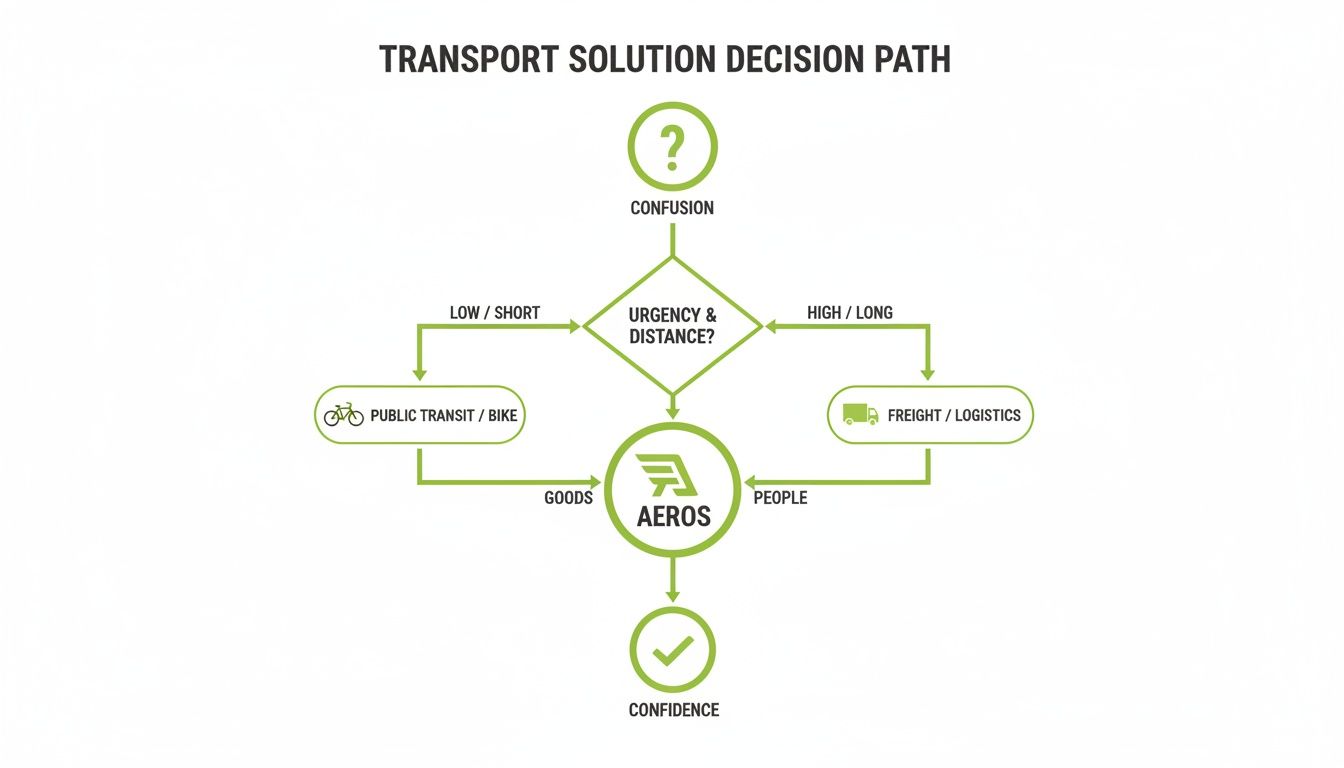
It’s designed to guide you from that initial uncertainty to feeling confident that you've picked the right service for your specific needs.
Express vs. Economy: The Strategic Choice
Once you've figured out the size, the next big decision is choosing between Express and Economy services. This isn't just a simple trade-off between speed and cost; it’s a strategic choice that says a lot about your business priorities and the promises you make to your customers.
To make this choice clearer, let's compare the main service types side-by-side.
Comparing Interstate Transport Service Types
| Service Type | Best For | Typical Speed | Cost Level |
|---|---|---|---|
| Express | Urgent orders, time-sensitive parts, next-day delivery promises | 1-2 business days | Higher |
| Economy | Routine stock replenishment, non-urgent orders, budget-focused shipping | 3-7 business days | Lower |
| Pallet | Bulk stock transfers, large wholesale orders | Varies (usually road) | Low per item |
| Satchel | Documents, small single-item e-commerce orders | Express or Economy | Low per unit |
This table gives you a quick snapshot, but the real decision comes down to your operational strategy.
Express services put speed above everything else, often using air freight or the most direct road routes to get your goods delivered ASAP. This is absolutely critical for urgent orders, time-sensitive parts, or simply meeting the next-day delivery expectations that are now standard in e-commerce.
Economy services, on the other hand, are all about being cost-effective. Your freight gets grouped with other shipments and travels along standard road or rail networks. It’s the perfect fit for routine stock top-ups, non-urgent customer orders, and any time the budget is your main driver.
The choice between Express and Economy is a balancing act. You have to ask the right question: Is the extra cost of speed genuinely justified by the customer's need or your own operational demands? Answering this honestly is the key to managing your budget and your reputation.
Many businesses get the best of both worlds by using a mix. For example, you might use an economy service for your regular warehouse transfers but give customers the option to pay a bit more for an express delivery. Understanding your domestic freight express options is the first step to building that kind of flexible shipping strategy.
What Actually Goes Into Your Shipping Quote?
Ever looked at two quotes for shipments of the same weight and wondered why the prices were worlds apart? It’s a common frustration. The truth is, freight pricing isn't just about how heavy something is; it's a mix of several factors that interstate transport companies weigh up to give you a final number. Getting a handle on these variables is the key to budgeting properly and avoiding those nasty surprise fees later on.
The first and most important concept to wrap your head around is the difference between actual weight and cubic weight.
Imagine you’re shipping a small, dense box of steel bolts. It’s heavy but doesn't take up much room. Now, picture a massive box filled with fluffy pillows. It’s light as a feather but hogs a huge amount of space in the truck. Carriers have to charge for both weight and space, so they'll calculate the price based on whichever is greater. This is why knowing the exact dimensions of your freight—length, width, and height—is just as critical as popping it on a scale.
The Key Levers That Adjust Your Price
Once you’ve got weight and dimensions sorted, a few other things come into play. Each one reflects a real cost the carrier has to cover to move your freight from point A to B.
You’ll see these factors reflected in almost every quote:
- Distance and Location: It’s simple, really—the further it goes, the more it costs. A shipment heading to a remote town will almost always cost more than a standard run between major hubs like Sydney and Melbourne.
- Need for Speed: Just like we covered earlier, an Express service costs a premium because you're paying for priority. An Economy service, on the other hand, is the more budget-friendly option if you can be flexible on delivery time.
- The Fuel Levy: This one is a moving target. Because fuel prices are always changing, carriers add a surcharge to cover the fluctuation. You’ll usually see it as a percentage of your base freight charge.
- Residential Surcharges: Dropping a pallet at a commercial warehouse with a forklift is quick and easy. Navigating a suburban street to deliver to a home address takes more time and effort, so most carriers add a small fee for it.
When you look at an invoice, don’t just see the final number. Being able to spot each of these individual charges gives you real control over your shipping budget. You can start making smarter choices to cut costs without letting your customers down.
The Broader Economic Forces at Play
Beyond your specific shipment, the prices you pay are also influenced by the bigger economic picture. The entire Australian logistics industry, already valued at over AUD 81 billion and on track to hit AUD 114 billion by 2027, relies heavily on our road and rail networks.
Massive government investment in infrastructure—around AUD 129 billion is earmarked for transport projects between 2024 and 2029—is designed to make our highways more efficient. For your business, better roads can mean more reliable delivery times and, hopefully, more competitive pricing from carriers.
This is where a multi-carrier platform really proves its worth. Instead of being stuck with one company’s rates, you can see what multiple interstate transport companies are charging for the same route. It’s the easiest way to find the true market rate and ensure you’re getting the best value.
Want to see how it all works in practice? You can use a simple tool to calculate your shipping charges and get a clear, instant quote that breaks it all down for you.
Mastering Your Legal Duties with the Chain of Responsibility
When you hand over your freight to an interstate transport company, your job isn't quite done. In Australia, a set of laws known as the Chain of Responsibility (CoR) makes it clear that everyone involved in the transport journey shares legal accountability for safety—from the person who packs the box to the driver behind the wheel.
Think of it like a relay race. The baton of responsibility is passed along the supply chain, but if anyone drops it, everyone in the chain can be held liable. This isn't just about avoiding a fine; it’s about making sure every person involved gets home safely at the end of the day.
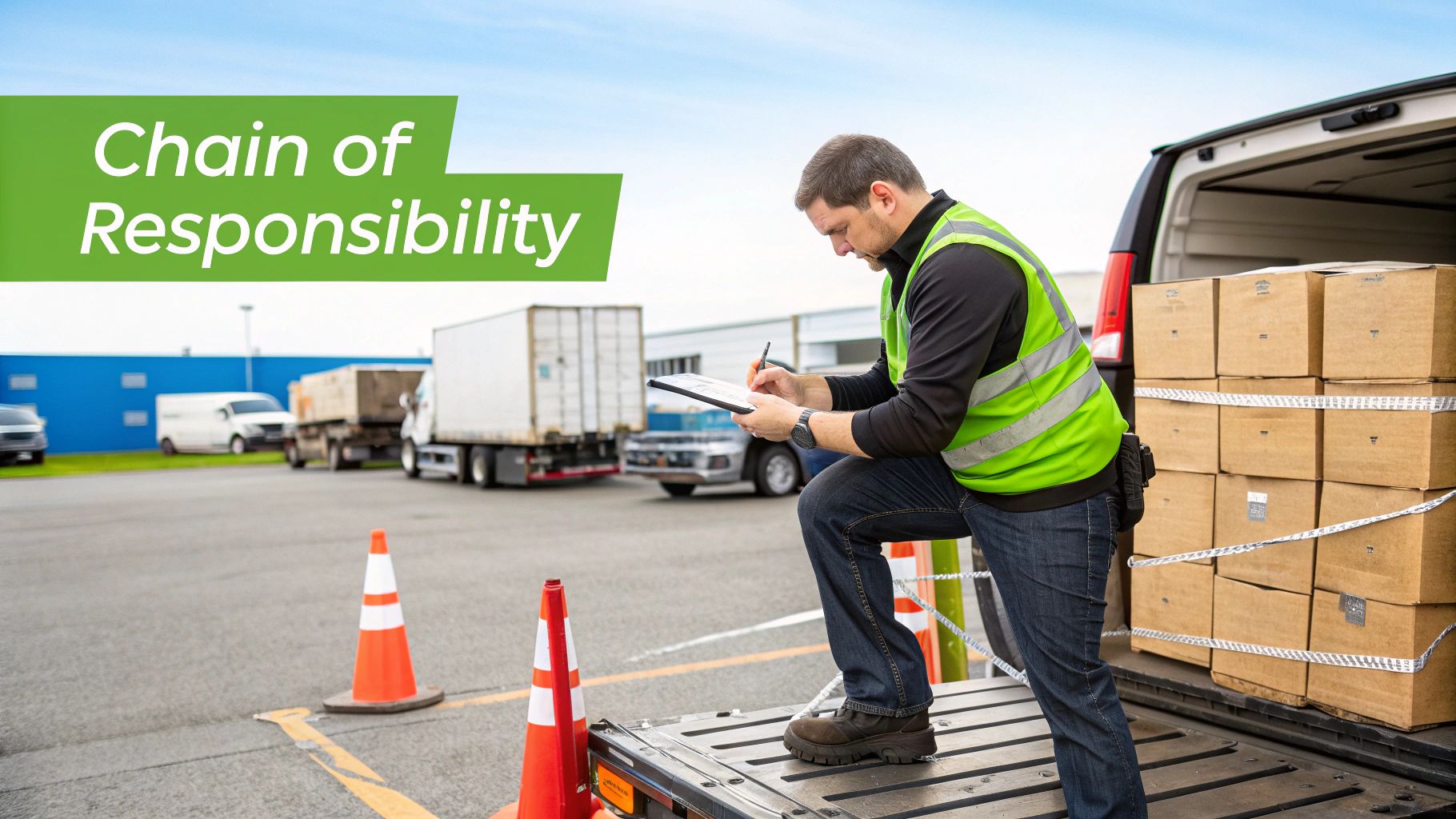
As the sender, you’re the first link. What you do directly impacts the safety and legality of the entire journey, which means you have a legal duty to take all reasonable steps to prevent safety breaches from happening.
Your Practical CoR Checklist
Compliance can sound intimidating, but for most businesses, it just comes down to getting a few key things right every single time. These aren't just suggestions; they are your legal obligations.
Here are the core duties you need to have locked down:
- Safe and Secure Packaging: Your goods must be packed to handle the realities of a long road trip. Cartons need to be sturdy and properly sealed, while pallets must be stable and shrink-wrapped so nothing shifts or topples over mid-journey.
- Accurate Declarations: The weight and dimensions you declare have to be spot-on. Under-declaring the weight of a pallet can lead to an overloaded truck, which is a massive safety risk and a serious CoR breach.
- Clear Labelling: Every single carton or pallet needs a clear, securely attached label. It’s fundamental for getting the freight to the right place, but it’s also a key piece of documentation—like understanding what is a consignment note and the role it plays.
- Declaring Dangerous Goods: If you’re sending anything hazardous—batteries, flammable liquids, certain chemicals—you are legally required to declare it. No exceptions. Failing to do so puts transport workers and the public in very real danger.
Understanding your part in the CoR is just smart risk management. Good packaging prevents product damage, accurate declarations avoid legal headaches, and clear labelling ensures your customers get what they ordered. It turns a legal duty into a tool for better business.
Why Compliance Is a Competitive Advantage
Getting CoR wrong can lead to serious penalties, including hefty fines for both individuals and the company. Beyond the financial sting, a breach can tarnish your reputation and cause major disruptions to your operations.
But looking at CoR as just a set of rules to follow is missing the point. Businesses that make these practices a core part of their operations actually see real-world benefits. Well-packed goods don’t get damaged, meaning fewer returns and happier customers. Accurate freight declarations mean no surprise re-weigh fees from the carrier, keeping your budget on track.
To truly get this right, it pays to develop a deep understanding of the transport Chain of Responsibility and how it applies to your business. At the end of the day, making safety a priority isn't just a legal box to tick; it’s the mark of a professional, reliable business that partners and customers want to work with.
How to Choose the Right Interstate Transport Partner
Picking a provider from the sea of interstate transport companies isn't just about chasing the cheapest quote. It’s a decision that directly impacts your efficiency, your customers' happiness, and ultimately, your bottom line. Think of it less like buying a service and more like bringing on a crucial business partner—the one who handles that final, physical link between your business and your customer.
Get it right, and your life gets easier. Get it wrong, and you're in for a constant headache of missed deliveries, damaged goods, and surprise fees.

Your Non-Negotiable Checklist
To find a provider who feels like a true partner, you need to look beyond the headline price. You're looking for features that deliver real value and iron-clad reliability.
Here's a practical checklist to get you started:
- Instant Online Quoting: Can you get a firm, all-in price within seconds? Or are you stuck filling out long forms and waiting for a callback? Modern platforms give you immediate transparency.
- Pricing Clarity: The price you're quoted should be the price you pay. Period. Look for companies that are upfront about all costs, like fuel levies and residential surcharges, so you can avoid nasty invoice shock later.
- Extensive Carrier Network: Do they have relationships with a wide range of carriers? This is the secret to getting competitive rates and reliable coverage everywhere, from metro CBDs to remote regional towns.
When a provider nails these three basics, it's a strong sign they're focused on a modern, customer-first approach to shipping.
Beyond the Basics: Modern Must-Haves
Once the fundamentals are in place, start looking for the features that will genuinely save you time and administrative pain. This is where you can spot a tech-savvy provider built for the way businesses operate today.
A great transport partner shouldn't just move your boxes; they should provide the tools that make the entire process feel effortless. This is where you separate a basic carrier from a genuine logistics solution.
Keep an eye out for these essential operational tools:
- Integrated Label Printing: The system should spit out a compliant, ready-to-go shipping label the second you confirm a booking. This one feature kills manual work and slashes the risk of human error.
- Live Shipment Tracking: You and your customer should have the ability to see exactly where a parcel is, in real-time. This isn’t a nice-to-have anymore; it’s a core expectation of modern customer service.
- Helpful Australian Support: If something goes sideways, can you get a real person on the line—someone in Australia who actually knows what they're doing and can solve your problem? Good, accessible support is worth its weight in gold.
As you weigh up your options, it's also worth considering how well a company runs its own ship. The use of specialised communication software tailored for transport companies can be a good indicator of a well-oiled machine. Finding the right courier company is about assessing both the tools they give you and the efficiency of their own internal processes.
The sheer scale of Australia's freight task is staggering, expected to hit 786 billion tonne-kilometres in 2024–25. With our road freight market alone valued at around USD 43.23 billion, it’s a massive and complex network. For small to medium businesses, partnering with a provider that can aggregate volume across this fragmented market is the key to unlocking better pricing and more reliable delivery times nationwide.
Why Aeros Couriers Is Your Smart Shipping Solution
Let's be honest, trying to navigate the world of interstate transport companies can be a real headache. We get it. Juggling confusing quotes, wrapping your head around legal duties, and just finding a carrier you can trust can slow any business down. This is exactly why we created Aeros Couriers – to cut through that complexity and turn your shipping headaches into a simple, streamlined part of your day.
Our whole platform is designed to solve the very issues we’ve talked about in this guide. We give you direct access to a huge network of carriers, which means you get clear, competitive quotes in seconds. You can finally stop the guesswork and start making smart decisions based on the best rates for any given route.
Your All-in-One Shipping Dashboard
Picture this: managing every single one of your interstate shipments from one clean, easy-to-use dashboard. That’s not a pipe dream; it’s what Aeros Couriers delivers. We built our system to give you back your most valuable resource: your time.
Right from the moment you log in, everything is at your fingertips.
- Get Instant Quotes: Forget waiting around for someone to call or email you back. Just plug in your shipment details and see firm, all-inclusive prices right away.
- Book in Minutes: Found a service you like? A few clicks is all it takes to confirm your shipment. The whole process is designed to be dead simple.
- Print Labels Automatically: As soon as you book, we generate compliant shipping labels for you. Just print and stick. This simple step wipes out manual data entry and cuts down on costly mistakes.
This seamless experience is what really makes the difference. We believe powerful technology should make your job easier, not add another layer of complexity.
By bringing quoting, booking, and label printing together in one place, we get rid of the friction that bogs businesses down. This is about more than just sending a package; it's about building a smarter, faster shipping process from the ground up.
Built-in Confidence and Support
It’s not just about the tools, though. We also provide the backup and guidance you need to ship with complete confidence. Our system gives you straightforward advice on packaging best practices and helps you stay on top of your Chain of Responsibility (CoR) duties, keeping your business protected and your freight safe. Plus, live tracking gives both you and your customers total visibility, answering that classic "Where's my order?" question before it’s even asked.
We’ve essentially rolled the power of multiple interstate transport companies into a single, easy-to-use platform. This gives you the flexibility and reach your business needs to grow. It’s a more intelligent way to handle your freight – designed to save you money and be incredibly simple to master. Many of our clients tell us that working with us is the key to stress-free deliveries across Australia.
When you partner with Aeros Couriers, you’re not just picking a carrier. You’re adopting a complete shipping solution that empowers your business by turning a traditionally tough task into a smooth, reliable, and affordable operation.
Frequently Asked Questions
Even when you've done all your homework, a few practical questions always seem to come up when you’re booking with interstate transport companies. Let's tackle some of the most common ones head-on so you can make smart decisions without any guesswork.
What’s the Cheapest Way to Send a Large Item Interstate in Australia?
For anything big or bulky, your most budget-friendly option is almost always going to be an ‘Economy’ road freight service. Think of it like a carpool for freight—your item shares truck space with other goods heading in the same direction, which splits the cost and brings the price down for everyone.
To really lock in the best deal, don't just go with the first quote you get. Using a multi-carrier platform is a game-changer here. It instantly pulls up live prices from a whole bunch of different carriers, so you can see the best market rate for your item’s exact size, weight, and destination.
How Long Does Interstate Transport Usually Take in Australia?
This is a classic "how long is a piece of string?" question. Delivery times can swing wildly based on the service you pick and, most importantly, where the parcel is going. The difference between a metro-to-metro and a regional delivery is huge.
- Express Services: Sending something between major hubs like Sydney and Melbourne? Express can often get it there the very next business day.
- Economy Services: That same Sydney-to-Melbourne route on an economy service will likely take around 2-4 business days.
- Cross-Country & Regional: If you're shipping from Perth to Brisbane or out to a small regional town, you need to be more patient. An economy service for these long hauls could take anywhere from 7 to 10 business days.
Always check the ETA (estimated time of arrival) when you book. It’s your best guide for managing expectations for yourself or your customers.
Do I Need Transit Insurance for My Interstate Shipment?
Look, every good carrier treats your freight with care, but let's be realistic—accidents can happen on a long journey. A bump in the road or an issue at a depot can lead to damage or loss, and the standard liability offered by carriers is often very limited. It might not come close to covering the actual value of your goods.
That’s why we always recommend getting additional transit insurance, especially if your items are valuable or fragile. It’s a small price to pay for complete peace of mind, knowing you’re financially protected for the full replacement value if something goes wrong.
Can I Track My Interstate Shipment in Real Time?
Absolutely. These days, real-time tracking is a non-negotiable feature. Reputable interstate transport companies and booking platforms will give you a tracking number for every single consignment.
You can follow your freight’s journey online right from the moment it leaves your door until it's safely delivered. This kind of transparency isn't just a nice-to-have; it's essential for keeping customers in the loop and planning your own operations.
Ready to stop juggling quotes and start shipping smarter? Aeros Couriers gives you instant access to a network of trusted Australian carriers, all in one place. You can compare prices, book, track, and manage all your interstate freight from a single, easy-to-use dashboard. Get an instant quote and see how much you could save.
