

A courier rate card is a provider’s published price list, built around a base item rate, included kilometres or zone bands, and a set of surcharges that get added on top. The single biggest driver of your final cost is the combination of service type, chargeable weight, and those surcharges, so check the card for mandatory fee disclosure and GST treatment before you commit to a quote.
TL;DR:
- Couriers charge whichever is higher, actual or volumetric weight; because each carrier sets its own divisor, identical boxes can receive different chargeable weights.
- Use flat rates for consistent parcels, tiered pricing when weight or distance bands fit your catalog, and exact quotes for bulky or variable shipments.
- Before requesting quotes, record parcel weight, dimensions, pickup and delivery postcodes, and collection time; then compare all in totals for identical service levels.
- Businesses shipping consistent, high volumes may secure custom carrier contracts that marketplace quotes cannot match, while occasional shippers should compare final invoice totals.
- Test the same parcel during routine periods and major sales peaks, because prices or available service windows may change when demand rises.
Table of Contents
- What you’ll find on a published courier rate card
- How chargeable weight is calculated (actual vs volumetric)
- Common pricing structures: flat rates, tiered rates and exact-cost quotes
- Step-by-step: how to read a rate card and estimate your shipment cost
- How Aeros’s shipment-rate approach illustrates a transparent rate card
- Comparing rate card structures across providers
- How route optimisation technology affects pricing and delivery time
- Why fee transparency makes costs easier to predict
- Active parcel monitoring: a service feature, not a price factor
- Guidelines for small businesses budgeting with rate cards
- Practical perspective: mistakes small businesses make when using rate cards
- Get a verified, all-inclusive shipment rate from Aeros
- FAQ
- Sources
What you’ll find on a published courier rate card
Most rate cards start with a base or item rate, which usually includes a set number of kilometres or applies within a defined zone band before distance charges kick in. Beyond that first zone, you’ll often see a per-kilometre or per-zone step rate added to the base.
Line items are presented differently depending on what you’re sending: per item for standard parcels, per pallet for freight, or per kilogram once you cross a weight threshold. A card that mixes these without clear labelling is harder to compare against competitors, so look for the unit each price applies to.
Surcharges are where rate cards can get murky. Common ones include fuel levies, after-hours or weekend collection fees, and public-holiday loadings. Under ACCC pricing rules, any mandatory fee has to be included in the advertised single price rather than sprung on you at checkout, and this applies to courier pricing the same way it applies to any other retail quote.
GST labelling matters too. A rate card should state clearly whether listed prices are GST-inclusive, and your invoice needs to separate the GST component for your own reporting.
A simplified example of how a card might present this:
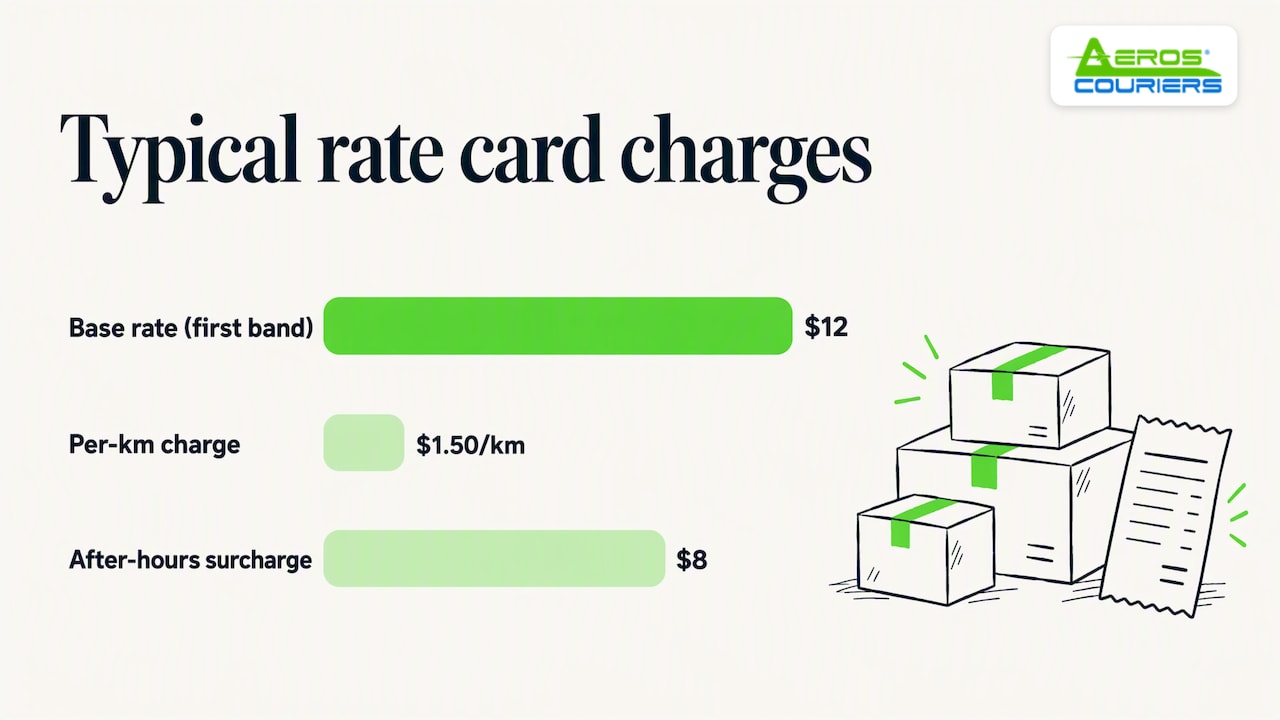
- Base rate: $12 for the first 15 km
- Additional distance: $1.50 per km beyond that
- After-hours surcharge: $8 flat fee
- Fuel levy: a percentage added to the base and distance charge
Reading a practical guide to courier pricing mechanics alongside the actual card helps you spot which of these elements apply to your shipment before you book.
How chargeable weight is calculated (actual vs volumetric)
Couriers charge by whichever is higher: the parcel’s actual weight on a scale, or its volumetric (cubic) weight, which estimates how much space the parcel takes up in a van or plane. This exists because a large, light box can take up as much room as a small, heavy one, and couriers need to price for space, not just mass.
Volumetric weight is worked out by measuring the parcel’s length, width and height in metres, multiplying those three figures together, and applying the carrier’s own volumetric divisor to convert that cubic figure into an equivalent weight. Each carrier sets its own divisor, so the same box can return a different volumetric weight depending on which rate card you’re reading.
Here’s how that plays out with two 10 kg parcels:
- A dense 10 kg parcel, tightly packed into a small box, likely has a volumetric weight below 10 kg, so you’re charged the actual 10 kg.
- A bulky 10 kg parcel, packed loosely into a much larger box, can return a volumetric weight well above 10 kg, meaning you pay for the larger figure instead.
Pro Tip: Measure your packaging before you request a quote, not after, and run the same dimensions through both your carrier’s calculator and an aggregator’s tool to see where the volumetric cutoff actually bites.
Small businesses that ship irregularly shaped or loosely packed items are the ones most often caught out by this rule, which is why packaging strategies that lower per-parcel costs are worth reviewing before you lock in a shipping price for your customers.
Common pricing structures: flat rates, tiered rates and exact-cost quotes
Business outlines three common ways couriers and sellers structure pricing: flat rates, tiered rates, and exact-cost quotes. Each suits a different kind of parcel profile.
- Flat rate: one price regardless of weight or distance, which works well when your parcels are consistently similar in size and weight.
- Tiered rate: price bands based on weight, value or distance, often paired with a free-shipping threshold that encourages larger orders.
- Exact-cost quote: price calculated from actual weight and dimensions at the time of booking, which suits irregular, bulky or high-value items where margins would otherwise erode under a flat rate.
The guidance recommends choosing your approach based on how consistent your products are in size and weight: uniform parcels suit flat or tiered pricing, while variable parcels suit exact-cost quoting.
Tiered rates with free-shipping thresholds can lift average order value, since customers add items to clear the threshold, but exact-cost quoting protects your margin on items that would otherwise be underpriced by a flat fee. The trade-off is checkout friction: a quote screen feels less reassuring to a buyer than a flat number stated upfront. Deciding whether to absorb shipping into your product price or pass it on separately usually comes down to how much weight and size variance sits across your catalogue, something covered in more detail in decoding the cost drivers behind courier pricing.
Step-by-step: how to read a rate card and estimate your shipment cost
- Pick the service type you need, same day, express or standard, and note how many kilometres or which zone is included in the base rate.
- Measure the parcel’s weight and dimensions, then work out chargeable weight by comparing actual weight against volumetric weight.
- Add any listed surcharges, fuel, after-hours or weekend fees, and check the card’s GST notes to confirm whether prices are GST-inclusive.
- Confirm the advertised total matches ACCC single-price rules, which require mandatory fees to sit inside the headline price rather than appear only at payment.
Before you request a quote, have these numbers ready: parcel weight, length, width, height, pickup and delivery postcodes, and your preferred collection time. Having them on hand means you can compare two or three providers in minutes rather than requesting separate manual quotes from each.
How Aeros’s shipment-rate approach illustrates a transparent rate card
We built our Shipment Rate tool around the same four steps above: select a service, enter your parcel details, and see the full price before you book. Our rate card starts from a competitive price for parcels up to 25 kg, a figure we publish directly on our shipment rate page, with no fuel surcharge or handling fee added afterwards.
- Enter weight and dimensions once, and our platform calculates chargeable weight the same way a carrier would, comparing actual against volumetric.
- Surcharges that other providers list separately are folded into the quoted price, so the number you see is the number you pay.
- Route optimisation technology and active parcel monitoring run in the background, supporting the price rather than sitting on top of it as an extra line item.
Checking our compare and book couriers page alongside the shipment rate tool lets you confirm the final all-in cost, including any rewards points applied, before you commit to a pickup time.
Comparing rate card structures across providers
Traditional courier rate cards often separate the base rate from fuel levies, handling fees and after-hours charges, which means the number you see first isn’t the number you pay. Comparing providers properly means lining up the all-in total for the same parcel, same distance and same service level, not just the headline base rate.
We quote a single all-inclusive figure from the outset, folding in the costs that other rate cards list as separate surcharges. That doesn’t mean every provider’s structure is wrong for every shipper. A business that ships enormous, consistent volumes might negotiate a custom-rate contract directly with a carrier that a marketplace platform doesn’t replicate. But for small businesses and individuals booking parcels without that negotiating weight, the practical comparison usually comes down to how many extra line items get added between the quote screen and the invoice.
Reading a comparison of courier pricing against Australia Post’s structure is a useful exercise if you’re weighing postal options against courier rate cards, since the two systems price distance and weight quite differently. The key question to ask of any card, ours included, is whether the quoted figure already contains every mandatory fee or whether some are still to come.
How route optimisation technology affects pricing and delivery time
Route optimisation software plans delivery runs by grouping parcels geographically and sequencing stops to minimise total distance and time on the road. Fewer kilometres driven per parcel means lower fuel and labour cost per delivery, which is part of how we keep our base rates low without adding a fuel surcharge on top.
The flow-on effect for delivery time is just as relevant as the cost saving. A well-optimised route reduces the chance of a courier arriving outside the estimated window, because the sequence of stops is planned rather than worked out on the fly. For same-day and express services, where the margin for delay is small, this kind of planning has a direct bearing on whether the delivery promise is kept.
For sellers choosing between service types on a rate card, it’s worth understanding that the price difference between standard and express isn’t just about speed, it reflects a tighter, more constrained route plan behind the scenes. That’s also why express and same-day options tend to carry a narrower pickup window, since the optimisation only works if the courier collects on schedule.
Why fee transparency makes costs easier to predict
The practical benefit of a transparent rate card is that you can budget with confidence before you book, rather than after you see the invoice. When every mandatory fee sits inside the advertised price, as ACCC pricing rules require, the quote you get is the quote you pay.
The ACCC has specifically reminded businesses to review card surcharges and ensure any surcharge passed on matches the actual cost of acceptance, warning that excessive or undisclosed surcharging can be unlawful. For a small business quoting shipping costs to its own customers, that same principle applies twice over: once to what the courier charges you, and again to what you pass on to your buyer.
Cost predictability compounds over a year of shipping. A seller who can quote a reliable landed cost per parcel can price products accurately, set free-shipping thresholds without guessing, and avoid the margin leakage that comes from surprise surcharges appearing weeks after a parcel ships. We publish an all-inclusive price with no hidden fuel or handling charges for exactly this reason, so the number on the shipment rate page is the number that lands on your account.
Active parcel monitoring: a service feature, not a price factor
Active parcel monitoring tracks a shipment’s location and status throughout its journey, giving both the sender and recipient visibility into where a parcel is and when it’s likely to arrive. This sits alongside the rate card rather than inside it, monitoring affects how confident you feel about a delivery, not what you pay for it.
That distinction matters when you’re comparing providers. A courier that offers tracking as a paid add-on is pricing a feature; one that includes it as standard is treating it as part of baseline service quality. We include active parcel monitoring on bookings made through our platform as a standard feature, which means it never shows up as a separate charge on your invoice.
For a small business fielding customer enquiries about “where’s my order”, built-in tracking reduces support load without affecting the shipment rate you quoted at checkout. It’s a service-value question, not a pricing one, and it’s worth separating the two when you’re reading any provider’s rate card.
Guidelines for small businesses budgeting with rate cards
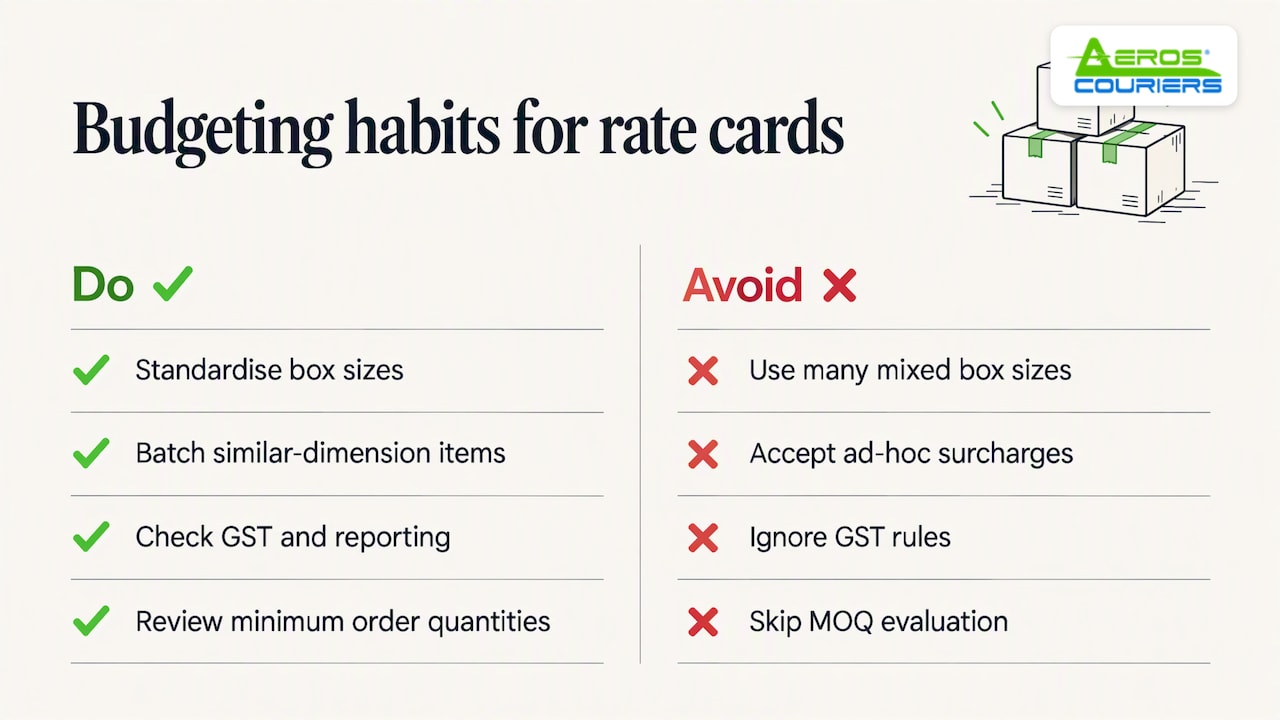
Rate cards are most useful when you treat them as a planning tool, not just a checkout step. A few practical habits make the biggest difference to budgeting accuracy.
Standardise your packaging where you can. Measuring and settling on a small set of consistent box sizes reduces the per-parcel cost variability that comes from volumetric weight swings, and it makes flat or tiered pricing genuinely viable rather than a guess. Batching similar-dimension items also puts you in a position to negotiate a volume-based rate band with your provider or aggregator, avoiding ad-hoc surcharges on individual bookings.
Check your GST and reporting obligations alongside your pricing. The ATO’s guidance on GST and international freight explains when freight services may be GST-free and how domestic services should appear on your tax invoices, which matters if courier costs are a regular line item in your business expenses.
If you’re shipping in bulk or managing supplier orders alongside delivery costs, reviewing how to evaluate minimum order quantities can help you think about cost-per-unit trade-offs the same way you’d think about cost-per-parcel on a rate card. Finally, a broader guide to parcel delivery for small businesses is worth reading if shipping is a growing part of your cost base rather than an occasional expense.
Practical perspective: mistakes small businesses make when using rate cards
The most common error isn’t misreading a price, it’s assuming a per-kilogram rate always applies and skipping the volumetric check entirely. The second is treating a quoted figure as final without confirming mandatory surcharges are already included, which is exactly what ACCC disclosure rules are meant to prevent. The third is testing a quote once, at a quiet time, and assuming peak-period pricing won’t differ.
Pro Tip: Run the same parcel through a quote tool at a normal time and again during a known peak period, like the lead-up to a major sale, to see whether the price or available service windows shift.
Fixing these is mostly operational: standardise packaging, keep dimensions on hand, and use rewards points where a provider offers them to offset the gap between quote and invoice.
— Aeros
Get a verified, all-inclusive shipment rate from Aeros
We built our platform so you never have to reverse-engineer a rate card to find the real cost. Enter your parcel details on our Shipment Rate page and the price shown already includes the fuel and handling costs other cards list separately.

- Get an instant quote from the Shipment Rate tool using your parcel’s weight and dimensions.
- Check the itemised breakdown to confirm no fuel, handling or after-hours fee has been added on top.
- Apply any reward points you’ve earned, then book pickup directly from the same screen.
| Step | What you check | Where |
|---|---|---|
| 1 | Instant quoted price from a competitive rate for parcels up to 25 kg | Shipment rate |
| 2 | Compare carrier options and book | Compare and book couriers |
| 3 | Parcel delivery service details | Parcel delivery service |
| 4 | Express, Same Day and Air courier options | Aeroscouriers |
Our starting rate is a competitive price for parcels up to 25 kg, published with no hidden fuel surcharge or handling fee attached, so the figure you see when you request a quote is the figure on your invoice.
Head to our Shipment rate page now to get your instant quote and book your next pickup.
FAQ
What are the courier rates in Australia?
Courier rates vary by provider, service type and parcel weight, but they’re generally built from a base item rate plus distance or zone charges, with surcharges for fuel or after-hours collection disclosed separately or folded into the total. Our own rate card starts from $4.90 for parcels up to 25 kg, with no added fuel or handling fee.
How much do couriers charge per kg?
Per-kilogram pricing usually only applies once a parcel exceeds a provider’s base weight allowance, and it’s calculated on chargeable weight, the higher of actual or volumetric weight, rather than actual weight alone. The exact rate differs between providers and service types, so checking the published rate card for your specific parcel is the only reliable way to confirm it.
How much would a 10 kg parcel cost?
The cost of a 10 kg parcel depends on whether it’s densely packed or bulky, since a loosely packed box can return a higher volumetric weight than its actual 10 kg. It also depends on distance, service type and any surcharges listed on the provider’s rate card, which is why getting an instant quote with your exact dimensions gives a more accurate figure than a general estimate.
How much does a courier charge?
A courier’s charge is built from a base rate, included kilometres or zone, chargeable weight, and any disclosed surcharges such as fuel or after-hours fees, with GST treatment noted separately on the invoice. Because these elements vary by provider and parcel, the only accurate way to know your cost is to request a quote using your parcel’s actual weight and dimensions.
Sources
Recommended
- Boost Your business postage account for cheaper, faster shipping
- Australia courier service: A Guide to Fast Shipping
- The Cheapest Way to Send a Parcel in Australia
- Cheap Courier Interstate Shipping Your Ultimate Guide
Courier quotes, tracking and support
Ready to send a parcel? Compare the available services for your postcodes, parcel dimensions and weight. For an existing delivery, use your consignment number to check tracking or ask our team for help.