If you’re running an eCommerce business in Australia, you know the feeling. You watch your shipping costs creep up, eating into margins that are already tight. It can feel like a battle you can't win. But what if I told you the secret to getting the cheapest rates with satchels and parcels in Australia isn't about finding one magical "cheap" courier?
It’s about a completely different way of thinking. The real game-changer is having the freedom to pick the absolute best, most cost-effective option for every single box or parcel you send out the door, anywhere in Australia.
Your Guide To Slashing Shipping Costs In Australia
Forget the noise and confusion. Let's get straight to the practical strategies that smart Australian businesses are using right now to get their shipping expenses under control. This isn't just about saving a few dollars here and there. This is about mastering the system—from packaging and technology to the dynamic pricing that defines Aussie logistics—and turning a major cost centre into a genuine competitive advantage.
The local logistics landscape here is booming. Australia's courier, express, and parcel (CEP) market is on track to hit USD 12.33 billion by 2026, growing by nearly 5% every year. This e-commerce-fuelled growth is great news for you. It means more competition and denser networks, which creates opportunities to find incredible value, especially if you know where to look. Platforms that unlock wholesale bulk pricing for fast, Australia-wide deliveries are where the real savings are found.
The New Rules Of Smart Shipping
To consistently get the best rates, you have to let go of one costly habit: carrier loyalty. I’ve seen countless businesses stick with a single provider out of familiarity, and it's one of the most expensive mistakes they make. The courier that's cheapest for a 1kg satchel to a metro address is rarely the cheapest for a 5kg box heading to a regional town.
This is exactly the problem that modern shipping platforms like Aeros Couriers were built to solve. Instead of juggling multiple accounts and spreadsheets, you get a single, clear view of your options for fast box and parcel deliveries anywhere in Australia.
A dashboard like this puts the power back in your hands. You can compare multiple carriers in seconds, book the cheapest or fastest one, and track everything from one spot. It takes the guesswork out of shipping and makes it a simple, data-driven decision. You can explore our guide on courier prices to see exactly how these real-time comparisons translate into direct savings.
The principle is simple but incredibly powerful: By accessing pre-negotiated, bulk-discounted rates across a whole network of carriers, you empower your business to always choose the best possible price for any delivery, anywhere in Australia.
This approach gives your business an immediate and significant leg up.
- Massive Cost Reduction: You're tapping into wholesale pricing that is normally reserved for the biggest players.
- Serious Time Savings: Getting instant quotes and booking all your shipments from one dashboard saves countless hours of admin work.
- Total Flexibility: You’re no longer stuck with one carrier's pricing, delivery network, or limitations.
When you adopt this mindset, you stop being a passive price-taker. You become an active, informed buyer of freight services, ready to make the smartest choice for your bottom line every time.
Stop Paying to Ship Air With Smart Packaging
Your biggest chance to save money on shipping happens right at the packing bench, long before you even think about which courier to use. It’s a step most businesses rush, but getting it right is the secret to unlocking the cheapest satchel and parcel rates in Australia.
Here’s the thing: you aren’t just charged for how heavy your parcel is. You’re charged for the space it takes up. This is a non-negotiable rule in Australian shipping known as cubic weight (or volumetric weight). Couriers will calculate both the actual weight and the cubic weight of your parcel, then charge you for whichever is higher. A big, half-empty box with a light item inside can easily double your freight bill, meaning you’re literally paying to ship air.
The Power of Rightsizing Your Packaging
Imagine sending a puffer jacket from Sydney to a customer in Perth. The jacket itself weighs less than 1kg. But if you toss it in a generic, oversized box, its cubic weight could jump to 4kg or even 5kg. You’ll be billed for the 5kg rate. Ouch.
Now, picture folding that same jacket tightly and slipping it into a correctly sized satchel or a smaller, form-fitting box. You could easily slash that chargeable weight—and your cost—by more than half. That simple change turns your packing station from a cost centre into a profit-saving machine.
It’s all about being deliberate with your choices.
- Standardise your options. Ditch the random collection of twenty different box sizes. Take a look at your most popular products and settle on three to five core box sizes that fit them snugly, along with a couple of satchel options for smaller goods.
- Embrace the satchel. For anything that isn't fragile—like clothing, accessories, or soft goods—prepaid satchels are your best friend. They often come with flat-rate pricing for items up to 5kg, which takes the guesswork out of pricing and saves you from nasty cubic weight surprises.
- Choose lightweight void fill. If you have to fill some empty space, don't use heavy, scrunched-up paper. Opt for lightweight air pillows or biodegradable packing peanuts. They offer fantastic protection with almost no added weight.
This three-pronged approach is a powerful framework for seeing immediate savings in your shipping costs.
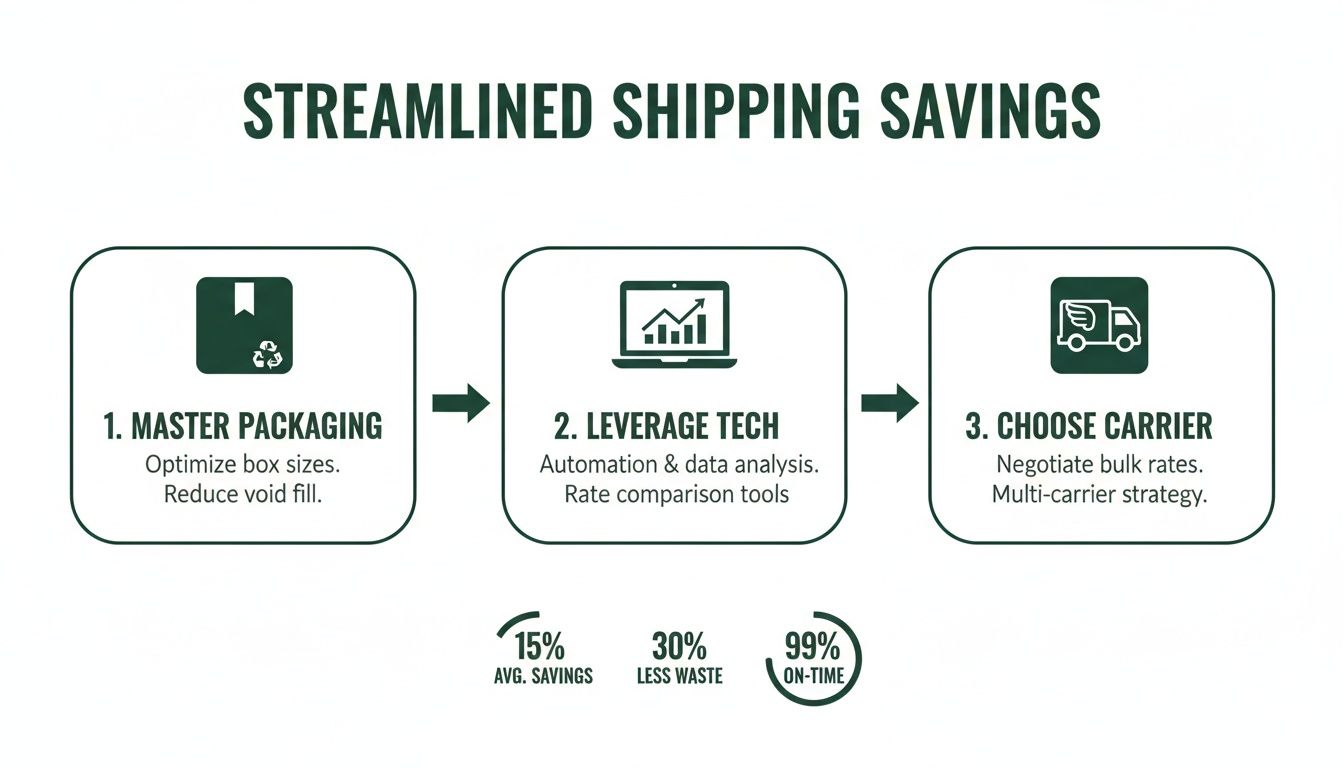
As you can see, mastering your packaging is the foundation. Get that right, and you instantly open up better and cheaper carrier options.
Mastering the Art of 'Cubing' Your Freight
In the logistics world, we call this "cubing"—the simple practice of making a shipment as compact as possible to cut down its cubic weight. It’s a skill that quickly becomes second nature, and it pays you back on every single order you send.
Think about this: last-mile delivery costs account for a massive 53% of total shipping expenses. Here in Australia, lightweight parcels are king, making up 69.41% of all consignments. This is precisely where smart satchel and small parcel shipping delivers the biggest financial wins. When you shrink your package size, you’re directly tackling the single biggest chunk of your shipping bill.
The goal is to make your package as small and dense as possible without risking the safety of what’s inside. Every centimetre you shave off a box's dimensions helps lower its cubic weight and secure a cheaper rate.
For a business sending out dozens of parcels a day, these small, consistent savings add up to thousands of dollars every year. This isn't just about trimming expenses; it’s about building a smarter, more scalable, and more profitable business from the ground up.
To dive deeper into specific options, you might want to read our guide on using a small satchel with Australia Post and other carriers. This is how you stop paying for empty space and start putting that money back where it belongs—into your business.
Choose The Right Courier For Every Single Delivery
Alright, you’ve packed your parcel like a pro. Now comes the moment of truth: choosing the courier. This single decision can make or break your shipping budget, and it’s where so many businesses go wrong. It's just so easy to stick with a familiar name out of habit, but that loyalty to one carrier is almost certainly costing you money.
The reality is, there's no single "best" courier in Australia. The market is packed with fantastic providers like Australia Post, StarTrack, Couriers Please, and Toll, and each one has its own unique strengths. One might have an unbeatable rate for 1kg satchels between metro cities, while another is the champion for bulky 5kg boxes going to regional WA. If you're only using one, you're leaving those savings on the table.

Play The Field, Don't Be Loyal
The secret weapon for slashing shipping costs is to stop thinking about a single "go-to" courier. Instead, you need to think shipment by shipment. The smartest move you can make is to choose the best-priced carrier for every single parcel you send. This is where a courier aggregator or booking platform like Aeros Couriers becomes your best mate.
Think about it: instead of juggling a dozen different accounts and spending your morning hunting down quotes, a platform does it all for you. For every single shipment, it pulls in the real-time prices from a huge range of couriers and lays them out for you.
Suddenly, you have complete clarity. You can see in an instant who offers the cheapest price for that specific parcel, on that day, to that postcode. This simple, dynamic approach ensures you’re always getting the sharpest possible rate.
Make The Fierce Competition Work For You
The Australian delivery market is incredibly competitive, with an estimated 29,786 courier businesses all fighting for your work. This is fantastic news for you.
For example, Australia Post might offer its reliable Parcel Post service for a 1kg box at AUD 10.85. But on that same day, Couriers Please might be doing the exact same route for AUD 10.22. It might not sound like much, but when you multiply that by hundreds or thousands of shipments, the savings are massive. An aggregator lets you cash in on this competition every time you book.
The real game-changer isn't just seeing the public rates side-by-side. It's getting access to heavily discounted, pre-negotiated bulk rates that are normally only available to massive corporations. You get the buying power of a national retailer, even if you only ship a few parcels a week.
This is what levels the playing field, allowing small and medium-sized businesses to finally compete on shipping costs with the big guys.
Know The Difference Between Metro And Regional Rates
Here’s a costly trap many fall into: assuming a carrier that’s cheap for city deliveries will also be cheap for regional routes. They are often worlds apart.
Let’s look at how this plays out:
- Scenario 1 (Metro to Metro): You’re sending a 2kg box from Melbourne to Sydney. A courier with a strong East Coast network will likely offer a lightning-fast service for a bargain price. Their trucks are already running that route every day.
- Scenario 2 (Metro to Regional): Now, you're sending that same 2kg box from Melbourne to Broome. That first courier’s price might suddenly triple, because they have a weak regional network and have to subcontract the final leg of the journey. Meanwhile, a different carrier that specialises in nationwide coverage might offer a far more reasonable rate.
Without comparing your options on a platform, you'd never see this difference. To illustrate, here’s a quick look at what you might see for a standard metro-to-metro delivery.
Sample Carrier Rate Comparison (Metro Sydney To Metro Melbourne 2kg Parcel)
| Carrier Type | Service Level | Estimated Cost (AUD) | Estimated Transit Time |
|---|---|---|---|
| Major National | Standard Road | $13.50 | 2-3 Business Days |
| Budget Courier | Standard Road | $11.80 | 2-4 Business Days |
| Aggregator Rate | Standard Road | $10.95 | 2-3 Business Days |
| Express Service | Express Air | $22.00 | 1-2 Business Days |
As you can see, simply choosing the right service through an aggregator for this common route could instantly save you 15-20% compared to standard direct rates. These small wins, applied consistently, add up to significant annual savings.
Being able to make an informed choice for any destination is the foundation of a smart package courier service strategy.
By treating every parcel as a unique job and using technology to find the perfect carrier for it, you can turn shipping from a painful cost into a genuine strategic advantage. This one shift in your thinking is the key to unlocking serious, long-term savings for your business.
Go Beyond the Quote: Use Platform Tools to Deepen Your Savings
Getting a great upfront price is one thing, but mastering your shipping costs for the long haul? That’s a whole different game. It comes down to using the smart tools built right into your shipping platform.
Think of platforms like Aeros Couriers as more than just a place to book a courier. They’re packed with features designed to do the heavy lifting for you, saving you not just money, but countless hours of admin work. These are the tools that separate the pros from the amateurs, and they're often the most overlooked.
Tame Your Workflow with Bulk Order Processing
We’ve all been there. A huge sales weekend leaves you with a mountain of orders to fulfil. The thought of manually entering 50, 100, or even 200 addresses, weighing each parcel, and printing labels one by one is enough to make your head spin. It’s a classic productivity killer.
This is where bulk processing tools are an absolute game-changer. Instead of tackling orders one by one, you upload a single spreadsheet (a simple CSV file is all it takes) and the platform does the rest. In minutes, you’ll have all your labels printed, tracking numbers assigned, and couriers booked. Those hours you just saved aren't just a convenience—they're real money back in your pocket.
Time spent on manual data entry is a labour cost, plain and simple. By automating that grind, you reclaim that budget and can pour it back into growing your business.
Be Smart About Your Delivery Add-Ons
When you’re trying to keep shipping costs low, every dollar matters. Two of the most common extras you’ll see are Signature on Delivery and Authority to Leave (ATL). Don’t just tick a box without thinking; a strategic choice here can save you a fortune over time.
Authority to Leave (ATL): This is your go-to for most low-value shipments. It’s typically a free option that lets the courier leave the parcel in a safe spot if no one’s home. For items heading to a secure, residential address, it’s a no-brainer. You avoid potential redelivery fees and keep things moving.
Signature on Delivery: This service adds a few dollars to the cost but gives you undeniable proof of receipt. Is it worth it? Absolutely—for high-value goods, or for deliveries to apartment buildings or business addresses where parcels can easily go astray. Think of that small fee as cheap insurance against the much bigger cost of a lost item and a replacement shipment.
The trick is to avoid a one-size-fits-all approach. Assess the value and destination of each order and choose accordingly. It’s a small step that prevents unnecessary costs while protecting your most important deliveries.
Protect Your Business with the Right Insurance
What happens when a parcel inevitably goes missing or gets damaged? If you’re uninsured, you’re on the hook for both the product and the shipping costs. It’s a painful double-whammy. What many businesses don't realise is that the standard liability included with a courier booking is incredibly limited, often capping out at just $100.
This is why inclusive freight insurance is a non-negotiable. Many platforms, including Aeros Couriers, build freight insurance into their service to give you that essential peace of mind. It turns a potential financial disaster into a simple claim process. For high-value items, paying a little extra for comprehensive cover is always a smarter move than footing the bill for a full replacement yourself.
You can see exactly how these choices affect your final price by using a comprehensive shipping price calculator to compare different services and add-ons side-by-side.
Get Paid Back for Shipping Through Rewards
Here’s a final trick that savvy businesses use: rewards programs. Some platforms give you points for every dollar you spend on shipping, which you can then redeem for real-world goods.
For example, the Aeros Couriers rewards program lets you exchange points for over 10,000 items, from office essentials to branded gear for your business. It’s essentially a rebate on your freight spend. You're turning a necessary business expense into an asset that helps you offset other costs, effectively lowering the true price of every single parcel you send.
Your Pre-Shipment Savings Checklist: The Final Check
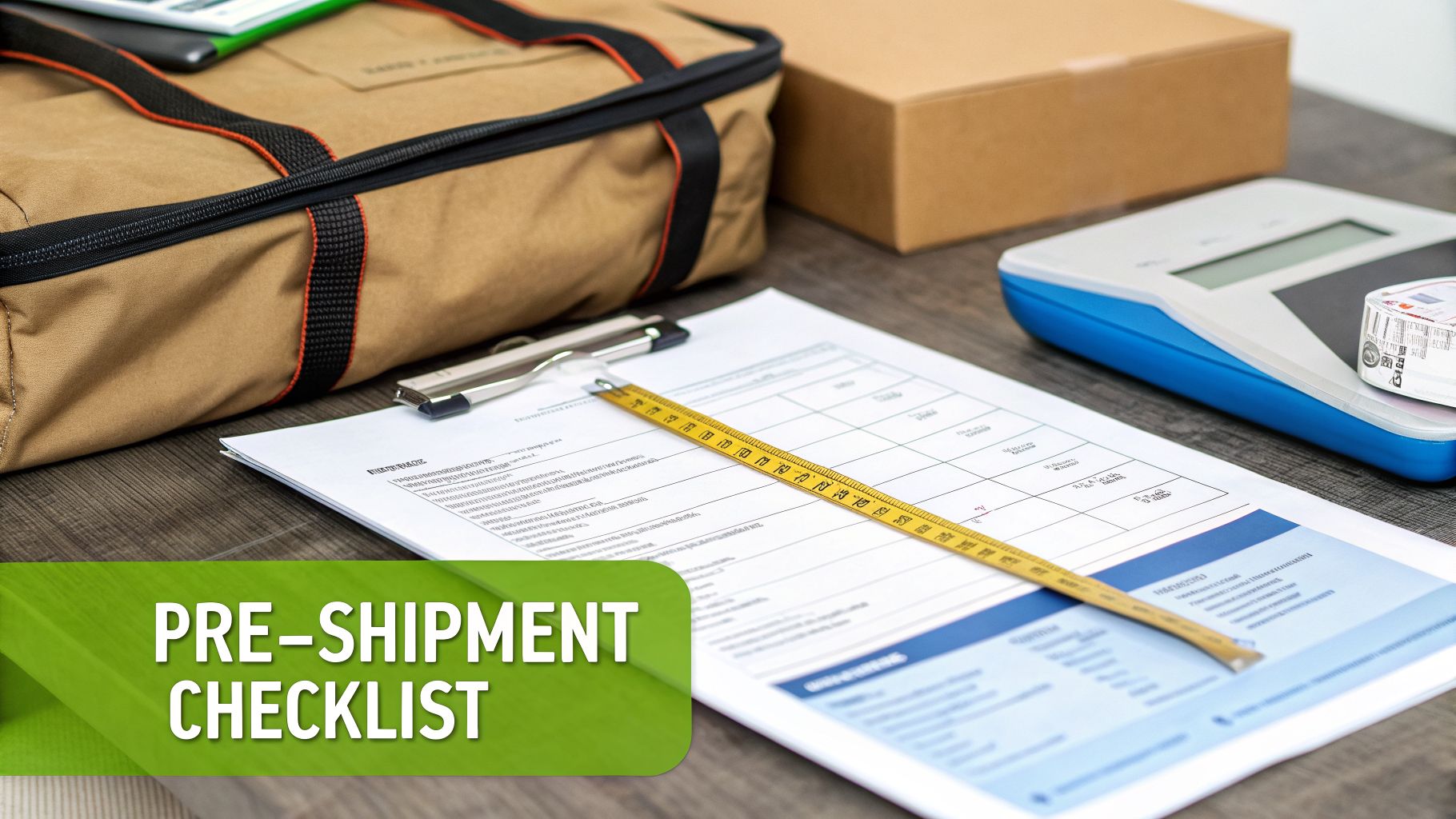
Alright, theory is great, but real savings happen when good habits become second nature at the packing bench. This isn't just a list; it's your new routine. Think of it as the final guardrail that stops you from overspending, ensuring you lock in the cheapest rate for your satchels and parcels in Australia every single time.
By running through these points for every shipment, you’re not just packing a box—you’re building a smarter, more resilient business. Let's make every single parcel count.
The Sanity Check Before You Seal the Box
Before that packing tape even comes off the roll, a few quick checks can save you from costly headaches down the line. This is where you catch the simple mistakes before they hit your bottom line.
Get the Real Numbers: Don't eyeball it. Grab a digital scale and a measuring tape to get the exact dead weight and dimensions (L x W x H). I've seen businesses get stung when a parcel that's just a few hundred grams or centimetres over gets bumped into a much higher price tier.
Right-Size Your Packaging: Is there a lot of empty space in that box? Could the item safely fit in a smaller box or even a satchel? You pay for every cubic centimetre, so killing empty space is the fastest win you'll find.
Double-Check That Address: It sounds simple, but a single typo in a postcode can lead to a failed delivery and an expensive return-to-sender fee. A quick second glance is a habit that costs nothing but saves plenty.
Locking in the Best Rate
With your parcel perfectly packed and measured, it’s time to make the booking decision. This is where a little bit of tech and a sharp eye come together to find the absolute best deal.
The single most expensive habit in Australian shipping? Sticking with one carrier out of routine. Taking 30 seconds to compare quotes on a platform will save you thousands over a year. It's a non-negotiable for anyone serious about cutting costs.
Now’s the time to jump onto an aggregator platform. Get those real-time quotes from every available carrier, all on one screen. You’re not just looking for a cheap rate; you're finding the cheapest rate for that specific parcel, to that specific postcode, at that exact moment.
With those quotes in front of you, ask these final questions before you click "book":
Is Express Truly Necessary? Does this parcel genuinely need to be there overnight? If your customer is happy with a standard delivery window, choosing a road service over express can slash your costs by 30-50%. Don’t pay for speed you don't need.
What About Insurance and Add-Ons? Is the item valuable? Make sure your freight insurance is sorted. For lower-value goods, selecting ‘Authority to Leave’ can often save you a few dollars and prevent the headache of redelivery attempts.
One Final Look: Glance over the whole booking one last time—the address, the service you picked, the final price, and the parcel details. Once you hit that button, it's a done deal.
To truly master your shipping costs, you need a system. This checklist gives you a simple, repeatable process to follow before anything leaves your warehouse. It's your secret weapon for making sure you're not leaving money on the table.
Below is a simple table you can print out and stick to your packing bench. It turns these concepts into a concrete, tick-a-box process.
Pre-Shipment Cost-Saving Checklist
| Checklist Item | Action Required | Potential Saving |
|---|---|---|
| 1. Accurate Measurements | Use a digital scale and tape measure. Record precise weight and dimensions (L x W x H). | Avoids surcharges for incorrect declarations. |
| 2. Optimal Packaging | Choose the smallest, most compact box or satchel that safely fits the item. | Reduces cubic weight, a major cost factor. |
| 3. Address Verification | Double-check the recipient's full address and postcode for typos. | Prevents costly redelivery or return fees. |
| 4. Compare Carrier Quotes | Use a multi-carrier platform (like Aeros) to compare real-time rates. | 10-40% savings by not defaulting to one carrier. |
| 5. Service Level Selection | Choose 'Economy/Standard' unless 'Express' is explicitly required by the customer. | 30-50% savings over express services. |
| 6. Insurance & Add-Ons | Add insurance for valuable items; use 'Authority to Leave' for low-value ones. | Prevents loss on valuable goods and avoids redelivery fees. |
| 7. Final Booking Review | Review all details (address, service, price) on the confirmation screen before paying. | Catches last-minute errors before commitment. |
Turning this checklist into a non-negotiable part of your workflow is the ultimate strategy for consistent savings. It makes everything that follows, like when you print your postage labels, a seamless final step. This discipline is what separates the businesses that are controlled by their shipping costs from those that control them.
Your Shipping Questions, Answered
Jumping into the world of Australian shipping can feel like navigating a maze. I get it. Over the years, I've heard the same questions from countless business owners trying to get a handle on their costs. Let's clear the air and tackle some of the most common queries so you can start shipping smarter, not harder.
Is A Courier Aggregator Really Cheaper Than Going Direct?
For most small and medium-sized businesses, the answer is a resounding yes. It’s almost always cheaper to go through a courier aggregator or broker.
Think of it like this: when you go directly to a carrier, you're just one small account paying their standard, retail rates. But a platform like Aeros Couriers brings together the shipping volume of thousands of businesses just like yours. This creates a massive pool of buying power.
With that collective volume, they can negotiate incredible wholesale rates that a single business simply couldn't dream of accessing on its own. You're essentially piggybacking on their bulk discount. It’s the difference between paying the shelf price and getting an exclusive, members-only deal.
Plus, you get to see all your options in one place. You can instantly compare every available carrier for your specific parcel and postcode, guaranteeing you’ve found the absolute rock-bottom price for that particular delivery.
How Much Does Cubic Weight Actually Affect My Parcel Cost?
Cubic weight has a massive, and often wildly underestimated, impact on what you pay. It’s one of those hidden costs that can absolutely crush your profit margins if you’re not paying attention.
Here’s the deal: carriers will always charge you for whichever is greater—the item’s actual weight or its volumetric (cubic) weight. A large, lightweight item is the classic culprit here.
Imagine you're sending a big, fluffy decorative cushion. It might only weigh 1kg on the scales, but if you pack it in a roomy box, its dimensions could give it a cubic weight of 5kg. You’ll be charged for the 5kg rate, no questions asked.
By using oversized packaging, you are literally paying to ship air. I’ve seen this common mistake inflate shipping costs by 50% or more, turning a great sale into a loss-maker in an instant.
Getting your packaging right is the single most effective way to fight back. By choosing a box or satchel that fits your item snugly, you slash its cubic dimensions and make sure you're only paying for the product you’re actually sending.
Are Satchels Always The Cheapest Bet For Small Items?
For items under 5kg that fit nicely, prepaid satchels are usually your most predictable and cost-effective solution. Carriers like Australia Post have standardised pricing for their satchels (e.g., 500g, 1kg, 3kg, 5kg), which takes all the guesswork out of calculating postage.
This simple, flat-rate pricing works because the uniform size and shape of satchels are perfect for high-speed, automated sorting at depots. The courier saves money on handling, and they pass a bit of that saving on to you. They're perfect for things like:
- Clothing and apparel
- Books and documents
- Jewellery and accessories
- Small, boxed electronics
But "always" is a big word in shipping. For something small but surprisingly heavy—like a solid metal part—it’s always worth comparing the satchel price against sending it as a small parcel in your own compact box. An aggregator platform lets you run this comparison in seconds, so you know for sure you’ve picked the cheapest path.
What's The Biggest Shipping Mistake Small Businesses Make?
Hands down, the most common and costly mistake I see is businesses getting comfortable with one carrier and using them for everything. This "set and forget" mentality, born out of habit or convenience, is a massive financial drain.
Carrier pricing in Australia is incredibly dynamic and depends entirely on the route. The courier with the best rate from Sydney to Melbourne is often the most expensive for a parcel going from Sydney to Perth. One carrier might have an unbeatable East Coast road network, while another is the only one that can reach a remote town in WA efficiently.
Sticking to a single carrier out of 'loyalty' is like only ever shopping at one supermarket and never checking the weekly specials. You're guaranteed to be overpaying.
The only way to win this game is to "play the field." Using a multi-carrier platform for every single shipment empowers you to pick the best-priced carrier for each individual job, every single time. It transforms your shipping from a static expense into a dynamic, cost-saving strategy.
How Do I Know If I Need Express Or Standard Delivery?
Simple: don't pay for speed you don't need. Choosing between express and standard road services should be a deliberate decision, not a default click. Standard services are significantly cheaper, often saving you 30-50% compared to an express air service.
Before you book, ask yourself these quick questions:
- Did the customer pay for express? If they didn't specifically choose and pay for a faster service at your checkout, a standard service is almost always the right call.
- What are the expectations? Most Aussie online shoppers are perfectly happy with a standard delivery window of 3-7 business days. Unless you've explicitly promised next-day delivery, standard is the norm.
- How critical is this delivery? For genuinely urgent documents or high-value items where time is money, the extra cost of express is easily justified. For just about everything else, standard is the smart, economical choice.
By defaulting to standard service unless express is truly necessary, you can bank substantial, consistent savings across all your shipments without ever letting a customer down.
Ready to stop overpaying and start shipping smarter? With Aeros Couriers, you can get instant quotes from Australia’s leading carriers for fast, Australia-wide box and parcel deliveries, access pre-negotiated bulk rates, and book your parcels in minutes—all from one simple dashboard. Discover how much you could save on your next shipment.
Courier quotes, tracking and support
Ready to send a parcel? Compare the available services for your postcodes, parcel dimensions and weight. For an existing delivery, use your consignment number to check tracking or ask our team for help.