So, you're looking for the cheapest way to send a parcel in Australia? The honest answer is: it depends. There’s no single "best" or "cheapest" service that wins every time.
For a small package zipping between capital cities, Sendle often has the edge on price. But if you're sending something to a regional town, a classic Australia Post flat-rate satchel might be unbeatable. The right choice always comes down to your parcel's specific size, weight, where it's going, and how quickly it needs to get there.
Finding Australia’s Cheapest Parcel Delivery Service
Trying to navigate the maze of Australian courier options can feel like a full-time job. You've got the big national players, nimble local couriers, and everything in between. The secret to actually saving money isn't finding one magic bullet, but understanding what drives the price up and knowing which service shines in which scenario.
This guide is here to cut through the noise. Before we dive into the nitty-gritty tactics, let's get a bird's-eye view. This decision tree is a great way to start thinking like a logistics pro, focusing on what matters most: size, destination, and speed.
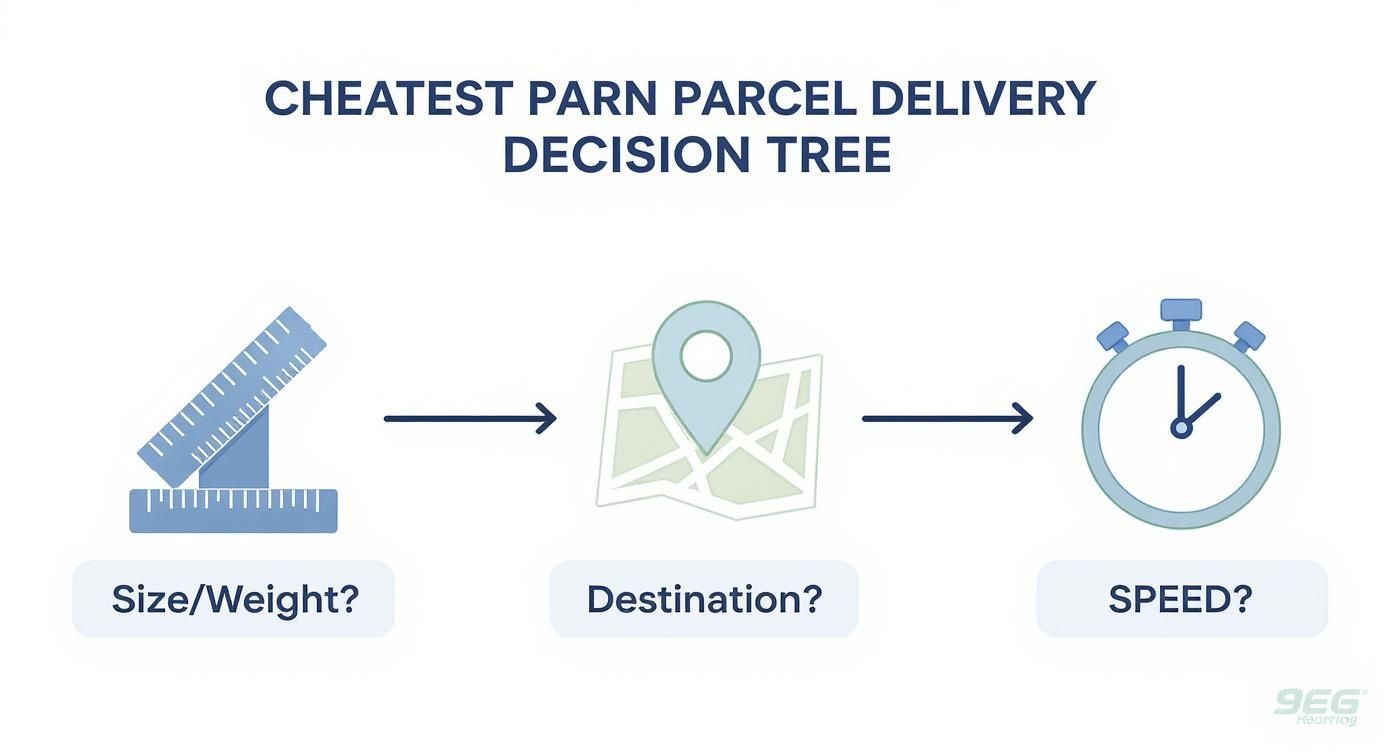
As you can see, the cheapest path changes based on the unique needs of your delivery.
At-a-Glance Parcel Service Comparison for Metro Deliveries
To give you a practical starting point, let's look at a common scenario: sending a standard 3kg parcel from Sydney to Melbourne. Here's a quick rundown of how the major players typically stack up for an everyday delivery.
| Service Provider | Starting Price (Under 5kg) | Best For | Key Feature |
|---|---|---|---|
| Sendle | Around $6.70 | Small businesses, low-volume eCommerce | Carbon-neutral, door-to-door service |
| Australia Post | Around $9.70 | Individuals, regional/PO Box deliveries | Extensive network, flat-rate options |
| Aramex | $7.50 – $8.00 | Budget-conscious senders, metro deliveries | Parcel Connect drop-off network |
| CouriersPlease | $7.50 – $8.00 | Flexible delivery options | Authorised drop-off points, redelivery choices |
This table gives you a general idea, but remember that prices fluctuate based on the exact weight and dimensions. Sometimes, Australia Post comes out cheapest for a specific weight bracket, like between 1 and 5 kilograms, proving that it always pays to compare for your specific item.
The 3 Factors That Really Drive Up Your Cost
No matter who you ship with, a few key factors will always dictate your final quote. Get these right, and you're already halfway to saving money.
- Parcel Size and Weight: This is the big one. Couriers bill you based on either the physical weight of your item or its cubic weight (a calculation of its size)—whichever is greater. A large, light-as-a-feather box can cost a fortune to ship simply because of the space it takes up on the truck.
- Destination: It's a simple fact of logistics. A parcel going from Sydney to a nearby suburb is a straightforward trip. Sending that same parcel all the way to Perth involves a much longer journey and more complex handling, which is reflected in the price.
- Delivery Speed: How fast do you need it there? Standard economy services are your best friend for saving money. The moment you click "Express" or "Same-Day," the cost jumps significantly. A standard metro delivery might be under $10, but an urgent one could easily push past $25.
The single biggest mistake I see people make is grabbing a box that's way too big for their item. That instantly inflates the cubic weight, and you can end up paying double the shipping cost for nothing but empty space. Always, always find packaging that fits your item snugly.
For anyone serious about finding the most cost-effective solution every single time, digging into the cheapest courier service for your unique shipping patterns is a must. This guide will show you exactly how to do that, from smart packaging hacks to using the right tools, so you never overpay again.
How Couriers Actually Calculate Your Shipping Costs
If you want to find the cheapest way to send a parcel, you first need a peek behind the curtain at how couriers work out their prices. It's not as simple as just popping your item on a scale. The real cost boils down to a few key factors that can dramatically change your final bill, sometimes in ways that don't seem to make sense at first glance.
Ever wondered why a big, light item like a fluffy cushion can cost a fortune to ship, while a small, heavy textbook is surprisingly cheap? The answer is something called cubic weight.
This is the industry's not-so-secret formula for charging you for the space your parcel takes up in their van or plane, not just what it weighs.
Cubic Weight vs. Actual Weight: The Deciding Factor
Every single courier in Australia, from AusPost to the big private carriers, will calculate two figures for your parcel: its actual weight (what your scales say) and its cubic weight. They'll then charge you based on whichever number is higher. It’s their way of making sure they don’t lose money shipping bulky, feather-light items that clog up their network.
The formula itself is pretty straightforward:
- Length (m) x Width (m) x Height (m) x 250 = Cubic Weight (kg)
Let’s look at a couple of real-world examples to see just how much of a difference this makes.
Scenario 1: The Small, Heavy Textbook
- Actual Weight: 2 kg
- Dimensions: 0.3m x 0.2m x 0.05m
- Cubic Weight Calculation: 0.3 x 0.2 x 0.05 x 250 = 0.75 kg
- Billable Weight: 2 kg (The actual weight is higher, so that's what you're charged for).
Scenario 2: The Large, Light Cushion
- Actual Weight: 0.5 kg
- Dimensions: 0.4m x 0.4m x 0.2m
- Cubic Weight Calculation: 0.4 x 0.4 x 0.2 x 250 = 8 kg
- Billable Weight: 8 kg (Here, the cubic weight is massive, so the parcel is treated as an 8kg item).
As you can see, that light cushion is suddenly billed as a hefty 8kg parcel purely because of its size. This is probably the single biggest reason people overpay for shipping—they grab a box that’s way too big for what’s inside.
To avoid this trap, getting your measurements spot-on is crucial. For a full breakdown, our guide on how to accurately calculate shipping charges walks you through every detail.
Why Your Destination Matters: Delivery Zones
The second major piece of the pricing puzzle is the destination. Couriers slice the country up into "delivery zones," and sending a parcel from Sydney to Melbourne is a completely different logistical beast than sending it to a remote town in WA.
In Australia, you'll generally encounter these categories:
- Metro: Shipping within the same major city or between capital cities on the east coast (like Sydney to Brisbane). These are always the cheapest routes.
- Regional: Sending to larger towns and areas just outside the main metropolitan hubs.
- Remote: Deliveries to rural, outback, or other hard-to-reach locations. These will always have the highest costs and longest delivery times.
A parcel sent from Melbourne to Perth can easily cost 30-50% more than the exact same parcel sent from Melbourne to Sydney. This isn't just about fuel; it reflects the entire supply chain cost, from line-haul transport and sorting facilities to finding a final-mile delivery partner out in the bush.
Getting It Right at Home
Your best defence against unexpected charges is to be accurate from the start. Always measure and weigh your parcel after it’s fully packed, taped up, and ready to go.
A simple measuring tape and a basic set of kitchen or bathroom scales will do the job. Just remember to round up to the nearest centimetre and gram to be on the safe side. Knowing these two numbers empowers you to compare quotes properly and choose not just a cheap service, but the right one for your package.
How Smart Packaging Can Slash Your Postage Bill
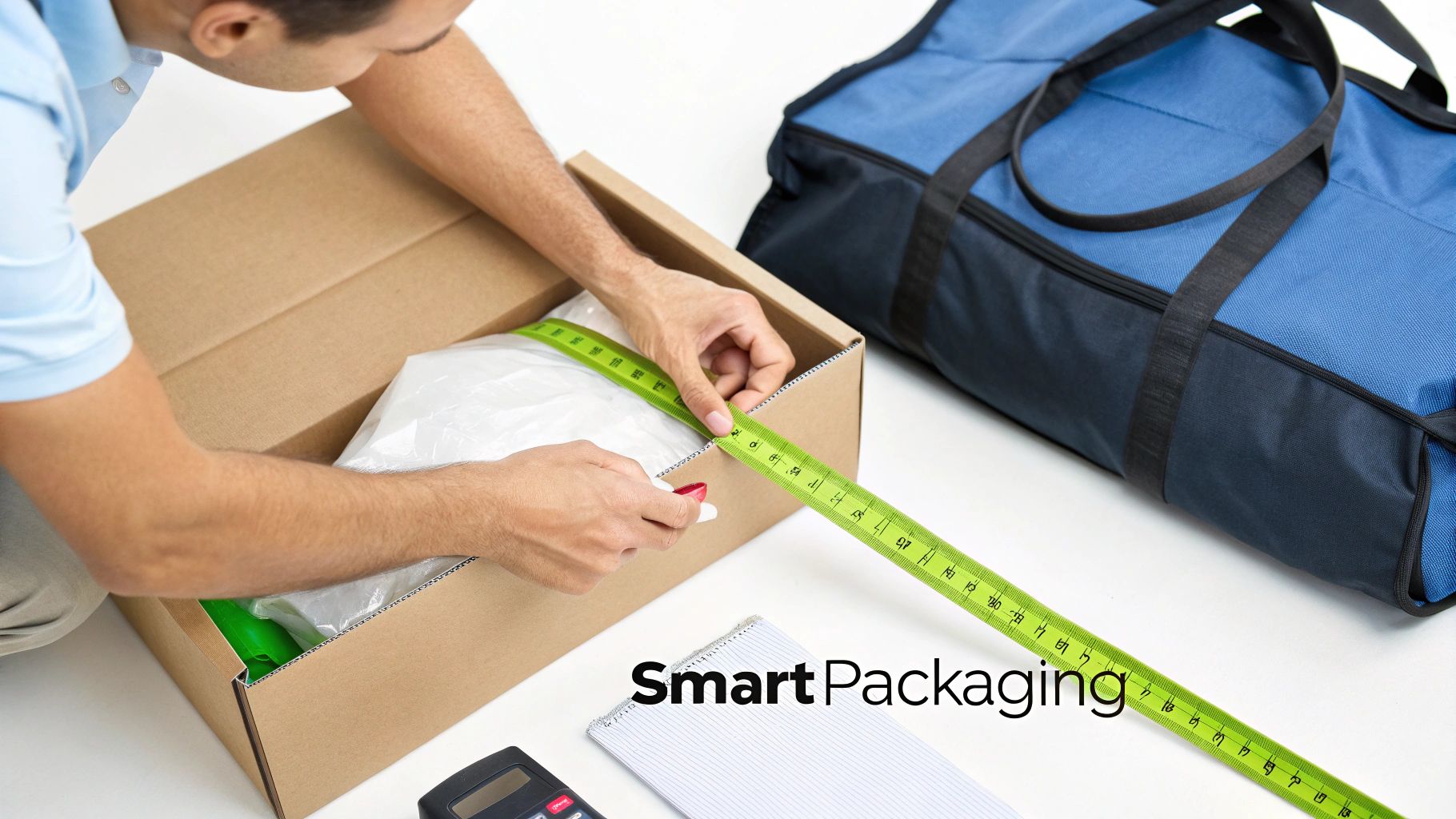
The box you put your item in isn't just a protective shell; it's one of the biggest factors determining your final postage cost. Honestly, mastering the art of smart packaging is probably the quickest win for anyone looking to find the cheapest way to send a parcel. You can save a surprising amount before you even start comparing couriers.
The number one culprit for expensive shipping? Wasted space. When you use a generic, oversized box for something small, you're literally paying to ship empty air. This is all down to a concept called cubic weight. Couriers will always charge you for whichever is greater: the actual physical weight of your parcel or its calculated cubic weight. A snug fit is your best friend here.
Matching the Right Packaging to Your Parcel
Think about it this way: sending a single t-shirt in a box big enough for a pair of boots is a classic rookie mistake. The shirt might only weigh 200 grams, but the box's dimensions could give it a cubic weight of 2 kilograms. Guess what? You'll be billed for the 2kg rate, which could easily be ten times more than you needed to pay.
Your first step should always be to find packaging that leaves as little empty space as possible. This doesn’t mean you should skimp on protective filler like bubble wrap, but the container itself needs to be the right size from the get-go.
For anything non-fragile like clothing, documents, or soft goods, poly mailer satchels are a brilliant, lightweight alternative to boxes. They add almost no weight and take up minimal space, keeping both the actual and cubic measurements right down. This simple switch can genuinely slash your costs.
Free Materials vs. Flat-Rate Satchels
When it comes to getting your hands on packaging, you've got a few options, and each one has its own cost-benefit trade-off.
- Recycled Materials: Reusing old boxes from online orders or grabbing some from a local store is a fantastic way to pack for free. Just give them a once-over to make sure they're still sturdy, with no weak spots. Crucially, tear off any old shipping labels to avoid any confusion in transit. This is the perfect approach for those awkwardly shaped items that just won't fit a standard box.
- Australia Post Flat-Rate Satchels: Never underestimate the value of these, especially for small but dense items. A flat-rate satchel can be the most economical choice because the price is fixed for anything up to 5kg. A heavy book or a small appliance can be sent across the country for a predictable, low price, often beating quotes based on actual weight and distance.
Here’s a pro tip: always compare. Before you even start packing, get a courier quote using your item's dimensions and weight, then check the price of a flat-rate satchel. You might be surprised to find that the "free" box you were about to use would have actually cost you more in postage.
Secure Your Items to Avoid the Ultimate Cost
The most expensive parcel you can send is one that arrives damaged. A broken item leads to refunds, replacement costs, and paying for shipping all over again—not to mention an unhappy customer or friend. Good packing isn't just about safety; it's about protecting your wallet.
For those wrestling with particularly large or bulky items, understanding the ins and outs of cheap large parcel delivery is vital to keep things safe without overspending.
Run through this quick checklist to get it right every time:
- Wrap Individually: If you're sending multiple things in one box, wrap each one separately in bubble wrap or paper.
- Fill the Voids: Use packing peanuts, scrunched-up paper, or air pillows to fill every gap. Your items shouldn't be able to rattle or shift around.
- Use Strong Tape: Seal the box properly along all seams using quality packing tape. Regular sticky tape or masking tape just won't hold up.
- The Shake Test: Once it's all sealed up, give the box a gentle shake. If you hear or feel anything moving inside, open it back up and add more filler.
By treating your packaging as a strategic tool instead of an afterthought, you take back control of one of the biggest variables in your shipping bill.
Comparing Australia's Top Couriers and Aggregators
If you've only ever used the red post box, you're probably paying more than you need to. Stepping away from the familiar can feel a bit odd, but trust me, that's where the real savings begin. To truly find the cheapest way to send a parcel, you've got to look beyond Australia Post and get a feel for the private courier landscape—and the powerful tools that let you compare them all at once.
The good news is that the Australian parcel delivery market is buzzing with competition. For anyone sending a package, this is fantastic. The part of the journey that gets a parcel to someone's front door—the 'last-mile'—is projected to grow by over 10.55% each year from 2025. This intense competition, especially on busy city-to-city routes, means private couriers are constantly trying to offer better rates than the national carrier.
What this means for you is that there’s no single "best" courier. Different companies are good at different things, so sticking to one provider out of habit is a surefire way to overspend.
The Main Players Head-to-Head
Let's break down the key contenders you’ll come across. Each has its own strengths, making them a better fit for different kinds of parcels and senders.
- Australia Post: The old reliable. AusPost’s biggest advantage is its unmatched reach. If you're sending something to a PO Box or a tiny town in the middle of nowhere, they are often the only affordable choice. Their flat-rate satchels can also be a bargain for small but surprisingly heavy items.
- Sendle: Built for small businesses and people selling on eBay or Shopify, Sendle offers a door-to-door service that’s frequently the cheapest for packages under 5kg going between major cities. They’re also a carbon-neutral service, which is a nice touch.
- CouriersPlease & Aramex: These guys, who you might remember as Fastway, are often very competitive on price, especially within the same city. They have huge networks of drop-off points (think newsagents and petrol stations), giving you a handy alternative to lining up at the post office.
So, how does this actually work in practice? Let's say you're sending a 5kg box with a kitchen appliance from Melbourne to regional Bendigo. A quick look might show Australia Post's standard Parcel Post service is around $18, while Sendle could come in closer to $15. Send that same package to a metro address in Sydney, and Sendle's price could dip below $10. It just goes to show how much the destination impacts your best option.
Feature and Cost Breakdown of Major Australian Couriers
To make it even clearer, here’s a quick look at how the main players stack up for a common scenario—shipping a 5kg parcel between two capital cities.
| Provider | Typical 5kg Metro Cost | Tracking Included | Pickup Service | Ideal User |
|---|---|---|---|---|
| Australia Post | $18 – $22 | Yes (Standard) | No (Drop-off only) | Individuals sending to remote areas or PO Boxes. |
| Sendle | $10 – $15 | Yes (Standard) | Yes (Included) | Small businesses, e-commerce sellers, metro deliveries. |
| CouriersPlease | $12 – $17 | Yes (Standard) | Yes (Optional) | Senders who prefer a mix of drop-off points and pickups. |
| Aggregator (e.g., Aeros) | $9 – $14 | Yes (Varies by carrier) | Yes (Varies by carrier) | Anyone wanting the lowest price without checking multiple sites. |
This table shows that for metro deliveries, aggregators and dedicated business couriers almost always offer a sharper price point and more convenient features like included pickups.
The Secret Weapon: Courier Aggregators
Let's be honest, manually checking prices on three or four different courier websites every time you need to send something is a pain. This is where courier aggregator platforms, like our own Aeros Couriers, become an absolute game-changer.
Think of an aggregator as a price comparison website, but just for shipping. You plug in your parcel's details—weight, size, and destination—one time, and the platform instantly fetches quotes from a whole range of couriers it partners with.
You get a clear, simple view of all your options on one screen.
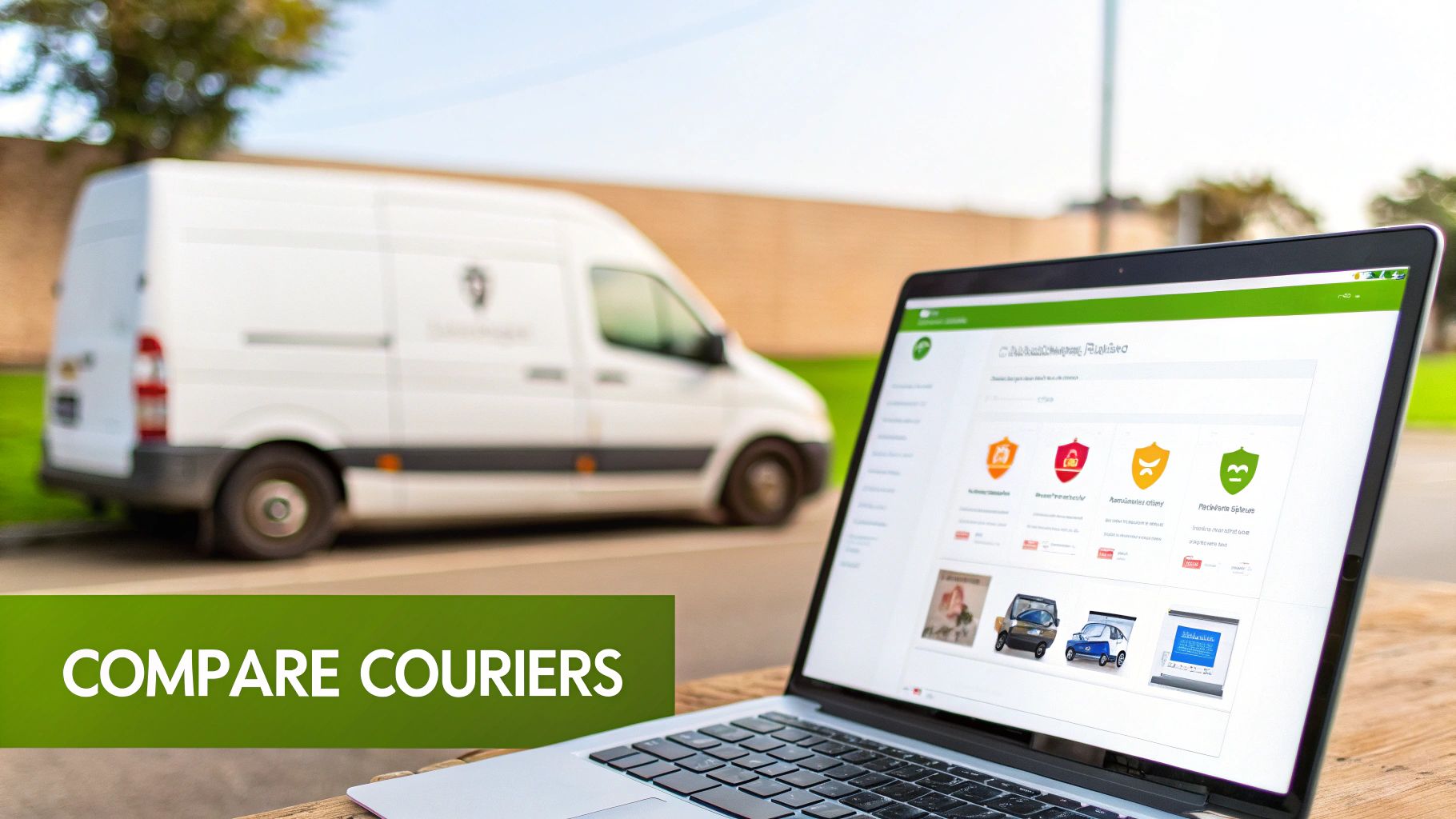
This allows you to see the price, estimated delivery time, and extra features (like pickup vs. drop-off) all side-by-side. It empowers you to make a smart, cost-effective decision in seconds, not hours.
The biggest advantage here is gaining access to wholesale or discounted rates. Because these platforms handle a massive volume of shipments, they can negotiate much better pricing with couriers than a single person or small business ever could. They then pass those savings directly on to you.
The real power of an aggregator isn't just finding a cheaper price; it's the certainty that you've found the best available price for that specific parcel, at that specific moment, without spending hours on research. It turns a guessing game into a simple, data-driven choice.
Of course, choosing the right service is about more than just the price tag. For a deeper dive into what separates a good service from a great one, have a read of our guide on selecting the best courier company for your needs.
By getting to know the individual couriers and using the power of aggregators, you can make sure you're never overpaying. It’s this smart approach that forms the foundation of always finding the cheapest way to send a parcel in Australia.
Advanced Cost-Saving Tips for Frequent Senders
For small businesses, eBay sellers, or anyone who finds themselves at the post office more than once a month, finding the cheapest way to send a parcel isn't just about one-off wins. It’s about building a smart, repeatable strategy that consistently chips away at your shipping overhead. When sending parcels is a regular part of your routine, those small efficiencies really start to add up.
This means moving beyond just comparing prices for a single parcel and getting into some next-level tactics. From unlocking special accounts and negotiating rates to making a calculated call on convenience versus cost, these are the insider strategies that help high-volume senders thrive.
Unlock Better Rates with Business Accounts
If you’re sending more than a handful of parcels each week, your first move should be opening a dedicated business account. Australia Post's MyPost Business, for example, is a free program that gives you tiered discounts based on how much you spend each week. It's simple: the more you send, the more you save on domestic parcels. It’s a powerful way to bring down costs without much effort.
These accounts aren't just about cheaper rates, though. They often come with features that genuinely make your life easier—think bulk label printing, simple tracking dashboards, and slick integrations with e-commerce platforms like Shopify or eBay. You're not just saving money; you're saving precious time.
The Australian parcel delivery market is booming and expected to hit $13.7 billion in 2025. This has fired up competition among couriers, but rising operational costs are also squeezing their margins. This is where you come in. Business accounts and negotiated rates are how they secure reliable volume, which means they’re keen to win the loyalty of frequent senders like you. You can dive deeper into these market dynamics in this Australian courier industry report.
Negotiate Bulk Discounts Directly
Once your shipping volume gets consistent and significant—I’m talking 20+ parcels a week—you’ve suddenly got leverage. Don't be afraid to pick up the phone and talk directly to courier companies or aggregator platforms about your shipping needs. Many are more than willing to negotiate custom rates for reliable, high-volume customers.
When you have that conversation, go in prepared.
- Know your average weekly parcel volume.
- Have data on the typical weight and dimensions of your parcels.
- Understand your most common delivery destinations (e.g., mostly metro or a lot of regional).
Laying this out shows you're a serious partner and helps them build a pricing structure that actually works for both of you. A small discount of 50 cents per parcel might not sound like much, but if you're sending 100 parcels a week, that's a saving of over $2,500 a year. It all adds up.
Pickup vs. Drop-Off: The Real Cost
Convenience always has a price tag. Getting a courier to pick up parcels right from your door is incredibly efficient, but it's often more expensive than using a designated drop-off point. Some services like Sendle bake the pickup cost into their standard fee, but others might charge extra for it.
On the flip side, dropping parcels off yourself at a post office or a local collection point (like a newsagent in the Aramex or CouriersPlease network) can shave a few dollars off each shipment. The real question is whether that saving is worth your time. For a business owner, spending an hour driving to and from drop-off locations might cost more in lost productivity than the shipping discount you get.
The pickup vs. drop-off decision should be a conscious business choice. Figure out what your time is worth per hour. If the time spent on drop-offs stops you from packing more orders or talking to customers, then the convenience of a pickup is a smart investment.
When to Skip Shipping Insurance
Finally, let's talk about shipping insurance. It feels like a must-have safety net, but do you really need it for every single parcel? The answer comes down to what you’re sending and your personal tolerance for risk.
For High-Value Items: Absolutely. If you're shipping electronics, jewellery, or one-of-a-kind products, insurance is a no-brainer. The small extra cost is nothing compared to the potential loss if that item gets damaged or goes missing.
For Low-Cost, Easily Replaced Items: Here's where you can save. If you're selling a $15 t-shirt that costs you $5 to make, paying $2 for insurance on every single one probably doesn't make financial sense. Over hundreds of shipments, you'd likely pay more in insurance premiums than you would to simply replace the rare lost parcel out of pocket.
It’s a calculated risk. Many businesses choose to "self-insure" for low-value goods by setting aside a small fraction of their revenue to cover any losses. For businesses shipping a high volume of low-cost products, this often turns out to be the cheapest approach. You can always see the exact cost difference by using a shipping quote calculator to compare prices with and without insurance before you decide.
Your Go-To Checklist for Cheap Parcel Delivery
Alright, let's pull all this together into a simple, repeatable action plan. Before you even think about sending your next package, quickly run through these checks. It's the best way to make sure you're consistently getting the lowest price.
Before You Even Grab a Box
This is where the real savings begin. Getting these initial steps right can slash your costs before you've even taped anything up.
- Get the Numbers First: Grab a tape measure and scales. Knowing the exact dimensions and weight is non-negotiable for getting an accurate price. Don't guess.
- Think About Flat-Rate Satchels: Got something small but surprisingly heavy? Check if a standard Australia Post flat-rate satchel would work out cheaper than paying by weight in your own box.
- Find the 'Just Right' Box: The goal is a snug fit. Using a box that's too big is one of the most common ways people overpay due to cubic weight charges.
Of course, saving money is one thing, but you also want your parcel to get there in one piece. The principles of understanding cargo security apply even on a small scale, reminding us that a secure parcel is just as important as a cheap one.
The Final Checks Before It Goes
Now that it's packed, a few final decisions will lock in your savings and get your parcel on its way without a hitch.
- Lighten the Load: When you need filler, reach for air pillows or even just scrunched-up paper. Heavier materials can push your parcel into the next weight bracket.
- Never Settle for the First Price: Always compare at least a couple of services. Jump onto a courier aggregator site to see multiple quotes side-by-side in seconds. Loyalty rarely pays in shipping.
- Economy Over Express (If You Can): Is it actually urgent? If not, always pick the standard or economy service. You're often paying a huge premium just for a day or two's difference.
- Scan for Sneaky Surcharges: Before you hit "pay", do a final check for any extra fees. Things like residential delivery or remote area surcharges can catch you by surprise.
Your Top Questions Answered
When you're trying to figure out the cheapest way to send a parcel, a few common questions always seem to pop up. Let's tackle some of the ones we hear all the time from people shipping across Australia.
Is It Cheaper to Use a Courier for Heavy Items in the Same City?
Absolutely. For anything bulky or heavy, even if it's just going across town, a courier will almost always be your cheapest bet.
Australia Post is fantastic for letters and small packages, but their prices can get pretty steep once you go over 5kg. Private couriers, on the other hand, are set up to handle heavier goods more efficiently. Their pricing models are built around weight and volume, which usually translates to much better rates for those larger same-city deliveries.
What’s the Most Affordable Way to Send a Very Small Item?
When you’re shipping something small and light—think a single book, a t-shirt, or some documents—you have a couple of smart options.
- Your Own Packaging: Often, the cheapest method is to use your own lightweight padded mailer or poly satchel. This way, you're paying purely based on the item's actual weight, not getting penalised for bulky packaging.
- Australia Post Flat-Rate Satchels: Now, if your small item is deceptively heavy (like a dense hardback book), this is where an AusPost flat-rate satchel really shines. You get one set price for anything that fits, right up to 5kg. It can easily beat a weight-based quote in these situations.
The trick is to quickly check both. Get a quote using your own packaging and compare it to the cost of a flat-rate satchel. A few seconds of homework can save you a few dollars.
How Can I Avoid Hidden Fees and Surcharges?
Ah, the dreaded hidden fee. They're a real pain, but you can usually dodge them if you know what to look for. The most common culprits are surcharges for delivering to a remote area, a residential address, or a "futile pickup" (when the driver shows up and your parcel isn't ready).
The single best way to avoid nasty surprises is to use a transparent quoting tool, like a courier aggregator. These platforms are designed to give you the full, final price upfront. They factor in all those potential surcharges based on the address you enter, so what you see is what you pay.
Also, be brutally honest with your tape measure and scales. Inaccurate weight or dimensions are the quickest way to get a bill adjustment after your parcel is already on its way.
Ready to stop overpaying? With Aeros Couriers, you can instantly compare quotes from Australia's most trusted carriers to find the cheapest rate for your delivery. There are no account fees and no hidden charges—just a simple way to get the best price, every time.
Get your instant quote and see how much you can save at Aeros Couriers.
Courier quotes, tracking and support
Ready to send a parcel? Compare the available services for your postcodes, parcel dimensions and weight. For an existing delivery, use your consignment number to check tracking or ask our team for help.