Sending a parcel across Australia shouldn't feel like a lottery, where you only find out the real cost at the very end. The final postal charges for parcels are a puzzle, but one you can absolutely solve. Let's peel back the curtain on confusing rate tables and show you exactly what you're paying for and why.
This guide is your key to mastering those costs. We’ll turn shipping from an unpredictable expense into a smart, affordable part of your routine for fast box and parcel deliveries Australia-wide.
Unlocking Smarter Shipping in Australia
Let’s be honest: no one likes the financial surprises or logistical headaches that can come with sending a package. Whether you’re a small business owner getting products to customers across the country or just sending a gift to a loved one, understanding how parcel delivery works is the first step to saving yourself time and money.
It's time to put the frustration of unexpected fees and complex pricing behind you. This guide is all about giving you the knowledge to make better choices, every single time you ship a box or parcel within Australia.
Think of it less as paying a fixed price and more like managing a set of variables that you have control over. By the time we're done here, you’ll not only know how to calculate your shipping costs with confidence but also how to strategically bring them down.
Moving Beyond the Post Office Counter
For generations of Australians, the default option for sending anything was a trip to the local post office. While it’s a familiar routine, it’s often not the cheapest route you can take for fast delivery. The world of parcel delivery has opened up, offering far more choice than ever before.
Modern courier platforms now provide an alternative that was once only accessible to huge corporations with massive shipping volumes. Here’s what they bring to the table:
- Access to Wholesale Rates: By bundling shipments from thousands of users, these platforms can negotiate incredible bulk discounts with major carriers and pass those savings directly on to you.
- More Carrier Options: Instead of being locked into one provider, you can compare prices and services from multiple couriers in a single, simple search to find the cheapest, fastest option.
- Greater Flexibility: You can send parcels and boxes of all shapes and sizes, without needing a special business account or minimum volume commitments.
This is about transforming shipping from a necessary chore into a managed, efficient part of your operations or personal budget. It’s about giving you the confidence to send parcels anywhere in Australia, knowing you’re making the smartest choice every time.
This guide is designed to be your practical companion. We'll focus squarely on sending boxes and parcels quickly within Australia, keeping things simple and steering clear of complex freight like pallets. Our mission is to help you find the cheapest and most reliable way to get your items from A to B, Australia-wide.
If you are looking for an affordable courier, understanding these fundamentals is the secret. Let’s unlock cheaper, faster, and more dependable deliveries together.
Ever found yourself staring at a shipping quote, completely baffled by how the final number was reached? You’re not alone. It often feels like a bit of a dark art, but I promise you, it's not. The final cost of sending a parcel isn't just about what the scales say.
Think of it less as a fixed price and more as a recipe with a few key ingredients. Once you understand what those ingredients are and how they interact, you can start making smart choices that put money back into your pocket. It’s about turning a confusing expense into a controllable one.
So, what are these factors that quietly add up behind the scenes? Let's pull back the curtain.
The table below breaks down the main elements that every courier, from Australia Post to a specialised service, uses to calculate your final charge.
Key Factors Influencing Your Parcel Charges
| Factor | Description | Impact on Cost |
|---|---|---|
| Weight & Dimensions | The physical weight of your parcel and its length, width, and height. Carriers use this to calculate cubic weight. | High. Larger and heavier parcels cost more. Carriers will charge based on whichever is greater: actual weight or cubic weight. |
| Destination | How far the parcel needs to travel within Australia, specifically whether it's going to a major city (metro) or a regional/remote area. | High. Sending a parcel to a remote town will always cost more than sending it to a neighbouring capital city due to lower delivery density. |
| Service Speed | The urgency of the delivery, ranging from standard road freight to express, time-critical air services for the fastest delivery. | Medium to High. You pay for speed. Express and overnight services come at a premium compared to standard 3-5 day delivery. |
| Extra Features | Optional services like Signature on Delivery, transit insurance for valuable goods, or requiring special handling. | Low to Medium. These are typically smaller, individual charges that can add up depending on how many you select. |
Understanding these four pillars is the foundation for mastering your shipping budget. Each one represents a lever you can potentially pull to adjust your costs.
What's Heavier: A Kilo of Bricks or a Kilo of Feathers?
This isn't a trick question; it’s the key to understanding cubic weight.
In the world of shipping, space is money. A courier van can only hold so much. While a kilo of bricks is small and dense, a kilo of feathers (or pillows, or cushions) takes up a huge amount of precious cargo space. This is why carriers don't just weigh your parcel—they measure it.
Cubic weight (or dimensional weight) is a formula carriers use to put a "weight" value on a parcel's size. They calculate the cubic volume and convert it into a weight equivalent. If that number is higher than the actual weight on the scales, they'll charge you for the higher cubic weight.
This is, without a doubt, the #1 reason people get hit with unexpected shipping costs. If you learn to pack smart and avoid shipping empty air in oversized boxes, you've already won half the battle to get the cheapest price.
The Tyranny of Distance: Why a Sydney to Perth Parcel Costs a Fortune
Australia is a massive continent, and this simple fact has a huge impact on your shipping bill. Couriers divide the country into delivery zones, and the further your parcel has to travel from its origin, the more zones it crosses—and the higher the price.
Sending a package from Melbourne to Sydney is relatively cheap. Why? That corridor is one of the busiest in the country, with thousands of parcels moving every day. This high volume creates incredible efficiency.
But sending that same package from Melbourne to a small town in regional Queensland? That’s a different story. It involves more travel time, more fuel, and often requires handing the parcel off to a local contractor for that "final mile" delivery. All of those extra steps add to the operational cost, which gets passed on to you.
Paying for Pace: Express vs. Standard
How fast do you need it to get there? Your answer directly affects the price. You’ll always pay a premium for speed.
Express services, which promise next-day or priority delivery, use air freight and dedicated networks to make it happen. This is a premium, high-speed service. On the other hand, standard road services are the workhorses. They are more economical but might take a few extra business days to arrive.
Beyond speed, other little extras can nudge the price up, such as:
- Signature on Delivery: Guarantees someone signs for the parcel, giving you proof it arrived safely.
- Transit Insurance: Essential for valuable items, this gives you financial protection if something goes wrong on the journey.
Getting a handle on these variables is crucial, especially when you start comparing the standard Australia Post courier charges with the rates you can get from wholesale platforms or other couriers. Each provider weighs these factors slightly differently, but the core principles always remain the same.
Calculating Cubic Weight: A Practical Walkthrough
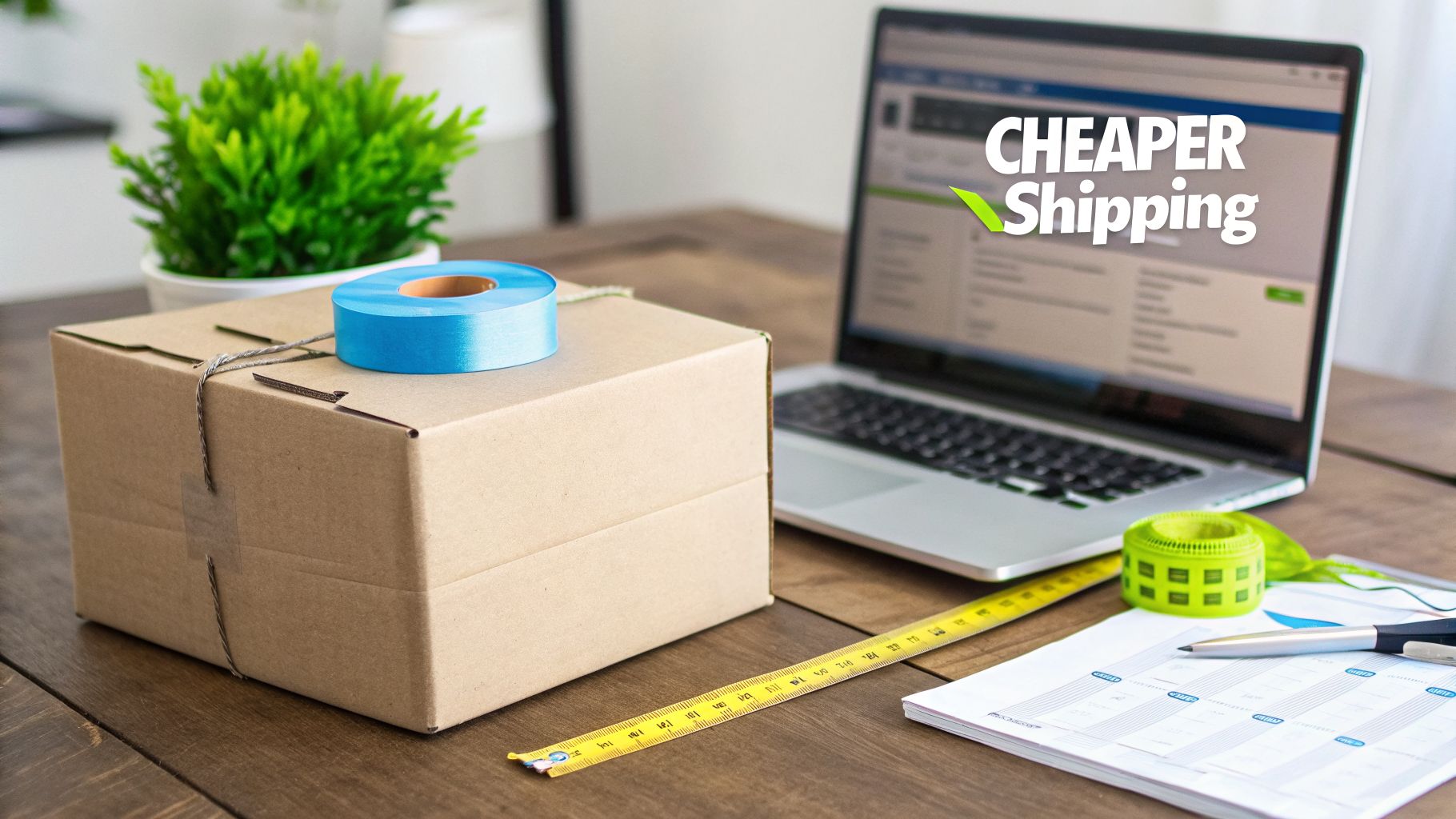
Think of cubic weight as the unspoken rule of the shipping world. It’s a concept that catches many people out, but understanding it is your ticket to getting a real grip on your parcel postage costs. The best way to picture it is to stop thinking about a courier's van having a weight limit and start seeing it as having a space limit. It’s a giant game of Tetris on wheels, and every single centimetre matters.
Let’s say you’re sending two completely different items within Australia. One is a small box packed with 5kg of hand tools. The other is a big, feather-light 1kg box holding a single, fluffy decorative cushion. Even though the tools are much heavier, that cushion's box eats up five times the room in the van. Cubic weight is simply how couriers charge for the space your parcel takes up, making sure that large, light items are billed fairly next to small, heavy ones.
This is, without a doubt, the most common reason people get hit with unexpected shipping fees. But once you get the hang of it, you can flip that around. Instead of a surprise cost, it becomes your best tool for saving money on every parcel you send.
The Formula That Puts You in Control
Calculating cubic weight isn’t some high-level maths problem; it’s a straightforward formula that everyone sending parcels in Australia should have in their back pocket. It works by turning your parcel's volume into an equivalent "weight".
The standard formula used by almost every courier in Australia is:
(Length x Width x Height in metres) x Cubic Conversion Factor = Cubic Weight in kilograms
That cubic conversion factor is the key. For road and air freight within Australia, this number is almost always 250.
Let's break it down into three easy steps:
- Measure Your Parcel: Once your item is all packed up and sealed, grab a tape measure and note its length, width, and height in centimetres.
- Convert to Metres: Simply divide each of those measurements by 100. So, a 50cm length becomes 0.5m.
- Do the Maths: Multiply your three new dimensions (in metres) together, and then multiply that result by 250.
The final number is your parcel’s cubic weight. The last step? Compare it to its actual, physical weight. The courier will always charge you based on whichever of the two is greater.
Getting this calculation right is like learning the house rules before you sit down to play. It stops you from paying to ship empty air and puts you back in charge of your costs.
Cubic Weight in Action: Two Real-World Scenarios
It's one thing to talk about the theory, but seeing it in practice is where it really clicks. The difference can be staggering and shows just how much your choice of box can affect your postal charges.
Example 1: The Small, Heavy Box
Let's say you’re sending a collection of books. You’ve packed them snugly into a tough little box.
- Actual Weight: 8 kg
- Dimensions: 30cm (L) x 25cm (W) x 20cm (H)
Now for the cubic weight calculation:
- Convert to metres: 0.3m x 0.25m x 0.2m = 0.015 cubic metres (m³)
- Apply the conversion factor: 0.015 x 250 = 3.75 kg
In this situation, the actual weight (8 kg) is higher than the cubic weight (3.75 kg). That’s great! It means your shipping cost will be based on the straightforward 8 kg weight.
Example 2: The Large, Light Box
Next up, you're posting a plush teddy bear. To keep it pristine, you pop it into a big box with plenty of protective padding.
- Actual Weight: 1 kg
- Dimensions: 50cm (L) x 40cm (W) x 40cm (H)
Let's run the numbers again:
- Convert to metres: 0.5m x 0.4m x 0.4m = 0.08 cubic metres (m³)
- Apply the conversion factor: 0.08 x 250 = 20 kg
Ouch. Here, the cubic weight (20 kg) is a whopping twenty times more than the actual weight (1 kg). You'll be charged for sending a 20 kg parcel, not a 1 kg one. This is a huge, but completely avoidable, price jump that comes down entirely to the size of the box.
To see how these numbers affect your own shipments, you can play around with different scenarios using a shipping cost estimator.
Metro Vs Regional Deliveries: Unpacking The Price Difference
Ever wondered why sending the same parcel to a regional town costs so much more than sending it across town in a major city? It’s a fair question, and the answer pulls back the curtain on the incredible logistical web that connects every corner of Australia. The price gap isn’t random; it’s a direct reflection of the real-world costs and challenges involved in fast, local delivery.
Think about a courier in a dense metro area like Melbourne or Sydney. They can often complete dozens of drop-offs in a single street or building, ticking off deliveries at a lightning pace. This high delivery density makes the cost per parcel incredibly low. Metro zones are powered by massive, automated sorting hubs and a constant flow of trucks on major highways, creating an economy of scale that keeps postal charges for parcels refreshingly affordable.
The Regional Reality: Cost In Every Kilometre
Now, let's follow that parcel's journey to a regional town. Suddenly, the game changes completely. That same driver might have to travel hundreds of kilometres between just a handful of drop-offs. This "last-mile delivery" is often the most expensive and complex part of the entire journey.
So, what’s driving up the cost for regional deliveries?
- Vast Distances: It's simple, really. More kilometres means more fuel, more time on the road, and more wear and tear on the vehicles.
- Low Delivery Density: With far fewer drop-offs per kilometre, each individual delivery becomes less efficient and more costly to service.
- Local Partnerships: Major carriers frequently rely on smaller, local contractors to complete the final leg of the journey. This adds another layer to the cost structure but is essential for reaching remote doorsteps.
The fundamental truth is that efficiency dictates price. In a bustling city, a courier’s route is a short, highly productive loop. In regional Australia, it's a long, winding road where every kilometre adds to the final cost on your shipping label.
A Tale of Two Parcels: The Cost in Action
Let’s make this real. Imagine you’re sending an identical 5kg parcel from a warehouse in Sydney, but to two very different destinations within Australia.
On one hand, you have a parcel going from Sydney to Melbourne. This is a high-volume, super competitive route. Multiple trucks and planes shuttle between these cities every single day, and the delivery network at both ends is dense and efficient. The result? A predictable and relatively low shipping cost for fast delivery.
On the other hand, a parcel going from Sydney to Broome is a completely different story. It has to cross the entire continent, likely being handled by multiple carriers and different modes of transport along the way. The final delivery in Broome will be managed by a local driver covering a huge area with very few drop-offs. The result is a significantly higher shipping cost that reflects the immense logistical effort required.
The table below gives a clearer picture of what this looks like with some sample numbers.
Sample Parcel Cost Comparison: Metro Vs Regional
These examples show how destination dramatically impacts the final postal charge for a standard 5kg parcel sent from Sydney.
| Route | Estimated Cost (Standard Post) | Estimated Cost (Courier Platform) | Key Cost Factor |
|---|---|---|---|
| Sydney to Melbourne (Metro) | $15 – $25 | $12 – $20 | High volume, high competition |
| Sydney to Perth (Metro) | $25 – $40 | $20 – $35 | Long distance, major route |
| Sydney to Cairns (Regional) | $35 – $60 | $30 – $55 | Long distance, lower density |
| Sydney to Broome (Remote) | $65 – $100+ | $55 – $90+ | Extreme distance, last-mile complexity |
As you can see, the further and more remote the destination, the more you can expect to pay. This is a fundamental reality of Australian logistics.
Understanding how to calculate your parcel's cubic weight is a critical step in managing these costs. This flowchart shows the simple three-step process to determine if you'll be charged for its size or its actual weight.
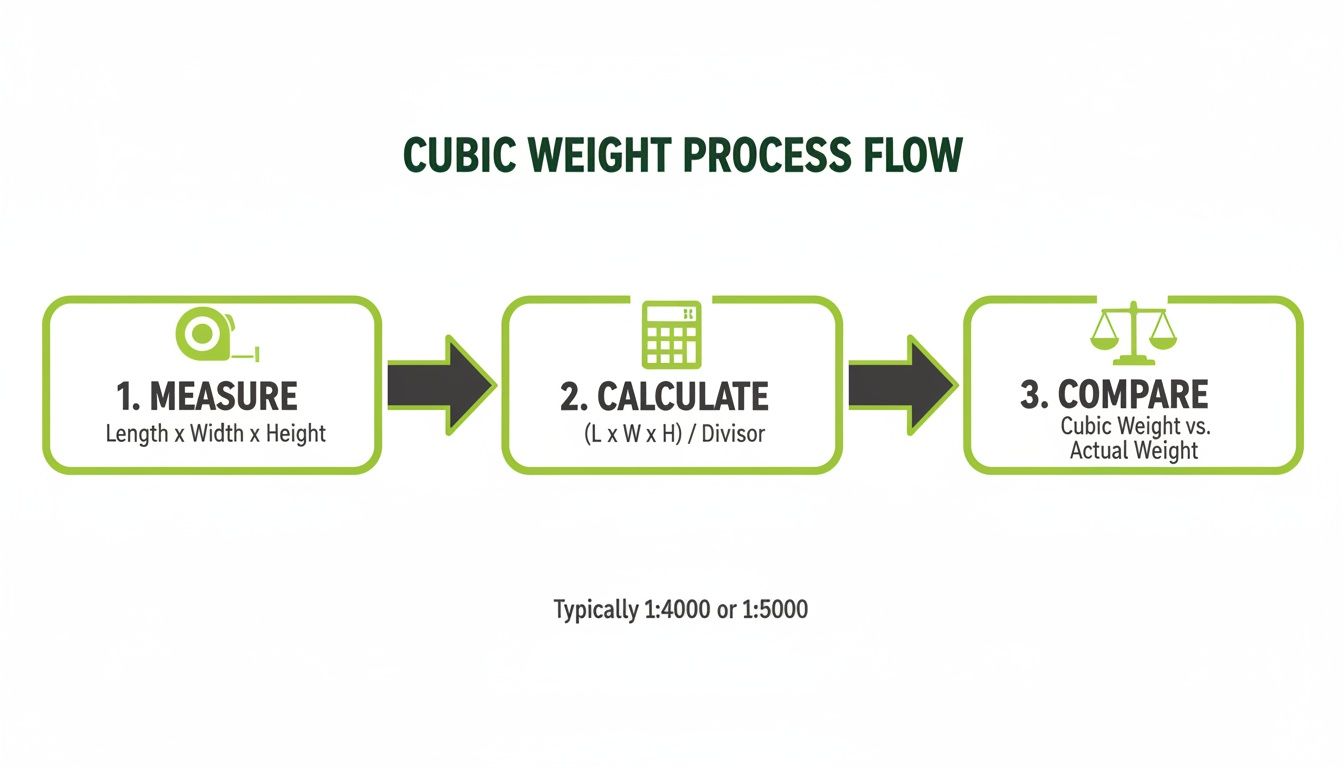
Remember, couriers always charge for whichever is greater—the physical weight on the scales or the cubic weight calculated from your parcel's dimensions.
While the metro-regional price gap is an unavoidable part of shipping across our vast country, understanding the 'why' helps you budget more accurately. It also gives you a real appreciation for the network required to get a package to some of our most beautiful and remote communities. This pricing evolution has been shaped by decades of changes in fuel costs, infrastructure, and population shifts. To get a sense of the deeper history, you can even explore historical postal rates to see how these factors have long influenced delivery costs around the world.
Proven Strategies To Reduce Your Parcel Shipping Costs
Let's get one thing straight: slashing your parcel shipping costs isn't about finding some mythical "magic bullet." It’s about being clever and making a few smart moves every time you send something. The power to save money is already in your hands, and it often starts with the simplest thing imaginable: the box.
Every parcel you send is a chance to turn an expense into a win. It’s a shift in mindset—from just sending an item to strategically shipping a packed parcel. The tips we’re about to dive into are practical, easy to put into action, and can start saving you money from your very next shipment.
Become a Master of Packaging
The biggest mistake people make? Paying to ship air. It sounds ridiculous, but when you use a box that’s way too big for your item, that's exactly what you're doing. We’ve already covered how cubic weight means you pay for the space your parcel takes up. The fix is simple: always use the smallest box possible that still keeps your item safe and sound.
- Right-Size Your Inventory: Keep a few different box sizes on hand. This stops you from grabbing a huge box for a tiny item just because it’s all you’ve got.
- Embrace Compact Packing: Use void-fill like bubble wrap or kraft paper, but only just enough to stop things from rattling around. Don’t overdo the padding and force yourself into a bigger, more expensive box.
- Consider Custom Packaging: If you're a business shipping the same product over and over, investing in custom-fit boxes can translate into massive savings down the line.
Just this one change—choosing the right box—can slash your cubic weight and cut your costs more often than you'd think.
Unlock Wholesale Rates with Courier Platforms
For years, the best shipping rates were a secret handshake reserved for massive corporations. If you didn't have the volume to negotiate, you paid full price. Not anymore. Courier aggregator platforms like Aeros Couriers have completely levelled the playing field for everyone in Australia.
These platforms work by bundling the shipping volume of thousands of small businesses and individuals just like you. This shared muscle gives them the power to negotiate incredible wholesale rates from major carriers for fast, Australia-wide delivery, and they pass those savings directly to you.
You no longer need a special account or a minimum shipping commitment to access the same cheap pricing as the big players. Even for a single parcel, you get the benefit of bulk-discounted rates. This is arguably the most powerful strategy for instantly lowering your costs.
Switching from paying retail at the post office to using the wholesale rates on a platform can easily save you 30% or more.
More Actionable Cost-Saving Tactics
Beyond smart packaging and better platforms, there are other powerful habits you can build. For anyone truly dedicated to trimming the fat from their shipping budget, an expert guide can provide some brilliant, actionable strategies to reduce shipping costs.
Here are a few more tried-and-true methods:
- Consolidate Your Shipments: Got multiple orders heading to the same address? Box them up together! Sending one 5kg box is almost always cheaper than sending five separate 1kg boxes.
- Know Your Surcharges: Get familiar with the little fees that can bite you. Things like residential delivery, failed pickups, or typing in the wrong address can add small but frustrating charges. A quick double-check of the details saves money.
- Choose the Right Speed: Don't pay a premium for express post if it's not truly urgent. If your delivery has some flexibility, choosing a standard road service is an easy win for your wallet. Always match the service speed to the situation.
By combining these tactics, you can build a shipping process that is not only dependable but also incredibly cost-effective. And if your business ships regularly, it’s worth looking into how a dedicated business postage account can unlock even deeper, more customised savings and features.
Find Your Cheapest Parcel Quote In Under 60 Seconds
Alright, so you've got the theory down. You know all about how postal charges are calculated and the clever ways to trim those costs. But what does that actually look like in practice? It's time to stop guessing and start seeing some real savings on fast, cheap parcel delivery.
This is where all that knowledge clicks into place. At Aeros Couriers, we built our entire platform on a simple idea: getting a great price on reliable shipping shouldn't be a chore. There are no confusing business account applications, no hidden charges, and definitely no restrictive contracts. Just direct, instant access to Australia's best courier rates for local deliveries.
Your Simple Path to Savings
Think about the old way: packing a box, driving to the post office, and just hoping the final cost for your postal charges for parcels doesn't sting too much. You can leave that all behind. Our system is designed to give you a firm, fair price in less time than it takes to boil the kettle, whether you're sending a box across town or across the country.
Ready to see how easy it is? Here’s all it takes to lock in wholesale shipping rates:
- Enter Your Locations: Just pop in the pickup and delivery postcodes. Our network covers every corner of Australia, from major city centres to the most remote regional towns.
- Provide Parcel Details: Measure your parcel's length, width, and height, and pop it on a scale for its dead weight. Accurate details mean an accurate quote—no nasty surprises later.
- Compare and Choose: Instantly, you'll see a range of quotes from Australia's most trusted carriers. You can compare them side-by-side and pick the service that perfectly matches your budget and delivery timeframe.
- Book, Pay, and Print: Once you've chosen your courier, finalise the booking online, pay securely, and print out your shipping label. That’s it! Your parcel is ready to be picked up.
This is more than just a booking tool. You’re tapping into the kind of heavily discounted wholesale rates that were once only available to massive corporations. We’re simply opening the door so everyone can access them.
Taking control of your shipping costs starts right here. The best way to understand the difference is to see it for yourself. Use our free shipping price calculator and watch the savings add up in real-time.
Frequently Asked Questions About Parcel Charges
Let's be honest, figuring out postage costs can sometimes feel like trying to hit a moving target. To cut through the noise, we've pulled together answers to the questions we hear every single day from Aussies sending parcels locally. Think of this as your cheat sheet to shipping smarter.
We want to get you from confused to confident, armed with practical advice you can use immediately.
What Is the Cheapest Way to Send a Parcel in Australia?
Hands down, the cheapest way is almost always through a courier aggregator platform like Aeros Couriers. We give you access to pre-negotiated wholesale rates from a whole range of carriers for fast, Australia-wide delivery—prices that are simply out of reach if you walk up to a post office counter.
The other secret? Always use the smallest, lightest box that will still safely protect your item. This simple trick helps you sidestep extra charges for cubic weight, making sure you only pay for what you absolutely need to.
How Can I Avoid Unexpected Shipping Fees?
Accuracy is everything when you're trying to dodge surprise costs. The golden rule is to measure and weigh your parcel after it’s been completely packed and taped up. Using a platform that gives you an all-inclusive, upfront quote is a game-changer, as it locks in your price before you even commit.
And one final, crucial check: make sure the delivery address is 100% correct. We're talking postcode, street name, and any unit numbers. A tiny typo can lead to a re-delivery surcharge—a frustrating and totally avoidable fee.
The single most powerful way to control your costs is to be precise. Accurate dimensions, weight, and addresses eliminate nearly all potential for unexpected fees, putting you firmly in charge of your budget.
Is a Satchel or My Own Box Cheaper?
This really comes down to what you're sending. A carrier's flat-rate satchel can be a brilliant deal for small but heavy items, since you pay one price up to a certain limit (like 5kg). The cost is predictable, with no measuring required.
But what if your item is light but a bit awkwardly shaped? It probably won't squeeze into a satchel. In that scenario, using your own lightweight, perfectly-sized box and paying for its exact dimensions is often far cheaper. When in doubt, get a quick quote for both options—it’s the only way to know for sure.
Why Are Courier Platforms Cheaper Than Australia Post?
It all comes down to the power of bulk buying. Courier aggregator platforms commit to sending huge volumes of parcels with carriers like TNT, Toll, and others. In return, they get massive wholesale discounts that aren't offered to the general public.
They then pass those savings directly on to you. When you go to a post office, you're paying the standard retail price for one parcel. When you use a platform, you’re tapping into the collective buying power of a massive company, even if you’re just sending one little box.
Ready to put this advice into practice and see what you could save? Get an instant, no-strings-attached quote with Aeros Couriers and unlock those wholesale shipping rates today. Find out more at https://www.aeroscouriers.com.au.
Courier quotes, tracking and support
Ready to send a parcel? Compare the available services for your postcodes, parcel dimensions and weight. For an existing delivery, use your consignment number to check tracking or ask our team for help.