As of mid-2025, you might think the cost for a standard letter in Australia is a straightforward $1.70. But that’s just the sticker price, and it can be misleading.
The real cost of sending a letter depends heavily on its size, weight, and even its thickness. What starts as a simple letter in your mind can quickly be reclassified as a more expensive ‘large letter’ or even a small parcel, catching many small businesses by surprise at the post office counter.
Your Guide to Australia Letter Postage Costs in 2026
If you've ever felt like postage prices are a constantly moving target, you're not alone. The journey from a simple stamp to the complex web of rates we see today is a story of constant adjustment, and for any business sending more than a few letters, understanding this landscape is key. It’s the first step toward finding smarter, more efficient ways to ship your goods Australia-wide.
The Official Rates at a Glance
To get our bearings, let's start with the current domestic rates from Australia Post. Think of these as the foundational costs you build upon.
Here’s a quick breakdown of what you can expect to pay for standard domestic letters within Australia.
Australia Post Standard Letter Costs 2026 At a Glance
| Letter Size | Weight Limit | Base Postage Cost |
|---|---|---|
| Small Letter | Up to 250g | $1.70 |
| Large Letter | Up to 125g | $3.40 |
| Large Letter | Up to 250g | $5.10 |
| Large Letter | Up to 500g | $8.50 |
These numbers give us a clear baseline, but they don't paint the full picture. The price on the stamp is just one part of a much bigger story—a story of steady increases.
Postage rates have climbed consistently for decades. After jumping to $1.50 in early 2024, the base rate for a small letter hit $1.70 by mid-2025. At the same time, large letters shot up to as much as $8.50, showing a clear and relentless upward trend.
This pattern of rising prices is a huge signal for anyone who posts items regularly. The real challenge—and the hidden opportunity—is learning to look beyond the post office counter. While traditional mail is fine for basic documents, modern businesses need fast, reliable, and cheap delivery for their boxes and parcels.
For a wider view on shipping expenses beyond just letters, you might find our comprehensive guide on the overall cost of postage helpful. These price hikes, approved by regulators like the ACCC, point to a system under pressure. You can dig into the details of these decisions and historical price changes on the ACCC's public records.
The Hidden Rules That Turn Your Letter into a Parcel
Have you ever popped something in the mail, thinking it was just a simple letter, only to be stung with a postage cost that made your eyes water? It’s a classic story, and it happens because sending mail in Australia isn't just about weight—it's a game with a few hidden rules.
Think of it like getting on a plane. The airline cares about the weight of your bag, sure, but they’re just as strict about its size. Too wide or too bulky, and your carry-on suddenly becomes checked luggage. Australia Post works the exact same way. It's not one thing that determines your cost, but a trio of factors.
The Three Dimensions of Postage Cost
Every single item you send is sized up against three key measurements. Get even one wrong, and your "letter" can instantly get bumped into a more expensive category, or worse, become a parcel. This is where you can get smart and save some serious money.
Here are the three factors that really decide what you'll pay:
- Size (Length and Width): A standard small letter needs to be no bigger than 130mm x 240mm. Anything larger, like a common C4 envelope holding an A4 sheet, is automatically a ‘large letter’ and costs more from the get-go.
- Thickness: This is the one that catches almost everyone out. A small letter absolutely cannot be thicker than 5mm. Just a few folded pages, a slightly puffy invoice, or a small product sample can easily tip you over that limit.
- Weight: For small letters, you’ve got a generous 250g to play with. But for large letters, weight becomes a huge factor, with price jumps at 125g, 250g, and 500g.
This little flowchart shows exactly how an item moves through the system. Pay close attention to how quickly a simple 'no' sends your costs climbing.
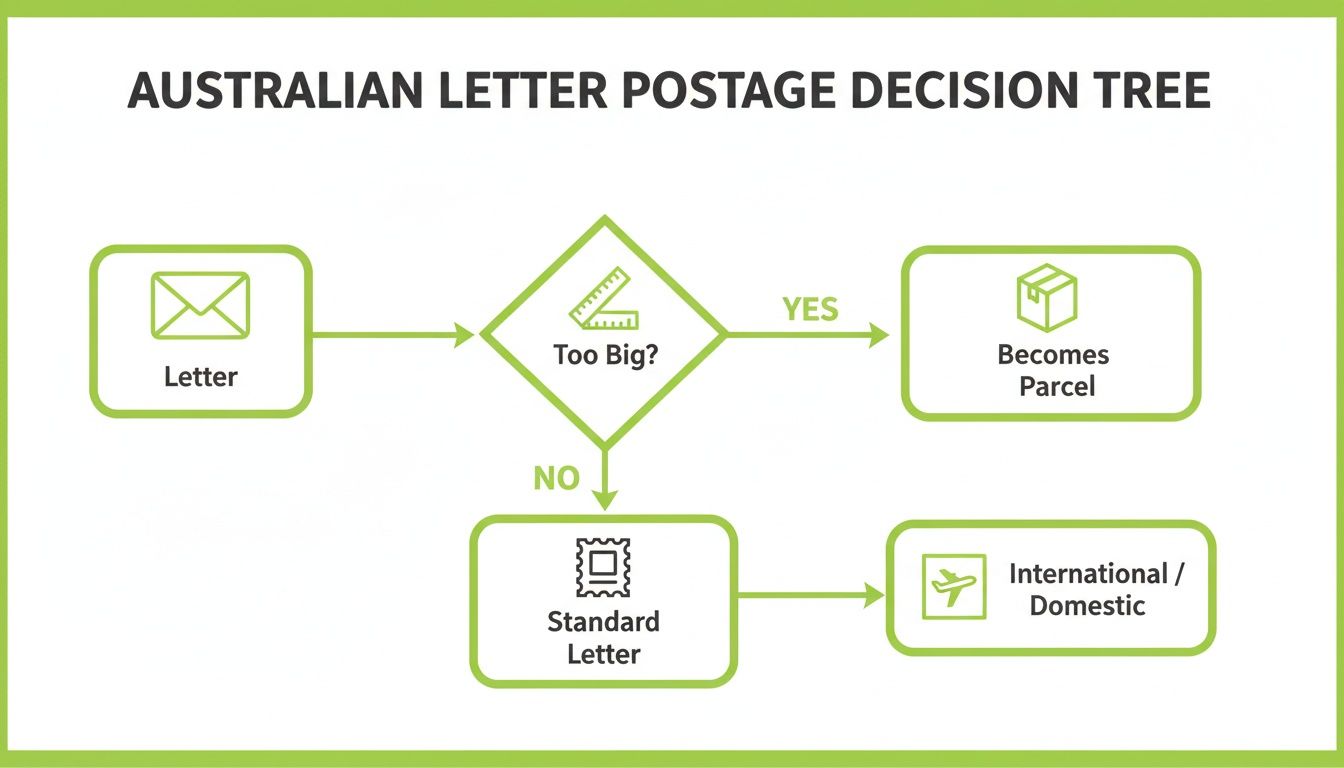
The real takeaway here is that failing any one of those checks—size, thickness, or weight—pushes your item into the next, pricier bracket.
From Letter to Parcel in a Heartbeat
Let's say you're sending a multi-page proposal in a standard business envelope. It fits the size requirements perfectly, but the stack of paper pushes the thickness just past the 5mm mark. In that instant, it’s no longer a $1.70 small letter. It's now, at a minimum, a $3.40 large letter. That's double the price.
The real cliff-edge is when your item is thicker than 20mm or heavier than 500g. At that point, it’s no longer a letter at all. It officially becomes a parcel, and the price you pay at the post office can skyrocket.
But here’s the inspiring part. Once you know these rules, you're not just at the mercy of the system anymore. You're in control. You can make strategic choices that save you money on every send. And when your item does cross that line into parcel territory, you suddenly have a whole new world of options that are often faster, more reliable, and even cheaper for local deliveries in Australia. If you're sending boxed goods, a deeper look at courier costs can be a real eye-opener, turning a frustrating expense into a genuine business advantage.
Why Traditional Postage Costs Keep Rising
It's easy to point the finger at inflation when the price of a stamp goes up yet again. But that’s only a tiny piece of a much bigger, more dramatic story. The real reason sending an Australia Post letter keeps getting more expensive is a massive shift in how we all communicate, and it’s put the national mail service in a really tight spot.
Think of it like this: Australia Post runs a gigantic, country-wide operation that costs a fortune to maintain every single day. By law, they have to deliver to every address, from city apartments to the most remote outback station. But what happens when the number of people using their main product—letters—drops off a cliff? That’s the problem they’re wrestling with right now.
The Shrinking Mailbag Paradox
At its heart, the problem is a tough paradox. The volume of mail is shrinking fast, but the reach of the delivery network is only getting bigger. All the fixed costs of running that network—the fleet of vans, the massive sorting centres, the wages for posties—don't shrink just because we're all sending emails and texts instead of letters.
As Australia’s population grows, more and more houses are built, adding thousands of new delivery points every year. This stretches the network even further. So, the dwindling revenue from a much smaller pool of letters has to cover the huge, and still growing, cost of servicing the entire country. The only way to make the numbers work is to charge more for every letter that does get sent.
The statistics paint a stark picture. In recent years, total domestic letter volumes have plunged by 13.4%, with some specific services like Print Post falling by over 20%. That’s hundreds of millions fewer letters in the system, all while the number of mailboxes to visit keeps climbing. You can see the historical data behind these postal rate trends for yourself.
This isn’t just a bad year; it's a permanent change in our behaviour. For any business that sends physical items, this trend is a clear sign that the old way of doing things is becoming financially unsustainable.
When you look at the real costs, exploring updated Australia Post courier charges often shows how parcel services now offer a completely different kind of value. The future isn’t about paying more for a service that's getting slower. It's about finding a smarter path forward for fast box and parcel delivery Australia-wide.
The Smart Alternative for Fast Parcel Delivery
When you’re constantly hit with rising postage prices and find that fewer of your items actually qualify as ‘letters’, it’s easy to feel stuck. The old way of simply sticking a stamp on something is quickly becoming a frustrating and expensive habit, especially for anything thicker than a birthday card. But this isn't a dead end. In fact, it's an opportunity. When your shipping needs outgrow the letterbox, a whole new world of smarter, faster, and often cheaper options for local delivery within Australia opens up.
This is where you can really start to get inspired. What if, instead of seeing shipping as a necessary evil that just keeps getting more expensive, you could turn it into a genuine advantage for your business? Modern courier platforms are designed to do just that. They’re built for sending boxes and parcels in a world that values speed, transparency, and finding the cheapest prices possible.

From Big Business Discounts to Your Fingertips
For a long time, the best courier rates were a well-kept secret, reserved for massive companies shipping thousands of items a day. But that’s all changed. Courier booking platforms act as your gateway to these incredible bulk-rate discounts, giving everyone access—from someone sending a one-off gift to a growing eCommerce store. This isn’t about just shaving a few cents off your postage cost; it’s a total game-changer.
Think of it like having a backstage pass to the shipping industry. Suddenly, you can:
- Get instant quotes from multiple trusted couriers in seconds.
- Compare different services on price and delivery speed, all on one screen.
- Book a parcel delivery anywhere in Australia with just a few clicks.
- Print your own shipping labels and track your package right to the recipient's door.
A Smarter Way to Ship Your Parcels
Let’s get practical. Say you need to send an item that weighs 500g but it’s too thick to squeeze into a large letter envelope. Under the old system, you’d head to the post office, it would be classified as a parcel, and you’d pay whatever the standard rate is. But with a modern courier platform, you’re in the driver's seat.
The real power comes from having choice and control. Instead of being stuck with one provider and one price, you can instantly see all your options. You might discover a courier that offers a quicker, door-to-door service for a price that’s the same or even less than standard parcel post.
This is the shift from being a passive mailer to a savvy shipper. You’re no longer just accepting the price you’re given. You’re actively choosing the best service for your budget and your deadline, every single time. It's especially important to explore the cheapest way to ship packages once you realise that what you used to think of as a 'large letter' is now a parcel in the eyes of most carriers.
To give you a clearer picture of this difference, here’s a quick comparison of sending a 500g item that's just a bit too bulky for a letter.
Traditional Post vs Modern Courier Platform
| Feature | Australia Post (Large Letter/Parcel) | Aeros Couriers (Parcel Service) |
|---|---|---|
| Booking Process | Over-the-counter or via their app | Instant online comparison and booking |
| Pricing | Fixed rate based on weight/destination | Multiple competitive quotes from different couriers |
| Pickup Service | Generally requires dropping off at a post office | Door-to-door pickup included with many services |
| Tracking | Standard tracking included | Real-time, detailed tracking from pickup to delivery |
| Flexibility | Limited service options (Standard, Express) | Wide range of services (Economy, Express, Same-Day) |
| Cost Control | You pay the set rate | You choose the price/speed that fits your budget |
As you can see, the courier platform puts the power back in your hands, offering flexibility and cost-saving opportunities that simply don't exist in the traditional system.
For businesses wanting to take that control to the next level, setting up a free business postage account makes it incredibly easy to manage all your shipments in one place and keep track of your spending. This is how you stop seeing shipping as a headache and start using it as a smart, efficient tool for success.
From Penny Post to Parcel Power: A Brief History of Australian Mail
To really get a handle on the shipping power you have at your fingertips today, it helps to take a quick trip back in time. It's almost hard to imagine a world where sending a letter didn't involve a complex puzzle of size, thickness, and weight, but was based on a single, simple price. Yet, just over a century ago, that was the reality.
The Days of the Penny Post
Something remarkable happened on May 1, 1911. Fresh off Federation, Australia joined the Imperial Penny Post system, which standardised postage right across our new nation. This move swept away the confusing patchwork of old colonial prices, establishing a uniform cost: just one penny (1d) to send a standard letter anywhere in the country. You can still find fascinating details on this era in official reports on historic letter volume and demand.
That flat-rate system represents an age of incredible simplicity. It was a time when the post truly was the great connector, uniting a vast continent with one affordable, straightforward service.
But, of course, things changed. The journey from that simple penny post to the intricate—and often expensive—model we navigate today isn't just a history lesson. It’s a story that perfectly illustrates just how much the world of shipping has evolved.
The simplicity of the past highlights the complexity of the present. While the Penny Post was perfect for its time, today’s businesses need something faster, more transparent, and more flexible than a stamp could ever be.
This very evolution is what has sparked the modern shipping solutions we now see. It shows us exactly why sticking only to the old ways can hold a business back. The challenges of rising prices and complicated rules have paved the way for brilliant new platforms that put you firmly in the driver's seat.
It’s a story that has moved from the humble letterbox to the powerful click of a mouse. It gives you, the sender, the ability to truly master your postage cost for every Australian letter and parcel. You're no longer limited by the past; instead, you can embrace a future where shipping isn't a headache, but a powerful tool for connection and growth.
Your Top Questions About Postage and Parcels in Australia
You've got the theory down, but what happens when you’re standing there with a package in hand, facing a real-world shipping dilemma? It's one thing to know the rules, but another to feel confident making the right call on the spot.
Let’s tackle some of those common "what if" moments. These are the practical insights you need to choose the smartest, most cost-effective shipping option every single time.
What Happens When My Item Is Too Thick for a Large Letter?
This is probably the most frequent hurdle people hit. The moment your item tips over that 20mm thickness limit for a large letter, it officially becomes a parcel.
You could, of course, send it through Australia Post's standard parcel service. But this is exactly where courier platforms completely change the game. Instead of being stuck with one price, you can hop online and get an instant quote to send it as a fully tracked parcel. You’ll often find it’s not just faster with door-to-door service, but surprisingly wallet-friendly, too.
Is It Cheaper to Buy Stamps in Bulk?
For anyone sending more than just a few letters, this is a great question. But when it comes to Australia Post, the short answer is no. Buying stamp booklets doesn’t change the price you pay per stamp; the rate is fixed.
Real savings aren't found in buying more stamps, but in rethinking your strategy for anything that isn't a simple flat document. The true "bulk discount" comes from using a courier platform. This gives you instant access to wholesale courier rates for your parcels—even if you're only sending one.
Think of a courier platform as giving you a bulk-rate account, but without the high-volume commitment. You get the discounted rates on every single parcel, right from your very first send.
Want to see the numbers for yourself? You can estimate shipping costs right here on our site.
What Is the Cheapest Way to Send a Small Tracked Parcel?
While Australia Post has Registered Post for letters, it can be a slow and pretty pricey way to track a parcel. When you absolutely need tracking on a small box or a thicker item, a courier service booked through an online platform is almost always the better move.
You can often lock in a fast, fully tracked courier service for a price that rivals—or even beats—traditional tracked mail. More importantly, the visibility you get is worlds apart. You can watch its journey from the second it’s collected to the moment it’s delivered.
Can I Use My Own Box with a Courier Service?
Yes, absolutely! This is one of the best parts of using a courier platform instead of being locked into prepaid satchels. You’re actually encouraged to use your own packaging.
Just pack your item safely in a box that fits it well, then measure its final dimensions (length, width, and height) and pop it on a scale. Punching these details into a courier platform will give you an accurate, instant quote. This freedom means you can protect your items properly and stop paying for oversized packaging you just don't need. It’s smarter, safer, and saves you money.
Stop overpaying and start shipping smarter. Aeros Couriers gives you instant access to Australia's cheapest parcel delivery rates. Get your free quote and book in minutes at https://www.aeroscouriers.com.au.
Courier quotes, tracking and support
Ready to send a parcel? Compare the available services for your postcodes, parcel dimensions and weight. For an existing delivery, use your consignment number to check tracking or ask our team for help.