

The first time your orders jump, shipping stops feeling like admin and starts feeling like operations. One good sales day can leave you standing over a bench full of satchels and cartons, comparing tabs, guessing ETAs, and wondering which of the australian courier companies will get the job done without chewing through your margin.
That’s the moment a lot of small businesses realise the product isn’t the only thing customers are judging. They’re judging the dispatch email, the tracking link, the delivery promise, and what happens when something goes wrong.
Your Growing Business Has a Shipping Problem
A familiar version of this plays out every week. A business gets traction, orders roll in from Sydney, Brisbane, Adelaide, and a few regional towns, and suddenly the old approach stops working. The owner who could once handwrite labels and drop off a handful of parcels now has to choose between speed, cost, and reliability on every single shipment.
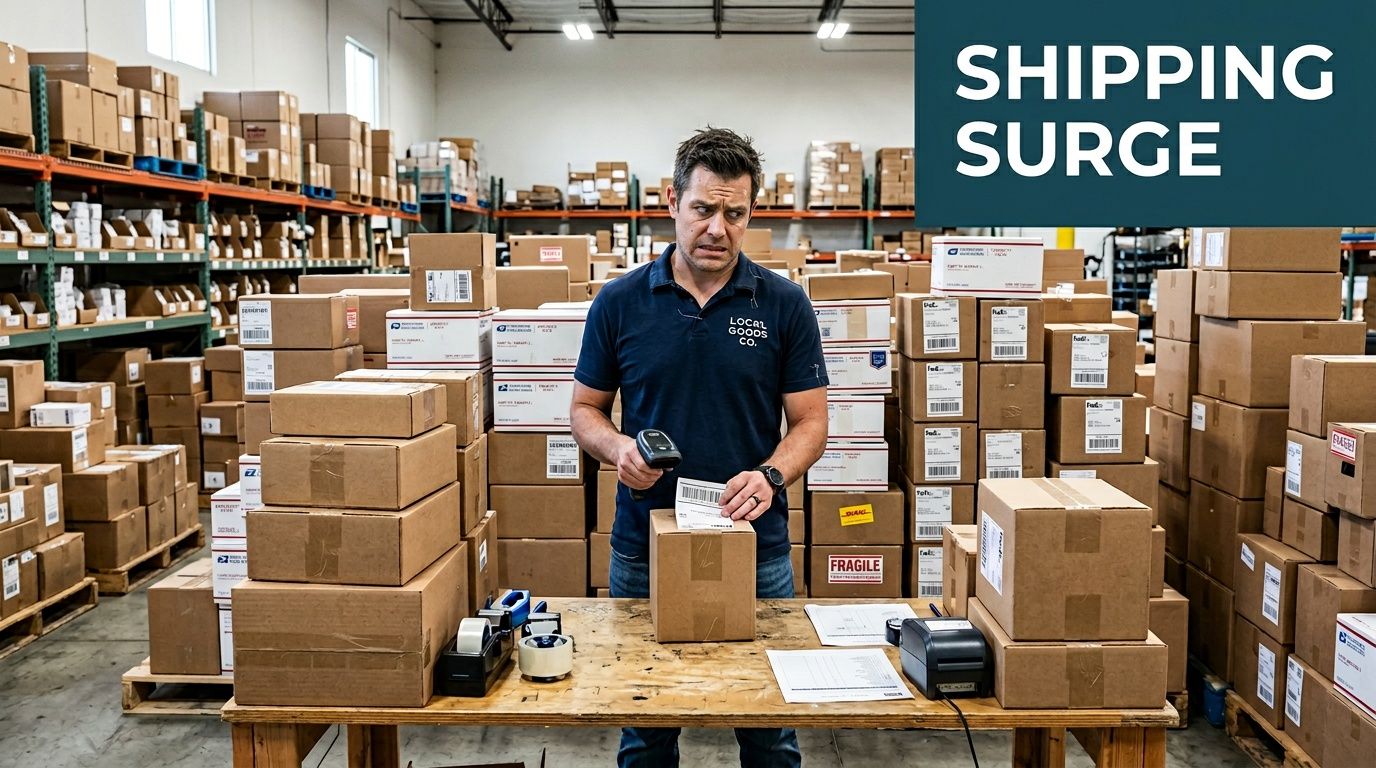
The problem isn’t lack of options. It’s the opposite. Australia has a crowded delivery market, and the names all start to blur together when you’re trying to move parcels fast and keep customers happy. Cheap can become expensive if tracking is poor. Fast can become risky if surcharges pile up or support disappears when you need it.
The market is big and still growing
This isn’t a small side issue inside the economy. The Australian Courier, Express, and Parcel market is valued at an estimated USD 11.75 billion in 2025 and is projected to reach USD 15.02 billion by 2030, growing at a CAGR of 5.03%, largely fuelled by e-commerce, according to Research and Markets on the Australian courier market.
That growth is good news for sellers. More demand usually means more services, more platforms, and more ways to buy shipping without negotiating enterprise contracts. It also means more noise. Some providers are built for metro speed. Some are built for broad coverage. Some look cheap until you start booking regularly and uncover the friction.
Shipping becomes part of your offer
Customers rarely separate your product from your delivery experience. If the parcel arrives late, damaged, or with no usable tracking, they don't blame the carrier first. They blame your business.
Practical rule: treat shipping as part of customer experience, not a back-office task.
If you’re feeling that pressure already, it helps to start with a system built for smaller operators rather than trying to patch together multiple accounts by hand. A useful starting point is small business shipping across Australia, especially if you need parcel sending without adding another clunky workflow.
Decoding Australian Courier Service Types
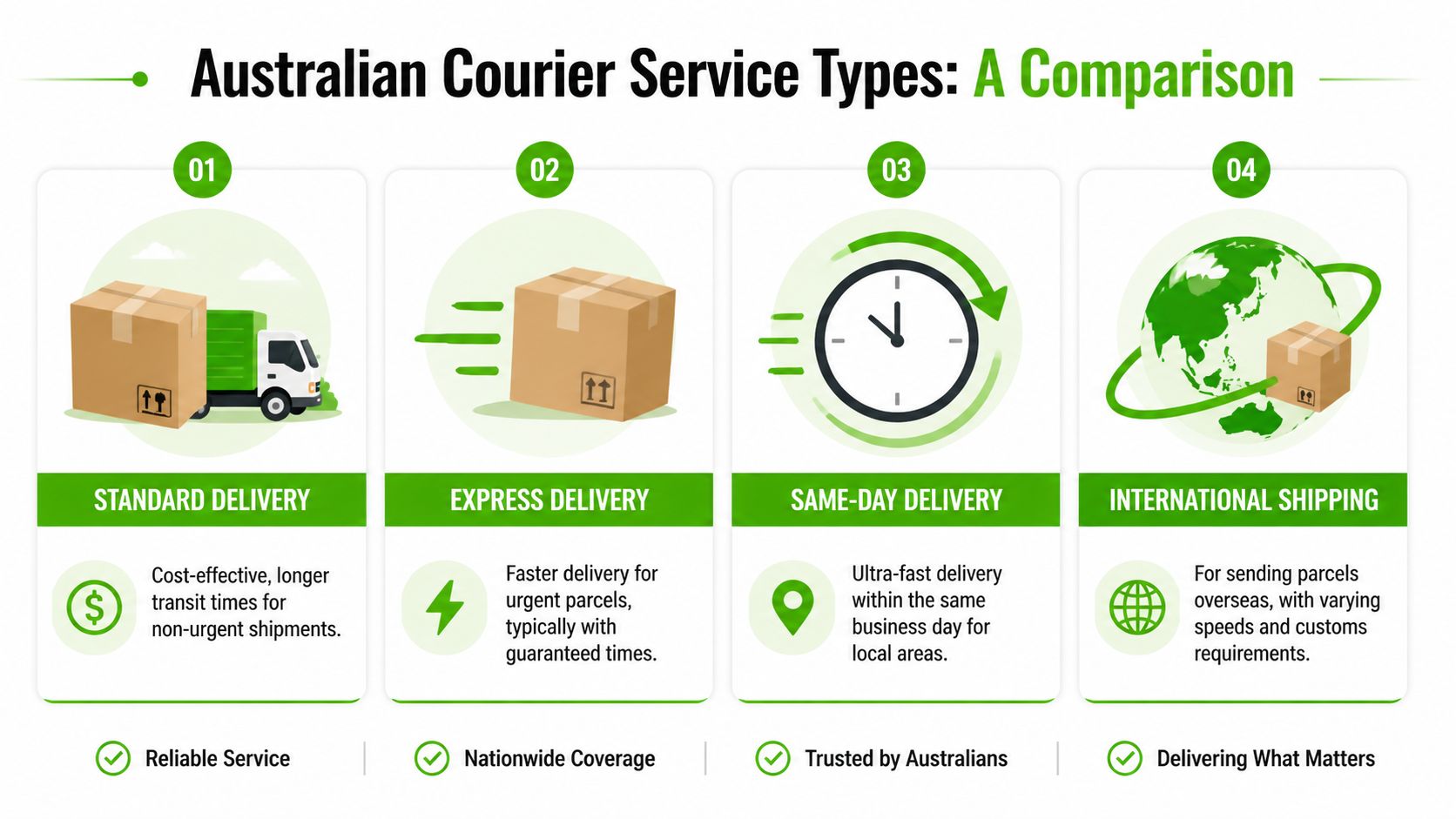
Most parcel services inside Australia fall into three practical buckets for small businesses: standard, express, and same-day. Think of them like airline seats. They all get your parcel from A to B, but the price, urgency, and expectations are different.
Standard works when timing isn't the product
Standard delivery is economy class. It’s built for affordability first. If you’re sending routine orders, replenishment stock to a store, or low-urgency customer purchases, this is often where you protect margin.
Use standard when:
- Your customer values price over urgency and is happy with a broader delivery window.
- The item is easy to replace and doesn’t need premium handling.
- You send regular volume and want to avoid paying express rates out of habit.
What doesn’t work is using standard for every order just because it’s cheaper on the quote screen. If your product is a last-minute gift, event item, or replacement part, the savings can disappear fast when customer service time kicks in.
Express is usually the sweet spot
Express is business class. It costs more, but for many growing online stores it’s the most balanced option. You’re not paying same-day pricing, yet you’re giving the buyer a stronger promise and a shorter wait.
A lot of australian courier companies position express as the practical middle ground, and that’s often right. It suits higher-value orders, impatient customers, and brands trying to look organised without taking on premium delivery costs everywhere.
A useful shipping setup isn’t the one with the fastest option. It’s the one that lets you choose speed only when speed matters.
Same-day is powerful, but narrow
Same-day is the private jet. It’s excellent when it fits and wasteful when it doesn’t. Local metro deliveries, urgent replacements, and B2B jobs with fixed deadlines can justify it. Everyday e-commerce orders usually can’t.
Before offering same-day, ask two blunt questions:
- Is the delivery area tight enough to support it consistently?
- Will the extra cost create profit, repeat business, or both?
If the answer is no, same-day becomes a marketing promise that operations can’t support.
Keep domestic and specialist needs separate
For this guide, the focus is local Australian parcel delivery, not overseas shipping or pallet freight. Still, some businesses have edge-case jobs where the sender is also coordinating a move, relocation, or specialist logistics. If that overlap ever comes up, planning your pet's move to Australia is a helpful example of how different logistics become once compliance and specialist handling are involved.
For ordinary parcels, keep it simple. Compare domestic options in one place, decide based on urgency, and avoid using premium services for orders that don’t need them. A practical reference point is domestic courier companies in Australia.
How Delivery Times and Pricing Really Work
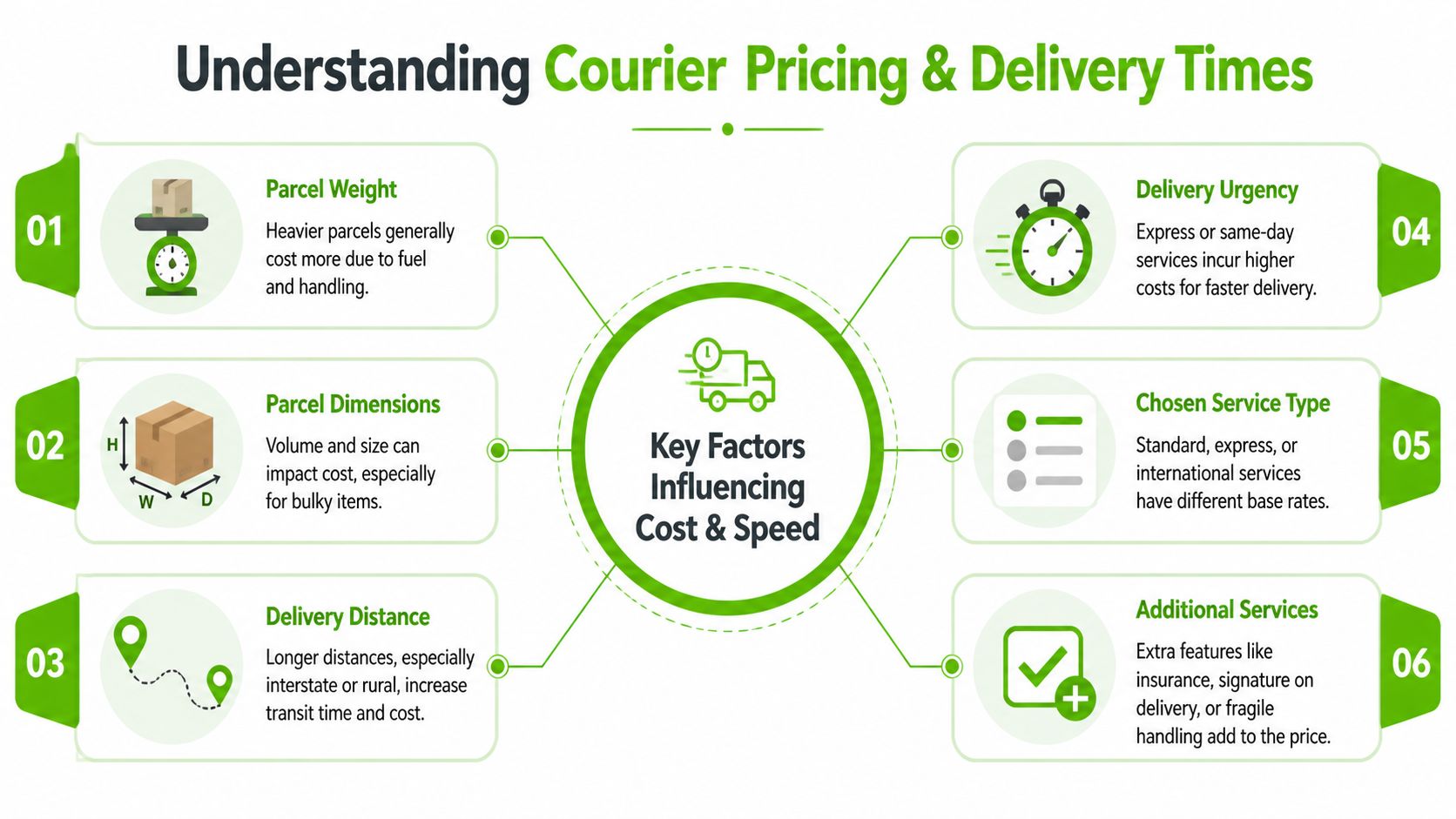
Courier pricing feels random until you break it into the few inputs that matter. For local parcel shipping in Australia, the big drivers are usually weight, dimensions, distance, and urgency. Add-ons like insurance or signature can matter too, but the quote usually rises or falls on the shape of the parcel and where it’s going.
Weight matters, but dimensions often hurt more
A compact heavy item can still price well if it stacks and travels efficiently. A light but bulky box can trigger a nasty surprise because couriers don’t only sell kilos. They sell vehicle space and handling efficiency.
That’s why two parcels with similar products inside can price very differently if one is packed neatly and the other is floating in an oversized carton. Small businesses lose money here all the time, usually because packing decisions get made on the bench instead of in the margin spreadsheet.
Metro and regional are not the same job
This is the part many sellers underestimate. A parcel moving between major metro areas is one kind of delivery problem. A parcel heading to a regional address is another.
Industry conditions make that split hard to ignore. While industry revenue has grown, a 0.7% dip in 2024-25 highlights uneven impacts, with disruptions like strikes and post-COVID challenges creating persistent delivery disparities and ETA uncertainty between metro and regional areas, according to IBISWorld's overview of courier pick-up and delivery services in Australia.
That means the cheapest quote on a city route may tell you very little about how the same provider performs outside dense areas. For your customers, this shows up as one frustrating pattern: metro buyers get clean delivery promises, while regional buyers get vague windows and occasional surprises.
A better way to quote before you publish rates
If you set flat shipping without testing enough destinations, you’ll either overcharge metro customers or undercharge regional ones. Neither is good.
Use this simple check before locking in your rates:
| What to check | Why it matters |
|---|---|
| Packed dimensions | Bulky parcels distort your cost faster than most owners expect |
| Residential or business address | Pickup and delivery conditions can change the service used |
| Metro or regional destination | ETA confidence and pricing consistency can shift sharply |
| Urgency level | Express should be chosen deliberately, not by default |
If you want a rough way to think about charge drivers before you book, tools like the Material Handling USA shipping tool are useful for understanding how packaging and shipment inputs affect price logic, even though your actual Australian quote will depend on local carrier rules.
Reality check: customers can accept slower delivery more easily than they can accept a delivery promise that keeps changing.
For day-to-day bookings, the practical move is to compare parcel rates with destination in mind, not just product weight. That’s why many businesses rely on courier pricing comparison tools instead of using one static rate card.
The Essentials of Tracking Insurance and Support
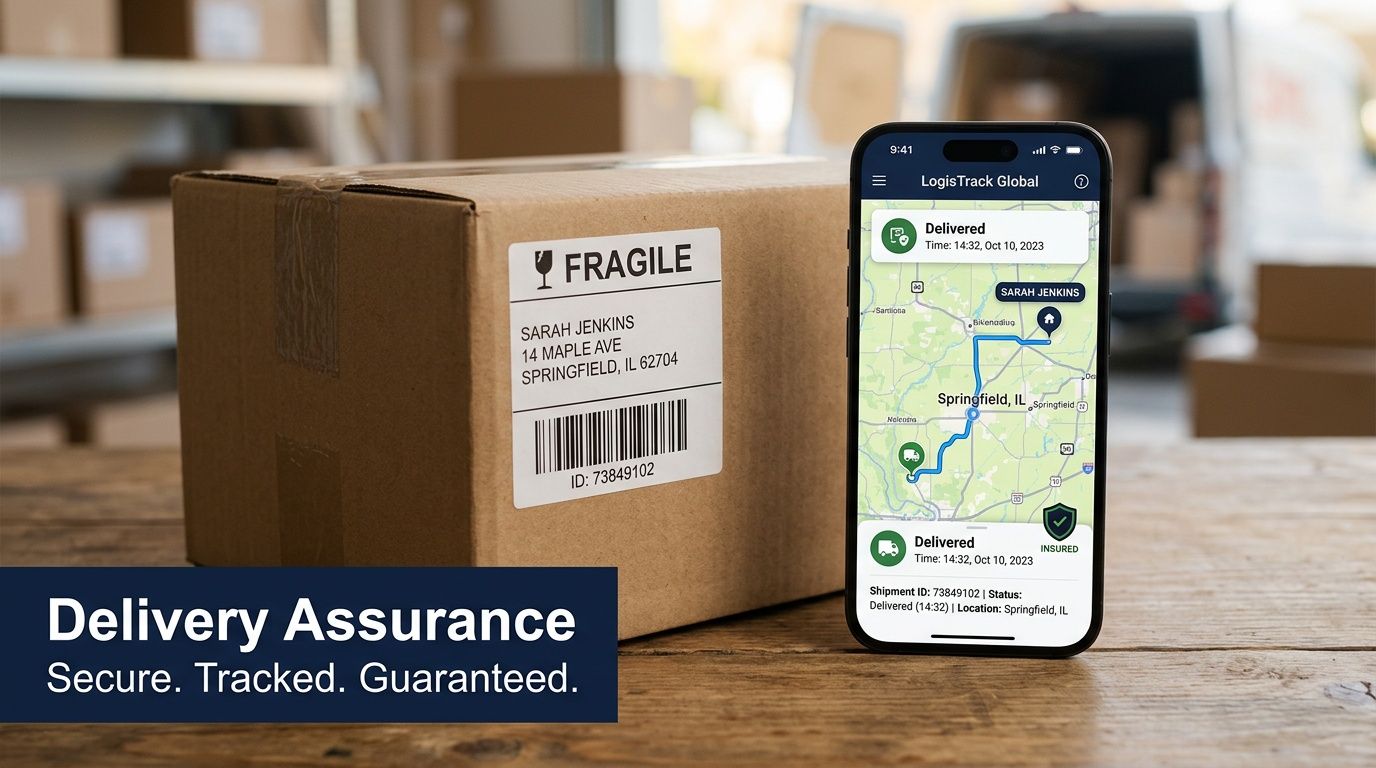
A parcel isn’t finished when it leaves your hands. That’s where trust either holds or starts to leak. Good shipping operations depend on three things working together: tracking that tells the truth, insurance that matches the item, and support you can reach.
What good tracking looks like now
A tracking number on its own isn’t enough. Customers expect movement updates that make sense. If a parcel sits in limbo with no scan events, they assume it’s lost, even if it’s merely delayed.
The stronger operators have set a clear benchmark here. Leading operators achieve on-time delivery rates exceeding 95% by using technologies like real-time GPS tracking and AI-driven dispatch systems to optimise routes and overcome Australia's unique geographical challenges, as noted by FST Express on courier technology and on-time performance in Australia.
For a small business, the practical lesson is simple. Don’t just ask whether tracking exists. Ask what the customer will see, and how often the information updates.
Insurance isn't just a tick box
Many senders assume a parcel is fully protected because the booking flow mentions cover somewhere. That assumption causes grief. Some bookings include limited protection. Some require extra cover for higher-value goods. Some claims fail because the packaging didn’t meet the carrier standard.
Check these points every time you compare providers:
- Included cover. What protection comes with the booking by default?
- Value limits. Does the included amount suit the item you’re sending?
- Packaging requirements. Could poor packing void the claim?
- Fragile or restricted items. Are there exclusions hiding in the fine print?
For businesses that regularly send customer orders, having a reference page for courier insurance options can save a lot of back-and-forth later.
Support matters most when something goes wrong
Nobody praises support on a perfect delivery day. They care when a parcel is delayed, scanned incorrectly, or damaged. That’s when a generic help form becomes a liability.
If you want a broader operations perspective, a guide to logistics operations is useful for understanding how shipping documents, handoffs, and accountability fit together behind the scenes. Even for simple parcel sending, the same principle applies. A clean process on paper usually leads to fewer disputes in real life.
The test I’d use is practical: if a customer emails you about a missing parcel at 3 pm, can you get useful information fast enough to answer them the same day? If not, your tracking and support stack isn’t good enough yet.
Common Shipping Pitfalls That Can Sink a Business
The worst shipping mistakes usually don’t look dramatic at first. They look like convenience. One provider for everything. One default carton size. One checkout promise for every postcode. Then the cracks widen.

The hidden risk most owners ignore
Price gets all the attention. Stability usually gets none, until it becomes the whole story.
That changed for many small businesses when the sudden closure of Sendle in January 2024 left its small business customers in limbo, highlighting a critical, often-overlooked risk: the need for contingency planning and choosing partners with proven stability, as covered by Procurement and Supply on the Sendle closure and its impact on small suppliers.
If your labels, dispatch process, customer notifications, and daily routine all depend on one platform, a shutdown isn’t just inconvenient. It can stop fulfilment cold.
Don’t ask only, “Is this cheap?” Ask, “What happens to my business if this option disappears next week?”
Cheap shipping can get expensive fast
A low base rate often hides the actual operational cost. The problems show up in places owners don’t always track properly:
- Manual follow-up. You or your team spend time answering “where is my order?” emails.
- Replacements and refunds. A damaged or late parcel eats margin twice.
- Checkout mistrust. Customers abandon when delivery promises feel vague or inconsistent.
- Exception handling. Address corrections, failed deliveries, and claim disputes clog the day.
What doesn’t work is treating shipping only as a cost-per-parcel line item. That ignores labour, support time, and brand damage.
Packaging mistakes create avoidable pain
Most courier disputes start before pickup. If the box is too weak, too large, poorly sealed, or badly labelled, the parcel enters the network already vulnerable. Then the claim becomes a debate about packing standards instead of a clean reimbursement.
A simple internal rule helps:
| Pitfall | Consequence |
|---|---|
| Oversized packaging | Higher charges and more movement inside the box |
| Weak tape or reused cartons | Split seams and damage in transit |
| No internal cushioning | Product damage even when the outer carton survives |
| Assuming all items are covered | Claim rejection or reduced payout |
Free shipping can quietly damage margin
“Free shipping” works as a sales message. It doesn’t work as maths unless you’ve built it into pricing, order thresholds, or product mix. Too many businesses offer it because competitors do, then discover their regional orders are the ones erasing profit.
If your shipping setup feels fragile, it probably is. The fix isn’t panic. It’s building options before you need them.
Finding Stability and Savings with a Courier Platform
For most growing businesses, manually juggling multiple couriers becomes messy long before it becomes efficient. Separate logins, different label flows, inconsistent tracking views, and no easy fallback option. That setup looks flexible until the daily volume rises.
A courier platform solves that problem by sitting between your business and the carriers. Instead of committing your whole operation to one provider, you compare services, book what fits the job, and keep options open if one network is delayed or unavailable.
Why the platform model works better for SMBs
The key advantage isn’t just convenience. It’s resilience. If one carrier is a poor fit for a route, or has service issues, you’re not rebuilding your process from scratch.
That flexibility pairs well with the broader tech shift in the market. Technology like AI route optimisation can reduce empty miles by 20-30%, while innovations like parcel locker networks can cut missed delivery rates from over 15% to under 5%, demonstrating how tech integration drives efficiency and reliability, according to Expert Market Research on the Australian courier, express and parcel market.
For small businesses, the takeaway isn’t that you need to build this tech yourself. It’s that your shipping setup should give you access to carriers and workflows already using it.
What to look for in a platform
The strongest platforms usually make a few things easy from day one:
- Instant quoting so you can compare services before you commit.
- Straightforward label creation without a long account application process.
- Tracking inside one dashboard rather than across multiple carrier portals.
- Optional service choices such as signature or added protection when needed.
One example is Aeros Couriers' courier comparison and booking platform, which lets users compare rates from multiple carriers, book online, print labels, and track shipments from one workflow. For SMBs focused on local parcels across Australia, that model reduces both admin load and dependence on a single carrier relationship.
Working rule: the cheaper shipping option is the one that stays manageable as order volume climbs.
Savings matter. Stability matters more than most owners think. The useful setup is the one that gives you both without forcing your team to learn three different systems just to send today’s orders.
Your Australian Courier Decision Checklist
Choosing between australian courier companies gets easier when you stop looking for a perfect provider and start scoring the fit for your business. A reliable choice is usually the one that handles your real mix of parcels, destinations, and customer expectations with the least friction.
Use this checklist before you commit.
Pricing and transparency
Ask for the full picture, not the headline rate.
- Are all charges visible up front? You want to know whether extras like signature or added cover change the final price.
- Does the quote reflect packed size, not product size? Too many businesses estimate off the item and forget the carton.
- Can you compare multiple options quickly? If rate checking takes too long, your team will stop doing it.
Delivery fit and coverage
Broad promises often break down in such circumstances.
- How clear are the ETAs for your actual destinations? Metro performance doesn’t automatically translate to regional consistency.
- Can the service handle residential deliveries cleanly? That matters for many e-commerce brands.
- Does the courier suit your order profile? A standard service may be right for most orders, with express reserved for exceptions.
Reliability and support
A polished checkout means little if help vanishes after booking.
- What does tracking show the customer?
- Can you reach local support when a parcel stalls?
- How stable is the business model behind the booking process?
Protection and process
This is the part people remember after a damaged delivery.
| Checkpoint | What good looks like |
|---|---|
| Tracking | Frequent, understandable updates |
| Insurance | Clear included cover and simple upgrade path |
| Packaging guidance | Easy to follow and practical |
| Proof of delivery options | Signature available when risk is higher |
Platform stability
This deserves its own question now. How long has the provider or platform been operating, and how dependent would your business become on it if you moved everything across?
If the answer makes you uneasy, keep looking. Convenience is useful. Dependence is dangerous.
If your business needs low-cost parcel delivery across Australia without the hassle of managing separate courier accounts, Aeros Couriers is worth a look. You can compare rates, book online, print labels, track jobs, and build a shipping workflow that stays practical as your order volume grows.
Courier quotes, tracking and support
Ready to send a parcel? Compare the available services for your postcodes, parcel dimensions and weight. For an existing delivery, use your consignment number to check tracking or ask our team for help.