
Sending a parcel across Australia shouldn't feel like a chore. It should feel like an achievement. This guide is your roadmap to mastering domestic shipping, turning you from a nervous sender into a logistics pro. Let’s pull back the curtain on the world of domestic courier companies and make every shipment of boxes and parcels Australia-wide a success story.
Your Guide to Sending Parcels Across Australia
Whether it’s a birthday gift for your cousin in Perth or your very first e-commerce order heading to Sydney, sending a package is about connection. It's an exciting moment! But the world of domestic couriers in Australia can sometimes feel a bit overwhelming, especially when you're looking for the fastest and cheapest option.
At its core, though, this industry is a powerful network built to bring people and businesses closer together, one parcel at a time. My goal here is to give you the confidence to navigate it all with absolute ease.
We'll unpack what really makes a courier service great, look at the different options you have for fast box and parcel delivery, and give you the insider knowledge to make sure your items arrive safely, soundly, and on schedule. Whether you're an online entrepreneur scaling up or just sending a care package to a mate, this is your path to clarity and peace of mind.
The Power of Local Shipping
The Australian domestic courier market is more alive and essential than ever before. This energy is being directly fuelled by the explosion in online shopping, which has completely reshaped how we all buy and sell goods across this vast country of ours.
The Australian domestic courier market hit an incredible AUD 12.5 billion in 2023, powered by a 15.2% annual jump in online retail sales. This boom means Aussie couriers are now handling over 2.1 million parcel shipments every single day, proving just how vital they are to our modern economy.
For small and medium-sized businesses (SMBs), this makes a reliable courier partner non-negotiable. In fact, these services are the backbone of e-commerce, responsible for a staggering 78% of all business-to-consumer deliveries.
With the market forecast to grow to AUD 18.7 billion by 2028, choosing the right partner for fast and affordable deliveries has never been more critical. You can get a deeper dive into these Australian courier market trends and what they mean for businesses like yours.
Understanding Courier Service Types
Not all shipping services are built the same. They're specialised to meet different needs, mostly balancing two key things: speed and cost.
Think of it like planning a trip. Sometimes you need the speed of a flight to get there tomorrow. Other times, a more relaxed and budget-friendly road trip is the perfect fit. Shipping works the exact same way.
To help you get started, here’s a quick breakdown of the main service types you'll come across when sending parcels around Australia.
Quick Guide to Australian Courier Service Types
This table summarises the main types of domestic courier services available for different parcel shipping needs across Australia.
| Service Type | Best For | Typical Speed | Common Use Case |
|---|---|---|---|
| Express/Overnight | Urgent documents and time-sensitive parcels | 1-2 business days between major cities | Sending a last-minute contract or a high-priority product. |
| Standard/Road | Cost-effective shipping for non-urgent goods | 3-7 business days depending on the route | Regular e-commerce orders or personal gifts. |
| Same-Day/Local | Immediate delivery within the same metro area | Within hours | Delivering urgent local documents or time-sensitive local parcels. |
Getting a handle on these basic categories is the first real step toward making a smart choice. When you match your parcel’s urgency and your budget to the right service, you’re not just sending a package—you’re setting yourself up for a successful, stress-free delivery every single time.
Understanding the Australian Courier Landscape
Remember when sending a parcel across Australia felt like you only had one or two choices? You picked the familiar name, paid their price, and hoped for the best. Well, those days are long gone. The courier world has completely changed.
Think of it like the Aussie coffee scene. You can still grab a reliable brew from a big chain, but now every corner seems to have an independent café with a unique blend, amazing service, or a loyalty card that actually feels rewarding. The shipping industry has gone through the same exciting transformation, and it puts you, the customer, firmly in the driver's seat.
This is fantastic news whether you’re a small business owner shipping products across the country or just sending a birthday gift to a mate. It means you no longer have to compromise. You can find a service that perfectly nails that sweet spot between speed, reliability, and what you’re willing to spend. Getting your head around this new landscape is the first step to making smarter shipping choices.
The Old Guard Meets the New Wave
For decades, a handful of giants dominated Australian logistics. These are the legacy carriers, the household names with vast, established networks of trucks, planes, and depots that can reach just about any postcode you can think of. They built the backbone of our national parcel delivery system, and their experience is undeniable.
But a new breed of player has entered the game, and they're not trying to build another trucking fleet. Instead, modern courier platforms and aggregators work as a clever digital layer, connecting you to all those legacy carriers through a single, user-friendly portal.
This model is a genuine game-changer for cheap and fast parcel delivery, and here’s why:
- Access to Better Rates: By buying freight in huge volumes, these platforms get wholesale prices that are usually off-limits to smaller businesses. They then pass those savings directly on to you.
- Real Choice: You can instantly compare quotes and delivery times from multiple domestic courier companies on one screen. No more jumping between websites to find the best deal for each specific parcel.
- One Simple System: Forget juggling multiple accounts and logins. You get a single dashboard to book, track, and manage every single delivery, no matter which carrier is actually doing the driving.
This healthy competition has forced the entire industry to lift its game. The result? Better pricing, more service options, and a real focus on what Australian businesses and individuals actually need for fast parcel delivery. You can see just how these integrated national courier services pull together the best of both worlds.
A Fragmenting Market Means More Power for You
This shift away from a market controlled by a few big names isn't just a feeling—the numbers tell the story loud and clear. It’s been driven by people like you demanding better prices and more flexible service.
As of early 2026, the top five couriers in Australia control about 68% of the market. That might sound like a lot, but it's a massive drop from the 82% they held back in 2018. This change has been fuelled by intense competition, with over 1,200 registered domestic courier firms now operating—a staggering 24% increase since 2020 alone. With 76% of businesses admitting they’ve switched carriers for better pricing, it's obvious where the power now lies.
This market shift is your advantage. It means finding a courier is no longer about accepting the default. It’s about actively choosing a partner that gets your goals, whether that’s saving money, delivering faster, or getting top-notch service.
Of course, a crucial part of this landscape is making sure everything is done by the book. All those vans and trucks on our roads are governed by strict regulations like the Heavy Vehicle National Law, which ensures safety and accountability. Working with a reputable platform means this compliance is already baked in, giving you peace of mind that your parcels are in safe, responsible hands.
How to Choose the Right Courier for Your Needs

Choosing the perfect domestic courier company can feel like a high-stakes balancing act. You're trying to weigh up speed, cost, and reliability, all while hoping your parcel gets where it’s going in one piece. But the secret isn't just about hunting for the cheapest rate; it’s about finding the absolute best value for what you actually need, right now.
This isn’t a game of chance. It’s about having a clear framework to make a smart, confident decision every single time you need to ship a box. By asking the right questions, you can cut through the marketing noise and find a partner that genuinely aligns with your goals for fast, cheap parcel delivery.
Let's break down exactly what you need to think about to make sure your parcels are always in the right hands. After all, there's no single "best" courier for every job, but there is always a best choice for your job.
Define Your Core Shipping Priorities
Before you even glance at a price, take a moment. What does a "successful delivery" truly look like for this specific parcel? Is it getting there by Tuesday morning at all costs, or is getting there affordably within the week perfectly fine? Your answers will instantly narrow down your options.
Start with these three game-changing factors:
- Speed: How Fast Is Fast Enough? Do you have a critical deadline that demands an overnight express service, or will a standard road service over a few days do the job? Express is fantastic for urgency, but standard delivery is far kinder to your budget for anything non-critical.
- Budget: What’s Your Sweet Spot? Be realistic about what you're willing to spend. It’s tempting to chase the absolute lowest price, but that might mean sacrificing proper tracking, insurance, or general reliability. The real goal is the best price for the level of service you actually require.
- Security: What Level of Assurance Do You Need? Is the item you’re sending valuable, fragile, or simply irreplaceable? If the answer is yes, then features like real-time tracking, signature on delivery, and included freight insurance suddenly become non-negotiable.
Thinking through these points creates a clear profile for your shipment. It’s the difference between shipping a signed contract and a pair of socks—both need to get there, but their priorities are worlds apart.
Look Beyond the Headline Price Tag
A cheap quote is only one piece of the puzzle. The best domestic courier companies offer more than just a low number; they provide a complete service that builds your confidence and saves you headaches down the track.
Once you have a few quotes in hand, it’s time to dig a little deeper and see where the real value lies.
A truly great courier partner delivers more than just your parcel. They deliver peace of mind, transparency, and the confidence that your shipment is being handled with care from the moment it leaves your hands to the moment it arrives.
This deeper value is where you find a long-term partner, not just a one-off service. For a detailed look at what that involves, you can learn more about how a modern package courier service brings all these elements together.
Key Service Features to Compare
To make a genuinely informed choice, you need to compare these specific features across different providers.
- Network Coverage: Does the courier have a strong presence in both the sending and receiving postcodes? This is absolutely vital for regional and remote deliveries, as some carriers are much stronger in certain parts of Australia than others.
- Customer Support: What happens when something goes wrong? Look for a provider with accessible, local Australian support. A 1300 number you can actually call is a massive advantage over dealing with offshore call centres or email-only support when you need a fast answer.
- Ease of Use: How simple is their booking process? A modern, user-friendly platform should let you get a quote, book a job, and print a label in just a few minutes. A clunky, complicated system is a hidden cost that wastes your valuable time.
- Insurance Policy: Is freight insurance included as standard? You need to understand the cover provided for loss or damage—it's a crucial safety net for protecting your investment.
By methodically working through these factors—your priorities, the deeper value, and the specific service features—you move from guessing to knowing. You equip yourself to choose a courier not just for one delivery, but to build a shipping strategy that truly empowers your business.
Navigating Prices to Save on Your Shipping Costs
Let's be honest, shipping costs can feel like a constant battle. But they don't have to eat into your profits. With a bit of insider knowledge, you can turn your shipping strategy from a necessary evil into a genuine competitive advantage. This is where you learn to master courier pricing and unlock real savings on every parcel you send Australia-wide.
Think about how a local supermarket stocks its shelves. They don’t buy a single can of soft drink at a time; they buy them by the truckload, securing a much lower price for each one. The world of domestic courier companies operates on the exact same principle.
When you book a one-off job directly with a big-name carrier, you're paying the standard retail price. But modern courier platforms act like that supermarket. They purchase shipping capacity in massive volumes, giving them access to wholesale rates that are simply out of reach for most small businesses. They then pass those savings directly on to you.
Wholesale vs. Retail Rates: The Game-Changer for Your Budget
The biggest secret to slashing your shipping spend is understanding the difference between retail and wholesale rates. It’s a simple concept with a powerful impact on your bottom line.
- Retail Rates: This is the price you see on a courier's website for a single booking. It’s designed for the public and doesn't factor in any kind of loyalty or volume.
- Wholesale Rates: These are the heavily discounted prices reserved for high-volume senders—like aggregator platforms—that commit to sending thousands of parcels. This bulk-buying power is what drives the cost per item way down.
By tapping into a platform that offers these wholesale rates, you immediately gain the buying power of a massive corporation, even if you’re only sending a few parcels a week.
Spotting and Sidestepping Hidden Fees
An attractive upfront quote can be deceptive. The logistics industry has a whole range of surcharges that can inflate your final invoice, so knowing what to look for is crucial for keeping your budget on track.
The price you're first quoted is rarely the final price you'll pay. It’s the extra fees for fuel, residential drop-offs, or awkwardly-sized items that cause bill shock. Your best defence is a transparent platform that shows you the all-in cost from the start.
Surcharges are an unavoidable part of shipping, but many can be minimised or avoided completely with a bit of foresight. To help you get ahead, we’ve broken down the most common fees and how to handle them. You can also get a more detailed look at how these charges affect your final bill in our complete guide to courier costs.
Here's a look at some of the usual suspects when it comes to extra courier charges.
Common Courier Fees and How to Avoid Them
| Fee Type | What It Is | How to Save |
|---|---|---|
| Fuel Surcharge | A variable fee that carriers add to cover fluctuating fuel prices. | This is hard to avoid, but comparing all-in quotes helps you see which carrier has the lowest combined rate on any given day. |
| Residential Delivery | An extra charge for delivering to a home address instead of a commercial one. | If possible, ship to a business address, office, or collection point. |
| Manual Handling Fee | A penalty for parcels that can't be processed by automated sorting machines (e.g., odd shapes, poor packaging). | Always use standard, sturdy cardboard boxes. Avoid tubes, satchels with loose items, or fragile packaging. |
| Redelivery Fee | Charged when the courier attempts delivery but no one is available to receive the parcel. | Use an ‘Authority to Leave’ (ATL) option where appropriate, or confirm someone will be present to accept the delivery. |
| Oversize/Overweight Fee | Applied to items that exceed the carrier’s standard size or weight limits. | Accurately measure and weigh your parcels before booking. If an item is large, check which carrier is most cost-effective for heavy goods. |
Understanding these fees is half the battle won. A little planning goes a long way in keeping your costs predictable and low.
With shipping expenses being a major headache for so many businesses, finding smart, cost-effective solutions is more important than ever. In fact, a staggering 92% of Australian businesses now cite shipping costs as a top concern. This is why platforms offering instant quotes, integrated tracking, and rewards are becoming so popular. By leveraging wholesale rates, these services can offer prices 20-30% below what you'd pay going direct—a massive win for any business.
Actionable Tips for Cheaper Shipping
Beyond just securing better rates, a few simple tweaks to your packing process can lead to significant savings. To get the absolute best value, exploring expert strategies to reduce shipping costs can seriously improve your bottom line.
Here are a few powerful habits you can start today:
- Optimise Your Packaging: Always use the smallest box that will safely house your item. Couriers calculate costs based on dimensional weight (the space a parcel occupies), so shipping empty air is literally throwing money away.
- Consolidate Your Shipments: If you have multiple items heading to the same address, combine them into one larger box. It’s almost always cheaper to send one consolidated shipment than several small ones.
- Compare, Compare, Compare: Don't ever settle for the first quote you get. A comparison tool lets you see real-time rates from multiple couriers side-by-side, so you can instantly pick the perfect balance of speed and price for every single job.
Mastering the Modern Courier Workflow
Shipping used to be a chore. Remember the days of paper dockets, endless phone calls just to get a quote, and the uncertainty of not knowing where your parcel was? Thankfully, the game has completely changed. Today, it’s all about the experience—the ease, control, and confidence you feel from the moment you book to the second it arrives.
The best domestic courier companies have moved far beyond just moving boxes. They've crafted a seamless digital workflow that puts the power right back in your hands. In just a few minutes, you can get an instant quote, book the job, print your label, and schedule a pickup, all from a single, clean online dashboard.
This isn't just a minor improvement; it’s about transforming a traditionally clunky process into something refreshingly simple. It frees you from admin headaches, giving you back precious time to focus on what really matters—growing your business or just getting on with your day.
The Power of a Digital-First Approach
This shift to a fully digital workflow isn't just about convenience. It’s a direct response to a massive surge in what customers expect and the skyrocketing volume of parcels crisscrossing Australia. As our love for e-commerce has grown, so has our need for faster, more transparent shipping.
The sheer scale of this growth is staggering. In a recent year, Australians received an incredible 1.2 billion parcels, a massive 220% jump from a decade ago. And with 82% of us now expecting to track our deliveries in real-time, the pressure has been on for couriers to adapt. For more on this trend, check out the global courier industry report.
Adopting a digital workflow with instant quotes, automated label printing, and a central tracking dashboard can cut your booking time by an amazing 70%. That’s a game-changing advantage in such a fast-paced market. It brings several key steps together into one fluid motion:
- Instant Quoting: Get immediate, clear pricing from multiple carriers.
- Effortless Booking: Lock in your shipment and details with just a few clicks.
- Automated Label Generation: Instantly create professional, compliant shipping labels.
- Scheduled Pickups: Easily arrange for a courier to collect the parcel from your door.
The Core Elements of an Effortless Workflow
At the heart of this modern approach are a few core features that work in harmony to give you a transparent, stress-free experience. These are no longer just ‘nice-to-haves’—they are the standard for any top-tier service.
Real-time tracking is probably the most important of all. It gives both you and your customer complete visibility over the parcel’s journey, turning any potential anxiety into happy anticipation. Every scan and update builds trust. Getting this step right is crucial, and you can learn more in our guide to perfecting your shipping labels printing process.
The modern courier workflow is designed to give you ultimate control and peace of mind. It’s about making logistics feel less like a challenge and more like an extension of your own efficiency, powered by transparency and simplicity.
Another non-negotiable is the inclusion of freight insurance. Shipping with the confidence that your parcel is automatically protected against loss or damage provides an invaluable safety net. It removes the guesswork and worry, allowing you to send your goods with absolute peace of mind.
This infographic breaks down a simple, three-step process for making the most of your shipping budget within this new workflow.
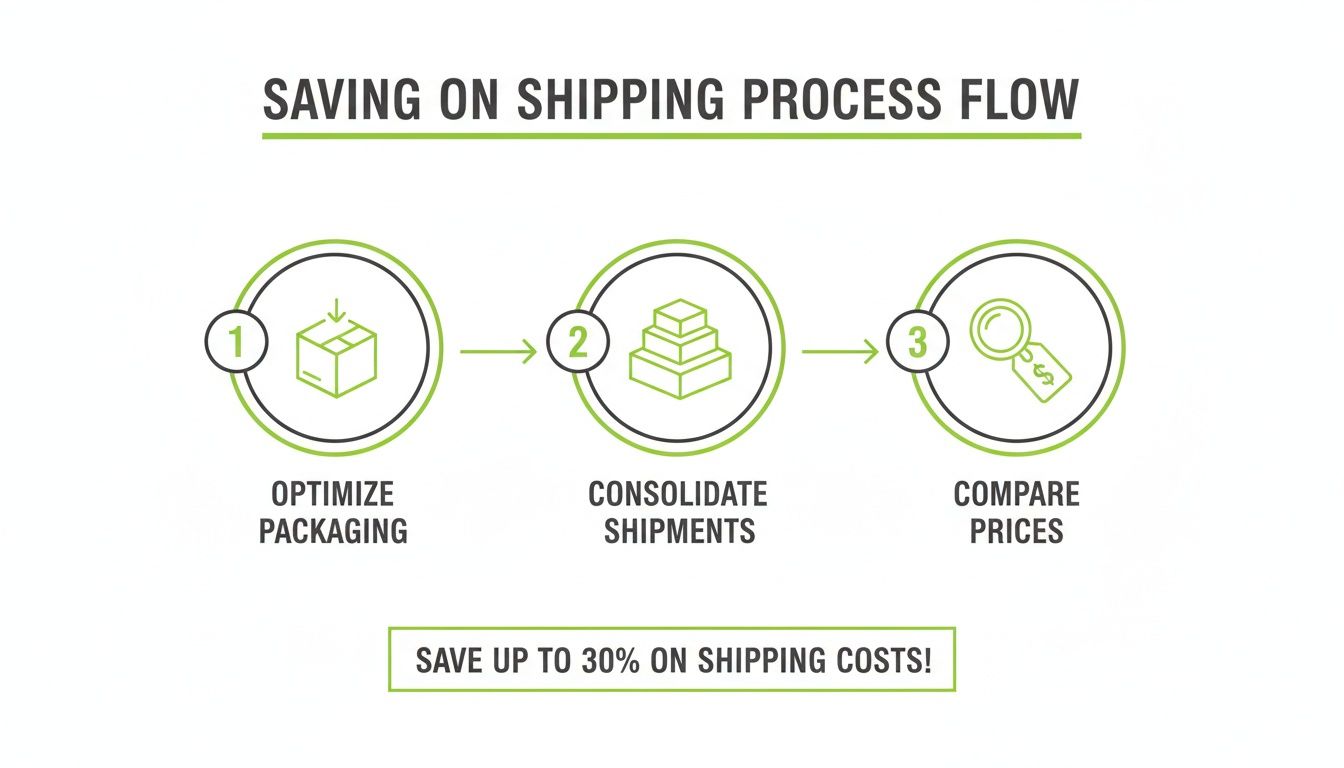
These steps—optimising your packaging, consolidating items, and comparing prices—are simple but powerful ways to cut costs without ever sacrificing quality or speed.
Frequently Asked Questions About Sending Parcels
When you're running a business, every minute and every dollar counts. So, it’s no surprise that when it comes to shipping parcels across Australia, the same few questions always pop up.
Let's walk through the answers I share most often. Getting your head around these key points can make all the difference between shipping being a headache and it becoming a real strength for your business.
How Can I Find the Cheapest Way to Send a Parcel in Australia?
Forget spending hours hopping between different carrier websites. The real secret to consistently finding the best price is using a shipping aggregator or multi-carrier platform.
Think of it like this: these platforms have incredible buying power because they represent thousands of businesses. This allows them to negotiate wholesale shipping rates you simply can’t get on your own. In one quick search, you can see all your options side-by-side and pick the perfect balance of speed and price for that specific parcel, without ever paying retail again.
What Is Dimensional Weight and How Does It Affect My Price?
This is a big one that catches a lot of people out. Dimensional weight (or cubic weight) is how carriers account for the space a parcel takes up, not just how heavy it is. A big, light box filled with cushions can cost more to ship than a small, heavy box of bolts because it eats up more valuable room on the truck.
To keep your costs down, always pack your items in the smallest box that will keep them safe. Use just enough filler to prevent movement, but don't overdo it. You want to pay to ship your product, not a box full of air. It’s a simple change that has a huge impact on your bottom line.
Do I Need Insurance for My Domestic Shipments?
While you don't have to get it, I strongly recommend freight insurance. It’s your financial safety net, especially when you’re sending anything valuable, fragile, or time-sensitive. It gives you genuine peace of mind, protecting you from the financial hit if something gets lost or damaged in transit.
The good news is that many modern shipping platforms now build a baseline of freight insurance right into their service. This takes the guesswork out of the equation and means your items are covered from the get-go, letting you ship with confidence.
What If I Don't Pack My Parcel Correctly?
Proper packaging isn't just about protecting what's inside; it's also about meeting the courier's rules. If your parcel is poorly packed or an awkward shape, it can be rejected outright or hit with a manual handling fee, instantly wiping out any savings you made.
Following the rules has become even more important. After regulatory changes to heavy vehicle laws back in 2023, carriers increased their compliance spending by 14%. As these package delivery statistics show, good packaging helps businesses avoid fines that can average over AUD 15,000 a year. It's also crucial to label your parcel correctly—you can learn more in our guide that explains what is a consignment note.
Can I Send Parcels from Home or Do I Need an Account?
Absolutely, you can. The old days of needing a corporate account and minimum monthly spend are long gone. Modern courier platforms are built for everyone, from home-based businesses to large warehouses.
You can book a one-off shipment from any home or office in Australia without any contracts. Just schedule a pickup online, print out the label, and the courier will collect it straight from your door. It’s just as easy to send a single gift as it is to dispatch a hundred orders a day.
Ready to see how simple, cheap, and fast sending your parcels across Australia can really be? At Aeros Couriers, we give you instant access to wholesale rates, a booking platform designed for real people, and genuine, local support. Get your free quote today and discover a better way to ship at https://www.aeroscouriers.com.au.
Courier quotes, tracking and support
Ready to send a parcel? Compare the available services for your postcodes, parcel dimensions and weight. For an existing delivery, use your consignment number to check tracking or ask our team for help.