

To compare courier prices in Australia, get instant quotes from several providers using identical parcel details, then convert each quote to a single “minimum total cost” figure before you decide. That figure, quoted price plus every unavoidable surcharge, is the one the ACCC says actually matters. Check liability and insurance terms and realistic transit times before you book.
TL;DR:
- Use identical parcel dimensions, weight, service level, and pickup options across providers; calculate cubic weight as length times width times height divided by 5,000, typically.
- Add residential, fuel, and remote area fees, then check whether declared value, insurance, and applicable GST add further costs to the final bill.
- Treat transit time as part of the price: standard delivery may take a few business days, while express can arrive next day for more.
- Businesses with mixed parcel sizes should compare tiered pricing, while flat rates suit consistent sizes but can lose money on bulkier shipments.
- Ask carriers to confirm postcode surcharges in writing, since address corrections, redelivery, or depot remeasurement can add fees after pickup.
Table of Contents
- How courier pricing works in Australia: what each line in a quote means
- Practical checklist: what to enter and compare when you pull quotes
- Step-by-step calculation: convert quotes into a single comparable minimum total cost
- Money-saving tactics that don’t sacrifice reliability
- Publisher perspective: how we apply transparent pricing to make comparisons simple
- Typical timeline expectations and how transit time affects price
- Where to find transparent pricing and your rights under ACCC and ACL
- Tips for comparing quotes fairly across different couriers
- Common pitfalls and hidden fees to watch for beyond standard surcharges
- Why parcel tracking and customer support quality matter for value
- Why we prioritise transparency over lowest headline rate
- Compare and book with Aeros: a practical next step
- FAQ
- Sources
How courier pricing works in Australia: what each line in a quote means
A courier quote is built from a few predictable layers, and understanding them is the only way to tell a genuinely cheap service from one that just looks cheap on the surface.
Most couriers price by weight band, by delivery zone, or through a flat rate that applies regardless of distance. Heavier or bulkier parcels often get pushed into a higher tier automatically, which is where volumetric weight comes in. Carriers calculate cubic weight from a parcel’s length, width and height, and if that figure is higher than the actual scale weight, they charge on the cubic figure instead. A doona box might weigh 3kg but take up as much van space as a 12kg parcel, so it gets billed accordingly.
On top of the base rate, several surcharges commonly apply:
- Fuel levies, which move with fuel costs and are rarely included in the headline rate.
- Residential delivery fees, charged because home drop-offs take longer than business addresses.
- Handling fees for oversized, irregular or heavy items.
- Remote area surcharges for postcodes outside metro zones.
- Peak season loadings around Christmas and other high-volume periods.
- Express or priority premiums for faster service levels.
Insurance and declared value also affect the final quote. Some carriers include a basic liability limit by default and charge extra for higher declared value, so this needs checking before you compare two quotes side by side. On the tax side, the ATO notes that whether GST applies to a delivery charge depends on how the supply is structured, so businesses need to apportion the delivery cost correctly rather than assume one blanket treatment.
The decisive figure isn’t the quoted base rate. Under ACCC pricing guidance, the price shown to consumers must be the minimum total cost, including taxes and any unavoidable or pre-selected fees.
Practical checklist: what to enter and compare when you pull quotes
Running quotes through several providers only works if you feed each one exactly the same information. Here’s a repeatable sequence:
- Measure the parcel’s length, width and height in centimetres, then calculate cubic weight (length × width × height ÷ 5,000 for most Australian carriers) to get a comparable volumetric figure.
- Enter the same service level, whether that’s standard, express or same day, into every quote tool so you’re comparing equivalent speed.
- Choose identical pickup and delivery options, door-to-door versus depot drop-off, since convenience changes price.
- Add any surcharges you expect to apply, such as residential delivery or remote area fees, even if the calculator doesn’t flag them automatically.
- Decide on a declared value and check what liability is included by default versus what costs extra as optional insurance.
- Record the quoted transit time and ask directly whether that window is guaranteed or indicative.
Pro Tip: Run two mock quotes for the same parcel, one using actual weight and one using cubic weight, so you know in advance which figure the carrier will bill on.
Skipping any one of these steps usually means two “quotes” aren’t actually comparable, and the cheaper-looking one can end up costing more once the missing pieces are added back in.
Step-by-step calculation: convert quotes into a single comparable minimum total cost
Start with the quoted price from the online tool, the headline figure before anything else is added. Then calculate volumetric weight and check which measure, actual or cubic, the carrier applies to your parcel, since this decides the base rate they’ll actually bill.
From there, add every fee you can reasonably expect:
- Residential delivery surcharge, if the drop-off address is a home.
- Fuel levy, usually a percentage of the base rate.
- Remote area surcharge, if the postcode qualifies.
The sum of the quoted price plus these unavoidable fees is the minimum total cost, the figure ACCC guidance says must reflect what a customer will actually pay, including taxes and any pre-selected extras.
GST treatment and insurance choice both move this number further. If delivery is charged separately from goods, the ATO’s guidance on apportioning consideration determines whether GST applies to that component. Opting for higher declared value adds a premium on top. When a quote looks unusually low, contact the carrier directly and ask for written confirmation of the full minimum total cost before booking, particularly for irregular or high-value shipments.
Money-saving tactics that don’t sacrifice reliability
Flat-rate shipping is convenient when your parcels are a similar size, but Business it can undercharge you once product sizes vary, since a flat fee set for small items starts losing money on bulkier ones. Tiered or exact-cost pricing suits businesses with mixed SKU sizes better.
A few other tactics help without compromising service:
- Optimise packaging dimensions to avoid tipping into a higher volumetric weight bracket.
- Batch multiple shipments together where possible, since regular shippers typically get better rates than one-off bookings.
- Use depot drop-off instead of door-to-door pickup when convenient, as it often reduces the quoted price.
- Negotiate volume rates if you ship regularly, rather than relying on spot discounts.
- Redeem rewards points or loyalty programme discounts where a courier offers them, since these reduce the effective cost per shipment over time.
Pro Tip: Before locking in a flat-rate plan, run three of your typical parcel sizes through a cubic weight calculation; if even one regularly exceeds the flat-rate assumption, a tiered price will usually save more over a month.
Publisher perspective: how we apply transparent pricing to make comparisons simple
We built our compare-and-book platform around the same idea this checklist relies on: the number that matters is the total you’ll actually pay, not the number in the biggest font.
- We quote parcels up to a typical business weight limit with pricing designed to avoid hidden fuel surcharges or handling costs.
- We show surcharges up front rather than adding them at invoicing, so the quote you see is closer to the minimum total cost you’ll be billed.
- We use route optimisation technology to keep delivery reliable while keeping rates competitive.
- We include active parcel monitoring and a rewards programme that reduces the effective cost of future shipments.
Running your own comparison is still worth doing, but a platform that discloses surcharges at quote stage removes most of the guesswork this article has been walking through.
Typical timeline expectations and how transit time affects price
Transit time is one of the biggest levers on price, and it’s worth separating expectation from guarantee before comparing quotes. Standard or economy services typically take longer because parcels are consolidated with other freight along the route, while express and same-day services cost more precisely because they skip that consolidation step.
A metro-to-metro parcel moving on a standard service might take a few business days, while the same parcel sent express can arrive the next day, at a noticeably higher price. Interstate and regional deliveries stretch timelines further, and remote postcodes can add both days and surcharges to the same parcel.
When comparing quotes, treat the stated transit time as part of the price, not a separate detail. A slightly cheaper quote with a vague delivery window isn’t necessarily better value than a slightly dearer one with a firm, guaranteed date, particularly for time-sensitive business shipments. Ask each carrier whether their quoted timeframe is a guarantee or an estimate, since only a guarantee carries any real weight if the parcel arrives late.
Where to find transparent pricing and your rights under ACCC and ACL
Australian consumer law gives you a clear right to see the real price before you commit. Under ACCC guidance, a displayed price must be the minimum total cost, including GST and any unavoidable or pre-selected extra fees, and businesses must not mislead customers about what they’ll actually pay.
That protection sits alongside the Australian Consumer Law’s general prohibition on misleading price representations. If a courier’s website or quote tool buries a mandatory fee until the final checkout screen, that’s the kind of practice the ACCC’s guidance is designed to prevent.
Worth noting separately: the ACCC’s monitoring of postal services treats parcel delivery as a competitive, non-reserved market, meaning prices aren’t regulated the way reserved letter services are. Competition between providers is what keeps rates in check, which is exactly why comparing quotes properly matters more than it would in a regulated market.
For business shipments specifically, it’s worth remembering that standard consumer guarantees don’t always apply the same way; the ACCC’s guidance on consumer rights is a useful starting point, but commercial shippers should still read the carrier’s own terms and arrange declared value or commercial insurance where needed.
Tips for comparing quotes fairly across different couriers
Different couriers structure their fees in different places, which makes side-by-side comparison harder than it looks. One carrier might fold fuel levies into the base rate while another lists it separately; one might include basic insurance by default while another charges it as an add-on.
A few habits keep the comparison honest:
- Always compare the minimum total cost, not the headline figure, since that’s the only number that reflects what you’ll actually pay.
- Use identical parcel dimensions, weight and service level across every quote you pull.
- Ask each provider to confirm, in writing, which surcharges apply to your specific postcode and parcel type.
- Check whether declared value and liability cover are included or optional, since this can swing the effective price significantly.
Business.gov.au’s shipping guidance also points to comparing providers on quote ease-of-use, shipping speed, parcel size and weight handling, pickup convenience, and compensation terms, not price alone. A courier that’s marginally dearer but offers clearer terms and more reliable tracking can still be the better value choice for a regular shipper.
Common pitfalls and hidden fees to watch for beyond standard surcharges
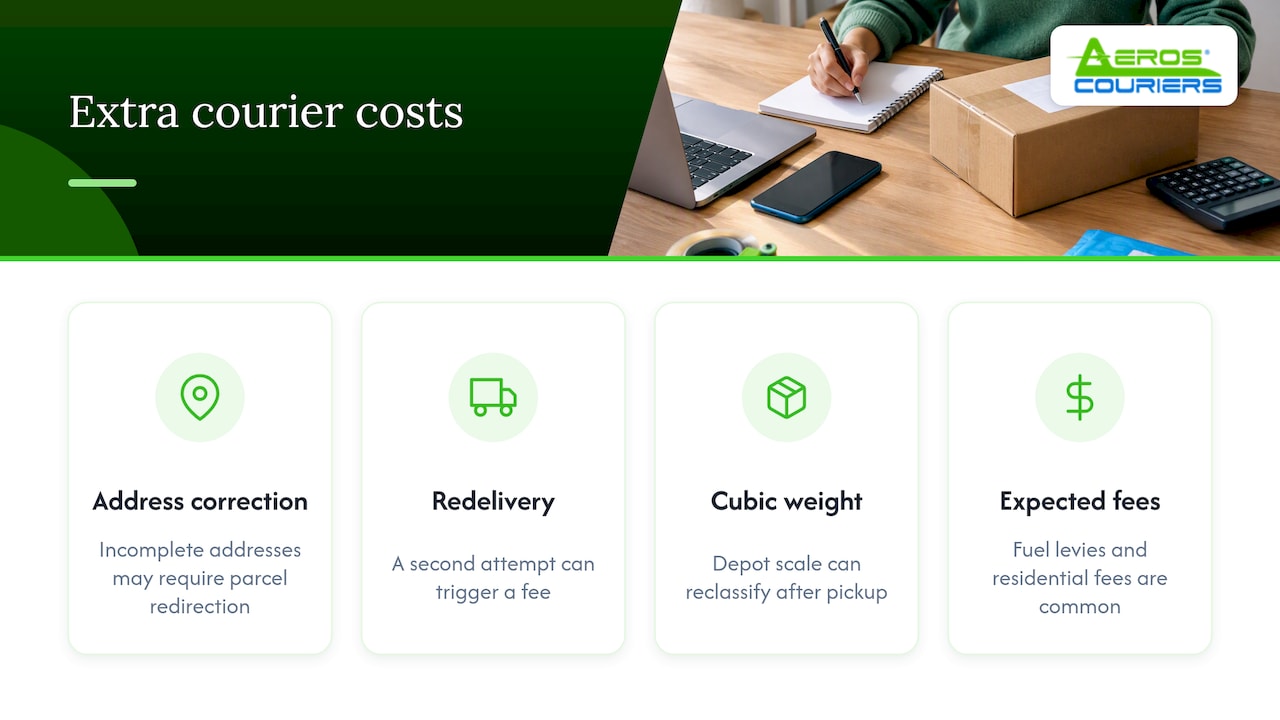
Beyond the fuel levies and residential fees most people expect, a few less obvious costs catch shippers out. Address correction fees apply when a delivery address is incomplete or incorrect and the carrier has to redirect the parcel. Failed delivery or redelivery fees can apply if nobody’s home and a second attempt is needed. Oversize or dimensional weight reclassification can also happen after the parcel’s already been picked up, if the carrier’s depot scale disagrees with the dimensions entered online.
Business.gov.au notes that volumetric weight is one of the most commonly underestimated factors in a courier bill, since light but bulky items frequently get billed on cubic weight rather than actual weight. Running a mock quote with both measures before you ship avoids this surprise at invoicing.
It’s also worth checking packaging requirements for specialised items. A shipper checklist for packaging and documentation set out for high-value parts shipments is a useful reminder that insufficient packaging or missing paperwork can trigger holds, extra handling fees or even damage claims that eat into any savings from a cheaper base rate. The same logic applies to any fragile, oversized or high-value parcel moving through a standard courier network.
Why parcel tracking and customer support quality matter for value
Price comparison shouldn’t stop once you’ve found the lowest minimum total cost. A courier that’s slightly dearer but gives you live tracking and fast, human customer support can deliver better overall value, particularly when something goes wrong.
Real-time tracking lets you spot a delay early and act on it, rather than finding out a parcel’s missing only when a customer complains. For businesses shipping regularly, that visibility also makes it easier to manage customer expectations and reduce support queries about “where’s my order”.
Support responsiveness matters just as much. A delayed or damaged parcel is far less stressful to resolve when a carrier answers quickly and clearly, rather than routing you through a slow ticketing system. When comparing quotes, it’s worth factoring in whether a provider publishes support contact details clearly and whether reviews mention fast resolution times, since this is part of what you’re actually paying for, even if it doesn’t appear as a line item on the quote.
Why we prioritise transparency over lowest headline rate
The cheapest-looking quote is often the most expensive once every surcharge lands on the invoice. Hidden fuel levies, handling fees and remote area charges can turn a bargain rate into the dearest option in practice.
We’d rather readers choose providers who disclose surcharges and liability terms before booking, not after. Run the checklist in this article against any quote you’re considering: measure, calculate cubic weight, add the surcharges, then compare the real minimum total cost. That’s the only fair test.
— Aeros
Compare and book with Aeros: a practical next step
Once you’ve worked through the checklist, running a live quote is the fastest way to see how it plays out in practice. We quote parcels up to 25kg, and we show surcharges at quote stage rather than adding them later, so the figure you see is built to match the minimum total cost you’ll be billed.

- We compare rates across major carriers instantly, so you’re not pulling quotes one by one.
- We include active parcel monitoring and responsive support if anything needs sorting.
- We run a rewards programme that reduces the effective cost of future bookings.
Enter your parcel details into our compare-and-book tool and test today’s rate against the checklist above before you commit.
FAQ
How do I ship a package within Australia?
Measure and weigh your parcel, then run quotes through an online comparison tool using identical details for each provider. Compare the minimum total cost, quoted price plus any unavoidable surcharges, rather than the headline rate, then book with a provider that confirms transit time and liability terms in writing.
What should I look for in a courier service in Australia?
Look for clear pricing with surcharges disclosed up front, realistic transit time commitments, and included or affordable insurance options. Business.gov.au’s shipping guidance also recommends weighing up pickup convenience, parcel size and weight handling, and the quality of tracking and reporting tools.
What drives down the cost of courier delivery compared to standard rates?
Flat, transparent pricing with no fuel surcharge or handling fee typically lowers the total cost compared with quotes that add several surcharges after the fact. Our rates start from competitive levels for parcels up to 25kg, with surcharges disclosed at quote stage rather than added later.
How much does a courier charge for delivery in Australia?
Courier charges depend on weight or volumetric weight, delivery zone, service level and any applicable surcharges such as fuel or remote area fees, so there’s no single standard rate. The only reliable way to know the real cost is to request a quote for your specific parcel and add any unavoidable surcharges to reach the minimum total cost.
Should I always compare courier prices before booking?
Yes, since fee structures vary significantly between providers and the headline rate rarely reflects the full cost. Comparing the minimum total cost, as outlined in ACCC pricing guidance, is the most reliable way to avoid surprises at invoicing.
Sources
Recommended
- What Is the Cheapest Local Courier in Australia?
- Cheap Courier Interstate Shipping Your Ultimate Guide
- The Cheapest Way to Send a Parcel in Australia
- A Guide to Australian Postal Parcel Prices
Courier quotes, tracking and support
Ready to send a parcel? Compare the available services for your postcodes, parcel dimensions and weight. For an existing delivery, use your consignment number to check tracking or ask our team for help.