

Let’s talk about the final, and most critical, leg of your product's journey: last mile delivery. This is the short but incredibly important step from a local depot or fulfilment centre right to your customer’s front door. For any Australian business, this final stage is often the most expensive and logistically complicated part of the entire shipping process, which is exactly why it needs your focus.
The Final Frontier of E-commerce
Picture this: your product arrives at a local distribution hub in Melbourne. But the most complex part is still ahead—those last few kilometres to a customer's apartment in a busy CBD laneway or a home on a quiet suburban street.
That final handover is where the magic happens. For most online brands, it’s the only real, physical touchpoint you have with your customers. A fast, reliable, and transparent delivery turns a simple transaction into a brilliant brand experience. On the flip side, a delayed or damaged parcel at this stage can undo all the great work you've put into your product and marketing.
Why It’s So Crucial for Australian Businesses
For Aussie SMBs, getting last mile delivery right isn't just about logistics anymore; it’s a massive competitive advantage. Online shoppers' expectations have skyrocketed. The delivery experience now heavily sways their satisfaction, their loyalty, and whether they'll ever buy from you again.
This is especially true here in Australia, where our geography throws some unique curveballs. Delivering a package efficiently within a local area means navigating:
- Dense urban centres like Sydney, with all their traffic and parking nightmares.
- Sprawling suburban communities with countless individual drop-off points.
- Vast regional and outback areas where the distance between two stops can be huge.
The Australian last mile delivery market isn't just growing—it's exploding. Valued at around AUD 5.5 billion in 2022, it's forecast to hit AUD 7.5 billion by 2027. This boom follows the incredible rise in online sales, which are predicted to jump from AUD 62.4 billion in 2021 to a staggering AUD 99.4 billion by 2026.
This growth opens up massive opportunities, but it also ramps up the pressure. Getting packages to local doorsteps efficiently is now a make-or-break factor for success. Small businesses that nail their last mile delivery will win customers and keep them coming back.
By getting to grips with the challenges and importance of this final step, you can fine-tune your shipping strategy and turn every delivery into a moment that strengthens your brand. A great place to start is by comparing the different courier services available in Australia.
Decoding the True Cost of Your Deliveries
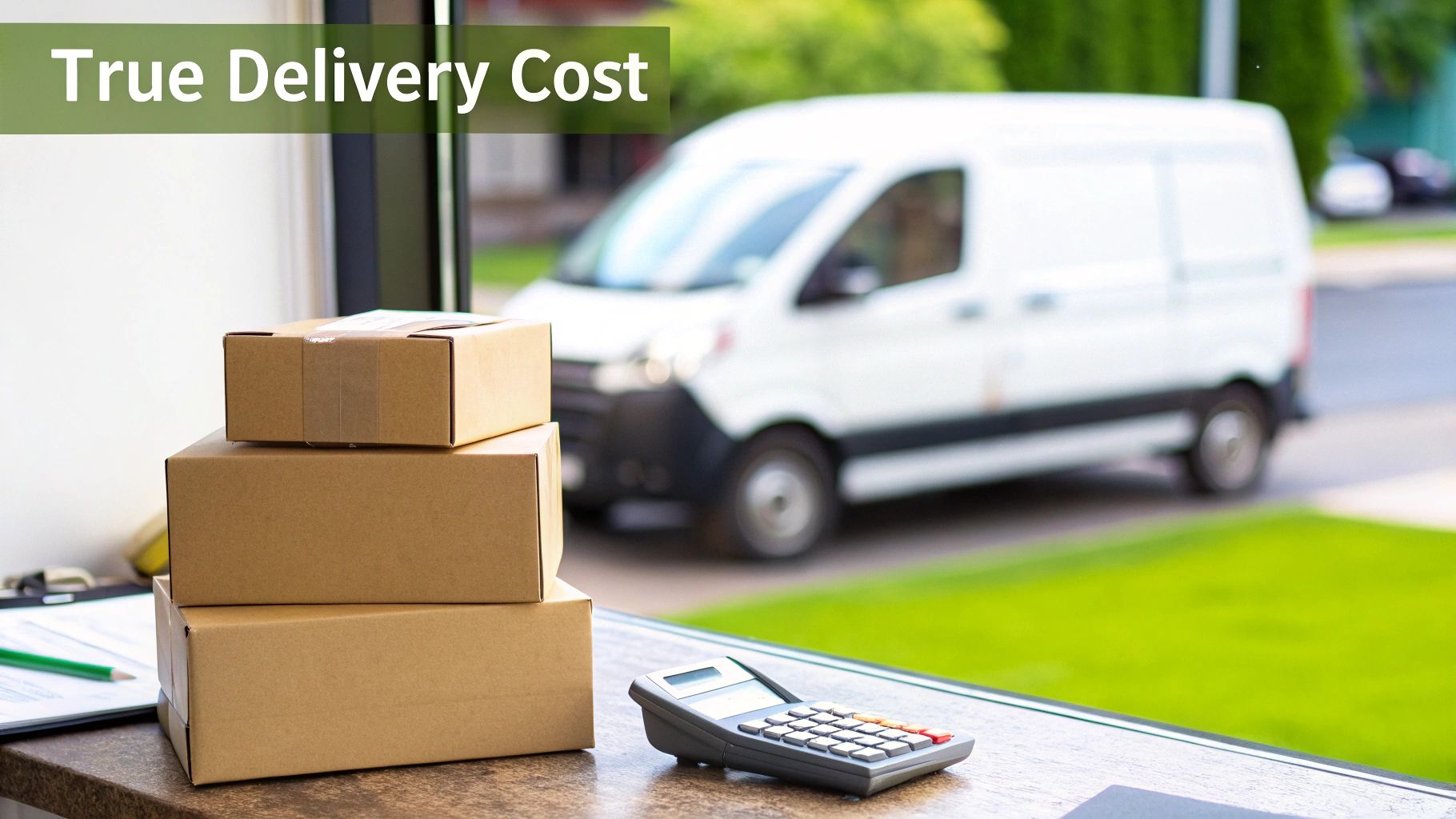
The price you see on a shipping invoice is just the tip of the iceberg. The real expense of last-mile delivery is often hiding in plain sight, buried in day-to-day operational hiccups and surprise charges that can quickly blow out your budget. For any Australian business, looking past the obvious costs like fuel and wages is the first step to figuring out where your money is really going.
It’s a bit like a home reno. The initial quote seems reasonable, but then you knock down a wall and find a problem that needs more time, more materials, and more money to fix. That initial shipping quote rarely accounts for the costly curveballs that pop up during that final, crucial leg of the journey.
Beyond the Obvious Expenses
A whole host of factors contribute to what it actually costs to get a package into your customer’s hands. While everyone expects to pay based on distance and package weight, several other elements can send expenses soaring.
These hidden costs usually fall into a few key areas:
- Failed Deliveries: One missed delivery isn't just an annoyance; it's a direct hit to your profit. The driver has to loop back, the parcel needs storing, and a second trip has to be organised. That's double the labour and fuel for a single order.
- Urban Congestion: Trying to get around Sydney or Melbourne during peak hour burns through fuel and adds precious time to every delivery run. It ultimately means fewer parcels dropped off per driver, per day.
- Geographic Premiums: Reaching customers in regional or remote postcodes always comes at a premium. These routes are far less dense, which translates to more kilometres and more time between each drop-off.
A failed delivery attempt is one of the most significant hidden costs in last-mile logistics. The process of re-routing, re-storing, and re-attempting delivery can erase the profit margin on a sale entirely, turning a successful order into a financial loss.
Dissecting the Real Budget Killers
To really get a grip on your expenses, you need to zoom in on the specific scenarios that quietly drain your bank account. These situations are all too common across Australia and represent the real-world headaches that mess with your shipping budget.
Failed Deliveries in High-Density Areas
Picture a courier trying to deliver a parcel to a secure apartment building in the Sydney CBD. If the customer isn't home to buzz them in, the delivery fails. This exact scenario plays out thousands of times a day, and it's incredibly expensive. The driver loses valuable time on their run, and your business is now on the hook for coordinating a redelivery, which usually comes with extra fees and admin.
The Surcharge for Speed
Customers increasingly expect same-day or next-day delivery, but that speed comes at a serious price. Express services force carriers to prioritise certain parcels, often pulling drivers off their standard, more efficient routes. This logistical shuffle means you pay a premium for urgency—a cost that can be tough to absorb, especially on lower-margin products. To get a better idea of how these variables hit your bottom line, you can explore a detailed breakdown of different courier costs in Australia.
The Financial Impact of Returns
Returns are just a part of doing business in e-commerce, but they’re effectively the entire last-mile process in reverse. This "reverse logistics" means you're paying for the parcel's return trip, the labour to inspect and restock it, and the admin to process the refund. It all adds up to a significant operational cost that many businesses simply don't factor in. Looking beyond specific delivery fees, adopting broader supply chain cost reduction strategies can unlock major savings across your entire logistics operation.
Once you start seeing these hidden expenses for what they are, you can make smarter decisions and find opportunities to trim costs without sacrificing your customer service.
How to Measure Your Delivery Performance
There's an old saying in business: "you can't improve what you don't measure." When it comes to your shipping, just guessing how things are going is a surefire way to burn through cash and leave customers disappointed.
To really get a grip on your last mile delivery, you need to track a few key numbers—what we call Key Performance Indicators (KPIs). These are the vital signs for your delivery operations, turning vague feelings like "shipping seems slow" into concrete problems you can actually solve.
Think of it like the dashboard in your car. You wouldn't set off on a road trip without a fuel gauge and a speedometer. In the same way, you can't run a successful business without knowing how quickly, accurately, and affordably your parcels are getting to your customers' doorsteps. These numbers give you the power to make smart decisions, showing you exactly where you can tighten up your budget and lift your game.
The Most Important Last Mile KPIs
For Australian businesses, you don't need to track dozens of metrics. Focusing on a few core KPIs will give you the clearest insights without drowning you in data.
-
On-Time Delivery (OTD) Rate: This is simply the percentage of your orders that arrive by the promised delivery date. It's the ultimate measure of your reliability and has a massive impact on customer happiness. A consistently high OTD rate builds serious trust and keeps people coming back.
-
Cost Per Delivery (CPD): This is your all-in cost for getting a single package to its destination, divided by the number of successful deliveries. It’s not just the courier fee; it includes everything from fuel surcharges and packaging materials to the time your team spends picking and packing. Keeping a close eye on your CPD is fundamental to protecting your profit margins.
-
Order Accuracy Rate: This one’s straightforward—how many orders are delivered perfectly? That means the right items, to the right address, with zero mistakes. A poor accuracy rate doesn’t just frustrate customers; it creates a cascade of expensive problems like returns, redeliveries, and damage to your hard-earned reputation.
These three metrics are the bedrock of any solid performance measurement system. They tell you if you're keeping your promises, controlling your costs, and getting the fundamentals right.
Tracking and Improving Your Metrics
Keeping tabs on these KPIs doesn't have to be a manual nightmare. Most modern courier platforms have built-in dashboards that do the heavy lifting for you, tracking these numbers automatically.
A great first step is to establish your baseline. Just track each KPI over a month to see where you stand. For example, if you discover that 92% of your orders are arriving on time, you can set a realistic goal to lift that to 95% next month. It’s also important to understand the journey of your parcels. Digging into the different stages of a shipment, like the meaning of in-transit status, can help you pinpoint exactly where delays are happening.
For Australian e-commerce, a good benchmark for On-Time Delivery is anything above 95%. If your rate is dipping below that, it’s a strong signal that something is wrong—it could be your choice of carrier or a bottleneck in your own warehouse. Either way, it’s time to investigate.
To help you get started, here’s a quick reference guide to the most essential KPIs for any Australian small or medium-sized business.
Essential Last Mile Delivery KPIs for Australian SMBs
This table breaks down the key metrics you should be watching to measure and improve your last mile performance.
| KPI (Key Performance Indicator) | What It Measures | Why It's Important for Your Business |
|---|---|---|
| On-Time Delivery Rate | The percentage of orders delivered by the estimated date. | Directly impacts customer satisfaction and loyalty. High rates build trust. |
| Cost Per Delivery | The total expense to deliver a single order successfully. | Reveals the true cost of your shipping and is critical for profitability. |
| Order Accuracy | The percentage of orders delivered without errors. | Minimises costly returns and protects your brand's reputation. |
By keeping these metrics front and centre, you can move from reacting to delivery problems to proactively managing them, ensuring your shipping becomes a competitive advantage.
Navigating Common Australian Delivery Hurdles
Australia’s local geography throws up a set of last-mile delivery challenges you just don’t see in many other parts of the world. Getting a package from a depot to a doorstep is one thing in a dense Sydney suburb, but it's a completely different ball game in a remote Queensland community. To get this final, crucial step right, you have to understand and plan for these distinctly Australian roadblocks.
The difference between city and country logistics is night and day. In metro areas, the main enemy is density. Couriers are in a constant battle with gridlocked traffic, navigating tricky multi-storey apartment buildings, and finding a legal place to park. Every minute spent circling the block is a minute not spent delivering, which sends costs up and slows everything down.
Out in regional and outback Australia, it's the complete opposite problem: a lack of density. The distances between drop-offs can be huge, stretching fuel budgets and driver hours to the absolute limit. A single delivery run might chew through hundreds of kilometres to service just a handful of customers, making it incredibly tough to stay cost-effective.
The Urban Versus Rural Divide
This fundamental contrast in the landscape directly hits your delivery times, costs, and ultimately, your customer's experience. You need a flexible strategy that can handle the high-frequency, stop-start nature of a city run as well as the long-haul reality of a regional route. The carriers and tools that are perfect for Melbourne might be totally wrong for getting a parcel to the Northern Territory.
These regional differences really shape Australia's last-mile delivery scene. High-volume metro routes allow for full trucks and better costs per parcel. But to service remote areas, carriers are having to get creative with things like drones and parcel lockers just to keep timelines and expenses in check. This adaptability is critical. Poor rural road quality and different state regulations make a one-size-fits-all approach impossible, highlighting the need for a versatile courier platform.
Understanding Your Legal Responsibilities
Beyond the physical challenges, Australian businesses also have to navigate a serious set of rules known as the Chain of Responsibility (CoR). These laws are all about improving safety in the transport industry, and they don't just apply to the courier companies—they apply to anyone sending or receiving goods.
Put simply, CoR means that if you're sending something, you share the legal responsibility for making sure it's transported safely.
Under Chain of Responsibility (CoR) laws, everyone in the supply chain can be held legally accountable for safety breaches. This includes the business packing the box, the warehouse loading it, and the driver at the wheel. It covers everything from declaring the correct weight and dimensions to ensuring goods are packed securely.
This has a direct impact on your business. For instance, if you under-declare the weight of a heavy pallet and it causes a truck to be overloaded, your business could be hit with massive fines. It's your legal duty to pack things properly so they don't shift in transit and to give your courier accurate information. Working with a courier platform that gives you clear guidelines on these rules is a must for staying compliant. It also helps you sidestep unexpected costs, and you can learn how to steer clear of extra courier charges to keep your budget on track.
This flowchart breaks down the essential performance indicators that show you how well you're managing these hurdles.
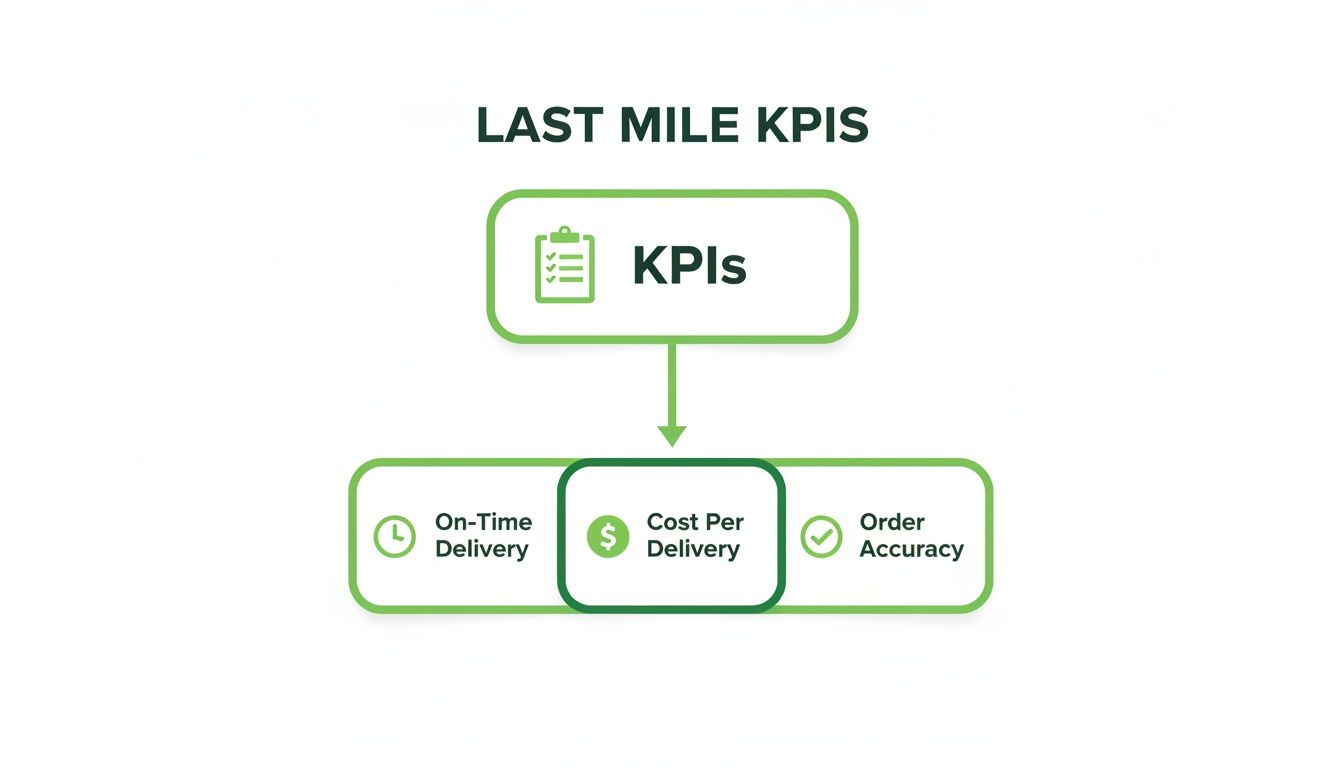
By keeping a close eye on metrics like on-time delivery rates and your average cost per delivery, you can see exactly how these geographical and regulatory challenges are affecting your bottom line.
Real-World Ways to Fine-Tune Your Last Mile
Knowing the challenges of last mile delivery is one thing, but actually overcoming them is a whole different ball game. This is where we move from theory to action. To build a delivery experience that keeps customers coming back and protects your bottom line, you need a playbook of practical, high-impact strategies you can start using today.
The key isn't to rip up your entire operation and start again. It’s about making smart, incremental changes that add up to big improvements. From smarter route planning to crystal-clear customer communication, these are the strategies that deliver low-cost, high-reward results for Australian businesses.
Sharpen Your Route Planning
At its heart, an inefficient last mile is often just a bad map. A driver zigzagging across a suburb burns through fuel and time, which sends your cost per delivery through the roof. Modern route optimisation software is a lifesaver here, using clever algorithms to map out the most efficient sequence of stops.
These tools crunch real-time data to find the smartest path:
- Traffic Conditions: They can dynamically re-route drivers to avoid a snarl-up in the Melbourne CBD or along Sydney’s notoriously busy Parramatta Road.
- Delivery Windows: If a customer has requested a specific delivery time, the software builds the entire route around honouring that commitment.
- Vehicle Capacity: It ensures each van is packed logically, so drivers aren't rummaging through a mountain of parcels at every stop.
While dedicated software might seem like a big step, even basic route planning with tools like Google Maps for smaller fleets can make a huge difference. To really get your fleet running smoothly, it's worth digging into established methods like these proven 10 fleet management best practices.
Pick the Right Carrier Mix
A one-size-fits-all approach to carriers just doesn't work for local Australian shipping. The courier who's perfect for a zippy satchel delivery across Perth is almost certainly not the right choice for a bulky pallet headed to regional New South Wales. The secret is to use a multi-carrier strategy to nail that perfect balance of speed, cost, and reliability.
This means working with a platform that gives you access to a whole network of different providers. By getting instant quotes for every single shipment, you can match the job to the right carrier, every time. You might pick an express service for urgent metro orders and a more budget-friendly option for standard, non-urgent regional deliveries. That flexibility is how you get a grip on your costs without ever letting your service standards slip.
Get Smart with Your Packaging
Packaging isn't just a box; it's a major cost driver. Carriers use a metric called dimensional weight (or cubic weight), which means they charge for the space a parcel takes up, not just what it weighs. Using a box that’s too big for a small item can lead to nasty surprise fees that chew right through your margins.
Optimising your packaging is one of the quickest wins for cutting shipping costs. A box that's even a few centimetres too large can easily push your parcel into a higher price bracket. You're literally paying to ship empty air.
Take a hard look at your packaging every few months. Your goal should be to use the smallest, lightest box that still keeps your product safe and sound. It’s a simple change that not only slashes shipping fees but also reduces your material costs and your environmental footprint.
Create a Clear and Fair Returns Policy
Nothing destroys customer trust faster than a confusing or difficult returns process. Your returns policy needs to be simple, clear, and dead easy for customers to follow. That transparency actually helps drive sales, because shoppers feel much more confident hitting "buy" when they know there's an easy way out if the product isn't quite right.
A smooth reverse logistics process is good for your business, too. By making returns easy to kick off and track, you can get products back into your warehouse and onto the shelf much faster, ready for the next customer.
Customer demand for lightning-fast deliveries is powerfully reshaping Australia's last-mile landscape. Today, 35% of urban shoppers are willing to pay a premium for same-day service, turning speed into a critical driver of loyalty. This has ignited a boom in same-day volumes, which are growing at a steady 5.2% CAGR through to 2030. Innovations like parcel lockers and AI-driven van utilisation are helping businesses slash costs while keeping their delivery promises, a vital approach in both dense Victorian suburbs and isolated hubs like Perth. Learn more about the market trends shaping Australian last mile delivery.
How Aeros Couriers Delivers a Smarter Solution

Tackling last-mile delivery in Australia isn't just about picking a carrier; it's about having a smarter, more flexible game plan. This is where a proper logistics platform stops being a "nice-to-have" and becomes a necessity, turning all those optimisation theories into real savings and happier customers. We built Aeros Couriers specifically to solve the headaches Australian small and medium businesses face every day.
Forget being stuck with one carrier's pricing and service gaps. Our platform instantly unlocks a whole network of local freight options. This multi-carrier setup is your secret weapon for controlling costs, letting you compare wholesale rates for every single parcel to find the perfect mix of speed and price for that specific job.
It’s not just about the money, either. It's about getting your time back. Our simple booking dashboard takes what used to be a mountain of admin work and turns it into a few quick clicks.
Direct Solutions for Your Biggest Challenges
We’ve designed our platform to hit your biggest delivery problems head-on. By giving you clear, upfront information and genuinely useful tools, we put you back in the driver's seat of your shipping, helping you make sharp decisions that boost your bottom line and keep your customers coming back.
Here’s a quick look at how we tackle those common last-mile pain points:
- Cost Management: We bundle the shipping volume from all our users, which gives you access to wholesale carrier rates. These are the kinds of prices usually reserved for the big players, meaning you start saving on every delivery, right away.
- Customer Transparency: Real-time tracking isn't an add-on; it's standard. This simple feature drastically cuts down on those "Where is my order?" calls and builds the kind of trust that creates loyal customers.
- Regional Complexity: Get clear ETAs for both metro and regional deliveries before you even book. This means you can set realistic expectations for customers, no matter if they're in a capital city or a country town.
Think of Aeros Couriers as your logistics command centre. It’s one simple place where you can compare, book, and track parcels across multiple carriers, bringing professional-grade shipping power to businesses of any size.
Built for Australian Businesses
Knowing the local landscape is everything. That’s why our platform is built from the ground up with Australia's unique geography and regulations in mind. You’re not just getting a generic shipping tool; you’re getting a solution that understands how business works here.
We help you stay on the right side of Chain of Responsibility (CoR) laws with straightforward guidance on packaging and declaring your freight correctly, lowering your compliance risks. Plus, every booking comes with inclusive freight insurance, giving you genuine peace of mind that your goods are protected from your warehouse to your customer's doorstep. You can find out more about how we are Australia's top choice for stress-free deliveries right here.
By rolling great pricing, powerful tools, and local know-how into one platform, Aeros Couriers makes smarter, more reliable shipping an achievable goal for everyone.
Got Questions About Last Mile Delivery? We’ve Got Answers.
When you're deep in the weeds of running a business, the finer points of shipping can throw up a lot of questions. Let's tackle some of the most common ones we hear from Australian businesses, clearing up the confusion and building on what we've covered.
How Can My Small Business Compete with Major Retailers on Delivery?
Trying to compete with the big guys isn't about buying your own fleet of vans; it's about being smarter and more flexible. The secret is to focus on what you can control.
The real game-changer is using a platform that gives you instant access to a whole network of couriers. This means for every single parcel, you can pick the perfect balance of speed and cost. Instead of being locked into one rate, you choose what's best for that specific order.
Plus, you can level the playing field by providing accurate delivery estimates right at the checkout. Tools like Aeros Couriers give you that power, letting you compare competitive quotes from multiple carriers without the overhead. It's all about access, not assets.
What Is The Chain Of Responsibility and Do I Really Need to Worry About It?
Absolutely. If you send anything within Australia, you are legally part of the Chain of Responsibility (CoR). Think of it as a shared legal duty for road safety that extends to everyone involved in the transport process—and that includes you, the sender.
For your business, this boils down to some fundamental tasks: packing your goods securely, weighing them accurately, and correctly declaring what's inside. Using a trusted platform like Aeros Couriers helps you stay compliant by providing clear guidelines on packaging and declarations, so you can meet your legal duties and sidestep some seriously hefty fines.
Under CoR, getting the parcel weight wrong or failing to declare dangerous goods isn't a simple mistake. It's a legal breach that can bring significant penalties down on your business. The responsibility is shared across the entire chain, making compliance a must.
Will Sending Parcels To Regional Australia Always Be Slow and Expensive?
It’s true that regional deliveries will almost always cost more and take longer than a quick trip across the city. But that doesn't mean you're stuck with bad options. The key is to manage it with transparency and choice.
Start by using a courier platform that shows you the real-world cost and ETA differences for regional postcodes before you confirm a booking. This gives you the power to either absorb that cost into your product price or present it as a clear shipping option to your customer.
Platforms like Aeros Couriers tap into a broad network of carriers, including those who are experts in regional runs, to find the most cost-effective and efficient path for that specific delivery. Giving your customers—and yourself—that choice is crucial for keeping costs in check and your regional customers coming back.
Ready to stop guessing and start shipping smarter? With Aeros Couriers, you can turn your last mile delivery into a genuine advantage. Get instant access to wholesale rates, compare quotes in seconds, and tap into a network of trusted carriers, all from one easy-to-use platform.
Book your next delivery in minutes and discover a better way to ship at https://www.aeroscouriers.com.au.
