A domestic courier is your secret weapon for sending parcels and boxes anywhere in Australia, fast and affordably. Forget the complexities of international customs or the heavy-lifting of large freight; we're talking about a simple, reliable way to get your goods from Sydney to Perth at the cheapest prices. It’s the essential service connecting businesses to their customers and families to their loved ones across our great country, focused purely on fast box and parcel deliveries Australia-wide.
Sending Parcels Without The Complexity

Welcome to your no-nonsense guide to Australian parcel delivery. Getting a box from your door to its destination shouldn't feel like solving a puzzle. A domestic courier service acts as the powerful, unseen force that fuels countless businesses and keeps personal connections strong, no matter the distance within Australia.
Think of it this way: a great courier is like having a logistics pro on your team, dedicated to one thing. They take your package—whether it's a birthday gift for your nan in a regional town or an order for a new customer in another capital city—and make sure it gets there safe and sound, and quickly.
The Driving Force Behind Australian E-commerce
The boom in online shopping has completely changed the game, putting couriers right at the centre of our modern economy. For any small or medium-sized business, a dependable and affordable courier isn't just a nice-to-have; it's the key to survival and growth. It’s what allows a boutique in Melbourne to win over customers in Brisbane, truly levelling the playing field with fast, cheap delivery.
The numbers don't lie. Valued at USD 1.17 billion in 2024, the Australia Domestic Courier Market is on a clear growth path, expected to hit USD 1.73 billion by 2033. This incredible expansion is almost entirely driven by e-commerce and our collective expectation for quick, seamless delivery of boxes and parcels.
Simplifying Your Shipping Experience
Choosing the right courier isn’t just about hunting for the lowest price. It's about finding a partner that helps you work smarter, builds trust with your customers, and frees you up to focus on what you do best—running your business. A modern courier platform cuts through all the old-school shipping confusion.
Instead of trying to compare confusing rate cards from different carriers, you can get an instant quote and book your delivery in just a few clicks. This approach is built on a few simple promises:
- Speed and Value: Get access to competitive rates for fast delivery, right across Australia.
- True Simplicity: An intuitive, easy-to-use system designed purely for sending parcels and boxes.
- Local Focus: A service dedicated to Australian shipping, so you're not getting lost in options for pallets or international freight.
When sending a parcel is this straightforward, it stops being a chore and becomes a powerful part of your workflow. If you're ready to dive in, you might find some useful tips in our articles on how to send a parcel the right way.
Navigating the Australian Courier Landscape
Trying to figure out domestic shipping in Australia can feel a bit overwhelming at first. You’ve got the giant carriers everyone knows, the local couriers zipping around your city, and a whole lot of options in between. Getting a handle on who does what is the first real step to finding a fast, affordable delivery solution that works for you.
So, who are the main players? You can really break the Australian courier market down into three groups. First, you have the large, national carriers — those household names with massive networks of planes and trucks. On the other end, you have thousands of independent couriers and sole operators, often the experts in a specific local area. And connecting them all? That’s where courier aggregator platforms come in.
Think of an aggregator as your secret weapon. They don’t own the trucks or planes themselves. Instead, they build powerful partnerships with a huge range of carriers and buy shipping services in enormous volumes, locking in wholesale rates that are simply out of reach for most small businesses.
An aggregator’s real strength is its ability to bundle the shipping needs of thousands of small businesses into one impressive bargaining chip. This allows them to negotiate serious discounts on parcel delivery, which are then passed straight back to you.
The Power of Choice and Competition
This bustling, competitive market is fantastic news for anyone sending a parcel in Australia. It means you’re not stuck calling ten different companies for a quote or locked into a single provider for everything. A good aggregator platform does all that legwork for you, laying out all your options on one simple screen.
This is a game-changer, especially for e-commerce stores and small businesses. Forget being stuck in a one-size-fits-all contract. You suddenly have access to a whole menu of services for every situation—from time-sensitive express deliveries to more budget-friendly standard shipping. This flexibility lets you choose the best domestic courier Australia has for each specific job, helping you balance speed and cost every single time you ship.
A Growing Industry Fuelling Your Business
The sheer scale of this industry is staggering, and it's growing at an incredible pace, powered by the needs of businesses just like yours. The Courier Pick-up and Delivery Services sector in Australia is on track to include 56,550 businesses by 2026, a number that has been rocketing up at a rate of 18.3% each year between 2021 and 2026.
This boom has pushed the industry’s value to an estimated $13.7 billion. What's really telling is that a massive 89.0% of these businesses are sole operators, which just goes to show how vibrant and competitive the local logistics scene truly is for parcel delivery.
For you, all this growth means more choice and better prices. With so many couriers competing for your business, a platform that connects you to the right service at the right price becomes an essential tool. It cuts through the complexity of managing multiple accounts and trying to figure out confusing rate cards.
The key is to find a platform that’s laser-focused on what you actually need: fast, cheap, and reliable local shipping for your boxes and parcels. When you find that, a tricky logistical headache becomes a powerful advantage for your business. For a closer look at how our own network operates, you can dive into our guide to Aeros Couriers' national courier services. It’s a system designed to give you the best of both worlds—the nationwide reach of major carriers combined with the sharp pricing secured through a smart, centralised platform.
Choosing Your Ideal Delivery Service
Sending a parcel across Australia isn’t a one-size-fits-all job. Every package is different, and every courier service is built to solve a specific problem. The real skill is learning to strike that perfect balance between how fast you need it there, where it’s going, and what you’re willing to spend.
For anyone running a small business or an e-commerce store, this choice is huge. It directly affects your customer's happiness and, of course, your bottom line. Does your customer need their order tomorrow morning, or are they happy to wait a few days if it means saving on shipping? Answering that one question sets you on the right path.
This flowchart gives you a simple way to visualise the decision-making process. It helps you navigate your options, whether you're sending something small and urgent or a bigger item where time isn't the biggest concern.
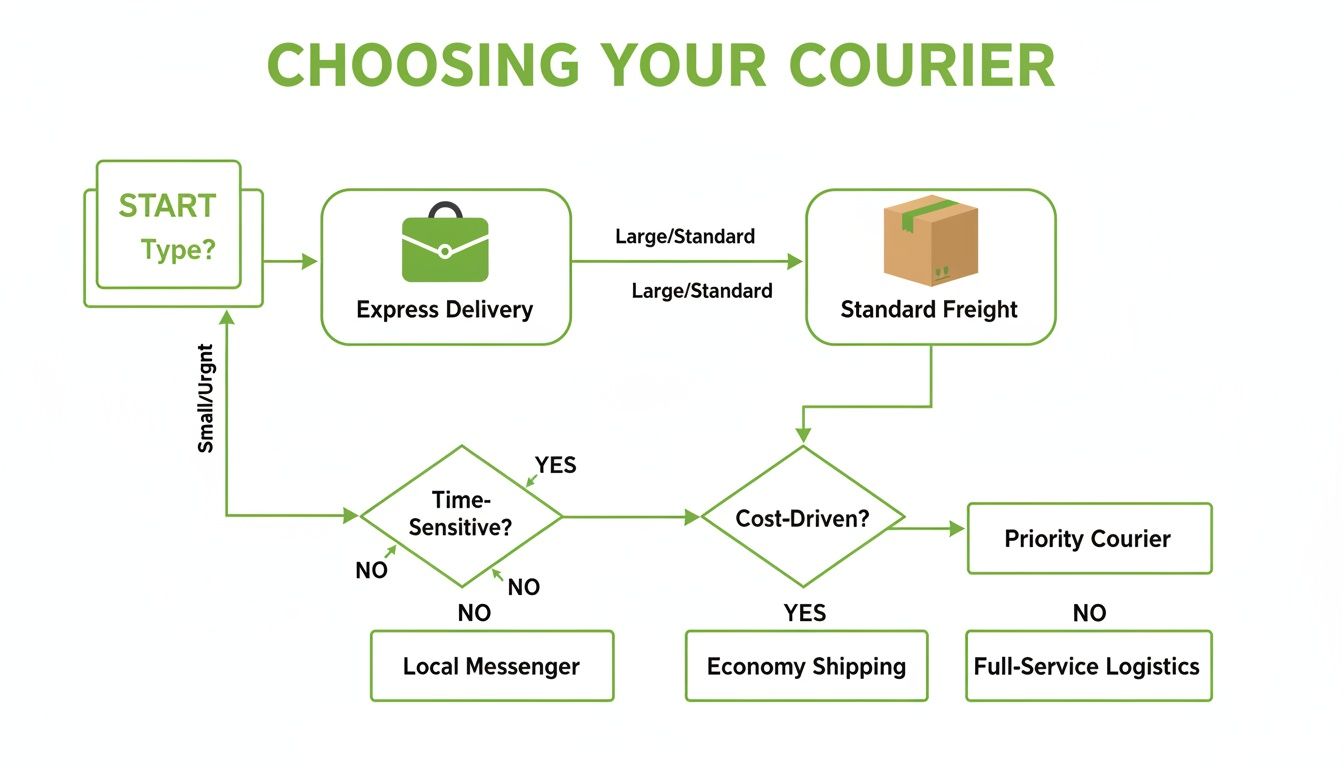
Ultimately, it all comes down to the nature of your item—its size, weight, and the required speed. These are the key ingredients for picking the most efficient and budget-friendly domestic courier service.
Decoding Your Delivery Options
To find the best fit, you first need to get familiar with the main players on the field. When you're sending boxes and satchels around Australia, you’ll generally come across three core service types, each offering a unique trade-off between speed and cost.
Standard Delivery: This is your workhorse. It’s the most economical and reliable choice for anything that doesn't need to arrive in a flash. Think of it as the sensible, cost-effective option for everyday shipping.
Express Delivery: When you need to turn up the tempo, express is your answer. It's perfect for getting important documents or customer orders delivered quickly, often by the next business day between major cities.
Same-Day Delivery: For those truly critical, time-sensitive shipments within the same city, this is the top-tier service. It’s the fastest you can get, but it naturally comes with a premium price tag.
The secret to a great shipping strategy is knowing when to invest in speed and when to save with a standard service. A modern courier platform makes this incredibly simple by showing you instant, side-by-side quotes for all your options.
If you’re keen to dig into the economics behind shipping rates, resources that help you understand the cost per mile can offer some fascinating insights into what drives pricing.
Comparing Courier Services at a Glance
Making a quick, informed decision is crucial when you've got a business to run. To help with that, we've created a simple table breaking down the core differences between the main services for sending a domestic courier in Australia.
Domestic Courier Service Comparison
| Service Type | Typical Speed | Cost Level | Best For |
|---|---|---|---|
| Standard | 2-7 business days | Low | Everyday parcels, stock transfers, and non-urgent orders |
| Express | Next business day (metro to metro) | Medium | Time-sensitive customer orders and important documents |
| Same-Day | Within hours (intra-city) | High | Extremely urgent deliveries within the same metro area |
This quick comparison should make it much easier to match your parcel's needs with the right solution, taking the guesswork out of your shipping.
Understanding Metro vs Regional Deliveries
Australia's sheer size plays a massive part in delivery times. It’s just common sense: a parcel zipping between Sydney and Melbourne has a much shorter journey ahead than one heading to a regional town in Western Australia.
Metro Areas: These are the major capital cities and their immediate suburbs. Because of the high volume of freight and well-established delivery networks, getting parcels between these zones is typically faster and more affordable.
Regional & Remote Areas: Any destination outside of a major metropolitan hub fits in here. Deliveries to these locations will almost always take longer and can cost more, simply due to the greater distances and less frequent service routes.
Setting realistic expectations for your customers is everything. A good booking platform will always give you an estimated time of arrival (ETA) at checkout, factoring in the destination postcode to give you a clear picture of the transit time. You can see all these options and more when you compare couriers with Aeros Couriers.
Getting Your Parcels Ready: Packaging and Compliance Done Right
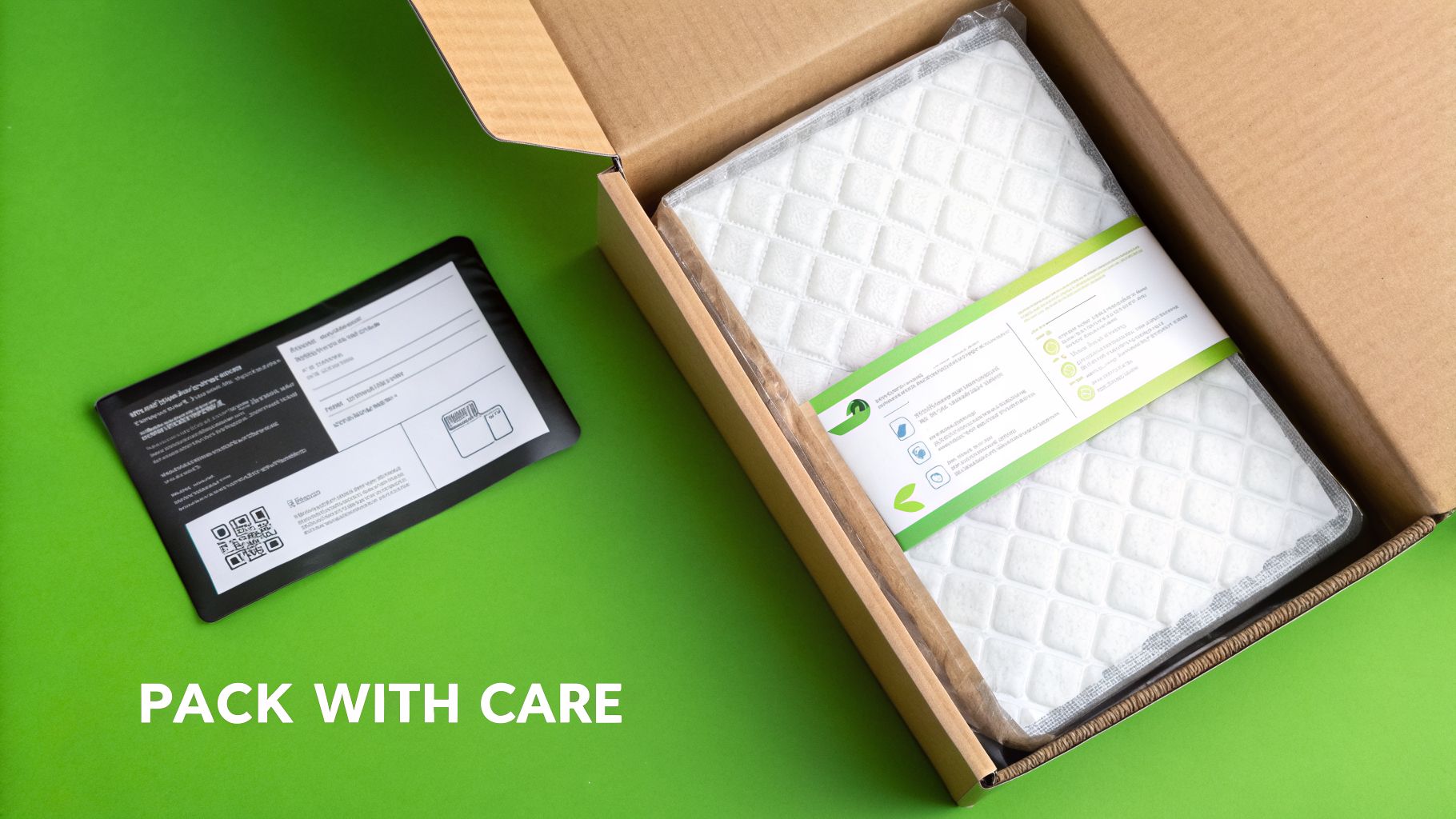
A great delivery experience starts long before a courier arrives at your door. The way you package your items isn't just about preventing damage; it's a huge part of your brand's story and your customer's first physical impression of your business. Think of your box or satchel as a suit of armour for your products—it’s the one thing standing between them and the rough and tumble of transit.
For any e-commerce brand, putting thought into your packaging shows you take pride in what you sell and, even more, that you value your customers. A few smart choices here can make all the difference, ensuring your goods arrive safely every time you send a domestic courier in Australia.
The Art of Perfect Parcel Packaging
While there's a science to great packaging, it doesn't have to be complicated. It really just comes down to a few core principles that keep your items safe and sound. Cutting corners here often leads to breakages, unhappy customers, and avoidable costs that eat into your profits.
To give your shipments the best possible protection, just follow these simple rules:
Choose the Right-Sized Box: Your box should be just large enough for the item plus a few centimetres of cushioning on every side. If the box is too big, things will rattle around and get damaged. Too small, and there’s no buffer to absorb impacts.
Cushion Everything: Fill every bit of empty space with good quality void fill. Bubble wrap, packing peanuts, or even scrunched-up paper works wonders to create a protective barrier. Here’s a good test: once it’s packed, give the box a gentle shake. Nothing should move.
Seal It Up Tight: Use strong, pressure-sensitive packing tape to seal all the seams. The 'H' method is your best friend here—run tape down the centre seam and then across both end seams. This reinforces the box and stops it from bursting open under pressure.
This simple three-step process is your formula for success. It turns a standard cardboard box into a fortress, ready for its trip across the country. Remember, your parcel will be handled by many hands and machines, so strong packaging is simply non-negotiable.
Navigating Dangerous Goods Compliance
While smart packaging protects your goods from bumps and drops, understanding compliance is what protects your business from serious legal and financial consequences. Many common, everyday items are classified as "dangerous goods" (DGs) because they can pose a risk during transport. We’re not talking about industrial chemicals, but often everyday consumer products.
It surprises many business owners to learn what counts. Things like perfumes, aerosol sprays, nail polish, and anything with a lithium-ion battery (like a phone or laptop) are all considered hazardous for shipping. Trying to send these items without declaring them properly is a major misstep.
Under Australia’s Chain of Responsibility (CoR) laws, everyone in the supply chain—and that includes you, the sender—is legally accountable for compliance. Claiming you didn't know is no excuse, and the penalties for sending undeclared dangerous goods can be huge, including massive fines and even shipping bans.
These rules exist to keep everyone safe, from the courier who picks up your parcel to the staff at the sorting depot. It’s crucial to know what you can and can't send.
This kind of guide helps to clearly show what’s off-limits, like explosives, flammable liquids, and toxic substances. Always check your products against your courier’s prohibited items list before you book a shipment—it’s a simple check that can save you from a world of trouble.
As the sender, it's your job to know what's in the box and declare it accurately. If you’re ever in doubt, just ask. Getting this right not only ensures your parcels travel without a hitch but also contributes to a safer network for everyone. Finally, make sure every parcel has a clear, scannable label—you can find out more in our guide to shipping labels and printing. When you master both your packaging and compliance, you can ship with absolute confidence.
More Than Just A to B: What Happens After Your Parcel Is Picked Up?
Sending a parcel is about so much more than just getting an item from your hands to your customer's. The moment your package is picked up, a new part of the journey begins—one built on transparency, security, and a genuine partnership. These post-booking features are what separate a basic delivery service from a true logistics partner, turning a simple task into a source of confidence for you and your customers.
For any business, but especially in e-commerce, this is where trust is truly won or lost. It’s the peace of mind you get from knowing exactly where your shipment is at all times. It’s the confidence that comes with having a safety net for your valuable goods. A modern domestic courier in Australia understands that the delivery is just one part of a much bigger promise to you and your customers.
Real-Time Tracking: The GPS For Your Parcel
Imagine handing over a package and having no clue where it is until it (hopefully) arrives. Not too long ago, that was the reality. Today, real-time tracking is an absolute must-have. Think of it as a live GPS for your parcel, giving both you and your customer a clear view of its journey every step of the way.
From the very first scan at pickup to the final confirmation of delivery, you can follow its progress. This isn’t a gimmick; it’s one of your most powerful customer service tools. When a customer inevitably asks, "Where’s my order?", you can give them a confident, accurate answer, building trust and easing their anxiety. That level of transparency isn't a luxury anymore—it's the standard. To really get ahead, it's worth looking at how innovations like specialised last-mile delivery management software can fine-tune your operations and give you an edge.
The demand for this visibility is happening on a massive scale. To put it in perspective, Australia Post delivered a record 102.8 million parcels during a recent Christmas peak period alone. This was a key driver in the 4.3% solid growth seen in domestic parcel volumes, a number that shows just how many packages are crisscrossing the country. It really highlights why reliable tracking is so vital for every single one. You can dive deeper into this parcel boom in this comprehensive industry report.
The Essential Safety Net: Freight Insurance
While every courier aims for a perfect delivery every time, the reality of a busy logistics network is that things can occasionally go wrong. That’s where freight insurance comes in. It’s your business’s essential safety net, protecting you from the financial hit if an item is lost or damaged in transit.
Shipping without insurance, especially for high-value goods, is a gamble you just don't want to take. It’s like driving a new car without any coverage—the potential cost of an accident is far greater than the small price of protection. Good freight insurance provides cover for the declared value of your goods, giving you a clear and simple path to compensation if the unexpected happens.
Choosing a courier that includes or offers straightforward freight insurance is a sure sign you're dealing with a provider who respects the value of your shipments. It shows they’re committed to protecting your interests, not just moving boxes.
Most modern booking platforms make adding insurance incredibly simple, often it's just a checkbox you tick. To get a deeper understanding of what it covers and why it’s so critical for your business, you can explore our detailed guide on insurance for couriers.
Turning A Cost Into A Reward
The very best business partnerships are the ones where everyone wins. A forward-thinking courier service actively looks for ways to give back to you, beyond just standard tracking and insurance. One of the most tangible ways they can do this is through a loyalty or rewards program.
Imagine turning a necessary business expense—shipping—into a direct benefit for your company. With a program like Aeros Rewards, every single dollar you spend sending parcels earns you points. You can then redeem those points for over 10,000 items, from essential office supplies to branded merchandise for your team or clients.
This creates a powerful, positive cycle:
- You ship parcels to run and grow your business.
- Every shipment earns you valuable reward points.
- You use those points to get things your business needs, offsetting other costs.
This completely changes your relationship with your courier. It moves from being purely transactional to a genuine partnership. It's a clear signal that your provider is invested in your long-term success, rewarding you for your loyalty and helping you find even more value in every single delivery you make.
Right, let's get you shipping. This is where the rubber meets the road—all your preparation is about to pay off. You’ve got your head around the different services and your goods are packed up tight. Now it's time to actually send something. Booking your first parcel should feel like a small victory, not a headache.
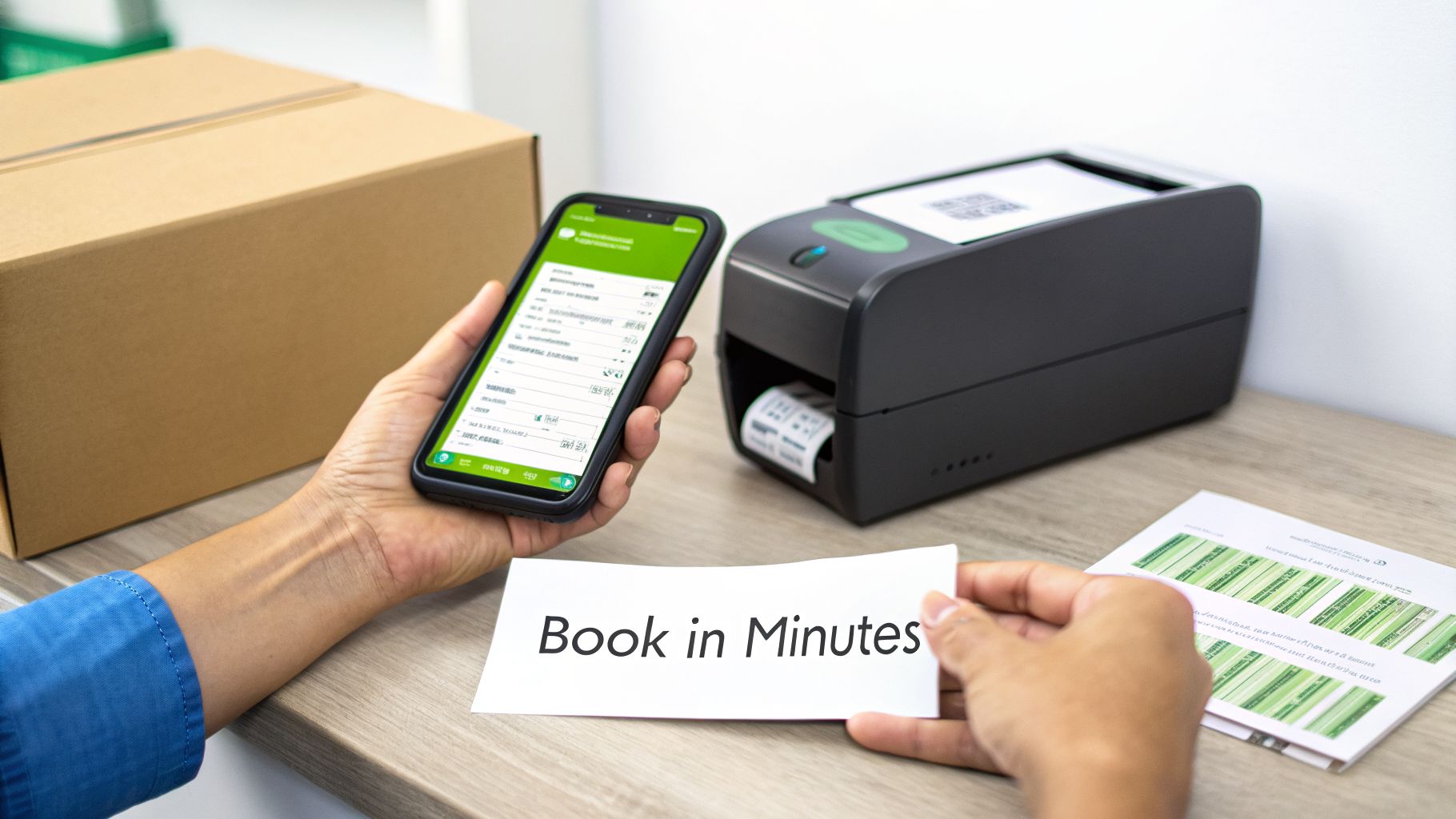
Forget about spending half an hour on sign-up forms or trying to decipher complicated rate sheets. Modern courier platforms are built for one thing: getting your parcel on its way, fast. The entire process is designed to take you from needing a quote to having a label in your hand in under five minutes. Seriously.
And you don't need a big corporate account or a promise of high shipping volumes to get access. A good platform opens the door to professional-grade logistics for everyone, whether you're sending your very first parcel or your thousandth. Let's walk through just how easy it is to book your domestic courier in Australia.
Your Five-Minute Booking Workflow
Let's put this into a real-world scenario. Imagine you've just sold a handmade item online. You need to get it from your workshop in Adelaide to an excited customer in Perth. The pressure's on to get it shipped quickly and let them know it's on the way.
Here’s how you can have it all sorted before your morning coffee even has a chance to cool down.
It all kicks off with a quick quote. The system is built to be intuitive, only asking for the must-have details to find you the sharpest price.
Pop in the Postcodes: Simply enter the pickup and delivery postcodes. This is the first piece of the puzzle, telling the system how far the parcel needs to travel.
Enter Your Parcel's Details: Grab a tape measure and scales. You’ll need the accurate length, width, height, and dead weight of your packed item. Getting this right is crucial—it's what determines the final cost and which courier services can handle your job.
Get Your Instant Quote: Hit that quote button! In a flash, the system crunches the numbers and shows you a list of available courier options, complete with pricing and delivery estimates for each.
The whole thing takes less than 60 seconds. You’re now looking at a crystal-clear comparison of your choices, ready to pick the perfect blend of speed and value for this particular shipment.
We built our platform on a simple idea: remove every single barrier to shipping. No sign-up fees, no credit card required for a quote, no fuss. We just want you to see for yourself how easy and affordable fast shipping can be.
From Booking To Pickup
Once you've picked the service that works for you, locking it in is just as quick. This is where you confirm the final details and get that all-important shipping label printed.
- Confirm Addresses: Give the full pickup and delivery addresses a final once-over. A small typo here can cause big delays, so accuracy is key.
- Add Your Extras: Decide if you want extras like a signature on delivery for peace of mind.
- Finalise and Pay: Complete the booking via our secure payment gateway. The price you see is the price you pay. No nasty surprises.
The moment you finalise the payment, your shipping label is ready to download and print. Think of this label as your parcel's passport—it has the barcode for tracking, the delivery address, and all the info needed to get it sorted and sent to the right place.
All that’s left for you to do is securely tape the label flat on your parcel and have it ready for the courier on your scheduled pickup day. It’s a clean, simple, and satisfying process. You’ve just organised a professional domestic courier service in minutes, right from your own desk. See? Powerful logistics don't have to be complicated.
Your Top Courier Questions, Answered
Sending parcels across Australia can feel like it comes with a long list of rules and "what-ifs." We get it. To cut through the confusion and help you ship with complete confidence, we’ve tackled some of the most common questions we hear from business owners just like you. Think of this as your cheat sheet for making smarter, faster shipping decisions.
What Is The Cheapest Way To Send A Parcel Within Australia?
This is the million-dollar question, isn't it? Hands down, the most affordable way is almost always through a courier aggregator platform. Think of us as your personal freight negotiator—we have massive buying power with the major carriers, and we pass those deeply discounted rates directly on to you. You end up paying far less than you would by going directly to the carrier yourself.
To really lock in the best price, just remember two golden rules:
- Be accurate: Always provide the exact weight and dimensions of your packed parcel. A few centimetres or grams can make a surprising difference.
- Compare your options: If it’s not urgent, standard delivery services will always be significantly cheaper than express. It’s worth a quick comparison.
How Long Does A Domestic Courier Take In Australia?
Transit times really come down to the service you select and where the parcel is headed. For instance, an express delivery between major cities like Sydney and Melbourne can easily arrive the very next business day. For most standard metro-to-metro routes, you can generally expect a delivery time of 2-5 business days.
The real game-changer is the destination postcode. Sending a package to regional or remote Australia will naturally take longer, sometimes between 7-10 business days, simply because of the vast distances involved. Any good booking platform will give you a clear estimated time of arrival (ETA) before you commit, so there are no nasty surprises.
Do I Need A Printer To Send A Parcel?
In short, yes—for now, at least. For the vast majority of domestic courier services, a printed shipping label is non-negotiable. This isn’t just a piece of paper; it’s the key to your parcel's journey. It contains the unique barcode that lets automated sorting machines and tracking systems do their job.
While the industry is exploring digital label options, they aren't mainstream yet. So, for reliable and successful shipping, you should always plan on having a printer ready to go.
Ready to see what a difference a truly simple, fast, and affordable courier platform can make for your business? With Aeros Couriers, you can get an instant quote and book your next delivery in minutes, all with no account fees. Get your free quote today and discover just how easy shipping should be.
Courier quotes, tracking and support
Ready to send a parcel? Compare the available services for your postcodes, parcel dimensions and weight. For an existing delivery, use your consignment number to check tracking or ask our team for help.