
Think of a modern courier business not just as a delivery service, but as the very lifeblood of Australian e-commerce. It’s the essential connection that gets products from a seller’s hands into a customer’s home, fuelling our booming digital economy with every single box and parcel.
This isn’t about just dropping things off anymore. The game has completely changed.
Riding the Wave of Australian E-commerce
Welcome to the engine room of online retail in Australia. A courier service today is so much more than a simple A-to-B operation; it’s a direct extension of a brand and a pivotal part of the customer experience.
Shoppers now expect fast, affordable, and fully-tracked delivery Australia-wide as standard. It's not a perk; it's the baseline. This new reality has created a huge opportunity for local courier operators who know how to navigate the unique challenges of our country—from the bustling city centres to far-flung regional towns.
The New Gold Rush Is Online
The massive shift to online shopping has lit a fire under the delivery industry. As countless businesses, big and small, set up their digital storefronts, the demand for reliable courier partners has gone through the roof.
For these small and medium businesses (SMBs), you’re not just another contractor—you’re a partner in their growth. Your ability to get their products to customers safely and on schedule directly shapes their reputation, builds customer trust, and ultimately drives their success. You are the final, critical handshake in their entire sales process. To really grasp why this final step is so important, it’s worth understanding the fundamentals of last-mile delivery.
Sizing Up the Opportunity
The numbers here are staggering. In 2023, Australian online retail sales soared to a record AU$62.1 billion, an 11.4% jump from the year before. That growth translates directly into a mountain of parcels, with major carriers handling over 2.5 billion parcels in FY2023 alone.
With about 70% of Australians now shopping online every month, SMBs are under immense pressure to offer competitive shipping. Average metro delivery rates might sit around $12-15, but those costs can quickly escalate for regional destinations, eating into their margins. You can find more great insights into how parcel delivery has evolved on Bluecrestinc.com.
In a market this dynamic, the real winners are the courier businesses that specialise. They find their niche in fast, affordable box and parcel delivery, leaving the complexities of heavy freight and pallets to others. They master the art of moving smaller packages with incredible efficiency Australia-wide.
This focused approach lets you build a lean, agile business that is perfectly tuned to what modern Aussie e-commerce sellers desperately need.
Your mission is clear: become the go-to solution for reliable, cheap parcel shipping that helps these businesses thrive. This is your chance to build more than just a business—it’s an opportunity to become a vital artery in Australia’s economic future.
Calculating Your Courier Business Startup Costs
So, you're serious about starting a courier business. Fantastic. Before you hit the road, let's talk numbers—the real, practical costs of getting your venture off the ground and running successfully in Australia.
Putting together a clear financial plan isn't just about ticking boxes. It’s about building a solid foundation for your business, so you can sidestep nasty surprises and steer yourself toward profitability from day one. Your success hinges not just on delivering parcels, but on running a financially smart operation.
And the opportunity is huge. Australia’s courier market is absolutely flying, thanks to a booming e-commerce scene and millions of us who now expect our goods delivered quickly and at the cheapest price.
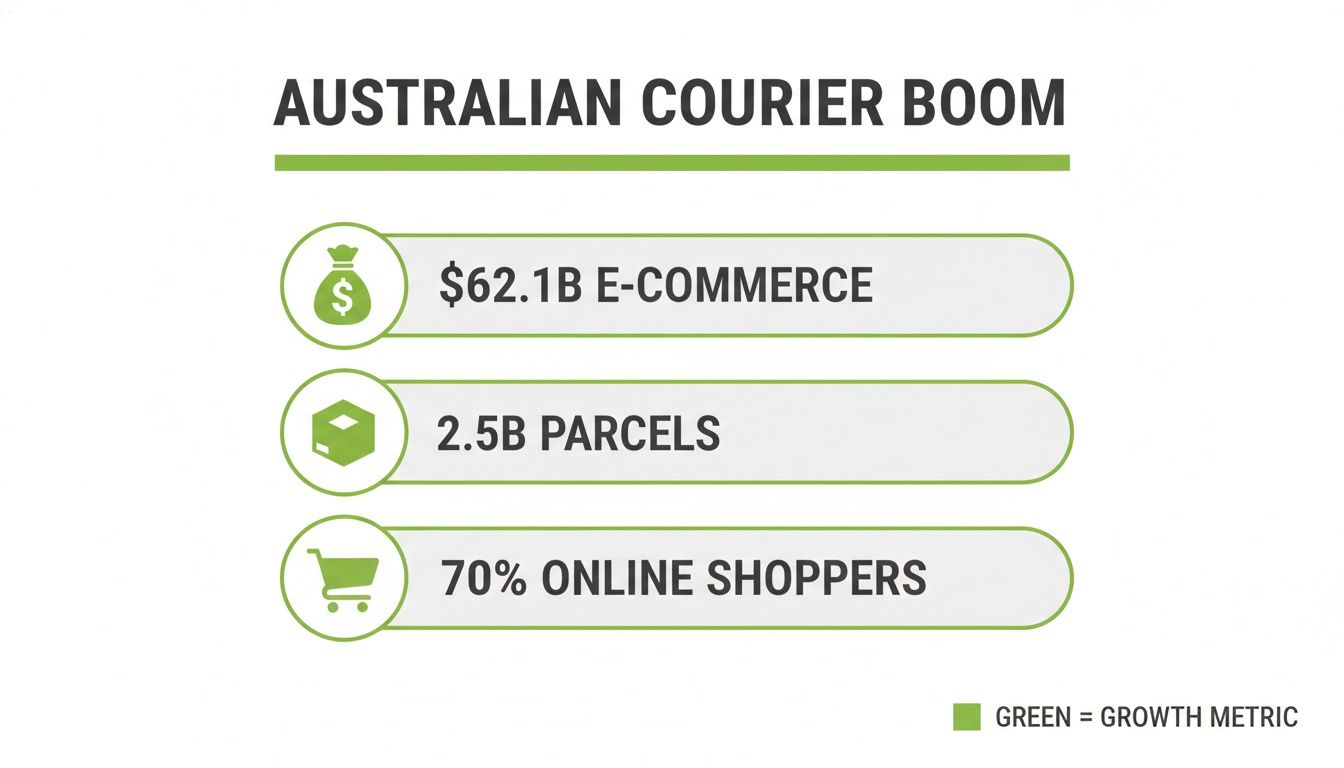
Those numbers paint a pretty clear picture. With over $62 billion in e-commerce sales, 2.5 billion parcels zipping around the country, and 70% of Aussies shopping online, the demand for reliable couriers has never been greater.
Essential Upfront Investments
Getting started means making a few key investments. Nailing these three areas—your vehicle, insurance, and business setup—is your first big step towards long-term success.
- Vehicle Acquisition: Your set of wheels is your mobile office and your main tool of the trade. While your trusty car might work for a few local deliveries, a cargo van is the real game-changer if you're serious. It gives you the space and security to handle more parcels per run, which directly translates to higher earnings.
- Essential Insurance: This is completely non-negotiable. Think of it as the seatbelt for your business. You'll need Public Liability Insurance to cover any accidents involving people or property, and Goods in Transit Insurance to protect the value of the items you're carrying. A single mishap without this cover could end your business before it even starts.
- Business Registration: To operate as a legitimate business, you'll need to sort out your Australian Business Number (ABN) and possibly register a business name. These are minor costs but are an absolute must for operating professionally.
Ongoing Operational Expenses
Once you’re up and running, your focus will shift to managing the daily costs that eat into your revenue. Keeping a close eye on these recurring expenses is the key to staying profitable.
Your main operational costs will be:
- Fuel: This will be your biggest and most unpredictable expense.
- Vehicle Maintenance: Regular servicing, new tyres, and the odd unexpected repair are all part of the job.
- Technology Subscriptions: Your phone plan and any software you use for bookings, navigation, or accounting.
Partnering with an established courier platform can be a smart move here. It often means you can skip the huge upfront cost and headache of building your own booking and tracking software. You get access to a pro-level system straight away, saving thousands and letting you focus on what you do best: delivering.
A Realistic Startup Budget
So, what does it all cost in the end? Every startup journey is a bit different, but this sample budget should give you a solid idea of what to aim for. This breakdown assumes you're kicking things off with a good quality second-hand van.
| Item | Estimated Cost (Low End) | Estimated Cost (High End) |
|---|---|---|
| Second-Hand Van | $15,000 | $25,000 |
| Annual Insurance Premiums | $2,000 | $4,000 |
| Business & ABN Registration | $100 | $500 |
| Initial Marketing & Supplies | $500 | $1,500 |
| Total Estimated Startup Cost | $17,600 | $31,000 |
Consider this budget your financial launchpad. Spending wisely on a dependable vehicle and proper insurance isn't just a cost—it's a direct investment in your business's reputation and future.
For a deeper dive into the numbers, feel free to explore our in-depth guide to Australian courier costs. Taking the time to plan your finances now is what will pave the way for a thriving courier business down the road.
Mastering Australian Logistics and Compliance
Think of logistics as the heartbeat of your courier business. It’s the constant, rhythmic process of getting a parcel from your client's hands to their customer's doorstep—smoothly, efficiently, and on time. Get this rhythm right, and your business thrives. Get it wrong, and you're heading for chaos, delays, and a reputation you don't want.
For a local Australian courier service focused on moving boxes and parcels, mastering the operational details isn’t just a nice-to-have. It's your secret weapon.
We’re not talking about coordinating massive freight containers or complex pallet shipments here. Your success is built on the art of moving smaller items with precision and speed, whether it’s a quick dash across a metro area like Sydney or a longer run into a regional town. Let’s break down what it really takes to make your operation run like a well-oiled machine from day one.
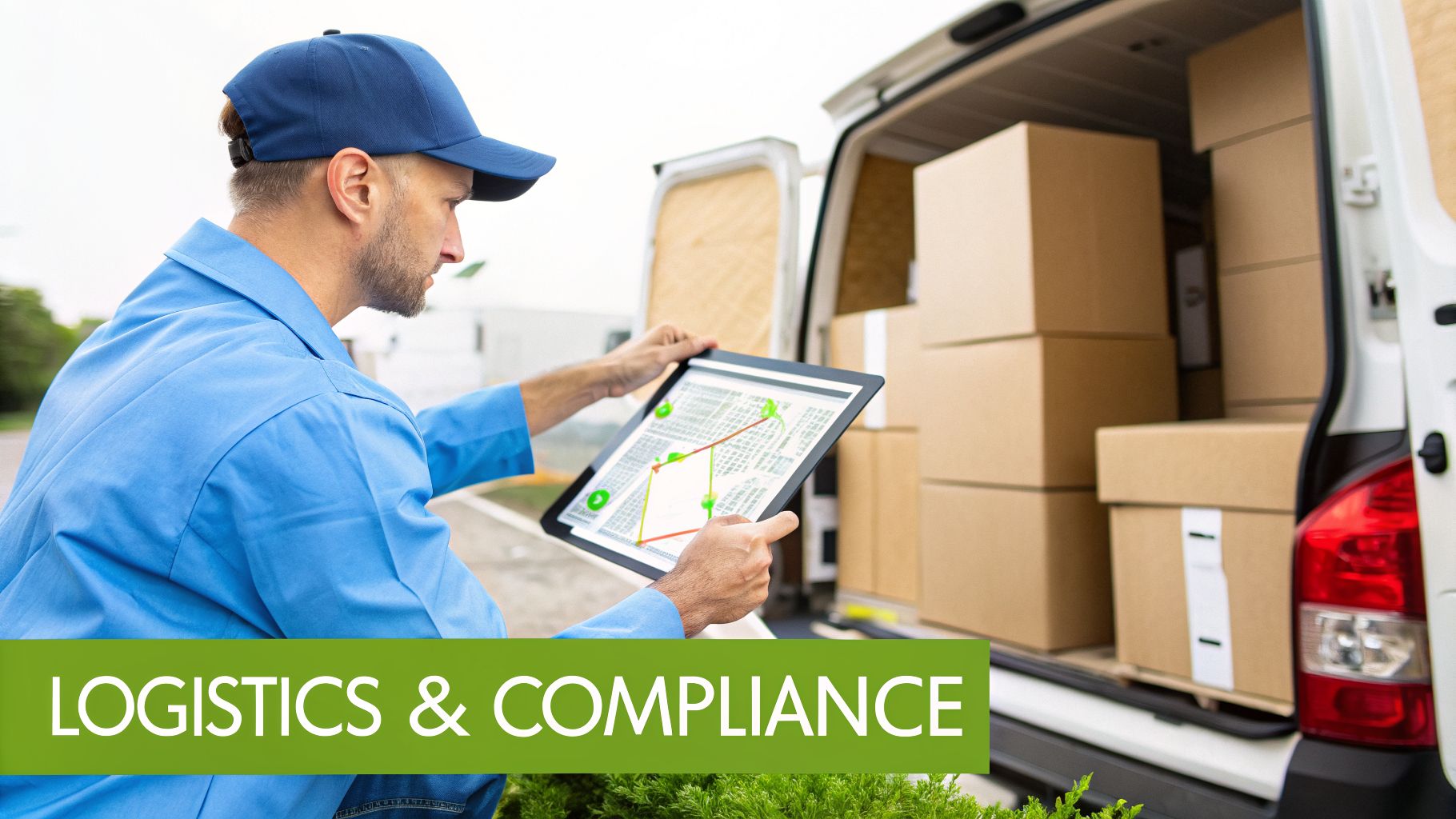
Smart Route Planning and Vehicle Loading
Your time is your money. Your vehicle's space is prime real estate. Wasting either one is a fast track to killing your profits. This is where smart route planning and vehicle loading become the twin engines driving your daily efficiency.
- Dynamic Route Optimisation: Don't just plug addresses into your GPS and go. A good app will re-order your stops based on live traffic and the most efficient path. This is an absolute game-changer in dense cities like Melbourne, where one wrong turn at peak hour can cost you an hour.
- Strategic Vehicle Packing: This is an old-school trick that never fails. Pack your van in reverse delivery order. The last parcel of the day goes in first, at the very back. Your first drop should be the last thing you load, waiting right by the door. This simple habit saves you from unpacking half your van at every stop.
- Maximising Space: It's time to get good at Tetris. Heavier, sturdier boxes go on the bottom to create a solid base. Lighter, smaller items can then fill the gaps on top. This doesn’t just let you fit more in—it stops parcels from getting crushed in transit.
Understanding Your Compliance Obligations
When you start a courier business in Australia, you become a vital link in the supply chain. That comes with serious legal responsibilities. These aren’t just rules on paper; they’re about keeping people safe on our roads, and ignoring them is not an option.
The most important concept you need to grasp is the Chain of Responsibility (CoR).
Think of CoR as a commitment to safety that everyone in the chain shares. It starts with the person who packs the box, includes the business that sends it, and extends right to you, the driver. If a safety law is broken, everyone involved can be held legally responsible.
For a local parcel courier, this means you must be certain your vehicle isn't overloaded, your load is secured properly, and you aren't driving while fatigued. It’s all about actively managing risks and putting safety above everything else. Getting compliance right protects you, your business, and everyone else on the road.
Best Practices for Handling and Delivery
Your professionalism is judged by more than just your speed. It's in the care you take with every single parcel. A damaged delivery means a costly claim and, worse, a damaged reputation.
Here are the non-negotiables for handling and that crucial final-mile delivery:
- Clear Packaging Standards: While your client is responsible for packing their goods, you have every right to refuse a parcel that's clearly unsafe. A flimsy, rattling box is just an accident waiting to happen.
- Proof of Delivery (POD): This is your best friend. Always, always get a signature or take a clear photo showing exactly where you left the parcel safely. Modern courier software makes this easy, giving you instant digital proof that shuts down any "I never got it" claims on the spot.
- Consignment Notes and Labels: Every item needs a clear label with all the critical tracking and delivery info. To make sure your records are spot on, you need to understand what a consignment note is and the vital role it plays in the entire process.
To help you stay on top of it all, here is a quick checklist of the key tasks that keep a courier operation running smoothly.
Essential Courier Operations Checklist
| Task Category | Daily Actions | Weekly/Monthly Actions |
|---|---|---|
| Vehicle & Safety | Pre-start vehicle check (tyres, lights, fluids). | Schedule regular vehicle maintenance. |
| Route & Deliveries | Plan and optimise delivery route. Check for road closures. | Review fuel efficiency and route performance. |
| Loading & Handling | Load vehicle in reverse drop-off order. Secure all parcels. | Clean and organise the vehicle cargo area. |
| Compliance & Docs | Ensure all parcels have clear labels. Use POD for all deliveries. | Review safety procedures. Check insurance/rego renewals. |
| Customer Service | Communicate any significant delays to customers. | Follow up with key clients for feedback. |
This checklist isn't just a to-do list; it's a framework for building habits that lead to excellence.
By mastering these fundamental logistics and compliance tasks, you stop being someone who just moves boxes. You become known for reliability, safety, and professionalism—the true cornerstones of any great Australian courier business.
How to Price Your Courier Services for Profit
Let’s talk about one of the biggest levers you’ll pull in your new business: pricing. Getting your rates right is more than just covering your fuel and time. It’s a bit of an art, really—finding that sweet spot where your prices are the cheapest, but you still build a business that actually rewards your hard work.
Think of it like tuning a guitar. Price too low, and you'll be run off your feet for pocket change. Go too high, and you might struggle to get a single call. The goal is to create a simple, fair pricing model that makes sense to your customers and puts real profit in your bank account.
The Building Blocks of a Smart Rate
Forget just slapping a 20% markup on your costs. A truly profitable pricing strategy for an Australian courier needs to be more flexible, accounting for the unique variables of every single delivery.
You absolutely have to factor these key elements into your quotes:
- Distance and Location: A quick dash across the Melbourne CBD is a world away from a long haul to a regional town in Queensland. Your pricing needs to reflect the real-world costs of those extra kilometres—not just fuel, but the added wear and tear on your vehicle.
- Parcel Dimensions and Weight: It’s not just about how heavy something is. You have to get your head around volumetric weight. This is the space a package takes up in your van. A massive, light box can be a silent profit killer if you're only charging for its physical weight, because it eats up space you could have used for other, heavier parcels.
- Delivery Speed: Time is money, and customers will always pay a premium for speed. Make sure you have clear, separate prices for your standard, same-day, and express or overnight services. This is an easy way to capture more revenue from those urgent "I need it now!" jobs.
- Fuel Surcharges: Fuel is easily your most unpredictable cost. A floating fuel surcharge that you adjust monthly is standard practice in this industry for a reason. It protects your bottom line from those painful, out-of-the-blue spikes at the pump.
Of course, a huge part of being profitable is managing your expenses wisely. A great place to start is by looking into maximising vehicle tax deductions to make sure you're claiming everything you’re entitled to.
Creating a Simple Rate Card
Once you have a handle on those factors, you can build a straightforward rate card for your customers. A great way to start is by defining delivery zones (e.g., Local Metro, Outer Metro, Regional) and setting a base price for a standard parcel in each zone. From there, you just add increments for extra weight and size.
Here's a simple example for a local metro delivery:
- Up to 5kg & 0.02m³: $12.00
- 5.1kg – 10kg & 0.04m³: $15.50
- 10.1kg – 20kg & 0.06m³: $22.00
- Express Surcharge: +$8.00
This kind of transparency makes it incredibly easy for customers to understand what they're paying for, and it helps you fire off quotes quickly and consistently. To see how all these pieces fit together in the real world, play around with an online shipping rate calculator.
The Insider’s Secret to Better Margins
Now, here’s a tip that can completely flip your profitability on its head: you don’t have to do all this alone. Partnering with an established courier platform gives you an advantage that’s almost impossible to build by yourself.
These platforms negotiate shipping rates with major carriers based on massive, collective volume. They are essentially buying shipping at wholesale prices—far, far cheaper than any small business could ever get on their own.
When you join a platform, you get to tap into their incredible buying power. It’s a genuine win-win.
- You Access Cheaper Rates: You can use these wholesale rates to offer incredibly sharp prices to your own customers, helping you win jobs you might have otherwise lost.
- You Boost Your Profit Margins: Or, you can charge the standard market rate and simply pocket the difference. This can dramatically increase your profit on every single delivery you make.
This single move takes you from being a small fish swimming alone to having the power of the whole school behind you. It takes the guesswork out of pricing and lets you focus on what you do best—delivering great service—while knowing your business is set up for real, long-term success.
Choosing Your Technology and Platform Partners
In the world of courier services, technology isn’t just a nice-to-have; it’s the engine that drives your entire operation. Think of it as your most trusted co-pilot. For any modern courier business focused on fast, cheap delivery, the right digital tools are the secret sauce that turns chaotic, stressful days into smooth, profitable ones.
Here’s a powerful truth that every successful new operator discovers: you don't have to build any of this tech yourself. The days of needing a massive, upfront investment to create custom software are long gone. The smart, modern approach is to find a brilliant courier platform to partner with.

Why Partnering Beats Building
Joining a courier platform is a bit like buying into a top-tier franchise. Instead of grinding away from scratch, you get the keys to a sophisticated online workflow that’s been tested, tweaked, and perfected over years.
This partnership instantly levels up your business with a whole suite of professional tools. You can offer clients instant quotes, dead-simple online booking, printable labels, and a single dashboard to track every job. It lets you go toe-to-toe with the big names from day one, without the cost, time, and headaches of developing your own software.
When you plug into an existing system, you get to pour all your energy and capital into what you do best: getting parcels delivered quickly and reliably across Australia. It’s about using someone else’s investment to fast-track your own success.
This strategy is especially powerful here in Australia. Our courier industry is a massive machine, employing over 145,000 workers. A city like Sydney alone moves a staggering 1.2 million parcels every single day. Reliability is everything, particularly when you hear that delivery failure rates can hit 12% in some regional areas. You can learn more about how the industry got here in this quick history of the courier industry.
Your Essential Technology Toolkit
Partnering with a platform gives you a mission control for your entire business. While the bells and whistles might differ between them, the core technology you get is all about making you more efficient and keeping your customers happy.
Here are the game-changing tools you’ll use every day:
- Centralised Booking and Quoting: Imagine a simple online portal where customers can get an accurate quote and book a delivery in just a few clicks. No more endless phone calls or email chains. This alone is a massive time-saver.
- Automated Label Generation: Once a job is booked, the system spits out a professional shipping label with all the right barcodes and tracking info. Every parcel is now correctly identified and ready to go.
- Real-Time GPS Tracking: This is completely non-negotiable in 2026. A live tracking dashboard gives both you and your client a crystal-clear view of where a parcel is at every step of its journey.
- Route Optimisation Software: This is a true money-maker. The software automatically maps out the most efficient multi-stop route for your daily runs, saving you a small fortune on fuel and time.
- Proof of Delivery (POD) Capture: Mobile apps let your drivers snap a quick photo or grab a signature as instant proof that a delivery is complete and safe, protecting you from any potential disputes.
Beyond the delivery-specific tech, running a tight ship also means having your finances in order. Using a good online accounting platform is key to managing your money, tracking what’s coming in and going out, and keeping your business organised. And as you grow, understanding how a shipment API works can unlock even more ways to streamline your operations through integrations.
By picking the right platform partner, you’re not just buying software. You’re adopting a proven blueprint for success, giving you the technological firepower you need to build a competitive and seriously profitable courier business.
To really get why courier platforms are taking off, you have to step into your customers' shoes. For thousands of Aussie small businesses and e-commerce sellers, the old way of shipping is history. They’re flocking to courier platforms because these services solve the real, expensive problems that keep them up at night.
Think about it this way. You’re running a small online shop from your garage in Adelaide. You've just had a record sales day—fantastic! But now you have orders to get to Perth, Cairns, and Hobart. The hard part isn't packing the boxes; it's figuring out how to ship them without blowing your budget.
This is exactly where a courier platform becomes a game-changer. Instead of wasting hours jumping between carrier websites to compare prices, you just log into one simple dashboard. In seconds, you see the cheapest and fastest ways to send your parcels anywhere in Australia, tapping into bulk shipping rates you could never dream of getting on your own. Suddenly, a logistical nightmare becomes a simple, manageable task.
A Single Source of Truth for a Growing Business
Now, let's look at another common scenario. Imagine you're the operations manager for a business with offices in Sydney, Melbourne, and Brisbane. Each location is constantly sending and receiving packages. You’re drowning in invoices from different carriers, tracking numbers are lost in email chains, and there’s no way to see the big picture.
A courier platform brings beautiful order to that chaos. You can set up a single company account, give each office the power to book its own deliveries, and still maintain complete oversight from one central hub. You see every shipment, track every dollar, and finally get a grip on your logistics. It’s more than just convenience; it’s about regaining control over a vital part of your business.
For Australian businesses, the appeal is incredibly straightforward. Platforms solve the three biggest shipping headaches: getting the best price for nationwide delivery, ensuring fast and reliable service, and simplifying the whole process from start to finish.
This move to smarter logistics isn't just about saving a few bucks, either. Businesses are under more pressure than ever to be efficient, and there’s a growing demand for them to be more sustainable. In fact, 32% of consumers now actively steer clear of companies they don't see as eco-friendly.
Platforms help businesses rise to these challenges. By optimising delivery routes, they can cut fuel consumption and reduce emissions. They also offer clear guidance on proper packaging, helping businesses avoid their share of the staggering AU$1.5 billion lost each year to returns from goods damaged in transit. You can get a deeper sense of how the industry is changing by exploring the history of the courier industry on Xpressman.com.
The Real-World Benefits for Your Future Customers
For the businesses you want to serve, the value here is crystal clear. It’s not about abstract features on a screen; it's about the tangible results that directly improve their profitability and make their customers happy.
Here’s what they really gain when they choose a courier business powered by a platform:
- Serious Cost Savings: They get instant access to the cheapest Australia-wide shipping rates. That money can go straight to their bottom line or be passed on to their customers as a competitive advantage.
- Time Back in Their Day: A single dashboard for booking, printing labels, and tracking saves hours of tedious admin. That’s more time they can spend marketing, innovating, and actually growing their business.
- Rock-Solid Reliability: With transparent, real-time tracking and proof of delivery, they can give their own customers a seamless and trustworthy experience from the moment they click "buy" to the second they unbox their order.
When you partner with a platform, you’re not just offering to move a box from A to B. You’re offering a complete, elegant solution to the most persistent shipping frustrations that Australian businesses face, day in and day out.
Answering Your Top Questions About Starting a Courier Business
Taking the leap into your own courier venture is a thrilling prospect. But with that excitement comes a whole lot of questions. We get it. Here are some straightforward, no-nonsense answers to the things we’re asked most often by people just like you, ready to start delivering boxes and parcels across Australia.
Can I Really Start a Courier Business with Just My Car?
Absolutely. Your own car is a fantastic way to get your wheels on the ground, especially for local metro runs and smaller parcels. Think of it as your launchpad.
However, if you're serious about scaling up and maximising your income with Australia-wide deliveries, you'll want to set your sights on a van. It's not just about fitting more in; a van offers better protection for the goods you're carrying, which means you can handle bigger, more valuable jobs and ultimately earn more on every single run.
How Do I Find My First Customers?
This is the big one, isn't it? The quickest and most effective way to get paying jobs from day one is to partner with an established courier platform.
Think of it this way: instead of spending your own time and money knocking on doors or building a website, you get to plug directly into a ready-made stream of work. These platforms are already connected to thousands of the small businesses and e-commerce sellers you want as clients. It’s the ultimate head start.
What Insurance Do I Actually Need?
Getting your insurance right isn't just a box-ticking exercise; it's about protecting your new business and your customers. There are two types you simply can't operate without in Australia.
The first is Public Liability insurance, which covers you if someone gets injured or their property is damaged in the course of your work. The second is Goods in Transit insurance, which protects the customer's items while they're in your vehicle. Some courier platforms include this freight insurance as part of their service, which is a massive cost-saving and a huge weight off your mind when you're just starting out.
Ready to turn your ambition into action with a trusted partner? Aeros Couriers provides the technology, support, and low-cost rates you need to launch your courier business and thrive. Get an instant quote or learn more.
Courier quotes, tracking and support
Ready to send a parcel? Compare the available services for your postcodes, parcel dimensions and weight. For an existing delivery, use your consignment number to check tracking or ask our team for help.