

“Return to sender” means a parcel or letter could not be delivered to the person it was addressed to, so the carrier is sending it back to whoever posted it. It is not a penalty and it is rarely a mystery: in Australia it almost always comes down to an address problem, an uncollected parcel or a refused delivery. What matters is what you do in the next few days, and that depends on whether you are the sender or the person waiting for the item.
TL;DR
- “Return to sender” (RTS) means the carrier could not deliver and is sending the item back to the sender’s return address.
- The usual causes are an incorrect or incomplete address, a parcel not collected from the Post Office within 10 business days, or a delivery that was refused or went to the wrong place.
- If you are the buyer, contact the seller first. If you are the seller, check the address, confirm it with your customer, then rebook.
- Under the Australian Consumer Law, a seller who cannot supply what you paid for within a reasonable time must offer a solution, such as redelivery or a refund.
- Most RTS parcels are preventable with a clean address, a clear return address on the label and tracking you actually watch.
Table of Contents
- What “return to sender” means in plain English
- Why parcels get returned to sender
- What happens to a parcel that cannot be returned
- If you are the buyer: what to do now
- If you are the seller: what to do when a parcel comes back
- How to stop parcels coming back
- Our perspective: returns are mostly a communication problem
- Book your next parcel with Aeros Couriers
- Quick glossary of related tracking terms
- FAQ
- Sources
What “return to sender” means in plain English
The phrase started as a note written on envelopes: the recipient (or the post office) marked it to show the item had not been delivered or accepted, and it should go back to where it came from. Today it is also a tracking status. Australia Post says that “returned” in tracking means it was unable to deliver the item and sent it back to the sender.
So when you see “return to sender” on a parcel you are expecting, it does not mean you did something wrong. It means the delivery attempt chain ended without a handover, and the parcel is now travelling in the other direction.
Two things it is not:
- It is not the same as a customer return. Australia Post separates the two: RTS is an undelivered parcel coming back, while a customer return is an item sent back under your returns policy after it arrived.
- It is not slang for “get lost”. The song title aside, in parcel terms it is purely an operational status.
Why parcels get returned to sender
Australia Post lists an incorrect or incomplete address, a parcel not picked up from the Post Office within 10 business days, and delivery to the wrong address among the main causes. The Commonwealth Ombudsman’s review of Australia Post complaints makes a similar point: items are generally not deliverable where the address is inadequate or incorrect, and most delivery complaints concern the last step, handing over to the addressee.
In practice, the reasons fall into a handful of buckets.
| Reason | What it looks like | Who can fix it |
|---|---|---|
| Wrong or incomplete address | Missing unit number, wrong postcode, street name misspelt | Sender, after confirming with the buyer |
| Not collected | Card left, parcel held at a Post Office or collection point, never picked up | Buyer (before the deadline), otherwise sender |
| Refused delivery | Recipient declines the parcel at the door | Sender and buyer, by agreement |
| Recipient moved | Old address, no forwarding arrangement | Buyer supplies the new address to the seller |
| Access problem | Locked building, no safe place, nobody to sign | Buyer, by sorting access or a different delivery point |
| Damaged or unreadable label | Torn, smudged or missing address | Sender |
A few of these deserve a closer look.
Unit numbers and apartment access
Apartment blocks cause a disproportionate share of failed deliveries. A missing unit number can look fine to the person typing it and be useless to a driver. If you live in a complex with a locked lobby, tell the seller how a driver can get in, or choose a delivery point that does not depend on access.
Parcels that sit uncollected
If a carrier leaves a collection card, the clock starts. For Australia Post, that clock is 10 business days at the Post Office. After that the parcel heads back. If you cannot get to the counter in time, contact the carrier or the seller before the window closes rather than after.
When the address is right but the parcel still comes back
Sometimes the address is accurate and the parcel still bounces. Australia Post’s stated policy is to deliver as addressed, so the address on the label counts more than the name. If a previous resident’s name is on the item, the carrier generally still delivers to that address. The Ombudsman’s guidance for people who receive mail meant for someone else is simple: cross out the wrong address and repost it, and if you know the right address, write it on the item first.
What happens to a parcel that cannot be returned
Sometimes there is no usable return address either. Australia Post runs Returned Mail Redistribution Centres, and the Ombudsman notes that staff there are trained to find correct addresses, and where there is no address information they may open items to identify the addressee or sender. That is the reason a clear return address on every label is worth the ten seconds it takes.
If you are the buyer: what to do now
You ordered something, the tracking says returned, and you want your goods. Work through this in order.
- Check the address on your order confirmation. Look for typos, a missing unit number or an old address saved in your account.
- Contact the seller, not the courier. The seller is the party you paid, and consumers are encouraged to contact the seller first to explain the situation and agree on a solution.
- Ask for a clear outcome. Do you want redelivery to a corrected address, or a refund? Put it in writing so there is a record.
- Do not assume you pay again. If the failure was the seller’s error, such as a wrongly keyed address, redelivery should not cost you extra. If it was your error, expect the seller to ask you to cover a new shipment.
- Keep every reference number. Order number, tracking number, emails. You may need them later.
If the parcel is still moving back and you spot the problem early, there may be a chance to fix it before it arrives. Our guide on changing a delivery address with a courier explains why asking the seller first is usually the quickest route. And if you cannot find the item at all, tracking a parcel without a number covers what to ask for.
Your rights when the parcel does not arrive
The Australian Consumer Law gives you protection here. According to the ACCC, if a business cannot supply a product you have paid for on time or within a reasonable time, it must provide a solution. Delays outside the business’s control, such as severe weather, do not automatically put it in breach, but it still has to resolve the matter within a reasonable time, which can mean a replacement or a refund.
The ACCC also stresses that when a product or service fails a guarantee, the business must offer a remedy and cannot send you off to the manufacturer. The ACCC has also taken action against businesses falsely claiming that delivery fees are non-refundable when the failure was theirs. A seller who says “that’s the courier’s problem” is not describing your rights accurately.
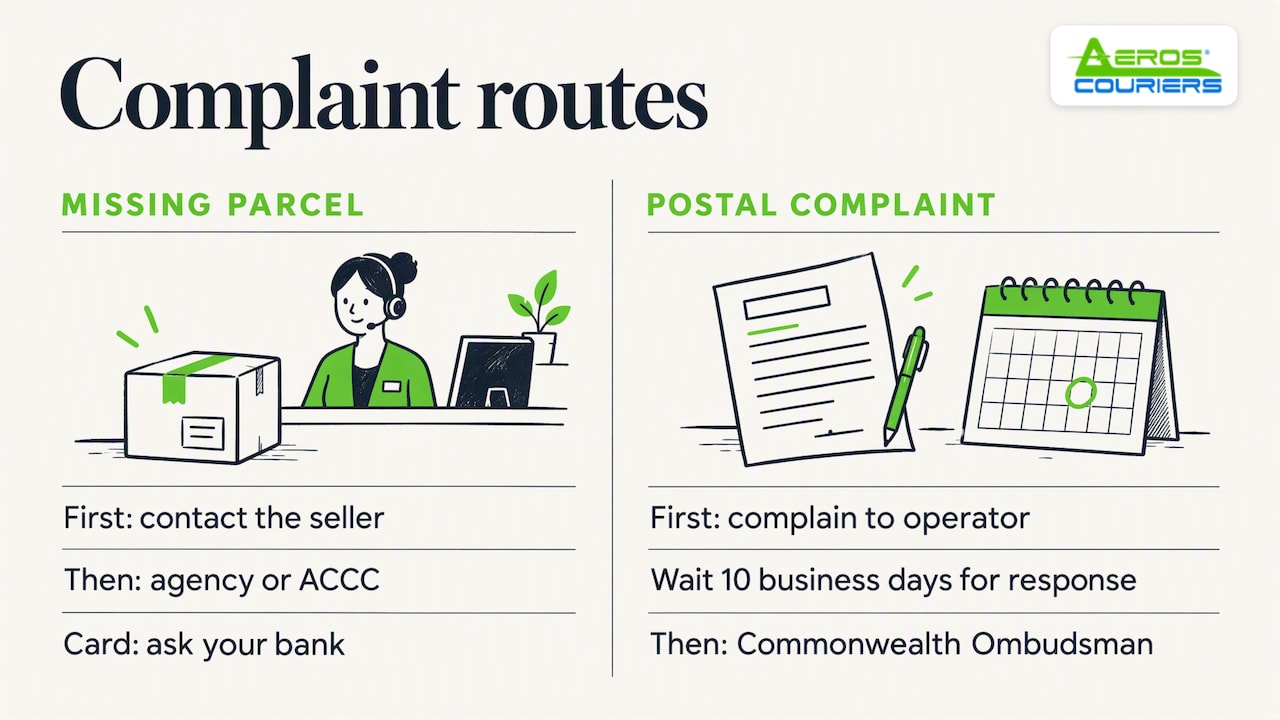
If the seller stalls, you can escalate. The Commonwealth Ombudsman can look at complaints about Australia Post and StarTrack, but only after you have complained to the postal operator directly and given it 10 business days to respond. Note the reference number the operator gives you, because the Ombudsman needs it.
For a dispute where you have paid and received nothing, speak to the seller first and then, if needed, to your state or territory consumer protection agency or the ACCC. If you paid by card, your bank may also have a dispute process.
If you are the seller: what to do when a parcel comes back
For a small business, an RTS parcel is a cost and a customer-experience problem at the same time. Handle it like this.
- Do not just reship. Reposting to the same address usually produces the same result.
- Contact the customer straight away. Ask them to confirm the full address, including unit number and postcode, and the best delivery point.
- Inspect the returned parcel. Check the label, the goods and the packaging. Look at what the carrier recorded as the reason.
- Decide who bears the cost. If your listing or checkout let a faulty address through, absorbing the reshipping cost is often the fair call, and the law may require it. If the customer gave a wrong address, your terms can say they pay for redelivery, as long as the terms are clear and do not misrepresent their rights. The ACCC’s 2025 sweep of online shopping policies found numerous examples of practices that could mislead consumers about their rights, so keep your wording accurate.
- Rebook with the right service. If the original delay was the issue, a faster option may rescue the order.
- Record the cause. After a few returns, patterns show up: a particular checkout field, a type of address, a service level.
One point about late orders in general: when transport delays hold up an online purchase, buyers want clear options. This guide to what to do when an online order runs late sets out the sort of 10-business-day follow-up steps that apply to delayed deliveries, and it is a useful model for the information you should give your own customers.
How to stop parcels coming back
Most returns are avoidable. These habits cut them sharply.
- Validate addresses at checkout. Use address auto-complete so customers pick a real, formatted address rather than typing freehand.
- Make the unit field obvious. Add a prompt for unit, level or building access notes.
- Print a return address on every parcel. Inside the parcel too, in case the outer label is damaged.
- Use a printed label, not handwriting. Smudged ink is a quiet cause of misreads.
- Send tracking and watch it. Customers who get a link can spot a wrong address early, and so can you.
- Match the service to the customer. For people who are rarely home, a delivery point that suits them beats three missed attempts.
- Chase uncollected parcels. If tracking shows a collection card has been left, nudge the customer well before the 10 business days are up.
If you ship regularly, it is also worth reviewing your carrier choice. Our guides to choosing an Australian courier company and to the cheapest, fastest domestic courier options walk through what to compare.
Our perspective: returns are mostly a communication problem
We see the same pattern again and again. A parcel is rarely returned because a driver was careless. It is returned because the information on the label did not match reality, and nobody found out until it was too late. That is why we build our service around visibility and fast human contact rather than around fine print.
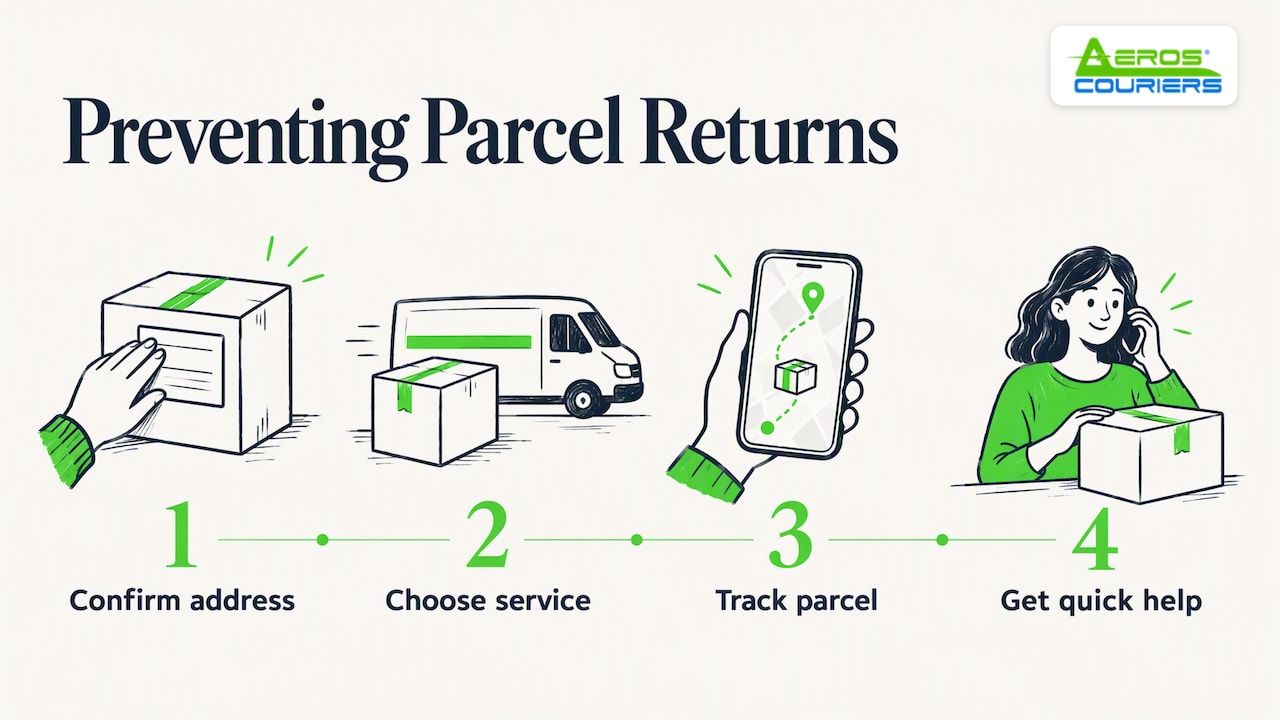
We believe senders should know the full cost of a shipment before they book. We publish flat, transparent pricing with no hidden fuel surcharges or handling fees, so a failed delivery does not arrive with a surprise on top. We also think active parcel monitoring matters: when you can see a parcel stall early, you can fix the address while it is still on the road instead of waiting for it to come back.
For small businesses in particular, the best protection is a short loop between you and your customer. Confirm the address, choose a sensible service level, track the parcel, and talk to someone quickly if it goes wrong. We try to make each of those steps easy.
— Aeros
Book your next parcel with Aeros Couriers
If you are sending a parcel and want to avoid the guesswork, Aeros Couriers lets you compare carriers and book online. Our rates start from $4.90 for parcels up to 25 kg, with door-to-door pickup, printable labels, shipment tracking, insurance and Australian customer support. You can look at our parcel delivery service, get a quote on the shipment rate page, or see our express and same-day options on the Aeros Couriers homepage. Sending something bulky? Our guide to sending big parcels cheaply helps.
Quick glossary of related tracking terms
RTS is one of several statuses you may see. Wording varies by carrier, so check the carrier’s own help page for the exact meaning.
- Returned: the carrier could not deliver and has sent the item back to the sender.
- Awaiting collection: the parcel is held at a Post Office or similar point, with a limited time to pick it up. For Australia Post, that limit is 10 business days.
- Delivery attempted: a driver tried and could not complete the handover.
- Redirected: the item is being sent to a new address, usually because of a redirection or a correction.
FAQ
What does “return to sender” mean on a parcel?
It means the carrier could not deliver the parcel to the addressee and is sending it back to the sender. Common causes are an incorrect address, an uncollected parcel or a refused delivery. The status does not automatically mean anyone is at fault.
Do I have to pay if my parcel is returned to sender?
It depends on who caused the failure. Australia Post describes returning undelivered parcels to business senders as no cost to return, but a seller may charge for reshipping if the customer gave a wrong address and the terms say so. If the seller made the mistake, you should not be asked to pay again.
Can I stop a parcel being returned to sender?
Sometimes. If you spot the problem while the parcel is still in transit, contact the seller straight away so they can talk to the carrier about a correction. If a collection card has been left, pick the item up before the 10 business days run out.
What should I do if I receive a parcel meant for someone else?
If you do not know the intended recipient’s current address, cross out the incorrect address and repost it, as the Ombudsman advises. If you do know it, you can add it to the parcel before reposting. Do not open it.
Who can I complain to if a returned parcel is not resolved?
Start with the seller, then the carrier, and keep the complaint reference number. If it concerns Australia Post or StarTrack and 10 business days pass without a response, you can take it to the Commonwealth Ombudsman.
Sources
- Australia Post: What does ‘return to sender’ mean?
- Australia Post: Return to sender help
- Commonwealth Ombudsman: Tools and resources
- Commonwealth Ombudsman: Review of Australia Post complaints
- Commonwealth Ombudsman
- Commonwealth Ombudsman: Before you make a complaint
- ACCC: Not receiving products or services that are paid for
- ACCC: Repair, replace, refund, cancel
- ACCC: Online shopping return policies sweep
Recommended
- Australia Post Tracking Not Updating? Here Is What to Do
- Courier Address Changes in Australia: Ask the Seller First
- Delivery Exception Meaning: 6 Immediate Steps to Fix It in Australia
Courier quotes, tracking and support
Ready to send a parcel? Compare the available services for your postcodes, parcel dimensions and weight. For an existing delivery, use your consignment number to check tracking or ask our team for help.