You’re probably in the same spot a lot of small Australian businesses hit sooner or later. Orders are coming in, customers want fast delivery, and every courier website seems to tell a different story on price, speed, and service. One quote looks cheap until extra fees appear. Another promises speed, but only on certain routes. A third works well in one postcode and poorly in another.
That’s why picking from the long list of courier companies in australia can feel harder than it should. The mistake I see most often is treating shipping like a one-time supplier choice. For local parcel delivery, that usually costs more than it saves. What works better is a system that lets you compare service levels and rates parcel by parcel, then book the option that fits the job.
Navigating the World of Australian Couriers
A small business owner ships ten parcels a week and can usually get by with habit. At fifty parcels a week, habit gets expensive. At a hundred, it starts creating customer service problems as well. One delayed carton means a refund request. Two damaged boxes mean you’re answering emails instead of running the business.
That pressure has grown because the market itself has become much larger and more crowded. The Australian courier industry expanded from 15,788 businesses in 2016 to an estimated 56,550 by 2025, and around 9.5 million Australian households received parcels in 2023, according to IBISWorld’s Australian courier industry data. More sellers are shipping, more households are buying online, and more courier operators are competing for the work.
Why more choice can make shipping harder
More providers sounds like good news, but in practice it creates three common problems:
- Pricing gets harder to compare because each courier structures services differently.
- Transit expectations rise because customers now assume quick updates and reliable delivery windows.
- One carrier rarely fits every parcel because metro, regional, lightweight, and urgent shipments all behave differently.
Practical rule: Don’t ask which courier is best in general. Ask which courier is best for this parcel, going to this suburb, at this service level.
That shift in thinking matters. If you’re shipping local boxes and satchels across Australia, the goal isn’t loyalty to a single brand. It’s consistency, visibility, and control over costs.
What small businesses need instead
Most small operators don’t need a complicated logistics stack. They need a simple decision framework:
| What to decide | Why it matters |
|---|---|
| How fast it needs to arrive | Fast services cost more, so urgency should be real |
| Whether the address is metro or regional | Coverage and pricing often change by location |
| How the parcel is packed | Poor packaging creates damage claims and surcharges |
| Whether tracking and proof matter | Not every shipment needs the same level of visibility |
The businesses that handle shipping well don’t guess. They compare, choose deliberately, and keep their process repeatable.
Decoding Australian Courier Service Types
Most confusion starts before you even compare prices. Businesses look at brand names first, when they should be looking at service types. In local parcel delivery, you’re usually choosing between standard, express, and same-day. If you understand the trade-off in each category, quotes make a lot more sense.
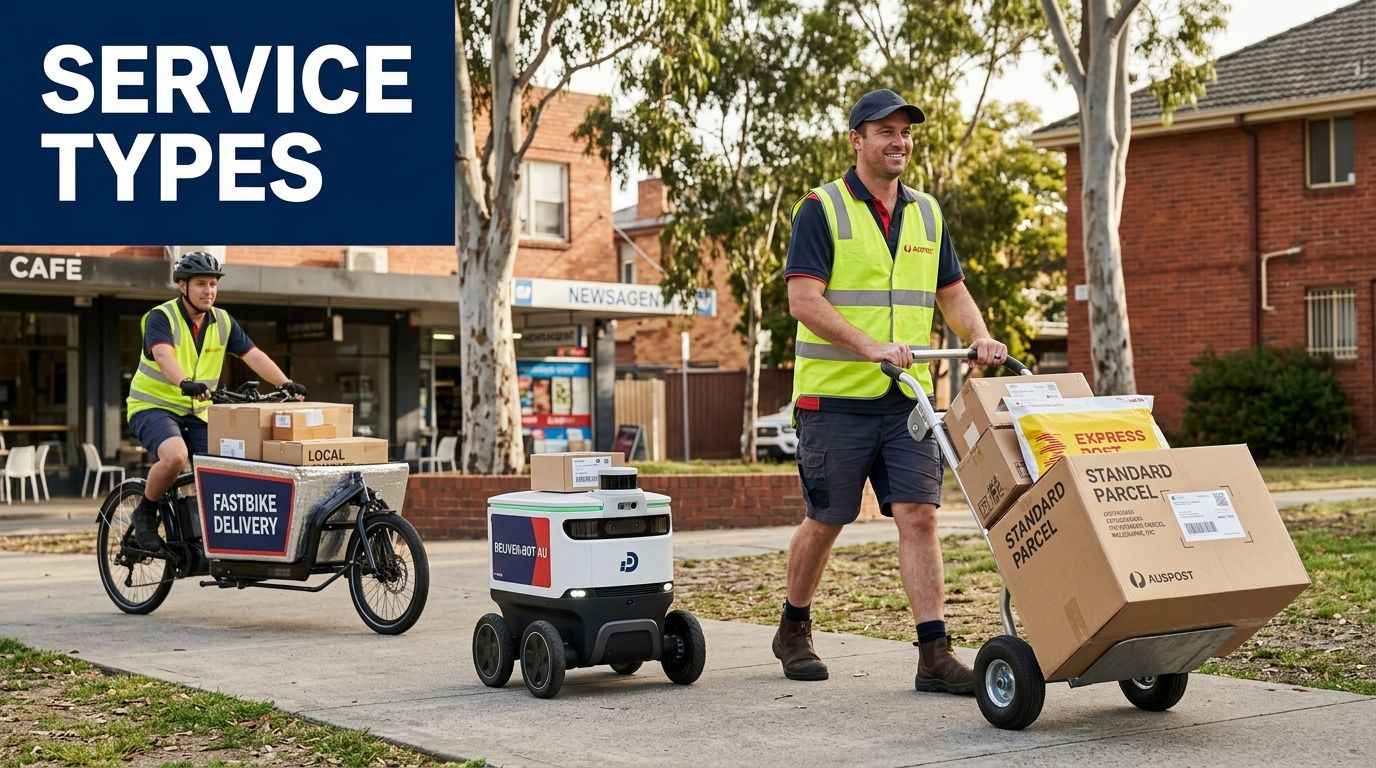
If you want a practical overview of booking options across local and nationwide parcel services, this guide to domestic courier services in Australia is a useful reference point.
Standard delivery
Standard is the budget option. It’s the service I’d use for routine eCommerce orders, replenishment stock, or any parcel where the customer cares more about a fair delivery charge than shaving a day off transit.
What standard does well:
- Keeps costs down for everyday boxes and satchels
- Works well for non-urgent orders
- Usually suits broad national coverage better than premium services
Where people get it wrong is using standard for urgent customer promises. If the parcel is tied to an event, replacement item, or time-sensitive order, standard can create avoidable support tickets.
Express delivery
Express is the middle ground. You’re paying more for priority handling and faster movement through the network. It’s often the right choice when the order has real urgency but doesn’t justify the cost of a dedicated same-day service.
A quick way to understand this is:
| Service type | Best for | Trade-off |
|---|---|---|
| Standard | Routine orders | Lowest cost, slower transit |
| Express | Important orders that still need margin control | Faster, but costs more |
| Same-day | Local urgent deliveries | Highest cost, narrowest use case |
If the parcel is replacing a faulty item, supporting a VIP customer, or fixing a fulfilment mistake, express often costs less than the customer service damage caused by delay.
Same-day delivery
Same-day is the taxi fare of parcel shipping. It solves a specific problem. It isn’t something most businesses should default to.
Use same-day when the delivery is local, genuinely urgent, and valuable enough to justify the spend. Don’t use it to cover for poor dispatch discipline. If orders leave late because your internal process is messy, same-day becomes an expensive band-aid.
How to choose without overpaying
A simple filter works well:
- Ask whether the customer needs speed
- Check whether the route is local enough for same-day to make sense
- Use express only where delay has a clear cost
- Keep standard as the default for regular orders
That one habit prevents a lot of unnecessary freight spend.
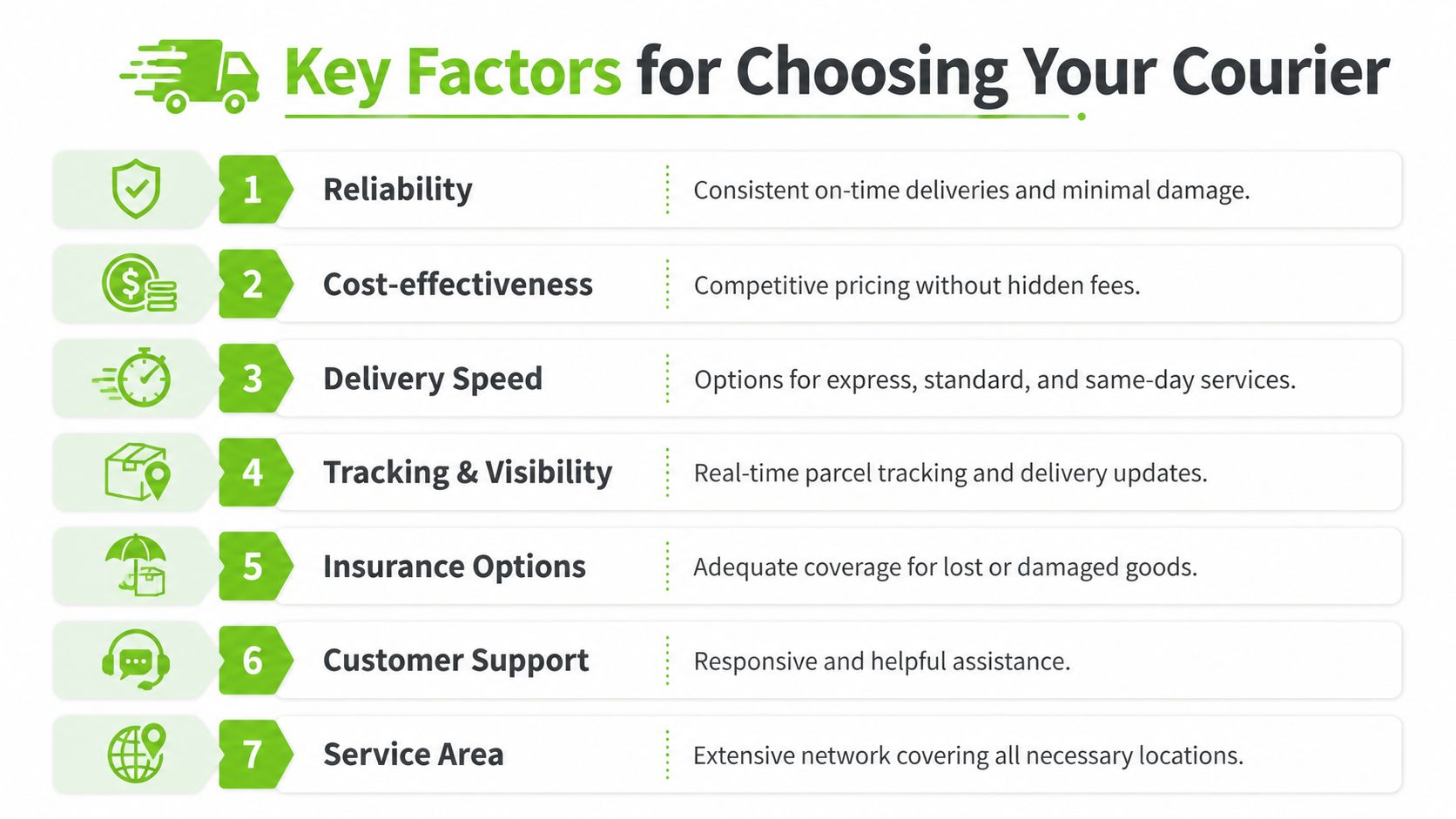
Key Factors for Choosing Your Courier
Price matters, but cheap shipping that creates damage, missed deliveries, or customer complaints isn’t cheap in the end. When I assess courier companies in australia for parcel work, I look at the full operating impact, not just the first quote on screen.
Australia’s courier footprint is heavily concentrated. New South Wales holds 29% of courier companies, Victoria 20%, and Queensland 19%, meaning those three states account for 68% of the country’s courier companies, according to Australian courier company market data. That matters because a provider that looks strong in Sydney and Melbourne can still be inconsistent once your parcels move further out.
Look past the headline price
The base quote is only one part of the cost. What matters is what the job costs after all the practical details kick in.
Check for:
- Residential delivery conditions that may differ from commercial drops
- Regional coverage strength if you ship outside major metro areas
- Insurance inclusion so a low rate doesn’t become expensive after one claim
- Pickup suitability for your workflow, especially if you dispatch daily
A cheap rate with weak tracking and awkward pickup windows often creates hidden labour cost inside your own team.
Match service level to customer promise
A common mistake is buying speed that the customer never asked for. The opposite mistake is choosing slow services when the order value or customer expectation is high.
Here’s the better test:
| Question | What it tells you |
|---|---|
| Is the order urgent or just important? | Helps separate express from standard |
| Is the destination metro or harder to service? | Affects both reliability and cost |
| Is the parcel low value or painful to replace? | Shapes your insurance decision |
| Will the customer chase tracking updates? | Determines how much visibility you need |
If you want a broader framework for evaluating providers, this guide on what makes a courier service the best breaks down the practical criteria well.
Coverage and support matter more than brochures
A courier can look polished online and still be a poor fit for your order mix. What counts is whether the provider handles your actual lanes well and gives you useful support when something goes wrong.
For businesses comparing major carrier strengths, this ecommerce shipping partner comparison is a helpful example of how to think through service trade-offs instead of relying on brand familiarity alone.
The right courier isn’t the one with the nicest sales pitch. It’s the one that reliably fits your parcel profile, delivery areas, and customer expectations.
Don’t ignore compliance and packaging discipline
For local box and parcel work, packaging still matters. If the carton is weak, oversized, poorly sealed, or badly labelled, the courier isn’t the only issue. Your business is creating avoidable failure points.
Good operators also give clear guidance on safe packing and handling requirements. That’s especially useful when your business ships a mix of satchels, cartons, and more awkward boxed items across different routes.
The Smart Way to Compare Courier Quotes
The old way of booking freight is still surprisingly common. Open one courier website, enter the parcel size, check the rate, open another tab, repeat the process, then try to work out whether the cheaper quote is comparable. It wastes time and usually produces bad decisions because the formats, service names, and inclusions vary.

For small and medium eCommerce businesses, this matters even more because 63.9% of Australians shopped online monthly in 2024, and aggregator platforms help fill the gap by giving smaller shippers access to wholesale pricing that used to be limited to higher-volume accounts, as noted in this Australian shipping platform overview.
Why manual quote gathering breaks down
Manual comparison creates friction in four places:
- It eats staff time every time you re-enter the same parcel details
- It hides true value because one quote may include tracking or insurance while another doesn’t
- It encourages habit buying where your team defaults to the same carrier to save effort
- It makes testing harder so you never learn which service is the cheapest for each route
That’s why multi-carrier platforms are so useful. They pull several service options into one workflow and let you compare them side by side.
What a multi-carrier platform changes
Instead of choosing one courier company and forcing every shipment through it, you compare live options for each parcel and book the one that makes sense. That approach is usually better for small businesses because your shipments aren’t all the same. A local satchel, a suburban carton, and a regional box have different cost and service profiles.
A practical platform should let you:
| Function | Why it saves time |
|---|---|
| Enter parcel details once | Cuts repetitive quoting work |
| Compare multiple carriers | Makes rates and service levels visible |
| Book from one dashboard | Reduces admin friction |
| Track jobs centrally | Keeps customer service cleaner |
If you’re looking at software that does this, a practical example is a courier quote comparison and booking platform, where the value comes from faster comparison and simpler booking rather than maintaining separate courier accounts.
Compare by outcome, not brand
A quote is only useful if it answers the right question. You’re not trying to prove one brand is universally cheaper. You’re trying to find the best value for this shipment.
For businesses that also want a broader freight-tech perspective, this guide on lowering international shipping costs is useful because the underlying principle is the same. Comparison tools reduce waste by replacing guesswork with direct rate visibility.
If your team can compare rates in seconds, they’ll compare. If comparison takes ten minutes, they’ll stop doing it.
Practical Strategies for Lowering Shipping Costs
Lower freight spend usually comes from process, not luck. Businesses often focus only on the quoted rate, but the larger savings usually sit in packaging, dispatch habits, and how often you compare options.
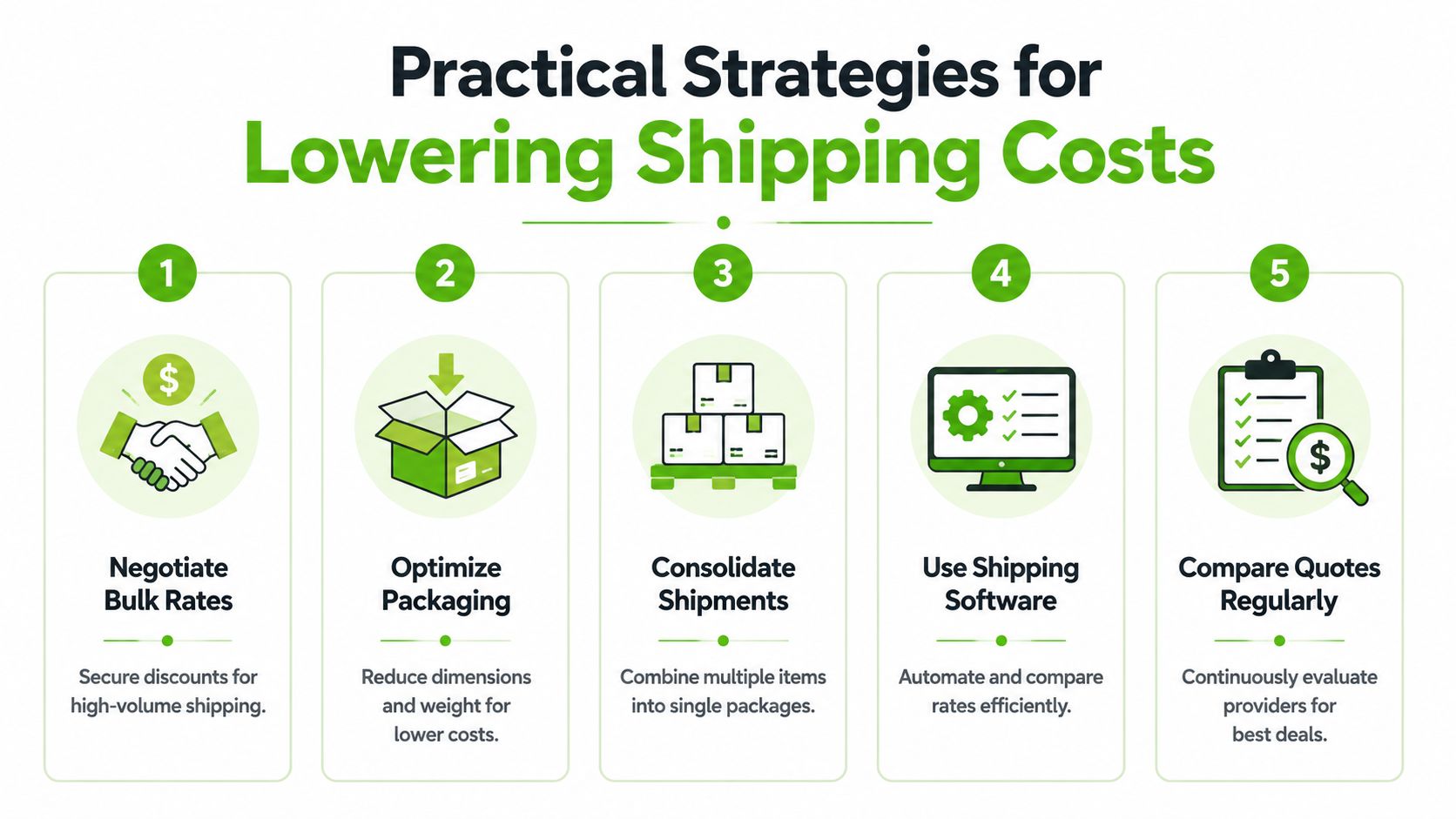
One useful benchmark is that aggregator platforms can offer starting prices for small parcels from AUD 7.60 to 8.95, with 15% to 25% savings compared to direct carrier quotes because they pass on volume-negotiated margins, according to this Australian courier pricing overview.
Tighten your packaging
Oversized cartons are a silent margin killer. If the box is much larger than the product, you’re paying to move air and increasing the chance of damage from internal movement.
Do this instead:
- Use the smallest safe carton that protects the item properly
- Match void fill to the product so contents don’t shift in transit
- Standardise box sizes for common orders to speed up packing and quoting
Compare every shipment type, not just once
Many businesses compare rates once, then stop. That works against you because different couriers can be stronger on different routes and parcel profiles.
A better habit is to compare by category:
- Local metro boxes
- Nearby interstate cartons
- Regional residential deliveries
- Lightweight satchels
That gives you a repeatable decision pattern without locking you into one carrier.
Reduce avoidable operational leakage
Shipping costs rise when dispatch is messy. Reprints, wrong labels, weak cartons, missed pickups, and customer address errors all add labour and rework.
Field note: The cheapest parcel is the one that leaves correctly the first time, with the right label, the right carton, and no need for follow-up.
Simple controls help:
- Check addresses before label creation
- Set a daily dispatch cutoff
- Keep packing materials consistent
- Train staff on one booking workflow
If you want a practical checklist focused on savings, this guide on how to reduce shipping costs for small business is worth keeping handy.
Use tools that remove account friction
The more accounts, portals, and payment quirks your team manages, the more admin cost creeps in. For smaller operators, a single workflow with clear labels, central tracking, and no unnecessary account complexity often saves as much in labour as it does in freight rates.
That’s the part many owners miss. Shipping isn’t only a carrier cost. It’s also a process cost inside your business.
How Aeros Couriers Streamlines Your Shipping
Most of the problems above come from fragmentation. Rates live in one place, bookings in another, tracking in another, and support depends on which carrier handled that parcel. A modern shipping workflow works better when those steps sit in one system.

That’s where a platform model is practical. Modern courier platforms use technology such as AI-powered route optimisation, and they pass some of those benefits to smaller businesses through competitive pricing and features like real-time tracking, which has been shown to cut failed deliveries by up to 18%, according to this Australian courier technology analysis.
What the workflow should look like
For local Australian parcel delivery, the best setup is usually simple:
| Step | What you need |
|---|---|
| Quote | Clear options from multiple carriers |
| Book | One screen, no repetitive admin |
| Label | Fast generation and print-ready output |
| Track | Central visibility after dispatch |
Aeros Couriers fits that model by letting users compare carrier options, book online, print labels, and manage shipments from one dashboard. For businesses sending regular boxes and satchels, that removes the need to bounce between separate courier systems. If you need collection options, the parcel pickup booking page shows how that process works in a straightforward way.
Where this helps in day-to-day operations
This kind of setup is useful when your team wants speed without losing control. It keeps quoting consistent, makes dispatch easier for staff, and gives customer service a single place to check shipment status.
It’s also practical when your order mix changes. Some days you need the cheapest reasonable option. Other days you need a faster service because a customer is waiting on a replacement or a launch order missed the normal dispatch window.
What works better than a single-carrier habit
A single-carrier workflow can feel simpler at first, but it often locks you into one pricing structure and one service profile. A multi-carrier dashboard is usually more resilient because it lets you choose based on route, urgency, and parcel type.
That’s a better fit for small businesses trying to control costs without lowering service standards.
Use one process, not one courier. That’s the difference between organised shipping and expensive shipping.
Your First Steps to Cheaper Faster Shipping
Start with one real parcel, not a full system overhaul. Measure the box properly, weigh it accurately, enter the sender and receiver details, and compare the available service options. That gives you a clean baseline straight away.
Then prepare the shipment properly before booking pickup. Use a strong carton, seal it well, apply the label clearly, and make sure the contents fit the service you’ve selected. Most delivery issues start before the parcel ever leaves your premises.
Finally, keep all future jobs in one workflow. A central dashboard makes it easier to track jobs, answer customer questions, and repeat the same process every day without relying on memory or guesswork.
If you do only one thing after reading this, stop choosing a courier by habit. Compare each parcel on its own needs. That’s how small businesses usually get cheaper rates, fewer delivery headaches, and a shipping process that effectively supports growth.
If you want a simpler way to compare local parcel services, book online, and manage pickups and tracking in one place, Aeros Couriers is an Australian-owned option built for businesses and everyday senders who want practical control over their shipping.
Courier quotes, tracking and support
Ready to send a parcel? Compare the available services for your postcodes, parcel dimensions and weight. For an existing delivery, use your consignment number to check tracking or ask our team for help.