If you're sending a few parcels a week, shipping can eat half a day. You pack the order, drive to the post office, join the queue, second-guess the pricing, then hope the delivery attempt lines up with your customer being home. If you're in regional Australia, that frustration usually gets worse, not better.
A smoother option is to bring the pickup to you. For small businesses, side hustles, home-based sellers and busy households, the main win isn't just convenience. It's control. You can compare carriers, book from your desk, print your label, hand the parcel over, and get on with the rest of your day.
Your Escape from the Post Office Queue
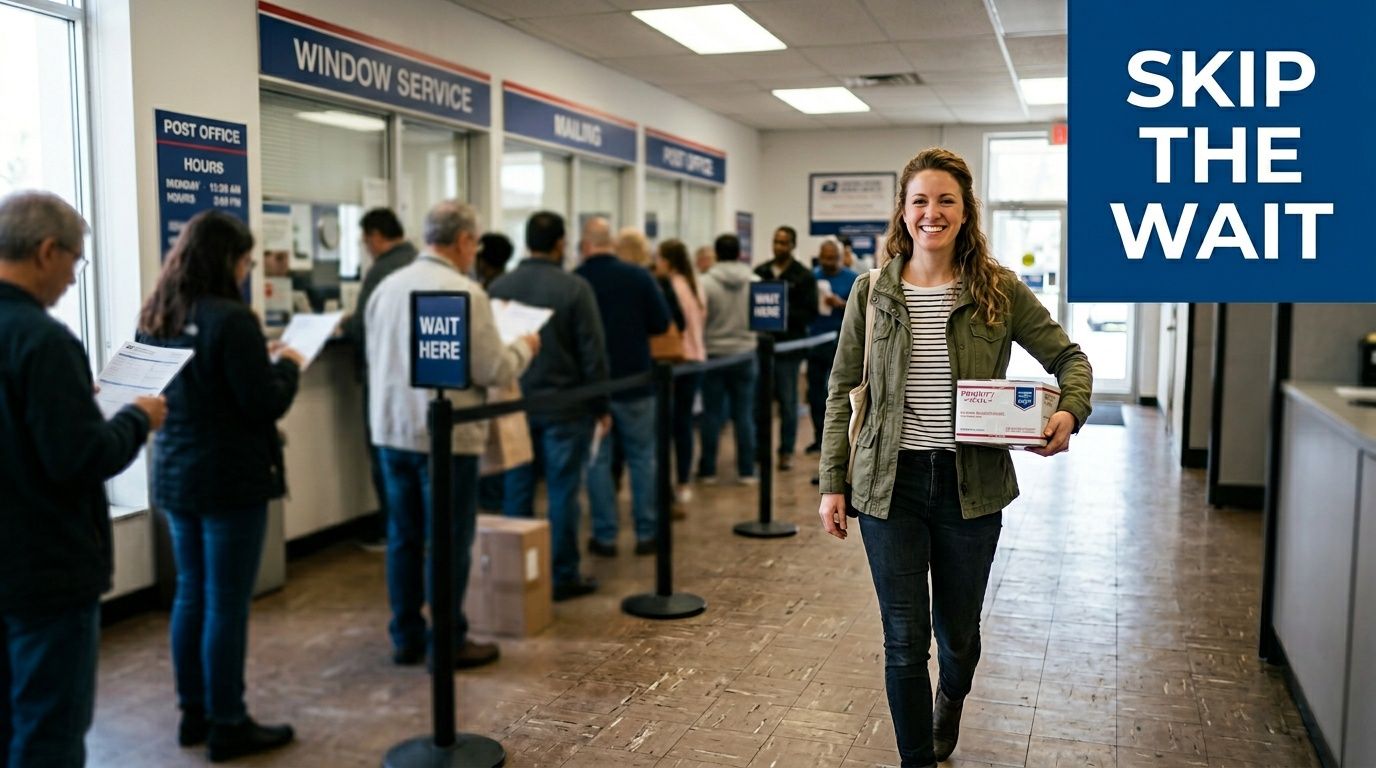
Most small operators don't struggle with packing orders. They struggle with everything around it. The driving, waiting, comparing rates on the fly, and fitting shipping errands into an already full workday.
That old routine feels manageable when you're sending one parcel. It breaks down when you're sending several each week, or when your stock room is your spare room and your nearest drop-off point isn't exactly around the corner.
Why pickup matters more outside metro areas
Regional businesses feel this harder than city senders. In Australia, 28% of the population lives outside major cities and faces limited parcel collection options, leading to failed delivery rates of up to 15% in remote areas. This costs the logistics sector AUD 250 million annually, according to Australia Post regional delivery reporting context.
That gap changes the value of pickup. What looks like a convenience in metro areas becomes a practical workaround in regional areas. Home and business collection can remove the wasted trip, reduce missed handovers, and make shipping feel predictable again.
If you're weighing different pickup methods, it's worth looking at Australia Post courier pick up options alongside broader multi-carrier booking tools so you can compare what suits your location, parcel type and delivery urgency.
What works better than the old model
The strongest shift isn't "online booking" by itself. It's multi-carrier booking without account friction. Instead of being locked into one network, you compare services for that specific job.
That matters because cheap and fast rarely come from the same carrier every time. One provider may suit a lightweight satchel going metro. Another may make more sense for a carton heading to a regional town. A system that shows the options upfront saves both guesswork and overspending.
Practical rule: If shipping requires a car trip and a queue before the parcel even starts moving, the process is too expensive in time.
The other overlooked benefit is mental load. No separate account applications. No back-and-forth just to access rates. No need to treat shipping like a specialist skill. You enter the parcel details, compare the choices, book the pickup, and move on.
For businesses trying to pick up parcels reliably across Australia, especially from homes, small offices, workshops or regional sites, that's a significant improvement. Shipping stops being an errand and becomes a task you can finish in minutes.
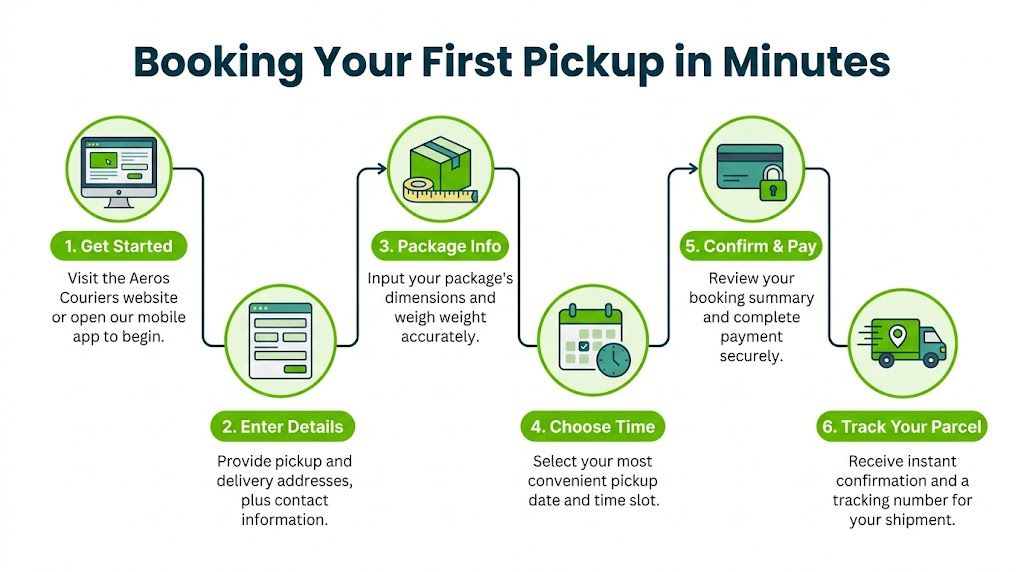
Booking Your First Pickup in Minutes
The booking process is simple when the parcel details are right. Most pickup problems don't start with the driver. They start on the screen, when the sender guesses the weight, rounds down the dimensions, or chooses a service that doesn't match the address or urgency.
Start with the parcel, not the price
Before you compare anything, pack the item first. Then measure and weigh the finished parcel. That's the number that matters.
Industry data shows 28% of surcharges, averaging $15 per parcel, stem from misdeclared weights, as noted in parcel shipping spend analysis. If you've ever wondered why a cheap quote turns into an annoying adjustment later, this is usually the reason.
A good booking flow guides you through the details clearly. That's why many small businesses use platforms that let them compare and book your courier in one place instead of checking separate carrier sites one by one.
Enter address details carefully
Address accuracy affects pickup success as much as delivery success. For a home pickup, include anything that helps the driver find the property quickly. Unit number, business name if relevant, gate code if needed, and a contact number that someone will answer.
For commercial pickups, use the pickup contact who'll be onsite during the window. If the parcel is sitting in a back storeroom and the front desk doesn't know about it, the booking becomes harder than it needs to be.
A strong habit is to think like the driver for ten seconds:
- Can they identify the site fast
- Will someone be there during the window
- Is the parcel ready when they arrive
- Will the label already be attached
If any answer is "probably", fix that before you confirm the booking.
Choose the service by outcome
Cheapest isn't always cheapest if it creates customer complaints or extra admin. Fastest isn't always sensible if the parcel isn't urgent.
Use a simple filter:
| Shipping need | Better choice | Why |
|---|---|---|
| Low-value item with flexible timing | Economy service | Keeps costs down when speed isn't critical |
| Customer needs it promptly | Express option | Better fit for time-sensitive orders |
| Residential receiver likely to miss deliveries | Tracked service with clear updates | Helps reduce "where is it" messages |
| Higher-value goods | Service with optional signature | Adds more control at handover |
Multi-carrier comparison helps. You don't need one default service for every order. You need the right service for this order.
Book a pickup window you can actually keep. A broad window is fine if the parcel is packed, labelled and near the door. It isn't fine if you're still taping the box when the driver arrives.
Review once, then pay
Before checkout, confirm four things only:
- The suburb and postcode are correct
- The parcel size matches the packed item
- The service level matches the urgency
- The sender contact can answer during pickup
That last review matters because most booking errors are boring errors. Wrong postcode. Old mobile number. Box measured before padding was added. None of them are dramatic, but each one creates delays.
Once paid, keep the confirmation handy and print the label straight away. The fastest bookings are the ones that move from screen to parcel without a break in between.
Preparing Parcels for a Perfect Pickup
A booked pickup only works if the parcel is ready. Drivers can collect a well-packed, clearly labelled box in seconds. They can't rescue a soft carton, a half-sealed satchel, or a label that's curling around a corner.
Pack for movement, not for the shelf
A parcel may look fine on your bench and still fail in transit. The test is whether the contents stay protected when the box is lifted, stacked, scanned and moved between vehicles.
Use a box that fits the item closely enough to limit movement, but not so tightly that the carton bulges. Fill empty space with suitable cushioning so the contents don't shift. If you're using a satchel, make sure the item won't split the seams or punch through the surface.
This quick comparison helps.
Carton vs. Satchel Which to Choose?
| Item Type | Best Choice | Why |
|---|---|---|
| Clothing, soft goods, non-breakable light items | Satchel | Flexible, light, and usually the easiest option for simple apparel orders |
| Boxed products, beauty packs, books | Carton | Holds shape better and protects corners during handling |
| Fragile items | Carton | Gives you room for cushioning and stronger sealing |
| Odd-shaped goods | Carton | Easier to size correctly and label properly |
| Small accessories in retail packaging | Depends on rigidity | If the product box crushes easily, use a carton |
Measure after sealing
Many senders come unstuck when they measure the empty box, add packing material, tape it up, then forget the parcel is now larger and heavier.
Measure the final packed parcel on a flat surface. Weigh it once it's completely sealed. If you add a label pouch, extra tape or internal fill after quoting, check it again.
Good prep usually looks like this:
- Box chosen for fit: Not oversized, not overstuffed
- Void fill added: Enough to stop movement inside
- Seams reinforced: Especially on heavier cartons
- Old labels removed: No duplicate barcodes anywhere
- Final dimensions checked: After the parcel is fully packed
Label placement decides how smoothly the job starts
Print the label cleanly and attach it to the largest flat face. Don't place it over a seam, around an edge, or under loose tape that reflects badly and makes scanning harder.
If you need a practical guide to placement, how to position the label on a package is worth reviewing before your first few bookings.
A parcel can be packed well and still fail at collection if the label is hard to scan. Flat, visible and secure wins every time.
For home senders, place the parcel near the entry point before the pickup window begins. For businesses, keep outgoing parcels in one obvious location and make sure the person onsite knows they're booked for collection. That small handoff detail prevents a surprising number of avoidable missed pickups.
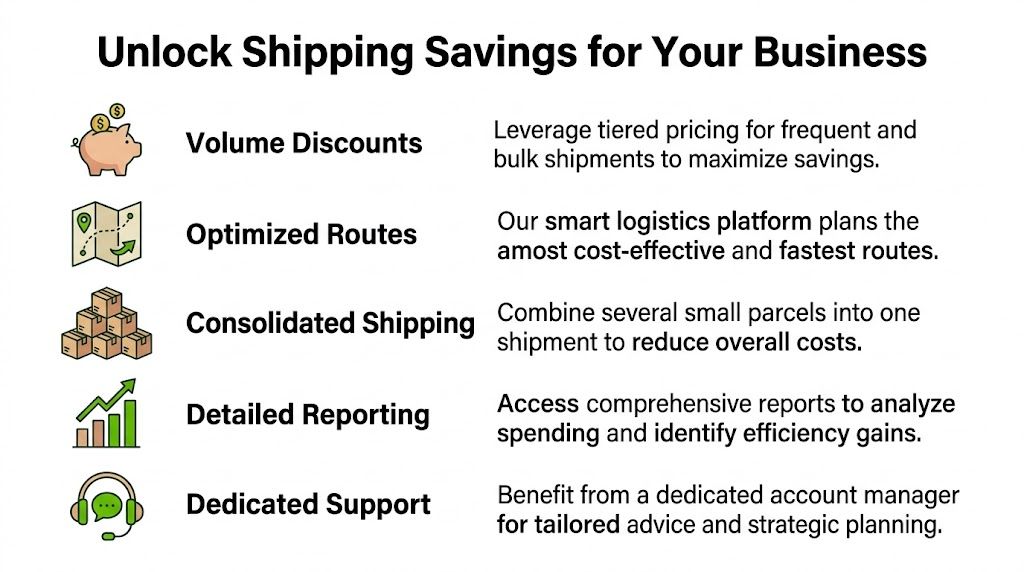
Unlock Shipping Savings for Your Business
Shipping gets expensive when you treat every order as a one-off. It gets cheaper when you run it like a system. Small changes in booking habits, visibility and service selection can pull costs down without making delivery slower or harder to manage.
Centralise your shipping decisions
If you send from more than one location, or even just split stock between home, office and warehouse, a single dashboard matters. Quotes, labels, tracking and order history in one place make it easier to spot waste.
Cross-site benchmarking and centralised data can identify significant efficiency gains. For parcel operations, optimising routes and processing times via a single platform can cut related costs by 15-20%, according to cross-site benchmarking analysis.
That doesn't only apply to larger operators. A growing online store can use the same principle. Standardise how staff book jobs, where labels are printed, and which service rules apply to different order types. The less variation you allow in routine shipping, the fewer avoidable charges you'll wear.
Use features that protect margin
The cheapest advertised freight rate isn't always the lowest total shipping cost. Margin gets lost in add-ons, replacements, admin time and customer support.
Three features matter more than most businesses realise:
- Included insurance: If freight cover is already built into the booking flow, you avoid scrambling later when something goes wrong.
- Tracking visibility: This cuts back on manual "where is my parcel" follow-up.
- Reward points: If every order contributes toward future business value, shipping spend works harder.
One practical option in Australia is Aeros Couriers, which lets businesses compare carriers, book without account applications, access included freight insurance, and earn reward points that can be redeemed through Simply Merchandise on a large catalogue of branded items. That's useful for businesses that want shipping to support both fulfilment and marketing spend.
The most economical shipping setup isn't the one with the lowest sticker price. It's the one that avoids rework, reduces support time and gives you something back on every booking.
Match checkout settings to real courier costs
Many e-commerce stores undercharge for shipping because their checkout rules were guessed months ago and never revisited. If your store runs on Shopify, this guide to setting shipping rates on Shopify is a practical resource for aligning what customers see at checkout with what fulfilment costs.
That matters because poor checkout settings create two bad outcomes. You either absorb the difference, or you surprise the customer later. Neither helps retention.
For businesses shipping regularly, a dedicated business postage account workflow can also make reporting and repeat booking cleaner, especially when multiple team members handle dispatch.
Small decisions that save more than they seem
| Decision | Better approach | Business effect |
|---|---|---|
| Booking ad hoc each time | Create a repeatable dispatch routine | Fewer mistakes and less staff time |
| Using one carrier by habit | Compare options per parcel | Better fit for price and speed |
| Treating shipping as admin only | Track it as a cost centre | Easier to improve margins |
| Ignoring rewards and included cover | Use them deliberately | More value from the same spend |
The goal isn't to obsess over every parcel. It's to remove silent waste from a process you repeat every week.
Navigating Compliance and Special Shipments
Compliance sounds heavier than it needs to be. For most parcel senders, it comes down to one principle. The item you're handing over must be safe, correctly declared and suitable for the network you're using.

Chain of Responsibility in plain language
Chain of Responsibility means everyone involved has obligations, not just the carrier. If a sender misdeclares goods, packs them poorly, or hands over something prohibited, that risk doesn't disappear because a driver collected it.
This matters at pickup because the handover is the first physical control point. In Australia, 18% of freight claims stem from improper handling during pickup, often related to non-compliance with Chain of Responsibility or dangerous goods laws, based on BITRE dangerous goods incident reporting context.
That number is a useful reminder that compliance isn't paperwork for its own sake. It protects your parcel, the driver, the network and your own liability.
Know what shouldn't go through a standard parcel booking
Many senders don't realise that everyday items can trigger dangerous goods rules. Batteries, aerosols, flammable liquids, certain cleaning products and some workshop materials are common examples.
If you're unsure, stop before booking. Don't guess based on how ordinary the product looks on a shelf.
A simple screening habit helps:
- Check the product contents: Especially for sprays, chemicals and battery-powered items
- Read the packaging labels: Hazard warnings are there for a reason
- Review courier restrictions: Standard parcel networks won't accept everything
- Ask before dispatching: Clarifying early is faster than dealing with a refused shipment
If your team sends mixed products, keep a reference list and train whoever books consignments. For a useful starting point, review hazardous goods classification guidance before sending anything questionable.
If you're hesitating about whether an item counts as dangerous goods, treat that hesitation as a sign to verify, not to proceed.
Set realistic expectations for regional deliveries
Regional shipping doesn't just affect convenience. It affects timing, access and communication. A parcel collected smoothly can still need longer in transit than a metro equivalent, particularly where delivery runs are less frequent.
The answer isn't to overpromise. It's to give customers realistic delivery expectations and use tracking updates well. Clear communication beats optimistic estimates that need explaining later.
Your New Era of Effortless Shipping Begins Now
The old shipping routine asks too much from small businesses. It asks you to leave your desk, lose time in queues, absorb surprise charges, and treat dispatch like a side quest in the middle of the workday.
A better routine is quieter. You compare, book, print, pack properly, and hand the parcel over from your home, office or shop. That change seems small until you repeat it every week. Then it becomes one of the easiest ways to protect your time.
The bigger shift is confidence. Once you know how to enter accurate details, choose the right service, prepare the parcel properly and screen anything with compliance risk, shipping becomes manageable instead of irritating. You stop reacting to problems and start preventing them.
What good parcel pickup really gives you
- More time back: No unnecessary trip to lodge each parcel
- Better cost control: Fewer avoidable surcharges and more consistent carrier choices
- Cleaner customer service: Tracking and clearer delivery expectations reduce inbound questions
- Less stress for regional senders: Pickup closes part of the gap created by limited local access points
If you like reading how courier operations evolve through integration and workflow simplification, the Parcel2courier Success Story offers a useful perspective on connecting order flow and shipping processes more cleanly.
The practical takeaway is simple. If you regularly pick up parcels from your desk, bench or stock shelf and get them moving without leaving the premises, your shipping process starts serving the business instead of interrupting it.
Ready to simplify sending across Australia? Get an instant quote, book a pickup, print your label and track your parcel with Aeros Couriers.
Courier quotes, tracking and support
Ready to send a parcel? Compare the available services for your postcodes, parcel dimensions and weight. For an existing delivery, use your consignment number to check tracking or ask our team for help.