Sending parcels across Australia is so much easier when you can just print postage labels from home. It's a game-changer, honestly. You get to skip the post office queues and avoid trying to navigate clunky carrier websites. What was once a frustrating chore becomes a simple task you can knock over in minutes.
The Smart Way to Handle Your Australian Shipments

Managing your local shipments doesn't have to be a headache. Whether you're running an e-commerce store out of Melbourne or just sending a one-off gift from Perth, using a platform like Aeros Couriers gives you an immediate upper hand.
The courier market in Australia is booming, which really underscores the need for digital tools that are actually easy to use. Since domestic parcels make up the lion's share of this market, being able to print labels quickly means businesses can get their orders ready for dispatch in no time.
A streamlined shipping process is a huge competitive advantage. It not only saves money but also enhances customer satisfaction by ensuring packages are dispatched quickly and professionally.
Taking a modern approach to your shipping offers some pretty clear benefits:
- Access to Competitive Rates: You can easily compare different courier options to find the best price for where your parcel is headed within Australia.
- Full Package Trackability: Keep an eye on your parcel every step of the way, from pickup to final delivery, with real-time tracking.
- Professional Appearance: Let's face it, a printed label just looks cleaner and more professional than a handwritten address, which helps build trust with your customers.
For a truly smart approach, especially when you're dealing with different regulations across states, it's worth looking into automated shipping compliance for your e-commerce store to cut down on errors. Our focus on an efficient local courier service is all about helping you take control of your logistics right from the start.
First Things First: Get Your Parcel Ready
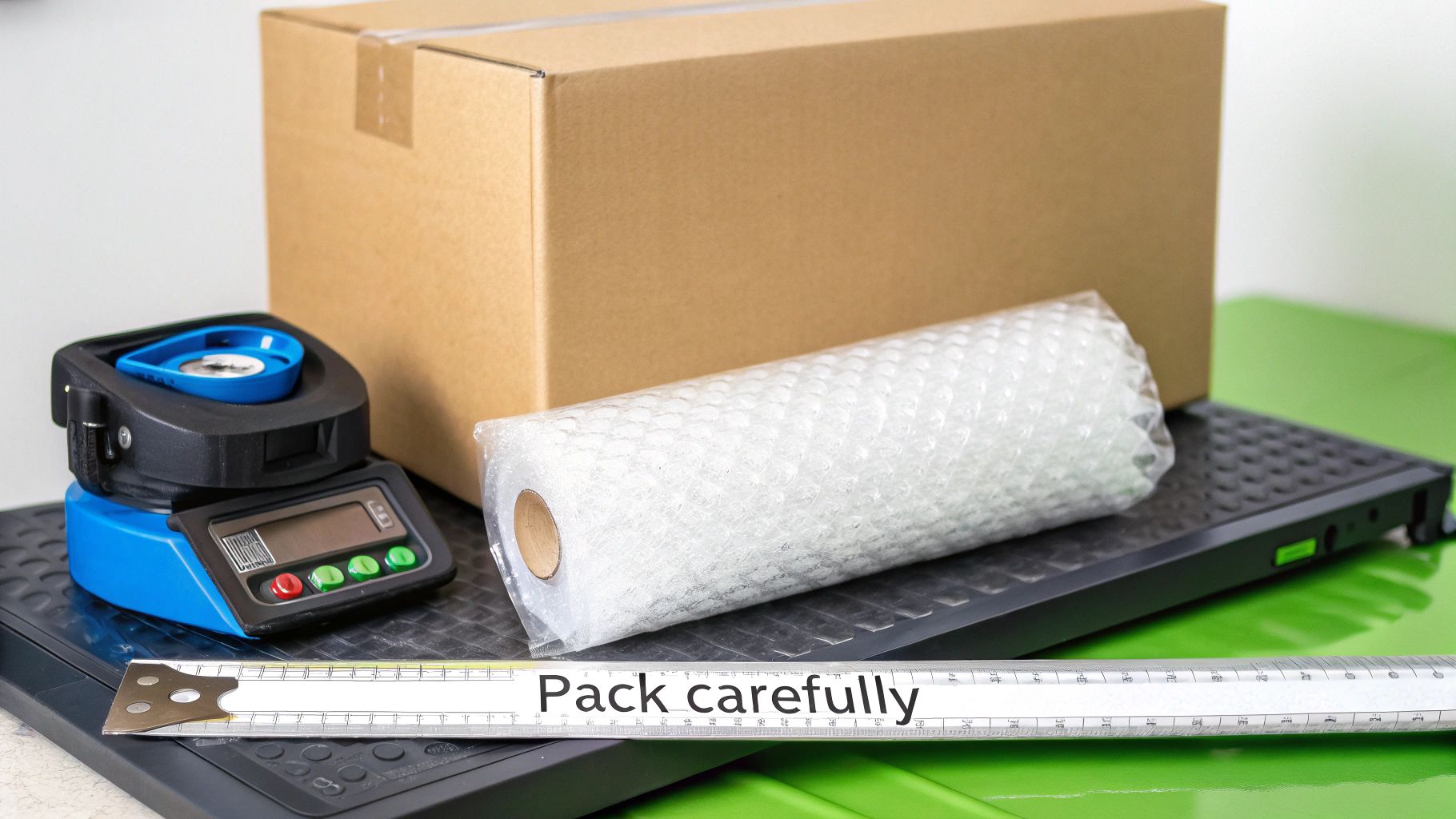
Before you even think about hitting that print button, taking a few minutes to get your parcel prepped properly can save you a world of hurt down the track. A perfect label on a poorly prepared package is a classic recipe for disaster.
The absolute first thing to lock down is your parcel’s measurements. Guessing the weight or dimensions is a surefire way to get an inaccurate quote, which often leads to surprise surcharges from the courier. These nasty fees pop up when the depot's automated scanners find a difference between what you declared and the actual size, and they can seriously sting.
Measure and Weigh Like a Pro
Always, always measure and weigh your parcel after it’s completely packed and taped up. Don't eyeball it. A small miscalculation of just a few centimetres can have a surprisingly big impact on the cost, particularly with larger items.
For shipping within Australia, couriers often use cubic weight to price bulky but light parcels. This is all about the space your package takes up on the truck, not just how heavy it feels. To avoid any confusion, it’s worth understanding how to calculate cubic weight for your parcels so you get the right price every time.
Getting these details spot-on ensures the barcode on your label has the correct data, which is key to avoiding delays and those dreaded extra charges.
Here's a simple rule to live by: the data you enter is the data that gets printed. Correct measurements lead to correct labels, which leads to a smooth, headache-free delivery.
Pack It to Protect It
How you pack your item is just as critical as getting the label right. Think about sending a fragile, handmade ceramic from Sydney all the way to Perth. The only thing standing between a delighted customer and a messy refund is your packaging.
- Pick the Right Box: Start with a new, sturdy cardboard box that gives your item a bit of breathing room. An old, beat-up box is just asking to be crushed in transit.
- Cushion Everything: Fill every single gap with bubble wrap, packing peanuts, or even scrunched-up paper. You want to stop the contents from shifting around. A good rule of thumb is to have at least 5cm of cushioning on all sides.
- Seal It Tight: Use strong packing tape on all the seams, top and bottom. This doesn't just keep it closed; it reinforces the whole structure of the box.
How to Generate Your Shipping Label Online
Right, let's get your parcel on its way. Actually creating your shipping label on the Aeros Couriers platform is designed to be a smooth ride, taking you from a quick quote to a ready-to-print PDF without any fuss.
It all kicks off with your parcel's details. Once you've got the exact weight and dimensions handy, you'll pop them straight into our online form. Getting this part right is absolutely crucial—it ensures everything that follows, from the price you pay to the barcode on the final label, is spot on.
This is the online dashboard where you'll start the label creation process.
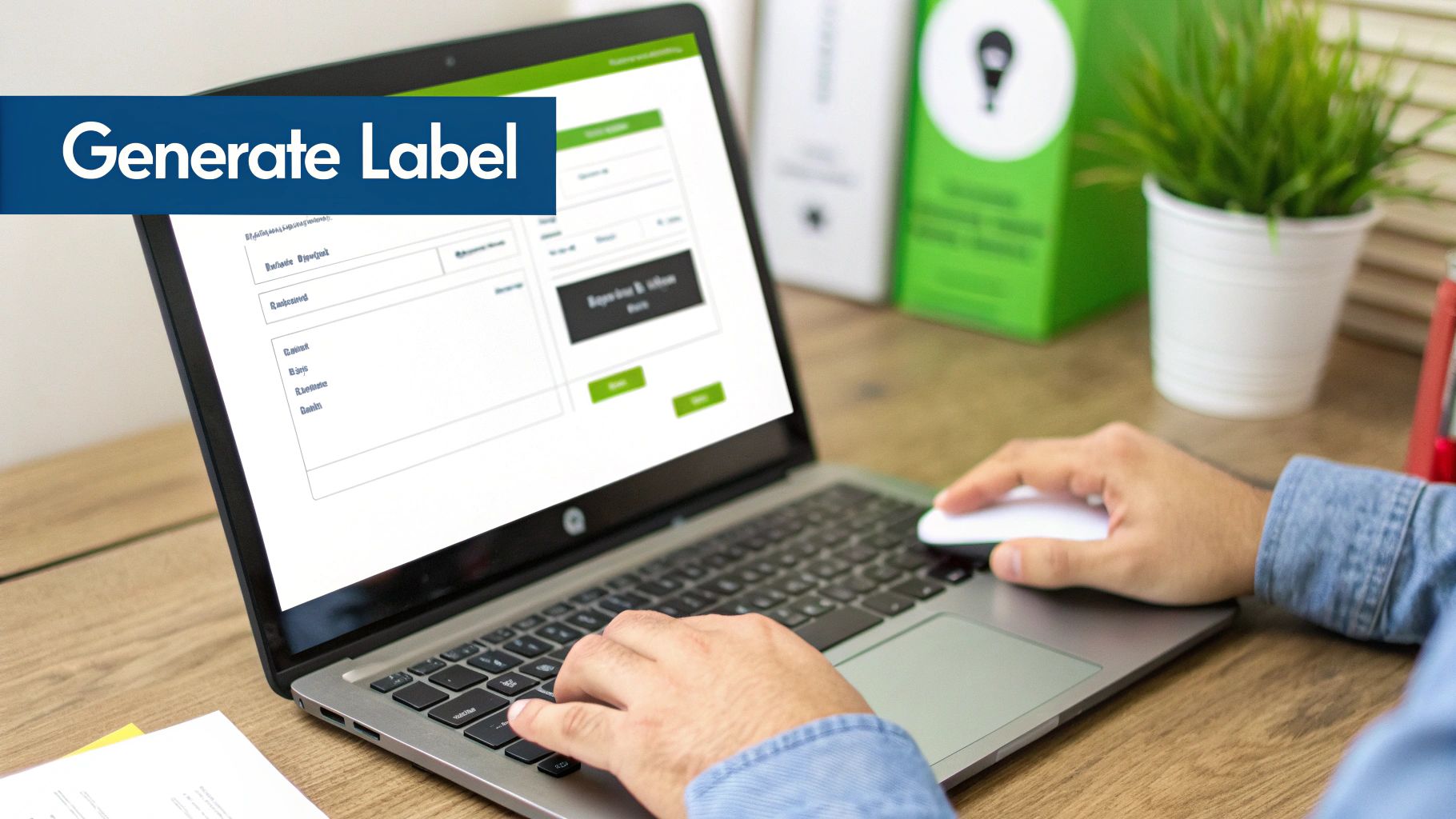
The clean layout helps you quickly enter your shipment's details, get an instant quote, and see which carrier options are available.
Choosing Your Carrier and Finalising Details
After you’ve entered the parcel information, our platform will show you a list of available Australian couriers. You can easily compare them by price and estimated delivery time, which puts you in the driver's seat to make the best choice for your needs. Whether you're chasing speed or trying to save a few dollars, you'll find an option that works.
Once you’ve picked a carrier, the system walks you through confirming the booking and entering the sender and receiver details. Accuracy here is non-negotiable. I always tell people to double-check every field, especially postcodes and street names, because a simple typo can cause major delivery headaches.
If you want a sneak peek, head over to our easy-to-use shipping quote calculator to see just how simple it is.
The demand for efficient shipping like this has skyrocketed. In 2025, Australia's Courier Pick-up and Delivery Services industry is a massive $13.7 billion market. It's been growing at an impressive 8.5% annually for the last five years, powered by 56,550 businesses that rely on digital platforms to print postage labels and keep up with the e-commerce boom.
Understanding Your Downloaded Label
The last piece of the puzzle is downloading your completed postage label as a PDF file. This single document contains every bit of information needed to get your parcel safely from your door to its destination within Australia.
Every single element on the label has a specific job. The barcode is the hero—it gets scanned at every depot and checkpoint, tracking the parcel’s journey. That tracking number? It’s what lets you and your customer follow its progress online.
Your label will also clearly show:
- The sender's and receiver's full addresses.
- The service you selected (e.g., standard, express).
- The parcel's declared weight and dimensions.
With this PDF saved, you're ready for the final step: printing it out and sticking it firmly onto your package for pickup.
Printing and Attaching Your Label Like a Pro
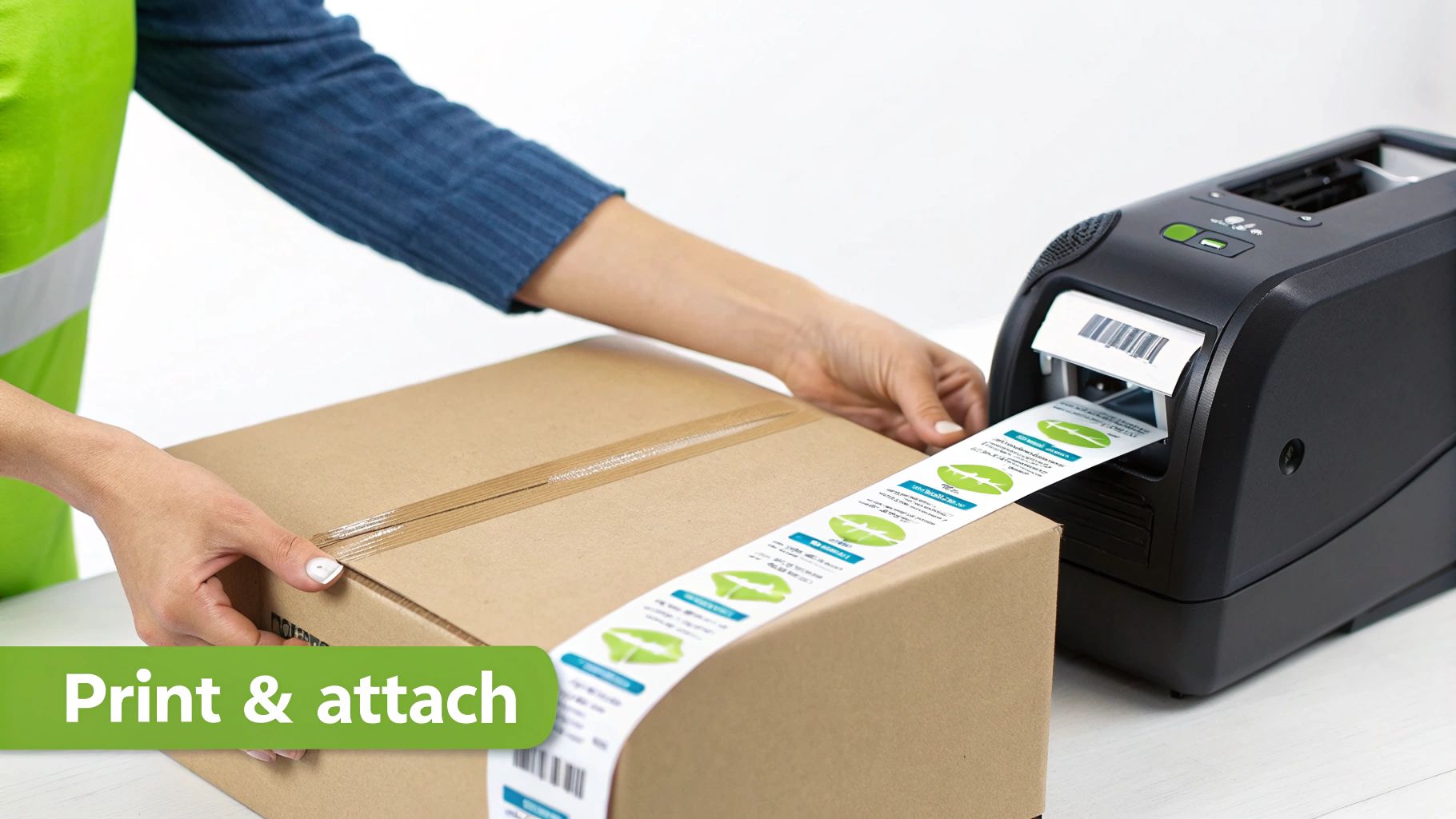
So, you’ve generated your label. Now comes the part that a lot of people overlook: getting it printed clearly and stuck on securely. A smudged or poorly placed label is a recipe for delays, because if a courier's scanner can't read it, your parcel isn't going anywhere fast.
The way you print can make a huge difference. If you're only sending a few things here and there, a standard A4 printer will do the job just fine. But once you start scaling up? For a business sending out 50 parcels a day, that time spent cutting and taping adds up. That's when switching to proper adhesive labels becomes a no-brainer.
A crisp, scannable barcode is your parcel's passport through the courier network. Ensuring it's printed at a high resolution and isn't smudged or creased is non-negotiable for a smooth delivery.
Choosing Your Printing Method
How you print your labels often depends on your shipping volume. There's no single "best" way; it's about what makes sense for your workflow. Here's a quick comparison of the common methods I see people using.
Label Printing Options Comparison
| Method | Best For | Pros | Cons |
|---|---|---|---|
| A4 Paper + Tape | Low-volume senders, personal parcels, and startups. | Very low cost, no special equipment needed. | Time-consuming, unprofessional look, tape can obscure barcodes. |
| A4 Adhesive Sheets | Growing businesses sending 5-20 parcels a day. | Faster than paper and tape, looks more professional. | Can be pricey per sheet, potential for printer jams. |
| Thermal Label Printer | High-volume businesses and serious e-commerce sellers. | Extremely fast, cost-effective per label, no ink required. | Higher initial hardware cost, requires specific label rolls. |
For those just starting out, printing on plain A4 paper is a perfectly good, budget-friendly option. Just be sure to tape it down on all four sides and—critically—don't let the tape cover the barcode or any address details.
Once your volume picks up, investing in a thermal label printer is a game-changer. These printers use heat to create the image, so you never have to buy ink or toner again. They print directly onto adhesive labels, letting you peel and stick in seconds.
Best Placement Practices for Your Label
Where you stick the label is just as important as how you print it. The aim is to give those high-speed, automated sorting machines a clean, flat surface to scan. A little bit of thought here can save a lot of headaches later.
- For Cartons: This one's easy. Place the label squarely on the largest, flattest side of the box. Keep it away from seams, edges, or any tape you've used to seal it up.
- For Satchels: Before you stick the label on, smooth out the satchel to get rid of any major wrinkles. Apply it right in the centre, far from any folds that could hide the barcode from a scanner.
- For Pallets: The label needs to be attached to the side of the palletised freight, where it's clearly visible for forklift operators and depot staff who won't have time to search for it.
Different platforms can also have their own quirks and rules. For example, it’s always a good idea to familiarise yourself with guidelines like Amazon's specific label requirements to avoid simple mistakes that can halt your shipment. Taking a few extra seconds to get the placement right ensures your package gets scanned correctly at every point of its journey across Australia.
Navigating Common Postage Label Hiccups
Even the best-laid plans can hit a snag. When you're in the middle of getting shipments out the door, small issues with postage labels can pop up. The good news? They're almost always simple to sort out without throwing your whole schedule off track.
That Blurry Barcode Problem
One of the most frequent culprits is a blurry or unreadable barcode. This is usually down to your printer settings being a bit too low-res.
Before you hit 'print' again, dive into your printer's settings and look for an option like 'High Quality' or 'Best'. This tiny tweak forces the printer to use more ink and detail, giving you a sharp, scannable barcode that machines will love.
Spotting a Mistake After You've Printed
We've all been there. The label is fresh off the printer, and you suddenly spot a typo in the delivery address. Whatever you do, don't just stick it on the box and hope for the best. An incorrect address is a one-way ticket to a 'return-to-sender' headache, which costs you both time and money.
If you find a mistake, the fix is straightforward. You’ll need to void the incorrect label right away in your Aeros Couriers dashboard. This cancels the tracking number tied to it and, more importantly, makes sure you aren't charged for a label you can't use.
With the old one cancelled, you can go ahead and generate a new, correct label. The process is a lot like creating the initial consignment note, which is essentially the contract and receipt for your shipment. If you want to get a better handle on the paperwork, you can learn more about the role of a consignment note in shipping.
Here’s the golden rule: never, ever try to fix a postage label with a pen. Automated scanners don't read handwriting. They only read the data embedded in the barcode, so any manual changes will be completely ignored, and your parcel will head to the wrong place.
When the Label Prints at the Wrong Size
What happens if the label comes out too big or too small for your package? This isn't an issue with the label itself but with your printing settings.
It’s an easy fix. When the print dialogue box appears, just make sure the scaling is set to 'Actual Size' or 100%. Avoid settings like 'Fit to Page', which can shrink or stretch the label and make it unscannable. Getting this right ensures your labels meet courier standards every time.
Your Top Questions About Printing Labels Answered
When you first start printing your own postage labels, you'll naturally have a few questions. I've heard them all over the years, so let's clear up the common sticking points right away to get your parcels moving smoothly across Australia.
Do I Need a Special Printer?
Not at all. You can absolutely start with the standard inkjet or laser printer you already have. Just print your label on regular A4 paper, trim it, and tape it securely to your parcel.
That said, if you find yourself shipping more frequently, a dedicated thermal label printer is a game-changer. They spit out adhesive labels in seconds and don't require any ink or toner, which saves a surprising amount of time and money in the long run. It's a worthy upgrade, but definitely not a day-one necessity.
What Happens if My Package Weighs More Than I Declared?
This is a big one. Accuracy is everything. Every courier network audits packages for weight and dimensions, and if they find a discrepancy, you will get hit with an extra charge to cover the difference. It’s an unwelcome surprise.
My advice is simple: always weigh and measure your parcel after it's fully packed and sealed. That final weight is the only one that matters. Get it right before you generate the label, and you'll avoid any nasty billing adjustments down the track.
Can I Print a Postage Label for International Shipping?
At Aeros Couriers, we’re all about mastering domestic shipping. Our entire platform is built to make sending cartons, satchels, and pallets anywhere within Australia as simple and affordable as possible. For now, that means we don't offer international shipping services.
The demand for fast, reliable local delivery is exploding. The Australian same-day delivery market was valued at AUD 1.52 billion in 2025 and is on track to nearly double to AUD 2.98 billion by 2034. This trend shows just how vital efficient domestic shipping is, which is exactly where our focus lies. For a deeper dive, check out this business report on shipping market analysis.
Remember: The whole point of printing your own postage labels is to make your Australian shipments faster and more cost-effective. Getting the details right from the start—with accurate measurements and the right tools—is the key to a professional and hassle-free process.
Ready to take control of your Australian shipping? With Aeros Couriers, you can get instant quotes, print postage labels in minutes, and track your parcels with ease. https://www.aeroscouriers.com.au
Courier quotes, tracking and support
Ready to send a parcel? Compare the available services for your postcodes, parcel dimensions and weight. For an existing delivery, use your consignment number to check tracking or ask our team for help.